Ultimate Guide to AI in Deal Sourcing
AI is transforming deal sourcing by automating processes, analyzing massive datasets, and improving decision-making efficiency. It helps buyers identify opportunities faster, prioritize leads, and streamline workflows, saving time and resources. Platforms like Clearly Acquired integrate AI tools to
 Samson JagorasPrincipal & CEO/CIOAugust 11, 2025

AI is transforming deal sourcing by automating processes, analyzing massive datasets, and improving decision-making efficiency. It helps buyers identify opportunities faster, prioritize leads, and streamline workflows, saving time and resources. Platforms like Clearly Acquired integrate AI tools to simplify acquisitions, making them accessible even for smaller firms.
Key takeaways:
- AI automates deal discovery: It scans market data to find both on-market and off-market opportunities.
- Lead scoring powered by AI: Ranks potential deals based on conversion likelihood using predictive analytics.
- Workflow automation: Handles tasks like NDA generation, document analysis, and pipeline tracking.
- Efficiency gains: AI reduces errors, cuts costs, and scales easily as deal volumes grow.
- Challenges: Requires high-quality data, investment in training, and robust security measures.
AI-powered platforms like Clearly Acquired help buyers manage the entire deal process - from sourcing to closing - through features like automated search, secure data rooms, and real-time analytics. This technology is now a must-have for staying competitive in acquisitions.
How to Use Artificial Intelligence for Deal Origination in Private Equity & Investment Banking

Core Components of AI-Powered Deal Sourcing
AI is reshaping how deal sourcing is done, streamlining processes that were once time-consuming and clunky. At the heart of this transformation are three key elements: automated discovery, lead scoring, and workflow automation. These components work together to eliminate many of the traditional hurdles faced in deal sourcing.
Automated Deal Discovery
AI has completely changed how buyers uncover acquisition opportunities. Using tools like web scraping, machine learning, and predictive analytics, these systems continuously scan the market for promising targets. This automated process replaces the need for manual research.
Machine learning algorithms sift through massive amounts of publicly available data - think financial filings, industry reports, news articles, and even social media - to spot businesses that might be open to acquisition. They pick up on signals like leadership changes, performance shifts, or strategic moves that could indicate a company’s willingness to engage in discussions.
Predictive analytics takes this a step further by identifying patterns that point to potential opportunities. By analyzing historical data from past acquisitions, AI can forecast which businesses might be ready to sell within a given timeframe.
One of the standout features of AI discovery is its ability to uncover off-market opportunities. These are businesses that aren’t actively looking to sell but show qualities that make them attractive targets. Some platforms combine searches for both on-market and off-market opportunities, offering buyers a more comprehensive view of the landscape through advanced search and filtering tools.
After identifying potential targets, the next step is refining these leads through accurate scoring and qualification.
Lead Scoring and Qualification
AI lead scoring has become a game-changer in deal sourcing. By analyzing data, these systems rank leads based on how likely they are to convert into successful deals.
"AI lead scoring involves using an AI-enabled tool to analyze prospect data and rank leads according to their conversion potential."
Traditional lead qualification relied heavily on manual methods and rigid criteria, which often missed subtle but critical details. In contrast, AI-powered scoring uses adaptable models that learn from past successes to improve over time.
| Factor | Traditional Scoring | AI Scoring |
|---|---|---|
| ⚙️ Mechanism | Basic rules-based automation | Predictive analytics and machine learning |
| ✅ Criteria | Predefined and static | Dynamic and data-driven |
| 🙋 Customization | Generic scoring | Tailored to specific data insights |
AI scoring reduces human error by relying on objective, data-driven analysis. It evaluates factors like financial stability, market positioning, growth potential, and strategic alignment - helping teams focus on the most promising prospects and increasing conversion rates.
"The primary way AI enhances lead scoring is by removing the need for manual input."
- Clay Team
For AI scoring to be effective, access to high-quality datasets is essential. Even the most advanced tools depend on enriched and accurate data to deliver meaningful results.
Once leads are identified and prioritized, the focus shifts to managing the deal pipeline efficiently.
Workflow Automation for Deal Management
After identifying and scoring potential deals, AI steps in to simplify the deal management process through intelligent automation. This reduces the burden of administrative tasks, allowing teams to focus on strategy and execution.
AI can handle tasks like generating NDAs, analyzing documents, and tracking pipeline progress in real time. For example, when a buyer expresses interest in a target, AI systems can automatically draft and deploy NDAs tailored to the deal’s specifics, including jurisdictional requirements.
Document management is another area where AI shines. It organizes and analyzes deal-related files, extracting key insights from financial records, legal documents, and due diligence reports. These structured summaries save buyers time and help them make quicker assessments.
Pipeline tracking powered by AI offers real-time updates on deal stages. It can flag bottlenecks, predict delays, and even suggest next steps to keep the process moving. Some advanced platforms integrate these features with secure AI-enhanced data rooms, where uploaded documents are automatically categorized and analyzed.
Beyond document handling, AI automates follow-ups, schedules meetings based on participant availability, and generates progress reports for stakeholders. This level of automation ensures that no opportunity slips through the cracks, allowing dealmakers to focus on building relationships and making informed decisions.
Benefits and Challenges of Using AI in Deal Sourcing
AI has brought significant changes to deal sourcing, offering a mix of advantages and hurdles. By understanding both, businesses can make smarter decisions about how to integrate AI into their processes.
Key Benefits of AI in Deal Sourcing
AI delivers several standout benefits in deal sourcing, starting with increased efficiency. For example, AI-powered forecasting can cut errors by 10–15% compared to traditional methods. This improved accuracy saves time and reduces costly mistakes.
Another major advantage is cost savings. Companies using AI often see up to a 5% reduction in costs and a 10–15% boost in sales. On top of that, AI-driven firms outperform competitors by 20–25% in revenue and market share. These systems also optimize strategies in real time, helping businesses improve engagement and maximize revenue.
AI’s ability to learn and adapt in real time provides a distinct edge. Over time, these systems become even more effective, delivering better results year after year.
Lastly, AI offers scalability. Unlike manual processes, which can struggle to keep up as deal volumes grow, AI systems handle increasing workloads with ease, making them perfect for scaling operations.
Challenges in Implementing AI
Despite its advantages, adopting AI comes with its fair share of challenges. One of the biggest hurdles is data quality. AI systems need clean, comprehensive data to function properly, but many businesses deal with fragmented or incomplete datasets. Poor data can lead to inaccurate predictions and flawed decisions.
Another challenge is organizational resistance. Employees often stick to familiar methods, and transitioning to AI requires significant change management and training. This resistance can slow adoption unless businesses invest in educating teams about AI’s capabilities and limitations.
Budget constraints are also a common issue. AI infrastructure, training, and integration require substantial investment, which can be tough for organizations looking for quick returns.
Then there’s the problem of transparency and accountability. AI decision-making can feel like a "black box", making it hard to understand or explain. This lack of clarity can complicate audits and compliance - especially in deal sourcing, where due diligence is critical.
Finally, data privacy and security are major concerns. Deal sourcing often involves sensitive information like financial data and strategic plans, which must be protected throughout the AI processing pipeline.
To tackle these challenges, successful companies focus on robust data governance, secure long-term funding, and comprehensive AI education. Starting with smaller pilot projects can also help businesses test AI solutions in controlled environments before scaling up.
Benefits vs. Challenges Comparison
| Aspect | Benefits | Challenges |
|---|---|---|
| Accuracy | 10–15% error reduction | Requires high-quality, comprehensive data |
| Cost Impact | Up to 5% cost reduction and 10–15% sales increase, with 20–25% revenue outperformance | High upfront investment and ongoing maintenance costs |
| Efficiency | Real-time optimization and continuous learning | Requires effective change management and employee training |
| Decision Making | Continuous learning improves engagement and revenue | "Black box" issues and accountability concerns |
| Scalability | Easily scales to meet growing market demands | Risks to data privacy and security when handling sensitive business information |
| ROI | Targeted approaches boost promotional ROI by 20–30% | Long-term investment may not align with short-term expectations |
sbb-itb-a3ef7c1
Ready to Make Your Next Move?
Whether you're buying, selling, or investing — Clearly Acquired gives you the tools, data, and support to close with confidence.
Best Practices for Using AI in Deal Sourcing
Using AI in deal sourcing isn’t just about picking the right software - it’s about laying the groundwork, integrating it thoughtfully, and continually refining its use. When done right, AI can transform your workflows without disrupting your operations.
Preparing Data for AI Tools
AI is only as effective as the data it processes. In fact, 85% of AI projects fail due to poor data quality. That’s why preparing your data is the most critical step.
Start by conducting a thorough data audit. This helps identify and remove incomplete, duplicate, or outdated records - common issues that can lead to significant errors. Pay attention to unstructured data that AI systems may struggle to process.
"Data consumed by AI-based systems must be accurate, consistent and explainable to mitigate any suboptimal behaviors of AI, yet the scope of data governance processes at most companies does not encompass the very data these AI systems prefer to consume." - Malcolm Hawker, Data Strategist
Once problem areas are identified, focus on cleaning and organizing your data. This includes eliminating duplicates, standardizing formats, and correcting obvious errors. For deal sourcing, this step ensures that financial records, contact details, and transaction histories are uniform and easy for AI to interpret.
Establish strong data governance policies. Centralize access, enforce security protocols, and implement compliance measures to protect sensitive business information. Clear metrics for data quality - such as completeness, accuracy, and timeliness - are also crucial. Tracking these metrics ensures your AI system remains effective.
A good example of the impact of clean data: a 2023 initiative to improve data quality boosted deliverability rates by over 30%, leading to noticeable revenue growth.
Once your data is in great shape, you’re ready to embed AI into your workflows.
Integrating AI into Existing Workflows
The key to successful AI integration is starting small. Pinpoint specific bottlenecks in your deal sourcing process where AI can make an immediate difference. This approach minimizes disruptions and helps build internal support.
Pilot programs are a great way to test AI tools in a controlled setting. These trials allow you to measure the impact, identify any issues, and give your team a chance to get comfortable with the technology before rolling it out across the company.
Training is another essential step. AI can process massive datasets and spot patterns, but it works best when combined with human expertise. Your team’s industry knowledge and relationship-building skills remain irreplaceable.
By reducing administrative burdens, AI allows your team to focus on high-value tasks. Track your progress carefully - monitor milestones and address potential issues early to ensure a smooth transition.
Once AI is part of your workflow, the focus shifts to keeping it running smoothly.
Continuous Monitoring and Improvement
AI systems aren’t “set-it-and-forget-it” tools. They need regular monitoring and updates to stay effective, especially in dynamic markets like deal sourcing.
Set up regular review cycles to measure performance against benchmarks. Track metrics like deal identification accuracy, time savings, and conversion rates to ensure the AI continues to deliver results. Automated alerts can also flag significant changes in performance, which might signal issues like data quality problems or model drift.
Compliance is another critical area. Regulations surrounding AI use are evolving, and deal sourcing often involves sensitive data. Staying compliant protects your business and builds trust with clients.
Feedback from your team is invaluable. They can spot issues or opportunities that the AI might miss, helping refine the system and improve its performance.
Keep your AI models updated with fresh data and market changes. Deal sourcing operates in fast-moving markets, and outdated models might overlook new trends or misclassify opportunities.
Plan for scalability as your deal volume grows. Monitor how your system handles larger workloads, including processing times and storage needs, to ensure it remains efficient.
Finally, document all updates and changes to your AI system. This transparency helps explain AI decisions to stakeholders and regulators, ensuring accountability.
For a streamlined approach, consider platforms like Clearly Acquired. Their AI-powered tools offer verified deal flow, advanced search capabilities, and automated processes tailored for Main Street business acquisitions. They support the entire transaction process - from sourcing to closing and beyond - making them a valuable resource for dealmakers.
Conclusion and Key Takeaways
AI's Impact on Deal Sourcing
Artificial intelligence has reshaped how buyers, brokers, lenders, and investors approach deal sourcing in the United States. This technology has evolved from basic automation to a strategic tool capable of delivering measurable results. Modern AI platforms can now process up to 100 times more data per company than traditional methods, uncovering opportunities that manual research often overlooks.
The numbers speak for themselves: AI platforms generate 2–6 times more deals, boost efficiency by 30%, and secure 70% of first deals. Companies like Copley Equity Partners, for instance, save three hours daily, enabling them to schedule three additional CEO meetings per day. Similarly, Azul has reported annual cost savings of approximately $120,000 due to these efficiencies.
AI also tackles a major limitation in conventional deal sourcing. Deal teams typically spend at least 20% of their time researching targets, yet incomplete data causes them to miss up to 90% of the private company landscape. By automating data collection and enrichment, AI ensures more opportunities are identified. This growing reliance on data-driven decision-making is evident in the venture capital space, where the percentage of data-driven firms increased by 20% from 2023 to 2024.
Clearly Acquired's AI-Powered Solutions
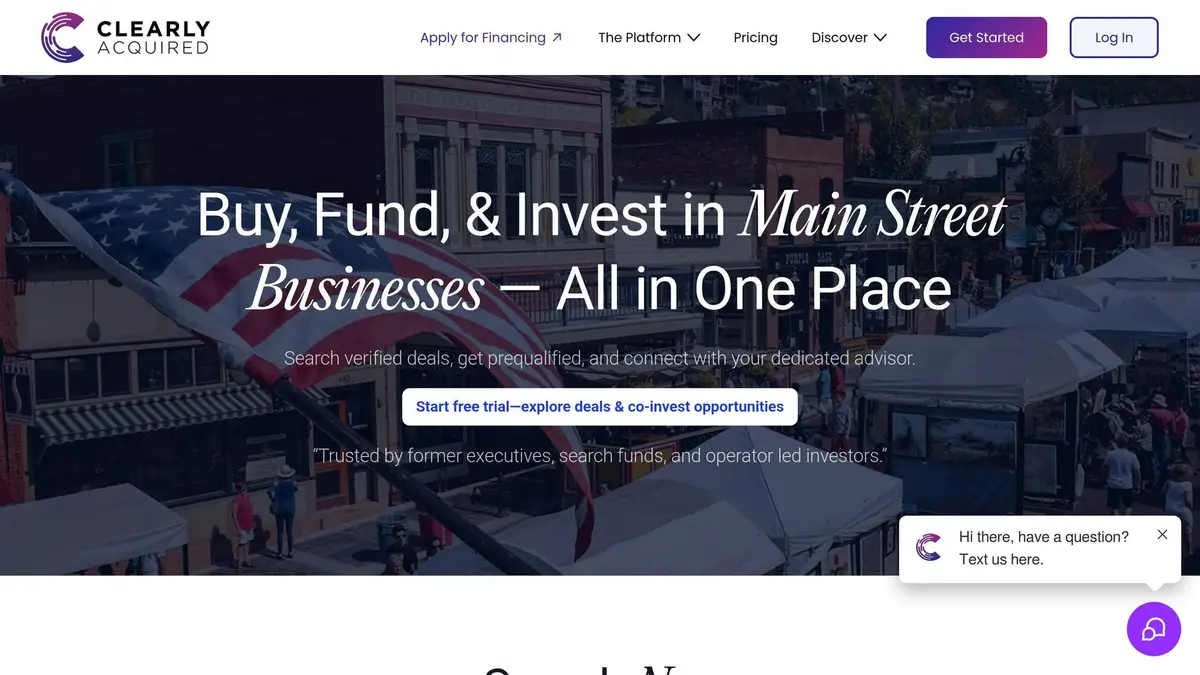
Clearly Acquired has built its platform to fully leverage AI’s capabilities, streamlining every stage of the deal process - from sourcing to closing. The platform integrates capital, advisory services, verified deal flow, and proprietary tools, creating a seamless experience for all involved.
But Clearly Acquired goes beyond just finding deals. It offers strategic funding solutions, loan brokerage services, and educational resources, all enhanced by AI to simplify acquisitions and financing. By providing secure and efficient communication tools, the platform empowers dealmakers to navigate opportunities with confidence.
Final Thoughts
AI is no longer just a tool for improving deal sourcing - it’s become essential for staying competitive. Organizations that embrace AI-powered solutions are better positioned to access more deals, close them faster, and achieve superior outcomes. They can process more data, identify higher-quality opportunities, and act more swiftly than their competitors.
Clearly Acquired embodies this future by offering a unified platform where AI enhances every step of the acquisition journey. From sourcing on-market and off-market businesses to securing the right financing, the platform eliminates many of the traditional challenges in deal-making. Exploring Clearly Acquired’s AI-powered platform could be the key to transforming your approach to deal sourcing and achieving greater success.
FAQs
How does AI make deal sourcing faster and more effective than traditional methods?
AI is reshaping how deal sourcing works by taking over tasks like finding opportunities, scoring leads, and analyzing markets. This cuts down on manual work and minimizes mistakes. Instead of relying on personal connections or spending hours on research, AI taps into advanced data analytics to pinpoint promising deals quickly and with precision.
With its ability to process massive datasets and forecast market trends, AI speeds up decision-making and sharpens deal evaluations. This not only simplifies workflows and saves time but also allows entrepreneurs and investors to zero in on high-potential opportunities with a stronger sense of confidence.
What challenges might businesses face when using AI for deal sourcing?
Integrating AI into deal sourcing isn't without its hurdles. One of the biggest issues lies in data quality and compatibility - inconsistent or incomplete data can throw off analysis and make decision-making less reliable. On top of that, resistance to change within companies can slow things down, especially when employees need to learn new technical skills to effectively use AI tools.
There are also concerns around data privacy and staying compliant with regulations, which add layers of complexity. And let's not forget the challenge of merging AI with legacy systems - a process that can be both complicated and costly. Overcoming these obstacles takes thoughtful planning, investments in employee training, and fostering confidence in AI-powered processes.
How can companies prepare their data for AI-driven deal sourcing tools?
To prepare your data for AI-powered deal sourcing tools, the first step is conducting a data audit. This involves identifying any inconsistencies, such as missing details, duplicates, or outdated records. Make sure your data is accurate, relevant, and gathered from reliable sources.
Once the audit is complete, focus on cleaning and standardizing your data. This means fixing errors, ensuring formats are consistent, and removing irrelevant or redundant entries. Establishing strong data governance practices at this stage is crucial - it helps maintain data quality and ensures compliance over time.
Lastly, ensure your data is easily accessible and shareable across teams. When your data is well-organized and ready to use, AI tools can provide precise insights and make your deal sourcing process more efficient.
About the author
Principal & CEO/CIO
Samson Jagoras has 15+ years across finance, real estate, and business acquisitions. He began his career as a Futures & Commodities broker and later served as Chief Strategy Officer of an INC 500 marketing and technology firm, helping scale revenue from $1M to over $100M. Today he buys, builds, and advises a portfolio of companies with a focus on M&A, capital allocation, and operational strategy.