Florida Guide to Selling a Manufacturing Firm
A state-specific, practical roadmap for selling a Florida manufacturing company—covering valuation, market conditions, buyer profiles, legal requirements, taxes, and a step-by-step sale process.
 Samson JagorasPrincipal & CEO/CIOJanuary 25, 2026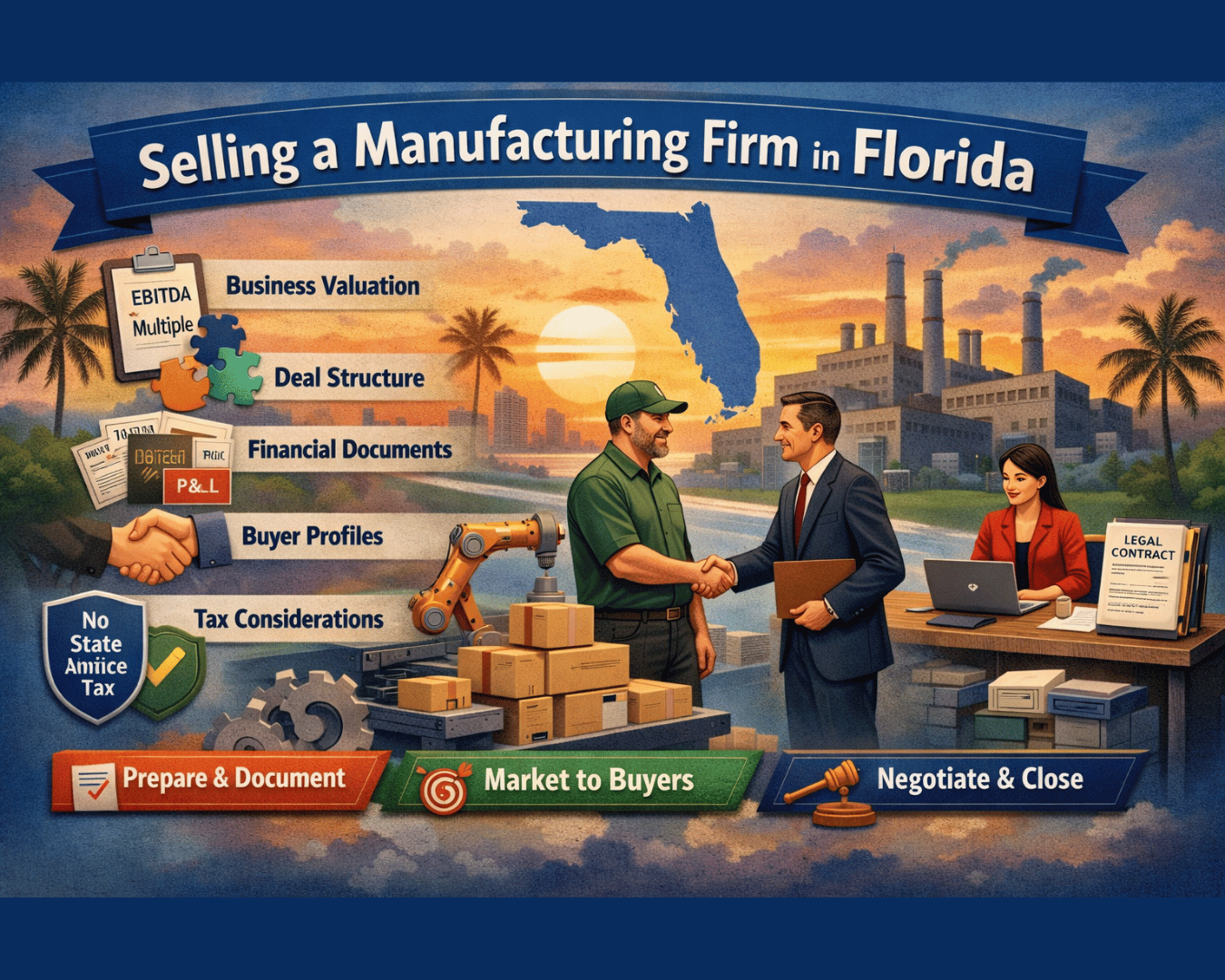
Ready to Make Your Next Move?
Whether you're buying, selling, or investing — Clearly Acquired gives you the tools, data, and support to close with confidence.
State-Specific Legal Requirements
Selling a manufacturing firm in Florida typically involves:
- Well-organized financial and legal documentation (3–5 years P&Ls, tax returns, equipment lists, inventory reports, key contracts).
- Compliance with manufacturing-specific certifications/regulations applicable to the business.
- License/permit review and transfer planning as needed for ongoing operations.
- Choosing a deal structure: asset sale (specific assets + contracts + goodwill) vs. stock sale (entity ownership + liabilities).
- Attorney-reviewed deal documents (leases, shareholder agreements, licensing, tax filings, purchase agreements).
- Confidentiality protection (NDAs) before releasing sensitive information.
- Clear purchase agreement terms: price, reps/warranties, indemnities, transition duties, and closing conditions.
- Coordinated closing with attorneys, accountants, lenders, and brokers.
- Early tax planning for federal capital gains and depreciation recapture (Florida has no state income tax).
Valuation Guidance
Common valuation approaches for Florida manufacturing firms include:
- Asset-based valuation: Especially relevant when machinery/equipment drives economic value.
- Income approach: Based on future earnings, cash flow durability, and risk profile.
- Market comparison: Benchmarks against similar Florida and national transactions.
Key value drivers include production capacity, supply chain reliability, technology adoption, working capital needs, customer concentration, competitive position, and market conditions. Deal structures often include seller financing, earnouts, inventory/working capital adjustments, equipment leases, transition services, and real estate negotiations.
Step-by-Step Process
-
Preparation
- Organize financials (P&Ls, tax returns) and supporting documentation (equipment/inventory lists, contracts).
- Confirm equipment condition and maintenance logs.
- Review org structure and retention plans for key talent.
-
Valuation
- Apply asset-based valuation for machinery-heavy operations.
- Model future earnings using an income approach.
- Benchmark against comparable transactions.
- Set a realistic, market-aligned price.
-
Marketing
- Use confidential, blind listings and controlled outreach.
- Qualify buyers before sharing sensitive info.
- Target strategic buyers, private equity, and expansion-minded operators.
-
Buyer Screening
- Verify capital capacity and relevant experience.
- Understand motivations and timeline.
- Use NDAs and staged disclosure.
-
Negotiation & Due Diligence
- Negotiate structure: price, earnouts, seller notes, inventory/WC adjustments, transition periods, real estate.
- Prepare diligence: updated financials, production KPIs, HR records, warranty history, compliance documents.
-
Closing
- Finalize purchase documents, verify inventory, transfer assets/licenses, coordinate funding.
- Execute a post-close transition plan.
Most manufacturing firm sales take 6–12 months, depending on deal size, buyer type, and diligence complexity.
Tax Consequences
Florida has no personal state income tax, so there is typically no Florida-level income tax on sale proceeds. Federal taxes still apply, including capital gains tax, ordinary income tax, and depreciation recapture. Asset sales require careful purchase-price allocation among goodwill, equipment, inventory, and receivables, which can materially change tax outcomes.
Depreciation recapture on machinery/equipment/real estate can increase tax liability because recaptured amounts are taxed as ordinary income. Installment sales may spread tax payments but must be structured carefully. Consider federal provisions such as potential Section 1202 treatment (where applicable) and work closely with a tax advisor.
Local Transaction Fees
Florida does not impose a specific state transaction tax on the sale of a business. Typical transaction costs include broker commissions (often 5%–15%, commonly ~10% depending on size/complexity), attorney fees, and closing costs (often split by agreement). Multi-state operations may introduce additional state tax considerations.
Checklists and Timelines
Seller Checklist
Legal and Financial Documentation
- Gather tax returns, P&Ls, balance sheets, and confirm ownership of major assets.
- Collect key contracts, leases, permits, and IP documentation.
Business Valuation
- Obtain a professional valuation and clarify working capital expectations.
LOI Drafting and Review
- Outline price, included assets, diligence deadlines, and protections (non-compete / non-solicit).
- Have a Florida attorney review terms before exclusivity begins.
Due Diligence (Typical: 30–90 days)
- Provide financial records, contracts, staffing details, and operational documents.
- Use NDAs and staged access for sensitive information.
- Organize a data room by category: Financial, Ops, Customer, HR, Legal/Compliance.
Closing
- Finalize signatures, verify inventory, complete asset transfers and funding.
- File necessary administrative updates (e.g., UCC-1 termination where applicable).
- Transfer or close licenses, permits, and tax accounts.
Seller Timeline
- 6–12 months before listing: organize documents, update financials, resolve compliance issues.
- 3–6 months before listing: build a data room, review financials and contracts with advisors.
- 1–3 months before listing: finalize diligence index, set up secure sharing, plan employee messaging.
Due Diligence Categories
- Financial: tax returns (3–5 years), P&L, balance sheets, bank statements.
- Operational: SOPs, equipment lists, leases, maintenance logs.
- Customer/Marketing: customer lists, contracts, sales reporting.
- HR: employee agreements, benefits, turnover history.
- Legal/Compliance: entity docs, licenses, contracts, IP documentation.
Local Brokerage and Professional Advice
For manufacturing firms, it’s best to partner with brokers and advisors who understand equipment-heavy underwriting, working capital norms, and industry buyer networks. Strong intermediaries help with preparation, valuation, confidential marketing, negotiation leverage, and end-to-end transaction coordination.
Consider working with a Florida business sale attorney and a CPA experienced in federal capital gains and depreciation recapture planning. Local brokers often emphasize strict confidentiality through buyer qualification and NDAs, and they can expand buyer reach to national strategic acquirers and private equity groups.
About the author
Principal & CEO/CIO
Samson Jagoras has 15+ years across finance, real estate, and business acquisitions. He began his career as a Futures & Commodities broker and later served as Chief Strategy Officer of an INC 500 marketing and technology firm, helping scale revenue from $1M to over $100M. Today he buys, builds, and advises a portfolio of companies with a focus on M&A, capital allocation, and operational strategy.