Broker Role in SMB Acquisitions: A Complete Guide
Business brokers simplify SMB acquisitions by connecting buyers and sellers, managing due diligence, and ensuring smooth transactions. They handle key tasks like business valuation, deal structuring, and risk management while leveraging platforms like Clearly Acquired to access over 3.2 million list

Business brokers simplify SMB acquisitions by connecting buyers and sellers, managing due diligence, and ensuring smooth transactions. They handle key tasks like business valuation, deal structuring, and risk management while leveraging platforms like Clearly Acquired to access over 3.2 million listings across 50+ industries.
Key Takeaways:
- What brokers do: Help with sourcing, valuation, due diligence, and closing deals.
- Why use a broker: They reduce risks, improve efficiency, and provide market insights.
- Tools they use: Platforms with AI-powered data rooms, automated NDAs, and deal hubs.
- Benefits: Faster closings, better opportunities, and professional oversight.
Whether you're buying or selling, brokers streamline the process and maximize outcomes.
Ep. #319 - The Ultimate Guide to Investment Banker and ...

Main Duties of Business Brokers
Business brokers serve as intermediaries in small and medium-sized business (SMB) acquisitions, handling everything from identifying opportunities to closing deals.
Finding and Marketing Deals
Brokers excel at creating listings that showcase key details like financial performance, market position, and standout features to attract serious buyers. They use specialized tools to craft detailed profiles and engaging descriptions, boosting visibility across a network of 3.2 million businesses in over 50 industries [1]. Once the listings are ready, brokers ensure the due diligence process runs smoothly by organizing and sharing information efficiently.
Managing Due Diligence
During due diligence, brokers oversee the exchange of information while maintaining strict confidentiality. They establish secure digital data rooms to store financial and operational documents, track who accesses them, and ensure timely communication between parties. This level of organization is essential for keeping negotiations on track.
Deal Negotiations and Closing
As deals move toward completion, brokers clarify terms, facilitate communication between buyers and sellers, and oversee progress to meet all closing requirements on time. They often rely on digital deal management tools to speed up the process and reduce potential risks [1].
Why Work With a Business Broker
Business brokers play an essential role in small and medium-sized business (SMB) acquisitions by simplifying complex transactions and safeguarding the interests of all parties involved. Their expertise spans strategic analysis, risk management, and deal structuring to maximize value.
Business Valuation and Market Analysis
Brokers rely on extensive market data to determine fair business valuations. With access to over 3.2 million business listings across 50 industries [1], they provide clear insights into market dynamics and make informed comparisons.
They organize business data into actionable reports that highlight key factors such as:
- Revenue trends
- Market position
- Growth potential
- Asset values
These insights are vital for informed decision-making and complement earlier steps like listing and due diligence.
Deal Terms and Risk Management
Brokers handle deal structuring and minimize risks through:
- Confidentiality Management: Ensuring secure communication and strict confidentiality throughout the process
- Financing Solutions: Identifying funding options like SBA loans or commercial financing
- Risk Assessment: Conducting detailed due diligence early to address potential issues
By structuring deals with care, brokers help ensure a better return on investment for their clients.
Broker Fees and Return on Investment
While brokers charge fees, their services provide clear value by improving transaction outcomes. Here’s how their expertise translates into measurable benefits:
| Benefit Category | Value Added |
|---|---|
| Deal Flow | Access to $6.5M in monthly business transactions [1] |
| Quality Control | Connections to verified buyers and sellers |
| Process Efficiency | Simplified acquisition procedures and documentation |
| Risk Reduction | Professional oversight and thorough due diligence |
These advantages lead to faster closings, reduced risks, and access to higher-quality opportunities, making brokers an integral part of the acquisition process.
sbb-itb-a3ef7c1
Ready to Make Your Next Move?
Whether you're buying, selling, or investing — ClearlyAcquired gives you the tools, data, and support to close with confidence.
Get Started FreeWorking With Brokers: Buyer Guidelines
Understanding how brokers structure deals is just the beginning. Buyers need to grasp key contract terms and verification processes to safeguard their interests.
Broker Contracts and Legal Terms
When working with business brokers, it's important to carefully review and understand the contract terms. A well-drafted broker agreement should clearly define the following:
| Contract Element | Key Details to Look For |
|---|---|
| Scope of Services | • How deals are sourced and screened • Level of due diligence support • Communication expectations |
| Fee Structure | • Success fee arrangements • Retainer fees • Payment timing and conditions |
| Duration | • Length of the agreement • Termination clauses • Obligations after termination |
| Exclusivity Terms | • Geographic limitations • Industry focus • Parameters for deal size |
It's wise to consult legal counsel to ensure the terms are fair and align with your goals. Pay close attention to how fees are calculated and make sure everything is clearly spelled out. Once the contract is in place, buyers should focus on thorough verification to establish credibility.
Buyer Verification Requirements
Verification is a critical step in business acquisitions, ensuring trust and transparency. Many platforms, such as Clearly Acquired, use tools like Plaid for secure identity authentication. Here's what the process typically involves:
-
Identity Verification
Submit a government-issued ID, prove financial account ownership, and confirm your business credentials. -
Financial Qualification
Provide proof of funds, demonstrate your investment capacity, and declare the source of your funds. -
Professional Background
Share your business ownership history, industry experience, and professional references.
On Clearly Acquired, Plaid enables buyers to securely verify their identity through their existing banking relationships, streamlining the process.
To make the process smoother, buyers should:
- Gather verification documents in advance.
- Keep financial statements and proof of funds up to date.
- Regularly update their professional credentials.
- Use secure platforms that offer automated verification tools.
Being well-prepared not only saves time but also builds trust with brokers and sellers.
Clearly Acquired Platform Features
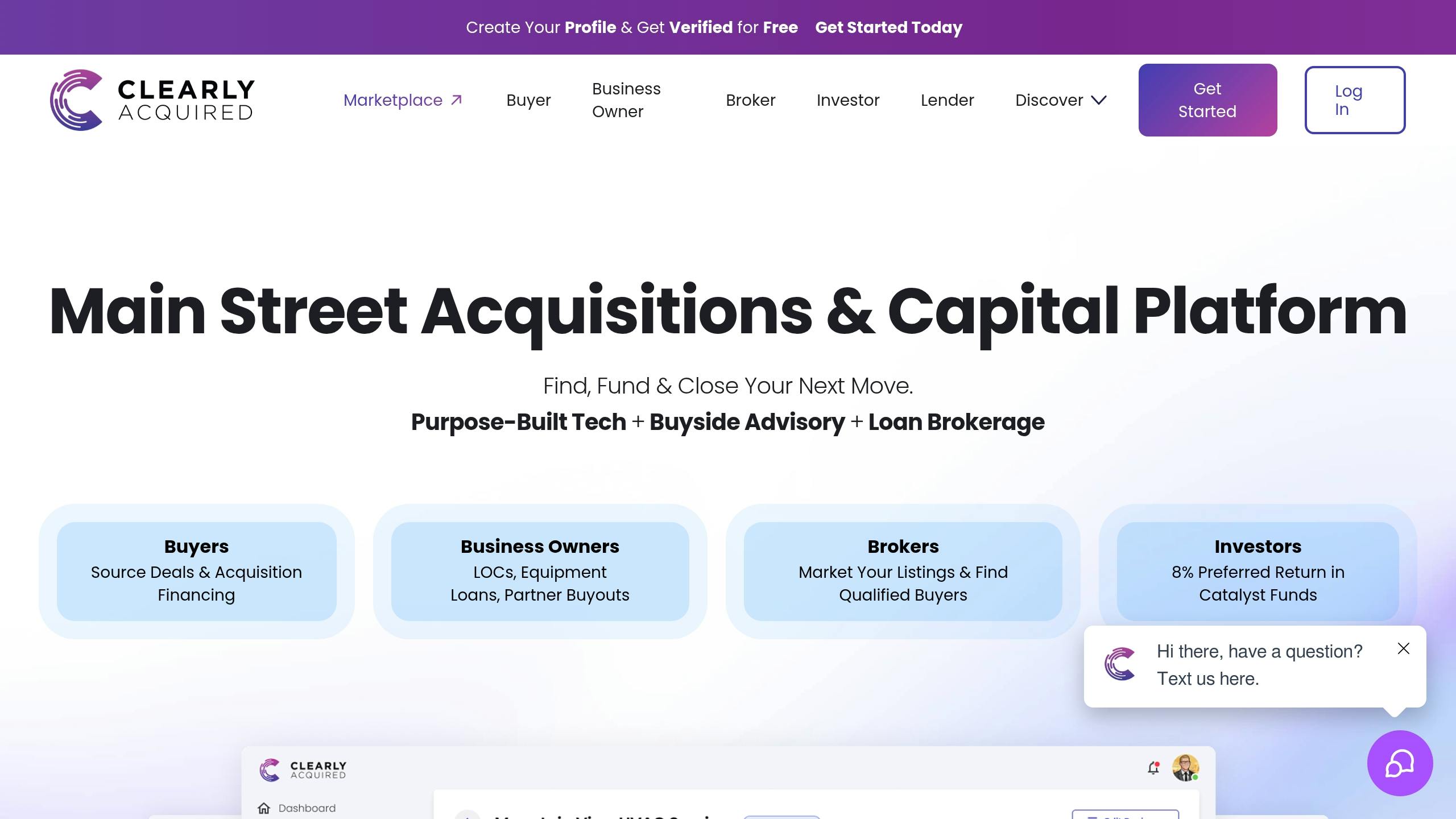
Clearly Acquired combines cutting-edge technology with practical tools to simplify SMB acquisitions. By complementing brokers' core responsibilities, the platform improves efficiency and ensures clarity throughout each transaction.
Tools for Buyers and Brokers
With access to a broad business listing database [1], users can tap into tools designed to identify and assess potential opportunities.
| Feature Category | Key Capabilities |
|---|---|
| Deal Sourcing | • Direct broker listings • Multi-marketplace connections • Off-market searches |
| Financial Tools | • SBA loan assistance • Equipment financing • Commercial loan options |
| Verification System | • Identity checks • Financial qualification • Professional background reviews |
AI-driven tools help brokers evaluate and process deals more effectively. Additionally, buy-side advisors and debt brokers provide expert advice on financing strategies, including creative solutions.
"Another valuable component I receive is guidance around financing a business acquisition. They're not only knowledgeable about SBA options but also offer invaluable insights and experience in creative financing strategies that help get deals across the finish line - especially valuable for someone making their first acquisition. They size up deals and leverage their network of lending institutions to find the best possible options, which makes me feel confident that I have the highest probability of closing." - Derrick Weidenaar [1]
These features integrate seamlessly with the platform's digital management tools, making every step of the acquisition process smoother.
Digital Deal Management Tools
Clearly Acquired simplifies acquisitions with advanced digital deal management features. Brokers can handle multiple transactions while maintaining confidentiality and structure. Key tools include:
-
Automated NDA System
Automatically deploy NDAs to ensure confidentiality and reduce administrative work. -
AI-Enhanced Data Rooms
Secure virtual spaces equipped with AI-driven analytics to aid decision-making. -
Deal Hub Integration
A centralized dashboard for tracking progress, managing documents, and communicating with stakeholders.
The platform supports approximately $6.5 million in business transactions every month [1]. Its Deal Room tools help brokers stay organized during negotiations and due diligence. Interactive dashboards and built-in messaging systems ensure clear communication between buyers and sellers, while the Secure Data Room safeguards sensitive data.
Together, these tools create a comprehensive system that supports smooth and efficient deal-making.
Summary
Business brokers play a key role in small and medium-sized business (SMB) acquisitions, offering expertise to guide buyers and sellers through the entire process. With advancements in technology, brokers are now blending their traditional skills with modern digital tools, reshaping the way transactions are handled.
Today’s acquisition platforms provide brokers with advanced tools to simplify tasks like deal sourcing, due diligence, transaction management, and financing. These platforms create a smoother, more efficient process for all parties involved.
Technology has significantly improved how brokers approach SMB acquisitions. For example, a network of over 125 advisors [1] uses digital tools alongside their industry knowledge to tackle challenges like information gaps and complex valuations. This approach ensures deals are executed efficiently and successfully.
FAQs
How do business brokers assess the fair market value of a small or medium-sized business during an acquisition?
Business brokers determine the fair market value of a small or medium-sized business by evaluating several key factors. These often include the company's financial performance, such as revenue, profit margins, and cash flow, as well as its assets, liabilities, and market position. Brokers may also review industry trends, comparable sales of similar businesses, and the overall economic environment.
In many cases, brokers use valuation methods like earnings multiples, discounted cash flow (DCF) analysis, or asset-based approaches to arrive at a fair market value. Their goal is to provide an accurate estimate that reflects the business's worth to both buyers and sellers, ensuring a transparent and equitable transaction process.