Private Credit vs. Traditional Lending for SMBs
Small businesses often face challenges when securing funding. Traditional bank loans can be slow, rigid, and hard to qualify for. Private credit offers a faster, more flexible alternative, especially for businesses needing quick access to capital or with less-than-perfect credit. Here's a quick comp
.jpg)
Get matched with the right lender for your business
Compare offers from our vetted network. Pre-qualify in minutes — no impact to your credit.
Small businesses often face challenges when securing funding. Traditional bank loans can be slow, rigid, and hard to qualify for. Private credit offers a faster, more flexible alternative, especially for businesses needing quick access to capital or with less-than-perfect credit. Here's a quick comparison:
- Private Credit: Faster approvals (5–14 days), flexible repayment terms, and lenient requirements (credit scores as low as 600). Costs are higher, with interest rates of 12–18%.
- Bank Loans: Lower costs (7.5–10% APR) but stricter qualifications (credit scores 680+), longer timelines (30–90 days), and rigid terms.
Quick Comparison
| Feature | Private Credit | Bank Loans |
|---|---|---|
| Approval Time | 5–14 days | 30–90 days |
| Interest Rates | 12–18% APR | 7.5–10% APR |
| Credit Score | 600+ | 680+ |
| Repayment Terms | Flexible (cash flow-based) | Fixed schedules |
| Collateral | AR, future revenue, IP | Hard assets, real estate |
Key takeaway: Choose private credit for speed and flexibility, and bank loans for lower costs and structured terms.
Understanding Private Credit
Private Credit Basics and Market Size
Private credit serves as an alternative funding solution for small and medium-sized businesses (SMBs). Unlike traditional bank loans, private credit offers more flexible options, such as:
- Lines of credit to manage cash flow
- Loans for purchasing equipment
- Financing for business real estate
- Capital to support business growth
These options highlight how private credit can better meet the needs of SMBs compared to traditional banking solutions.
Main Private Credit Benefits
Private credit stands out by offering advantages that cater specifically to the needs of SMBs. Its flexibility and tailored approach address many of the hurdles associated with conventional lending.
Here’s a quick breakdown of its benefits:
| Benefit | Description |
|---|---|
| Faster Funding | Quick approval processes for accessing capital fast |
| Flexible Terms | Payment schedules designed to match cash flow |
| Broader Criteria | Easier qualification compared to bank loans |
| Customized Solutions | Financing tailored to unique business requirements |
Private credit is especially useful for established SMBs looking to fund growth or navigate post-acquisition transitions. Whether it’s for expansion, buying equipment, or covering operational costs, private credit provides the capital businesses need without limiting their flexibility. Its ability to adapt to specific business situations makes it an appealing choice for SMBs focused on growth.
What is Private Credit? | Direct Lending Explained

Bank Lending Overview
Traditional bank loans remain a primary funding source for small and medium-sized businesses (SMBs), but the approval rates have dropped significantly. Today, major banks approve only 13% of SMB loan applications, compared to 28.2% in 2019 [9][10].
Bank Loan Process Steps
Getting a traditional bank loan involves three main stages, each with its own timeline and requirements:
-
Document Collection (1–4 weeks)
This stage involves gathering extensive paperwork, including:
-
Underwriting Process (2–6 weeks)
During underwriting, banks evaluate:
-
Final Review and Funding (1–2 weeks)
The last phase includes:
- Reviewing all documentation
- Signing the loan agreement
- Disbursing funds (usually 3–10 days after approval) [6]
These steps often lead to operational delays and complexities for SMBs.
Common SMB Obstacles
Small businesses face several challenges when applying for traditional bank loans. Here’s a breakdown of common obstacles:
| Obstacle | Impact | Statistics |
|---|---|---|
| Insufficient Collateral | Top reason for rejection | 42% of cases [4][8] |
| Credit Requirements | High minimum credit scores | 33% rejection rate [9] |
| Cash Flow Issues | Concerns over revenue stability | 25% of rejections [8] |
| Business History | Short operating history | 20% of denials [8][9] |
On average, SMB loan applications require 32 documents [5][7], and over half (54%) of applicants need professional help to complete the process [7][9].
Other hurdles include:
- Long approval timelines (30–90 days)
- Strict collateral requirements (100–150% of the loan amount)
- Complex financial covenants
- Limited flexibility in loan terms [2][5]
To improve approval chances, SMBs are often advised to maintain at least a six-month banking relationship before applying [2][7]. These stringent conditions are driving many businesses to explore alternative financing options, such as private credit.
sbb-itb-a3ef7c1
Private Credit vs. Bank Loans: Key Differences
Approval Odds and Requirements
Private credit and bank loans differ significantly when it comes to approval criteria. Approval rates for private credit are much higher (65–80%) compared to bank loans (25–40%). This is because private credit lenders typically have more lenient requirements, including lower credit score thresholds, shorter operational history, and broader collateral options.
| Requirement | Private Credit | Traditional Bank Loans |
|---|---|---|
| Minimum Credit Score | 600+ | 680+ |
| Business History | 6–12 months | 2+ years |
| Collateral Types | AR, future revenue, IP | Hard assets, real estate |
| Cash Flow History | 6 months profitable | 2+ years profitable |
Time to Funding
Private credit stands out for its speed. While traditional bank loans can take anywhere from 30 to 90 days to process, private credit often delivers funding within 5 to 14 days. For instance, a tech startup was able to secure growth capital quickly enough to finalize a strategic acquisition.
Payment Terms and Rules
Repayment flexibility is another area where private credit shines. Unlike the rigid repayment schedules of bank loans, private credit allows for options tailored to cash flow cycles, such as revenue-based, seasonal, or deferred payments. For example, a Florida beach resort used private credit to defer payments while recovering from hurricane damage, resuming payments during its peak season.
Cost Breakdown
Private credit generally comes with higher costs, including interest rates (12–18% APR vs. 7.5–10% APR for bank loans) and origination fees (2–5% vs. 2.25–3.5%). However, its faster funding and flexible terms often offset the higher upfront expenses.
| Cost Component | Private Credit | Bank Loans (SBA 7(a)) |
|---|---|---|
| Interest Rate | 12–18% APR | 7.5–10% APR |
| Origination Fee | 2–5% | 2.25–3.5% |
| Monitoring Fees | 0.25–0.75% annually | None |
| Prepayment Penalty | None | 1–5% (first 3 years) |
Covenant requirements vary as well. Private credit focuses on cash flow metrics, with quarterly reporting, while bank loans impose stricter debt service coverage ratios (1.25× or higher) and require monthly reporting.
| Covenant Type | Private Credit | Bank Loans |
|---|---|---|
| Financial Ratios | Focus on cash flow | DSCR 1.25×+ required |
| Reporting | Quarterly | Monthly |
| Owner Draws | Flexible | Often restricted |
| Additional Debt | Generally allowed | Usually prohibited |
These differences highlight why small and medium-sized businesses (SMBs) often turn to private credit when speed and flexibility are more important than lower costs.
Selecting Your Best Funding Option
Evaluating Your Funding Needs
When deciding between private credit and traditional bank loans, it’s important to assess your specific needs, including timing, credit profile, business stage, fund usage, and your comfort with risk.
| Factor | Private Credit Works Best For | Traditional Lending Works Best For |
|---|---|---|
| Timing | Quick access to capital | Planned growth with longer decision timelines |
| Credit Profile | Businesses with lower credit scores | Companies with strong credit histories |
| Business Stage | Emerging or early-stage businesses | More established companies |
| Use of Funds | Flexible funding for various needs | Specific purposes like fixed assets or real estate |
| Risk Tolerance | Higher rates for faster funding | Lower rates with predictable repayment terms |
For instance, an e-commerce company needing quick inventory funds might lean toward private credit, while a well-established manufacturer could favor the structured, lower-cost terms of a traditional loan. Similarly, businesses with seasonal cash flow might benefit from flexible repayment plans, whereas those with steady income streams may prefer predictable schedules.
Once you’ve clarified your funding priorities, use a comparison platform to explore your best options efficiently.
Using Clearly Acquired for Funding
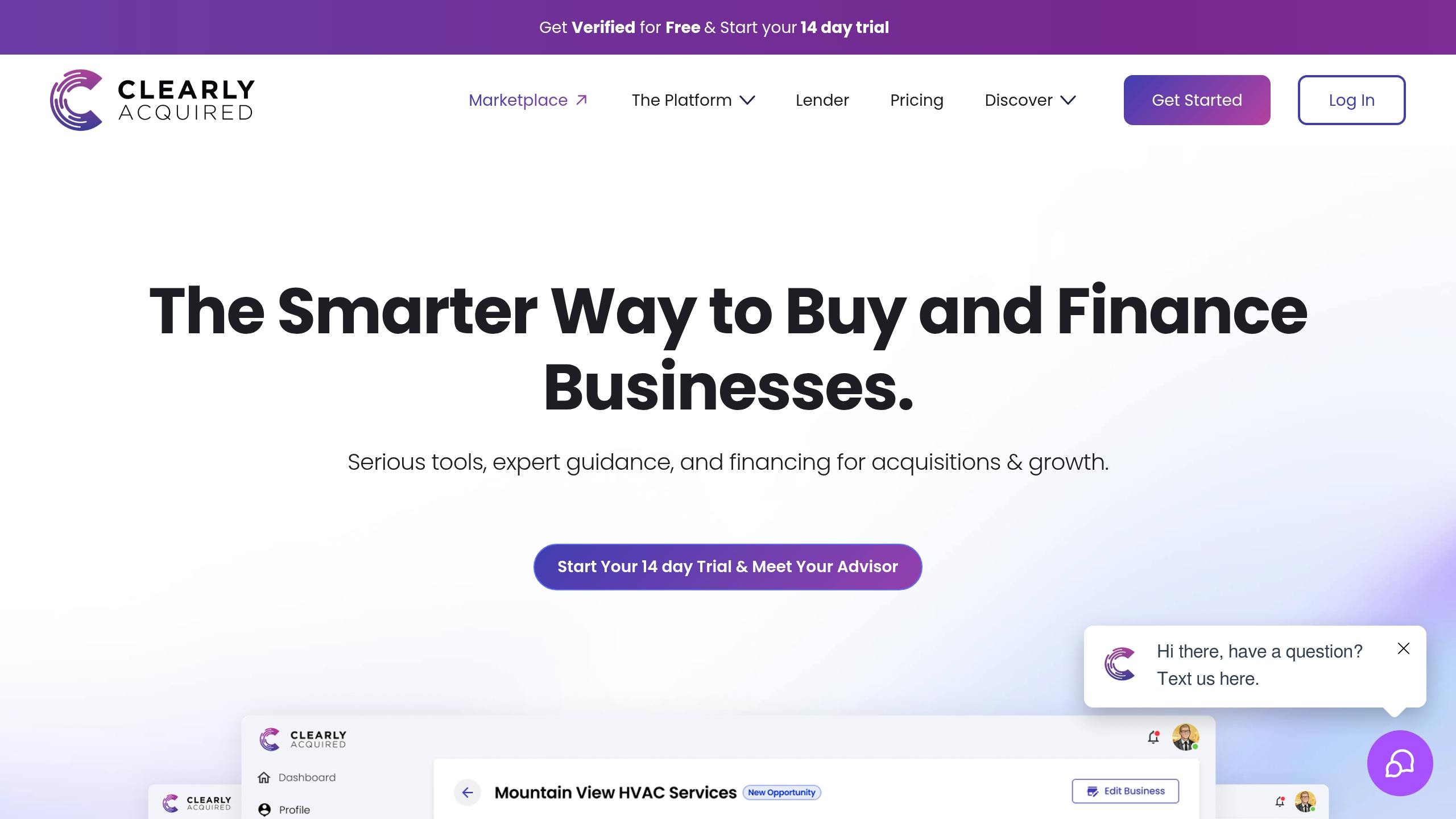
After evaluating your needs, Clearly Acquired provides a centralized platform to access a variety of funding options quickly. Their offerings include:
- SBA loans for long-term, lower-cost financing
- Equipment financing for purchasing business assets
- Lines of credit to cover working capital
- Commercial real estate loans for property purchases
- Partner buyout financing for ownership transitions
"The Smarter Way to Buy and Finance Businesses. Serious tools, expert guidance, and financing for acquisitions & growth." - Clearly Acquired [1]
With over $6.5 million in monthly business transactions and a network of 125+ advisors [1], Clearly Acquired simplifies the funding process. Key features include:
- Access to multiple funding options through a single platform
- Expert advice from experienced financial advisors
- A streamlined application process for diverse funding types
- Educational tools like the Purchase to Profits course
Clearly Acquired’s Buy-Side Advisors work to structure funding solutions tailored to your business goals, balancing cost, speed, and flexibility to support your growth and operational plans.
Conclusion: Private Credit's Impact on SMB Funding
Private credit is reshaping how small and medium-sized businesses (SMBs) secure funding, filling gaps that traditional banks often leave behind. The impressive monthly business sales reported on Clearly Acquired [1] highlight how quickly this funding model is evolving.
What sets private credit apart? It offers quicker approvals and more flexible terms than typical bank loans - an essential edge for businesses needing fast access to capital.
Industry professionals underscore its value:
"They're not only knowledgeable about SBA options but also offer invaluable insights and experience in creative financing strategies that help get deals across the finish line - especially valuable for someone making their first acquisition."
– Derrick Weidenaar [1]
These platforms are opening doors to a broader range of funding options, giving SMBs more opportunities to grow and thrive.
FAQs
Why might a small business choose private credit instead of a traditional bank loan?
Private credit can be an attractive option for small businesses because it often offers greater flexibility and accessibility compared to traditional bank loans. Private credit funds may provide customized financing solutions that cater to unique business needs, such as faster approval times or more lenient requirements for credit history or collateral.
Additionally, private credit can support a variety of use cases, including acquisitions, growth initiatives, or working capital needs, making it a versatile choice for businesses that may not meet the rigid criteria of traditional lenders. For businesses seeking tailored funding solutions, private credit can be a valuable alternative to explore.
Find the right lender for your business
Whether it's working capital, an SBA loan, or acquisition financing — we'll match you with the right capital partner.
Apply for Financing