Tax Clearance Certificates and Successor Liability
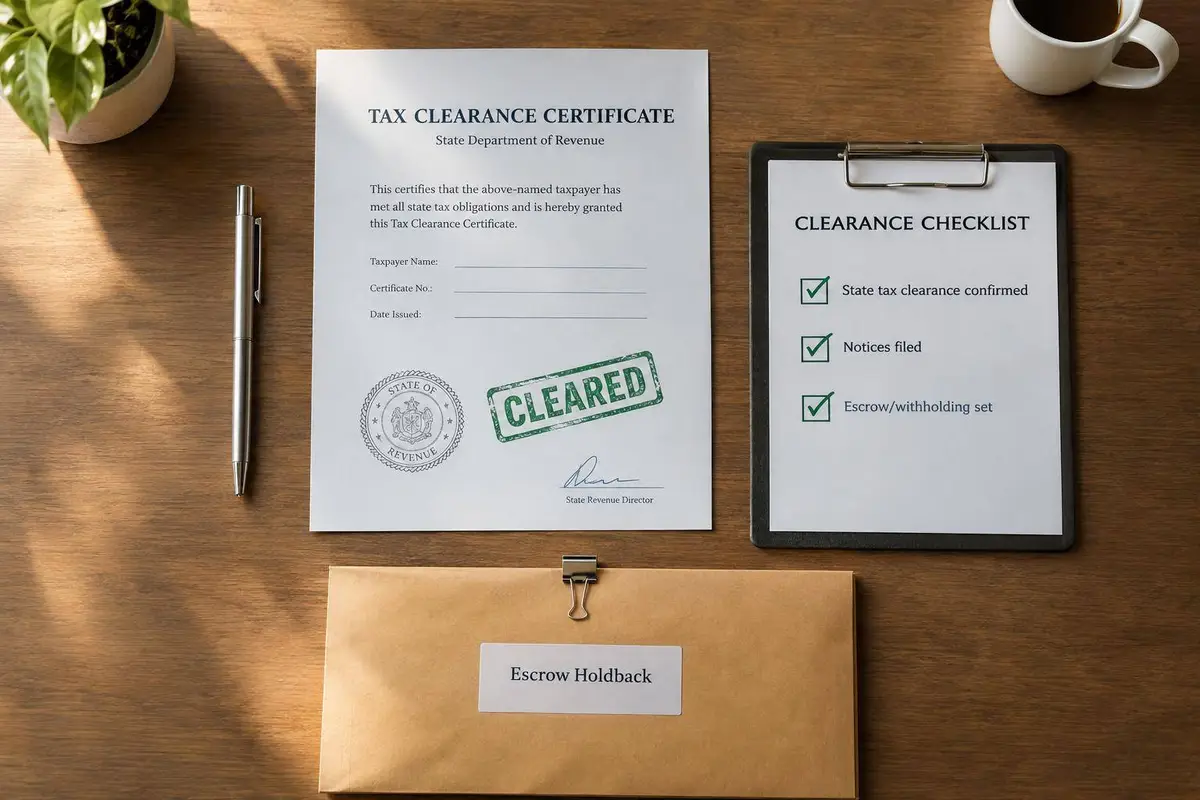
Avoid successor liability: confirm state tax clearances, file required notices, and use withholding or escrow before paying.
 Samson JagorasPrincipal & CEO/CIONovember 25, 2026
Get matched with the right lender for your business
Compare offers from our vetted network. Pre-qualify in minutes — no impact to your credit.
Buying business assets can leave you responsible for the seller’s unpaid state taxes. I’d check notice deadlines and clearance requirements before releasing funds - not after closing. In New York, for example, buyers must submit Form AU-196.10 at least 10 days before payment or possession, whichever comes first.
My closing checklist comes down to four questions:
- What am I buying? Asset purchases, equity purchases, and mergers carry different tax risks.
- What does the state require? Pennsylvania, New York, Indiana, and Michigan have different notice, withholding, and release rules.
- What does the clearance cover? I check the taxes, dates, transaction details, and conditions - and review liens and excluded taxes separately.
- Can I release the money? I verify clearance, use lawful withholding or escrow when needed, and delay closing if required steps remain incomplete.
<u>A seller’s indemnity does not stop the state from pursuing the buyer.</u> I treat it as a backup reimbursement claim, supported by contract terms, funding controls, and assigned post-closing duties - not a replacement for state-law compliance.

Tax Clearance and Successor Liability: Buyer Decision Guide
State Bulk-Sale Rules for Buyers
When a transfer creates successor-liability risk, check whether state bulk-sale rules require notice, withholding, or delayed payment. State tax bulk-sale rules are separate from commercial bulk transfer laws. Repealing or limiting commercial transfer laws does not remove tax notice, withholding, or clearance duties.
Which Transfers Require Notice or Withholding?
Look at the assets being transferred - not the purchase price. State notice or withholding requirements may depend on inventory, fixtures, equipment, real estate, a going concern, or a percentage of a covered asset class.
Pennsylvania illustrates why the denominator matters: its audit guidance describes transfers of 51% or more of a covered class of Pennsylvania assets, not necessarily 51% of the seller’s entire business. Transfers near 51% need specific review; missing the procedure can trigger taxes, interest, and penalties. Identify the covered asset mix, apply the threshold, and plan notice and a funding holdback before closing.
Thresholds and release rules vary by state. Check both before moving funds to buy a business.
Requirements in Pennsylvania, New York, Indiana, and Michigan
These states use different triggers and release procedures. Check current statutes and agency instructions before closing.
| State | Trigger and taxes to check | Notice, withholding, and release | Validity and noncompliance |
|---|---|---|---|
| Pennsylvania | Check covered Pennsylvania asset transfers, applicable taxes, and any separate agency requirements. | Advance notice is generally required 10 days before closing. Plan a holdback or escrow. Managing these requirements is easier with a centralized deal hub for documentation. Clearance follows the transfer, final returns, and payment obligations - not closing. | Without clearance, the purchaser may face a bulk-sale assessment. See the Department of Revenue. |
| New York | Check whether sales-tax bulk-sale rules cover the transfer. | File the required notice and wait for the applicable release before paying the seller. Follow the Tax Department’s bulk-sales guidance. | Confirm whether the release covers the transaction and what happens if the notice is defective. |
| Indiana | Apply the more-than-50% tangible-personal-property test, checking covered taxes and exclusions. | Confirm the application process and timing with the Department of Revenue before closing. | Check how long the certificate remains valid and whether changes to the transaction require a new certificate. |
| Michigan | Check the business-transfer trigger and covered taxes under MCL 205.27a. | Follow withholding and release conditions. Do not treat private escrow as a substitute without statutory support. | Confirm the applicable agency-response period before releasing funds. |
If clearance comes after closing, make the agreement separate the ownership transfer from payment to the seller. Assign responsibility for notices, final returns, agency responses, and proof of payment.
sbb-itb-a3ef7c1
Tax Clearance Coverage and Limits
After reviewing notice and withholding rules, check the certificate’s scope: what it clears and what it leaves open. The title alone won’t tell you. Confirm the issuing agency, covered taxes and periods, and transaction conditions.
Confirm Covered Taxes, Periods, and Conditions
Match the certificate to the deal file, including the legal name, EIN, account number, assets, locations, transaction type, and closing date. Check conditions, reservations, and expiration with the agency. Also confirm whether coverage includes taxes incurred, reported, assessed, or later found due through the cutoff date.
Before any funds move, use this table to check what each document covers.
| State | Coverage | Exposure left open | Required buyer action |
|---|---|---|---|
| Pennsylvania | Clears successor exposure on covered Pennsylvania taxes through the transfer date if notice and payment requirements are met. | Taxes from other agencies and the buyer’s post-closing liabilities. | Hold back funds pending required clearances; obtain separate unemployment clearance where applicable. |
| New York | Covers only the transaction’s sales and use tax exposure; payroll, income, property, and other taxes fall outside the release. | Amounts identified in an unresolved notice of claim. | Confirm the release covers the transaction before paying; retain funds for unresolved claims as required. |
| Indiana | Covers only the listed tax categories for qualifying transfers; confirm the 60-day validity at closing. | Taxes outside sales, use, county innkeeper’s, and food-and-beverage taxes; taxes from other agencies. | Obtain separate protection for uncovered taxes before releasing any related holdback. |
For Michigan, confirm the current Michigan statute, form, deadline, and covered taxes before relying on the document.
Taxes and Periods Not Covered
A valid state release may cover only part of the tax picture. Federal, local, payroll, unemployment, property, and excise taxes may remain open. Check each program separately, including any required Pennsylvania unemployment-tax clearance.
Review any gap between the certificate’s cutoff date and closing. Also check final returns triggered by the sale and the buyer’s post-closing obligations.
Successor-liability protection does not necessarily cancel the seller’s debt or release a recorded lien. Obtain separate lien searches, payoff statements, and releases for encumbered assets. Seller indemnity gives the buyer a reimbursement claim; it does not release a lien or stop collection.
Unfiled Returns, Audits, and Later Tax Assessments
Pending audits or unfiled returns can delay clearance or limit its scope. New York may issue a notice of claim while a review or audit is pending.
Confirm any fraud or misrepresentation exceptions. Report material changes to the seller, assets, price, structure, or closing date. If the agency cannot confirm coverage in writing, get state-specific tax advice before deciding whether to release funds, retain a holdback, or delay closing. For those navigating these complexities, Clearly Acquired provides tools to manage deal flow and professional support throughout the acquisition process.
Buyer Checklist: Tax Diligence Through Post-Closing
Once the scope is clear, move from review to filings, funds control, and post-closing follow-through.
Identify Exposure and File Notices
Assign one owner to each task. Tax counsel maps the entities, locations, nexus, accounts, deal structure, and transferred assets by jurisdiction. The seller supplies records, authorizations, and signatures.
For each filing, record the agency, form, submission method, deadline, required authorization or confidentiality waiver, and expected response time. Track notice deadlines separately from agency response times.
Check Clearance Before Releasing Funds
Treat clearance as a condition for releasing funds - not a formality. Give the closing agent written release instructions and identify who can approve disbursement. Verify the document through an independent agency contact or portal, then confirm that it covers the deal and meets the release conditions. Keep submission and delivery records.
Stop automatic release of funds if any required item is missing. Counsel should determine whether statutory withholding or a permitted escrow allows closing.
Obtain separate tax, legal, lender, and investor sign-offs. Lenders may require reserves or delay funding. Investors may require a price adjustment or stronger protection. Neither lender nor investor approval replaces statutory compliance.
| Document | Responsible party | Deadline | Issuer | Closing condition | Retained evidence |
|---|---|---|---|---|---|
| Bulk-sale or transfer notice | Seller, buyer, or both, as state law requires; buyer’s counsel tracks | Statutory deadline | Revenue or labor agency | Filed and receipt confirmed before closing | Signed notice, submission receipt, delivery record |
| Clearance or release | Seller requests; buyer verifies | Before related funds are released | Tax agency | Verified, applicable, and conditions satisfied | Certificate, verification notes, agency correspondence |
| Payroll or unemployment clearance | Seller; buyer follows up | Before closing where required | Labor or unemployment agency | Required clearance or lawful withholding arrangement | Clearance, account statement, payment proof |
| Withholding or escrow instructions | Counsel and closing agent | Before disbursement | Applicable statute and signed agreement | Required amount retained; release authority documented | Calculation, instructions, closing statement |
| Final returns | Seller prepares; buyer tracks | Agreed and statutory due dates | Seller and applicable agencies | Filing and payment duties assigned | Schedule, filed returns, acceptance and payment receipts |
Build Contract Protections and Post-Closing Duties
Once funding controls are set, put them in the purchase agreement. To protect against post-closing tax and successor-liability claims, require tax representations covering registrations, returns, payments, audits, liens, and payroll obligations. Add covenants for final-return filing, payment, record access, authorization, and cooperation. Make required clearance - or a legally available alternative - an express closing condition.
Define indemnity coverage for pre-closing taxes, successor claims, interest, penalties, and professional fees. Spell out survival periods, notice deadlines, dispute control, settlement consent, and escrow releases. Indemnities do not bind tax authorities; recovery depends on enforceability, available escrow, and the seller’s resources.
After closing, assign an owner to final returns, account changes, agency notices, audit responses, and indemnity and escrow deadlines. Keep the tracking matrix and supporting evidence in a secure deal file.
If an assessment arrives, preserve the envelope or electronic timestamp. Determine whether the assessment falls within clearance coverage, follow the agreed dispute-control process, and notify indemnifying parties within contractual deadlines.
Conclusion: Release Funds, Withhold, or Delay Closing
Once you’ve confirmed scope and coverage, choose the closing path with the lowest risk:
Release funds when clearance is verified, required notices were filed on time, and tax exposure is resolved. Check that the clearance matches the state rules, deal structure, taxes, and period covered.
Withhold or escrow funds if money remains at risk and clearance is pending or partial - but only where state law allows it. Base the holdback on documented exposure, not a fixed percentage.
Delay closing if a required procedure was missed or unresolved successor-liability risk leaves protection incomplete. Calculate unpaid taxes, interest, and penalties, and identify unresolved periods. Get state tax advice before proceeding.
A certificate can narrow inherited tax risk. It doesn’t end diligence or replace deal-specific legal advice.
FAQs
Do I need tax clearance in every state where the seller operates?
Request tax clearance certificates for payroll, sales, income, and property taxes in every state where the seller operates. These certificates may help limit successor liability, but only for the taxes and periods they explicitly cover.
A clearance may not shield you from later assessments for prior periods or unresolved issues, such as worker misclassification. Verify tax transcripts and filings independently, and use escrow holdbacks, indemnification clauses, and purchase price adjustments to address potential liabilities.
What if I discover unpaid seller taxes after closing?
An asset purchase doesn’t automatically protect you from the seller’s unpaid taxes. You may still be responsible, especially if you didn’t obtain tax clearances before closing.
Tax clearance certificates may limit successor liability, but that protection has limits. It covers only the taxes within the certificate’s scope and only through its issuance date - not later tax periods or liabilities hidden from tax authorities.
Clearly Acquired supports acquisition due diligence, helping buyers identify tax exposure and structure deals to reduce risk.
Can I fix a missed bulk-sale notice deadline?
The information provided does not establish whether a missed bulk-sale notice deadline can be corrected.
Tax clearance certificates may protect buyers from successor liability by confirming that the seller has met specified tax obligations. That protection applies only to the taxes and periods covered. Tax liabilities tied to unfiled returns, underreported amounts, or matters outside the certificate’s scope remain a risk.
Asset purchases may still carry tax claims, while stock purchases typically retain legacy tax risks.
Related Reading
Find the right lender for your business
Whether it's working capital, an SBA loan, or acquisition financing — we'll match you with the right capital partner.
About the author
Principal & CEO/CIO
Samson Jagoras has 15+ years across finance, real estate, and business acquisitions. He began his career as a Futures & Commodities broker and later served as Chief Strategy Officer of an INC 500 marketing and technology firm, helping scale revenue from $1M to over $100M. Today he buys, builds, and advises a portfolio of companies with a focus on M&A, capital allocation, and operational strategy.