Independent Sponsor Promote: How Waterfalls Work
Clear, step-by-step guide to modeling sponsor promote waterfalls: capital return, preferred return, catch-up, and residual splits.
 Samson JagorasPrincipal & CEO/CIONovember 23, 2026
Invest in profitable Main Street businesses
Create your investor profile to access curated deal flow, co-investment opportunities, and the Catalyst Fund.
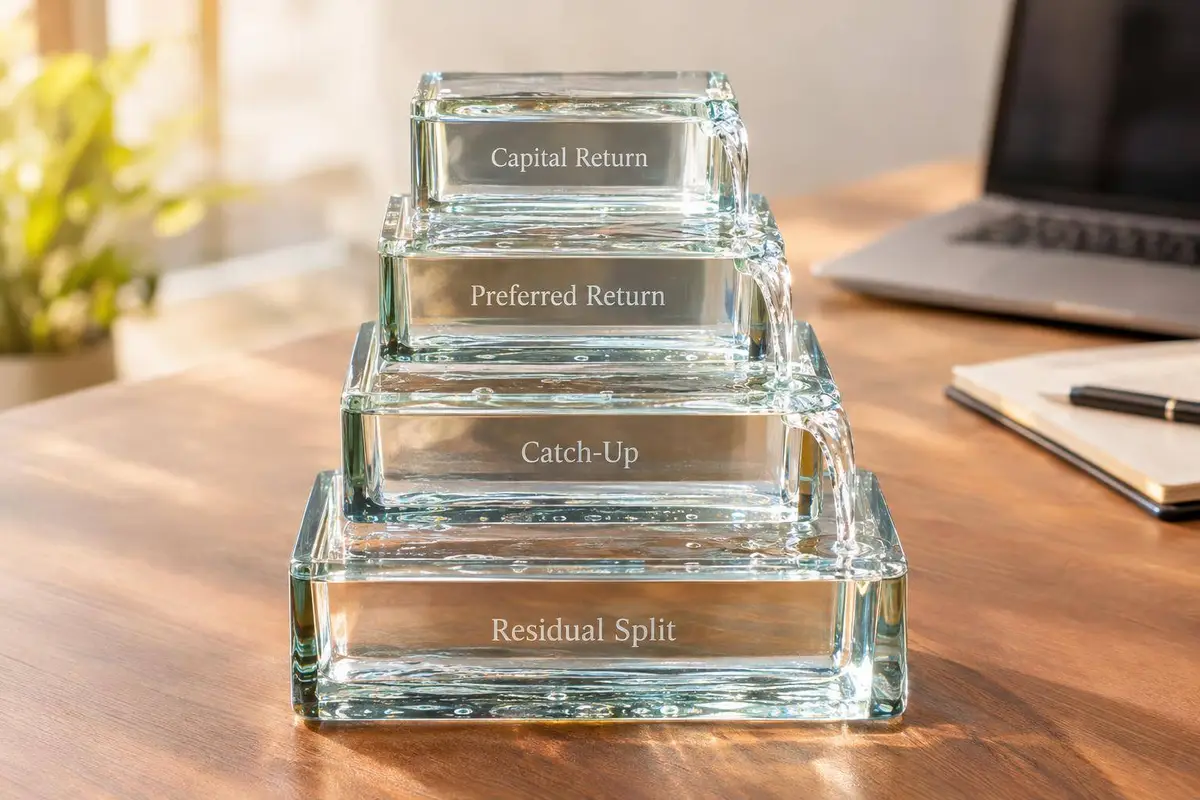
An 80/20 split doesn’t mean the sponsor gets 20% of exit proceeds. I calculate the promote by following the payment order: investor capital back, preferred return, sponsor catch-up, then the remaining profit split.
In this example, $2 million at exit returns $1.8 million to investors and $200,000 to the sponsor. That assumes $1 million invested for five years, an 8% simple preferred return, a full catch-up, and no sponsor equity or interim payments. Investors earn 1.80x their money, or about 12.47% annually.
Here’s what I check before relying on those numbers:
- Catch-up terms: Removing the catch-up cuts the sponsor’s payment from $200,000 to $120,000.
- Preference and payment order: These determine who gets paid first and what remains unpaid if cash runs short.
- Tier rules: Higher profit-sharing rates may apply only to dollars within each tier - not earlier payouts.
- Cash available: Debt, fees, reserves, and payment dates affect what reaches the waterfall.
My starting rule: <u>model the agreement, not just the headline split</u>. Then test lower and higher exits and confirm that every dollar paid matches the cash available. A preferred return sets payment priority; it does not guarantee payment.
Learn how to model a waterfall promote with catch up in 12 minutes with a free model download

sbb-itb-a3ef7c1
Step 1: Define the 4 Waterfall Tiers
Using the $1,000,000 equity and $2,000,000 exit assumed above, the waterfall has four tiers.
Each tier receives only the cash left after earlier tiers are paid. If proceeds run out, later tiers get nothing.
| Tier | Recipient | Payout condition | Purpose |
|---|---|---|---|
| 1. Return of capital | Investors | Until investor capital is fully returned | Repays invested principal |
| 2. Preferred return | Investors | Until the accrued preference is paid | Gives investors priority on profits |
| 3. Sponsor catch-up | Sponsor | Until the sponsor reaches its target share of cumulative profits | Brings the sponsor to its negotiated profit share |
| 4. Residual profit split | Investors and sponsor | All cash remaining after Tiers 1–3 | Allocates additional profits 80% to investors and 20% to the sponsor |
To apply these tiers, the agreement must define what counts as capital, what accrues preference, and which profits form the catch-up base.
Understand Capital Recovery and Preferred Returns
Capital recovery is not profit. The agreement must define eligible capital, including funded fees, reserves, and follow-on contributions. This example uses a deal-level waterfall.
An accrued preference sets priority - not a guaranteed payout. If proceeds fall short, some preference may remain unpaid. The agreement determines what happens to that balance.
It must also specify the rate, capital base, contribution dates, treatment of interim distributions, and whether preference compounds. Each detail affects the payout math.
| Preference type | Calculation method | Sensitivity to cash-flow timing |
|---|---|---|
| Simple accrual | Annual rate × agreed capital base × elapsed time; unpaid preference earns no additional preference | Contribution dates and capital repayments affect accrual |
| Compounding | Unpaid preference earns additional preference | Compounding periods and payment dates affect the balance |
| IRR-based | Measures whether cash flows reach a target annualized return | Every cash-flow amount and date can affect the hurdle |
At 8% annual compounding, the preference on $1,000,000 grows to about $469,328 in five years.
With capital and preference defined, the next step is to determine how the sponsor catches up.
Define the Sponsor Catch-Up and Residual Split
The 100% catch-up rate determines who receives cash during this tier. The 20% promote target determines when the tier ends.
Catch-up applies only to profits - not returned capital. For a full catch-up, the required payment equals 20% ÷ 80% × prior investor profit. That payment determines how much cash goes to the sponsor before the residual split starts.
Check whether the agreement includes the preference in catch-up profits, allows a partial catch-up, or skips catch-up entirely. These choices can change sponsor compensation even if the residual split stays the same.
Next, apply these tiers to the $2,000,000 exit proceeds, dollar by dollar.
Step 2: Distribute the $2,000,000 Exit Proceeds

Independent Sponsor Waterfall: How $2 Million Is Split
Using the assumptions above, distribute the $2,000,000 in cash at exit in this order: return the $1,000,000 investor contribution, pay the 8% simple preferred return, complete the full sponsor catch-up, then split the remaining cash 80%/20%.
| Tier | Available proceeds | Investor distribution | Sponsor distribution | Proceeds remaining |
|---|---|---|---|---|
| 1. Return of capital | $2,000,000 | $1,000,000 | $0 | $1,000,000 |
| 2. 8% simple preferred return | $1,000,000 | $400,000 | $0 | $600,000 |
| 3. Full sponsor catch-up | $600,000 | $0 | $100,000 | $500,000 |
| 4. 80% / 20% residual split | $500,000 | $400,000 | $100,000 | $0 |
| Total | $2,000,000 | $1,800,000 | $200,000 | $0 |
Return $1,000,000 and Pay the $400,000 Preference
First, return the $1,000,000 investor contribution. Then pay the $400,000 preferred return, calculated as $1,000,000 × 8% × 5 years.
Pay the $100,000 Catch-Up and Split the Remaining $500,000
Let C equal the sponsor catch-up. To calculate it, solve C ÷ ($400,000 + C) = 20%, which gives C = $100,000.
That leaves $500,000. Split it 80%/20%: $400,000 to investors and $100,000 to the sponsor.
Reconciliation: $1,800,000 to investors + $200,000 to the sponsor = $2,000,000 distributed. Each row’s available proceeds must match the previous row’s remaining balance. The final balance is $0.
Calculate Investor MOIC and IRR
Investors receive $1,000,000 in returned capital plus $800,000 in profit. Their multiple on invested capital (MOIC) is $1,800,000 ÷ $1,000,000 = 1.80x.
With one contribution at closing and one distribution exactly five years later, annualized IRR is 1.80^(1/5) − 1 ≈ 12.47%. This calculation excludes interim cash flows, extra contributions, fees, and taxes. No sponsor return is shown because no sponsor equity contribution is assumed.
Ready to Make Your Next Move?
Whether you're buying, selling, or investing — Clearly Acquired gives you the tools, data, and support to close with confidence.
Step 3: Compare Payment Order and Promote Terms
Start with the same base case from Step 2: $1,000,000 of investor capital, a five-year hold, $2,000,000 of exit proceeds, an 8% preferred return, a $100,000 catch-up, and an 80/20 residual split.
The comparisons below show which terms change how much each party receives and which change only when payments begin or how they’re applied.
Full Catch-Up vs. No Catch-Up
Removing the catch-up shifts $80,000 from the sponsor to investors at the same exit. In both structures, sponsor participation starts after investors receive $1,400,000. Full catch-up sends the next $100,000 entirely to the sponsor. Without catch-up, those dollars immediately split 80/20.
Structure Distributable proceeds Investor proceeds Sponsor proceeds Investor MOIC Promote begins above Full catch-up $2,000,000 $1,800,000 $200,000 1.80x $1,400,000 No catch-up $2,000,000 $1,880,000 $120,000 1.88x $1,400,000
Capital-First vs. Preference-First Payments
When the preference is fixed at $400,000, reversing the payment order changes which entitlement remains unpaid - not total cash received. For these investor priority layers, that distinction matters only when proceeds fall short of funding both.
Exit proceeds Payment order Capital paid Preference paid Total to investors Unpaid entitlement $2,000,000 Capital first $1,000,000 $400,000 $1,800,000 None $2,000,000 Preference first $1,000,000 $400,000 $1,800,000 None $1,200,000 Capital first $1,000,000 $200,000 $1,200,000 $200,000 preference $1,200,000 Preference first $800,000 $400,000 $1,200,000 $200,000 capital At $2,000,000, investor totals include the residual distribution; sponsor proceeds remain $200,000 under either order.
Interim payments can also change how the preference accrues:
A $200,000 capital repayment after year two could reduce future preference accrual to an $800,000 base if the agreement requires it.
Define the accrual base, payment timing, and whether the preference is cumulative or compounding.
8% vs. 10% Preferred Returns
A higher preference delays sponsor participation but leaves this exit’s final allocation unchanged. That’s because the proceeds fully fund both catch-ups.
Preferred return Five-year preference Catch-up amount Investor proceeds Sponsor proceeds Investor MOIC Promote begins above 8% $400,000 $100,000 $1,800,000 $200,000 1.80x $1,400,000 10% $500,000 $125,000 $1,800,000 $200,000 1.80x $1,500,000
At lower exits, the extra $100,000 of investor priority can reduce or eliminate sponsor payments.
The next example changes the structure itself, rather than just the hurdle size.
Model Marginal Promote Tiers at 1.5x and 2.0x
Use a different structure: return capital, then split the next dollars 90/10 until investors reach 1.5x, 80/20 until they reach 2.0x, then 70/30. Each rate applies only inside its tier.
These investor/sponsor splits replace the preference-and-catch-up waterfall. The hurdles measure cumulative investor distributions against contributed capital - not total exit proceeds. Earlier distributions aren’t recalculated when a new tier begins.
Five-year exit proceeds Structure Investor proceeds Sponsor proceeds Investor MOIC Sponsor participation starts after Hurdles reached $1,200,000 Base $1,200,000 $0 1.20x $1,400,000 Base: no promote $1,200,000 Marginal $1,180,000 $20,000 1.18x $1,000,000 Below 1.5x $2,000,000 Base $1,800,000 $200,000 1.80x $1,400,000 Residual split $2,000,000 Marginal $1,800,000 $200,000 1.80x $1,000,000 1.5x reached; 2.0x not reached $3,000,000 Base $2,400,000 $600,000 2.40x $1,400,000 Residual split $3,000,000 Marginal $2,450,000 $550,000 2.45x $1,000,000 1.5x and 2.0x reached Dollar amounts are rounded to the nearest dollar; calculate tiers using unrounded values.
Conclusion: Model the Waterfall Before Signing
Payment priority controls cash flow; catch-up controls when the sponsor starts sharing profits. Before signing, trace each tier back to the definitive agreement. Use this checklist to compare the model with the deal documents.
Check the Model Against the Agreements
- [ ] Contribution amounts and dates
- [ ] Preferred return start date, rate, and compounding
- [ ] Carryforward and payment order for unpaid preference
- [ ] Catch-up start/stop points, percentage, and sponsor co-investment treatment
- [ ] Fees, expenses, offsets, and tax distributions
- [ ] Follow-on capital, capital calls, refinancing proceeds, and interim distributions
- [ ] Clawback, escrow, giveback, and true-up terms
Model downside, base-case, and upside exits using the actual funding schedule. Then reconcile investor MOIC, IRR, sponsor distributions, promote, preferred return, and any unpaid capital or preference. Check every formula against the definitive distribution provisions, and confirm that total distributions equal available proceeds.
Once the math checks out, verify that the deal can fund those distributions.
Fit the Waterfall to the Deal's Capital Structure
Debt repayment, lender restrictions, and reserves determine how much cash reaches the equity waterfall. The capital stack must account for debt capacity, reserves, equity needs, and lender restrictions.
| Term | Definition |
|---|---|
| Contributed capital | Cash or property actually funded and included in the agreement’s capital-return calculation. |
| Distributable proceeds | Cash legally and contractually available after permitted expenses, debt repayment, reserves, and other required deductions. |
| Subsequent contributions | Capital funded after closing whose priority, preference, and participation must be specified separately. |
This guide is educational only; consult qualified legal and tax advisors before closing. Before closing, reconcile the model with the definitive agreement.
FAQs
How does sponsor co-investment affect the promote?
Sponsor co-investment tells only part of the story. The distribution waterfall’s payment order determines actual returns, not ownership percentages alone. It sets when investors and sponsors receive capital, preferred returns, and profits.
For example, Clearly Acquired’s Catalyst Fund I pays investors an 8% preferred return first, then returns their initial capital. After that, profits are split 80/20 between investors and the sponsor.
Can interim distributions trigger a sponsor clawback?
The waterfall terms described here don’t state whether interim distributions can trigger a sponsor clawback.
A distribution waterfall defines who gets paid and in what order. Payments typically cover debt and transaction costs first, followed by return of capital, preferred returns, and profit splits. A sponsor catch-up may also bring the sponsor’s share of profits in line with the agreed-upon percentage.
How do follow-on investments affect waterfall payouts?
Payouts on follow-on investments depend on where the new capital sits in the distribution waterfall - the order in which proceeds are paid out. Proceeds typically cover debt and transaction costs first. Next come investor capital and accrued preferred returns, followed by a sponsor catch-up and the final profit split.
That payment order matters. Preferred investors may get their capital and preferred return before common equity holders or management incentives receive anything. So ownership percentages don’t always match actual cash payouts.
Related Reading
Get verified and access deal flow
Join our verified investor network and explore the Catalyst Fund — cash-flowing, uncorrelated Main Street assets.
About the author
Principal & CEO/CIO
Samson Jagoras has 15+ years across finance, real estate, and business acquisitions. He began his career as a Futures & Commodities broker and later served as Chief Strategy Officer of an INC 500 marketing and technology firm, helping scale revenue from $1M to over $100M. Today he buys, builds, and advises a portfolio of companies with a focus on M&A, capital allocation, and operational strategy.