Stock vs. Asset Deals: Government Contract Novation
Compare stock vs. asset deals for federal contracts; learn when novation, approvals, and interim payment planning are needed.
 Samson JagorasPrincipal & CEO/CIOOctober 24, 2026
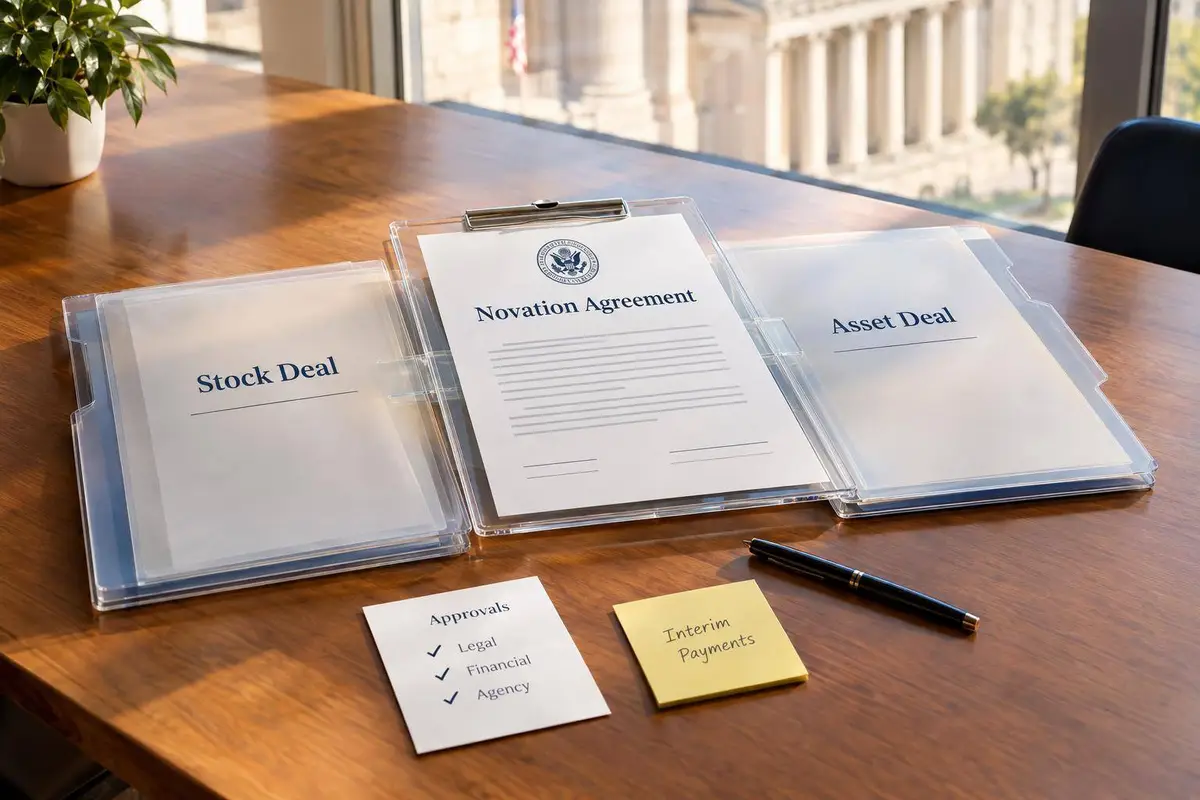
Stock deals usually avoid novation. Asset deals usually require it. I start with one question: Will the same legal entity keep the federal contract, control the assets used to perform it, and continue the work?
Before signing, I check contract terms, approval requirements, liabilities, and payment arrangements - not just the deal’s label. Closing does not equal Government approval, and some small-business recertification deadlines run just 30 calendar days after the applicable trigger.
Quick Comparison
| What I check | Stock purchase | Asset purchase |
|---|---|---|
| Contracting entity | Usually stays the same | Usually changes |
| Novation | Generally unnecessary if FAR conditions are met | Typically required for successor recognition |
| Liabilities | Remain with the acquired entity | Deal terms do not limit the Government’s rights |
| Notices and approvals | Contract, security, and ownership rules still apply | Novation plus other applicable requirements |
| Small-business status | Ownership changes may trigger recertification | Transfers may trigger recertification |
| Performance and payments | Usually remain with the same contractor | Need an interim plan while recognition is pending |
My approach: map each contract before signing, assign approval and financing tasks before closing, and track filings and contract updates afterward. <u>If novation is needed, plan for a payment gap - there is no guaranteed approval date.</u>

Stock vs. Asset Deals: Federal Contract Novation
M&A Guide for Government Contractors: Part 2

sbb-itb-a3ef7c1
Stock vs. Asset Purchases: Contract Continuity Compared
Start the novation review with one question: Does the contracting entity change?
| Issue | Stock purchase | Asset purchase |
|---|---|---|
| Contracting party | Usually stays the same legal entity. | Usually changes to a successor entity. |
| Novation | Generally not needed when FAR 42.1204(b) conditions are met. | Typically required when the business used to perform the contract transfers to a successor. |
| Other notices and approvals | Separate requirements may still apply. | Requires novation review plus other applicable approvals. |
| Legacy liabilities | Stay with the acquired entity. | Contractual liability allocations bind the parties, not the Government. |
| Diligence | Review legacy liabilities, asset control, certifications, and planned reorganizations. | Review affected contracts, transferred assets, successor capability, and approval requirements. |
| Small-business recertification | Ownership changes can trigger recertification and other program consequences. | Transfers can trigger recertification and affect program eligibility. |
| Claims and payments pending recognition | The existing contractor stays responsible; claims and payments generally remain with it, subject to required updates. | Address interim performance, claims, payments, and pending modifications explicitly. Payments may continue to the seller until the Government recognizes the successor. |
Stock Purchases: Keeping the Same Contractor
FAR 42.1204(b) requires three conditions: the contracting party does not legally change, it retains control of the assets used to perform the contract, and it continues performing despite changes in ownership or management.
Document all three conditions, then review any post-closing merger or asset transfer separately. Because the contract stays with the same legal entity, diligence focuses on legacy liabilities rather than contract transfer.
Asset Purchases: Transferring Contracts to a Successor
Transferring the business or assets used to perform the contract can require novation. That includes qualifying mergers and consolidations - deal labels do not decide the outcome. The purchase agreement alone cannot transfer federal contracts. The responsible contracting officer must determine that recognizing the successor serves the Government’s interest.
Match the obligations assumed through novation with specific indemnities, suitable escrow or insurance protection, and access to historical contract records. When novation is required, closing risk centers on the documents, timing, and interim performance.
Other Notices and Approvals
Novation does not replace other approvals. Review ownership-change notices, contract-specific approvals, and organizational conflicts of interest, including impaired-objectivity concerns. Check security and program approvals, too: facility and personnel clearances, classified-work restrictions, and foreign ownership, control, or influence.
Assign responsibility for updating SAM registration, representations, certifications, contacts, and payment information. FAR 42.1204(b) also allows a formal agreement to address ownership-change issues even when novation is not required.
For small-business contracts, check post-deal affiliation, size, and applicable 8(a), HUBZone, WOSB/EDWOSB, or SDVOSB ownership and control requirements. Applicable rules may require recertification within 30 calendar days, so verify each program’s trigger and deadline. Continuing to perform a contract does not necessarily preserve eligibility for future set-aside orders.
Run these approval reviews in parallel with novation. If novation is required, address the submission package, timing, and interim performance plan.
Asset-Deal Novation: Process and Closing Risks
When an asset deal requires novation, the main risks are timing, document quality, and performance during the review. Under FAR Subpart 42.12, the contracting officer reviews the submission, assesses the buyer’s ability to perform, and decides whether to recognize the successor. The officer can request more information. Neither approval nor a fixed review period is guaranteed.
Novation Agreement and Required Documents
The novation agreement involves three parties: the transferor, transferee, and Government. The transferee takes on the contract obligations. The transferor waives related claims and rights against the Government and usually guarantees performance unless the Government waives that requirement.
Submit three signed copies of the proposed agreement, a transaction summary, and evidence of the buyer’s ability to perform. That evidence must cover personnel, facilities, finances, and contract-specific performance requirements. Include a schedule of affected contracts with contract numbers, contract types, contracting offices, amended values, and approximate unpaid balances as of the transfer date.
The submission must also show that the transfer has occurred. Include authenticated transfer instruments, corporate approvals, legal opinions confirming the transfer and its effective date, pre- and post-transfer audited balance sheets, and applicable security evidence and surety consents.
Prepare these filings before closing where possible, then complete documents that depend on the transfer afterward. The Government may keep requesting supporting materials after the deal closes.
Performance and Payment While Novation Is Pending
After closing, the seller may remain the point of contact for billing and claims until the Government recognizes the successor. In a stock deal, the contractor usually stays the same. In an asset deal awaiting novation, the buyer is not yet recognized as the contracting party. Closing, submission, and Government recognition are separate events. Plan for payment and performance separately.
Before closing, have government-contract counsel review interim arrangements with the contracting officer. Specify who can submit invoices, receive payments, handle modifications, and pursue claims. A services agreement or subcontract can help keep work moving, but neither transfers contract rights. Owning the assets does not transfer those rights either.
Make the seller’s cooperation enforceable, including its duties to deliver documents and respond to Government requests. Where feasible, tie closing conditions to required approvals and an agreed interim plan. Set outside dates, extension and termination rights, and holdbacks or escrow provisions to address delayed, conditioned, or denied recognition.
Before funding, lenders should confirm receivable eligibility, payment controls, and collateral treatment. Size working-capital reserves for the potential payment gap, including payroll, suppliers, and debt service - not an assumed approval date.
Ready to Make Your Next Move?
Whether you're buying, selling, or investing — Clearly Acquired gives you the tools, data, and support to close with confidence.
Government Contract Diligence by Deal Stage
Turn the stock-versus-asset analysis into a deal-stage checklist that puts legal requirements into action.
Before Signing: Check Contracts and Ownership Rules
Build a contract-by-contract inventory of federal prime contracts, subcontracts, purchase orders, task orders, options, claims, pending modifications, and contracts nearing expiration. Identify which contracts stay with the same entity and which move to a successor.
For each contract, record the contractor’s legal identity, contracting agency, contracting officer, contract number, contract type, remaining backlog value, option dates, key personnel, payment status, and applicable NAICS codes. Review assignment, change-of-control, consent, key-person, security, and conflict-of-interest terms. Keeping the same contractor does not mean compliance duties stay the same.
Check whether the buyer’s ownership, affiliates, or control arrangements could affect small-business size, 8(a), HUBZone, woman-owned, or service-disabled veteran-owned eligibility. Also review facility and personnel clearances, foreign ownership, cybersecurity requirements, and organizational conflicts of interest. Have government-contract counsel resolve unclear requirements with the appropriate contracting or security official. Keep written guidance when available.
Before Closing: Assign Approval and Financing Tasks
Use the inventory to build the closing tracker. Include every required novation, name-change agreement, notice, consent, registration update, and security submission. Give each item an owner, deadline, and status.
A legal-name change is not the same as a change in the contracting entity. FAR Subpart 42.12 treats them differently. Separate stock-deal continuity tasks from asset-deal submissions and any interim arrangements needed while awaiting successor recognition.
Connect the purchase agreement and financing documents to the tracker’s required approvals and novation timing. Buyers and sellers should assign transition and post-closing cooperation duties. Sponsors, lenders, and investors should identify which approvals control funding or holdback releases. Have counsel coordinate SAM.gov, CAGE, certification, security, and payment updates.
After Closing: Track Compliance and Contract Updates
After closing, shift from approval tracking to compliance tracking. Carry unresolved novation and notice items into a compliance register, then track contracting-officer responses, executed agreements, contract modifications, option dates, and reporting deadlines.
Verify that invoicing complies with contract requirements and that personnel, facilities, systems, and security controls still meet those requirements. Document changes to ownership, control, legal name, address, and banking details. Calendar the applicable 30-day size and socioeconomic rerepresentation deadline after a qualifying acquisition or novation, and keep proof of filing.
Conclusion: Choose a Structure That Meets Contract Requirements
Base your choice on whether the contracting entity changes. Stock deals usually avoid novation; asset deals usually require it.
Neither structure eliminates notice, consent, security, reporting, or contract-specific duties.
Before committing, have government-contract counsel confirm the contracting entity, map the assets and performance responsibilities tied to each contract, and determine novation, notice, consent, compliance, and approval requirements. Then align closing conditions and acquisition financing strategies with those findings. A pending novation is not an approved transfer.
FAQs
Could a post-closing merger trigger novation after a stock purchase?
Possibly - if the merger changes the contracting entity. A stock purchase generally avoids novation because the legal entity stays intact and its contracts remain in place. Change-of-control clauses may still require notice or approval.
An asset deal, on the other hand, requires separate transfers of contracts, permits, and leases. That makes novation or consent more likely.
What happens if the Government denies novation?
If novation is required, a denial means the Government has not agreed to the contract transfer. Asset deals usually need novation or consent when the contracting party changes.
A stock purchase generally avoids novation because the same legal entity remains the contracting party, so the contract typically continues. But change-of-control clauses may still require notice or consent from a third party.
Can an acquisition affect my eligibility for future set-aside orders?
Stock purchases generally don’t require government contract novation because the legal entity holding the contract stays the same. Asset deals, by contrast, move the assets or business performing the contract to a new entity. That move may require novation, along with a separate assignment or consent.
A stock deal can still trigger change-of-control clauses, which may require notice or consent, or give a party the right to renegotiate or terminate the contract. Review both the contract’s transfer terms and its change-of-control provisions.
Related Reading
About the author
Principal & CEO/CIO
Samson Jagoras has 15+ years across finance, real estate, and business acquisitions. He began his career as a Futures & Commodities broker and later served as Chief Strategy Officer of an INC 500 marketing and technology firm, helping scale revenue from $1M to over $100M. Today he buys, builds, and advises a portfolio of companies with a focus on M&A, capital allocation, and operational strategy.