FCC License Assignment vs. Transfer of Control
Decide whether a deal changes the license holder or who controls it—the key test that determines FCC filing, timing, and closing rules.
 Samson JagorasPrincipal & CEO/CIOOctober 23, 2026
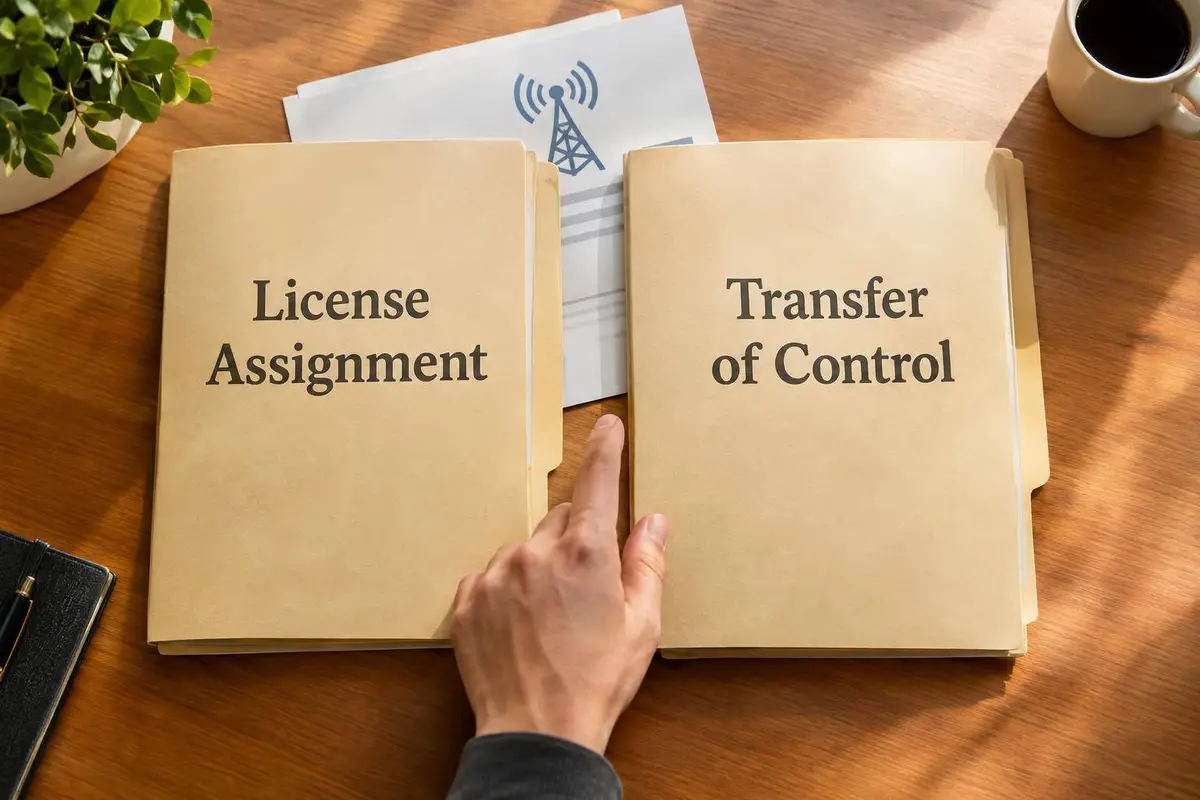
An FCC license assignment changes who holds the license. A transfer of control changes who controls the existing licensee. Before setting your closing date, I’d use a business acquisition checklist to check both: either change may require FCC consent.
Here’s the check I’d use for your deal:
- Asset purchase: Does the license move to the buyer?
- Equity purchase or holding-company sale: Does direct or indirect control change?
- Merger: Which entity survives, holds the license, and controls it?
- Internal reorganization: Does ultimate control stay the same? Even then, approval or notice may be required.
- Investor rights and financing: Do voting, board, management, or lender rights shift actual control?
Quick Comparison
| Question | Assignment | Transfer of control |
|---|---|---|
| What changes? | The entity holding the license | Control of the existing licensee |
| Who is involved? | Assignor and assignee | Transferor and transferee |
| What determines the filing? | Authorization and service rules | Authorization, service rules, and control rights |
| Can closing require prior consent? | Yes | Yes |
My closing rule: <u>filing is not permission to close</u>. I’d have FCC counsel confirm the forms, filing parties, consent requirements, and notice deadlines before closing. For many wireless approvals, the deadlines are 180 days to close after public notice of consent and 30 days after closing to notify the FCC - but those deadlines do not apply to every deal.

FCC License Assignment vs. Transfer of Control
FCC Compliance Requirements
sbb-itb-a3ef7c1
FCC License Assignment vs. Transfer of Control
The filing depends on what the deal changes: the license holder, who controls it, or both.
| Issue | License assignment | Transfer of control |
|---|---|---|
| Legal licensee | Changes | Stays the same |
| Controlling owner | May stay the same in a pro forma reorganization | May change directly or indirectly |
| Transaction trigger | Authorization moves | Control changes |
| Filing parties | Assignor and assignee | Transferor and transferee, with the licensee joining as required |
| Approval requirements | Substantial voluntary assignments generally require prior consent; pro forma procedures vary | Substantial voluntary transfers generally require prior consent; pro forma procedures vary |
Section 310(d) generally requires prior FCC consent for covered voluntary license assignments and transfers of control. The FCC must also find that the transaction serves the public interest, convenience, and necessity. Other authorizations fall under separate statutory and service-specific rules. That means one FCC filing doesn’t cover every authorization a business holds.
Assignments: The License Moves to Another Entity
Buying assets doesn’t automatically transfer the authorization. The license stays with the seller unless the FCC approves a new holder. Disclosures usually address ownership, citizenship/foreign ownership, and technical qualifications.
A pro forma assignment changes the entity holding the license without changing ultimate control. Eligibility depends on the actual ownership and control structure - not whether the parties call the deal a reorganization. An assignment with a different ultimate controller generally receives substantial-transaction treatment. Some services allow notice-only treatment for qualifying pro forma assignments; others still require prior approval.
If the buyer also changes who controls the licensee, the deal may need a transfer-of-control filing instead of, or in addition to, an assignment filing.
Transfers of Control: The Licensee Stays the Same
De jure control (formal voting control) depends on formal voting power, usually majority voting rights. A shift to 50% or more often triggers review, but no single percentage provides a universal safe harbor.
De facto control (practical operational control) concerns who actually directs the business. The FCC examines board rights, management authority, budgets, personnel, programming, and financing - not just the cap table.
Even a minority stake can create control issues if governance or contractual rights give an investor practical authority over operations. Likewise, an ownership change at the parent level can change control while the operating subsidiary remains the named licensee.
Review shareholder agreements, management agreements, and financing documents together. This control analysis determines which FCC filing comes first and whether closing must wait for consent. The deal’s structure drives the filing type, timing, and closing mechanics.
How Deal Structure Affects FCC Filings
Use the assignment-versus-control test to assess the most common acquisition structures.
| Transaction structure | Licensee status before and after closing | Likely FCC filing | Main diligence question |
|---|---|---|---|
| Asset purchase of licensed assets | Seller holds the license before closing; buyer or buyer subsidiary holds it afterward | Assignment, generally requiring prior FCC approval unless an exception applies | Which buyer entity will hold the authorization? |
| Equity purchase of controlling interest | Licensee stays the same; controlling owner changes | Direct or indirect transfer of control | Does the buyer gain direct or indirect control? |
| Merger | Depends on which entity survives; authorization may stay with the survivor or a subsidiary | Assignment if the license holder changes; transfer of control if only its controller changes | Which entity survives, holds the authorization, and controls it? |
| Holding-company insertion | Licensee may stay the same while the ownership chain changes | Pro forma transfer if control stays unchanged; service rules determine whether notice or prior approval applies | Does the change affect only legal form, or control too? |
| Holding-company sale | Named licensee may stay the same; ultimate control changes as part of a business exit strategy | Indirect transfer of control, potentially requiring FCC consent | Who ultimately controls the licensee? |
| Internal restructuring | Licensee and ultimate owners may stay the same | Pro forma filing may still be required; service rules determine whether notice or prior approval applies | Does ownership stay unchanged, and which filing applies? |
Map each transaction step to the entity that will hold or control the license after closing. The deal label alone doesn't determine the filing. The answer depends on whether the license changes hands, the licensee survives, or only the control chain changes.
Asset Purchases, Equity Purchases, and Mergers
For each deal type, answer three separate questions: Who holds the authorization? Which entity survives? Who controls the licensee?
A parent-level merger can leave licensed subsidiaries in place while still triggering an indirect transfer of control.
Holding Companies and Internal Reorganizations
Changes at the parent level can matter even when the operating licensee stays the same. Show the ownership chain before and after closing. A pro forma insertion may still require notice or approval, and a later holding-company sale needs its own control analysis.
Investor Rights and Acquisition Financing
Review voting, board, veto, management, and financing rights together. A minority economic investor may still have effective control if those rights are broad enough. Customary minority protections, however, don't automatically establish control.
Financing documents should also make foreclosure, the exercise of voting proxies, and management replacement subject to applicable FCC requirements. Those remedies may require separate consent.
Ready to Make Your Next Move?
Whether you're buying, selling, or investing — Clearly Acquired gives you the tools, data, and support to close with confidence.
FCC Filing and Closing Requirements
Whether a deal is an assignment or a transfer of control determines which filing is needed, who files it, and whether closing must wait for FCC consent.
Identify the Service, Form, and Filing Parties
Once you classify the deal, match it to the correct FCC form and filing party.
For each authorization, record the call sign or number, licensee, parent entity, service, jurisdiction, FCC bureau, and filing system. The purchase agreement’s label isn’t enough. Check the authorization, service rules, ownership chain, and who actually controls the licensee.
FCC Form 603 covers many wireless assignments and transfers. Broadcast deals follow separate procedures, often involving Forms 314 and 315. Telecommunications deals may also require Section 214 filings.
Use this matrix to match the transaction type to the filing requirements.
| Requirement | Assignment | Transfer of control |
|---|---|---|
| Filing parties | Assignor generally files; assignee supplies required certifications and information | Transferor generally files; transferee supplies required certifications and information |
| Ownership disclosures | Assignee ownership and attributable interests; Form 602 where applicable | Transferee ownership chain, controlling interests, and relevant governance rights |
| Closing consequence | Moving the license to another entity without required consent risks an unauthorized assignment and monetary forfeitures | Changing control of the existing licensee without required consent risks an unauthorized transfer and monetary forfeitures |
Match the form, required signer, exhibits, and notice duty to each authorization. Check that the application aligns with the purchase agreement, ownership chart, governance documents, and financing terms. Include all applicable eligibility, citizenship, foreign-ownership, compliance, and competitive disclosures - not just the buyer’s name.
Sequence FCC Consent, Closing, and Notices
Build the closing timeline around required FCC approval and any post-closing notice rules.
Confirm who holds the license before and after closing and whether control changes. File the required applications, obtain required consent, close before that consent expires, and submit the required notices and ownership updates. Filing an application does not authorize closing.
For many wireless approvals, parties have 180 days after public notice of consent to consummate and 30 days after consummation to notify the FCC. These deadlines don’t apply to every deal, and they aren’t promises about processing times. Request any needed extension before expiration, and keep the filing confirmation.
Qualifying pro forma transactions may use notification or abbreviated procedures. Check the applicable requirements rather than filing duplicate notices. A buyer can also trigger an unauthorized transfer by taking actual control before legal closing.
Build FCC Requirements Into the Deal Plan
Make required FCC consent a closing condition. Assign responsibility for applications, certifications, fees, FCC responses, and post-closing notices. Address conditioned approvals, outside dates, extensions, and termination rights in the deal documents.
Confirm that financing will remain available if FCC review runs past the planned closing date. Any interim management arrangement must leave the existing licensee in control until lawful closing.
Conclusion: Confirm FCC Requirements Before Closing
Determine the FCC path by what changes in ownership or control, not by the deal’s label. That applies to asset purchases, equity acquisitions, and holding-company changes.
Use this final check to turn the earlier analysis into a closing decision.
| What changes? | Review needed | What to verify |
|---|---|---|
| Asset purchase: the named licensee changes | Assignment of authorization | Service-specific procedure and consent rule |
| Equity acquisition: the licensee stays the same, but a new person or entity gains direct voting control | Transfer of control | Whether control changes and whether prior approval applies |
| Ownership or control changes above the licensee, including at a parent or holding company, or through an internal reorganization | Indirect transfer of control or pro forma/internal-reorganization review | Whether ultimate control changes and what filing or notice applies |
These rules help flag issues; they don’t establish final classifications. Keeping the same licensee does not rule out an FCC filing. An internal reorganization is not automatically exempt, either.
Once you’ve mapped the transaction, confirm the filing path before setting closing mechanics. Before closing, have FCC counsel compare the pre- and post-closing authorization holder and control chain to confirm the service, form, consent requirement, and notice deadlines.
FAQs
Can my deal require both an assignment and a transfer filing?
It depends on the deal structure and the licenses involved. Asset purchases often require new FCC license filings or reapplication because licenses may not automatically transfer with the assets. Equity purchases more often keep existing licenses in place, subject to transferability rules and any notice or approval requirements.
Holding-company acquisitions can also trigger control or beneficial-ownership requirements, even when the operating licensee stays the same. Whether FCC notification or reauthorization is required depends on who controls the licensee.
How do I document unchanged control in a holding-company reorganization?
The asset-versus-stock distinction doesn’t fully explain how to document that control remains unchanged in a holding-company reorganization.
In an asset purchase, licenses often require a new application or reissuance. In a stock purchase, the legal entity stays in place, so existing licenses and contracts typically remain in effect. Still, change-of-control notices or approvals may be required.
What can I do before FCC approval without taking control?
During pre-approval diligence, check for license and permit issues tied to the acquisition structure. Asset purchases often require new licenses or assignments. Stock purchases may keep existing licenses, permits, and contracts in place, but a change in control can still trigger FCC filings - even when the change involves a holding company.
Clearly Acquired supports this review through M&A and capital advisory services, using AI-native tools to flag potential license and permit blockers.
Related Reading
About the author
Principal & CEO/CIO
Samson Jagoras has 15+ years across finance, real estate, and business acquisitions. He began his career as a Futures & Commodities broker and later served as Chief Strategy Officer of an INC 500 marketing and technology firm, helping scale revenue from $1M to over $100M. Today he buys, builds, and advises a portfolio of companies with a focus on M&A, capital allocation, and operational strategy.