Incurable Breaches: Pre-Closing Termination Rights
Don’t terminate a deal over a pre-closing breach until you’ve confirmed cure options, tracked deadlines, and verified termination rights.
 Samson JagorasPrincipal & CEO/CIOOctober 23, 2026
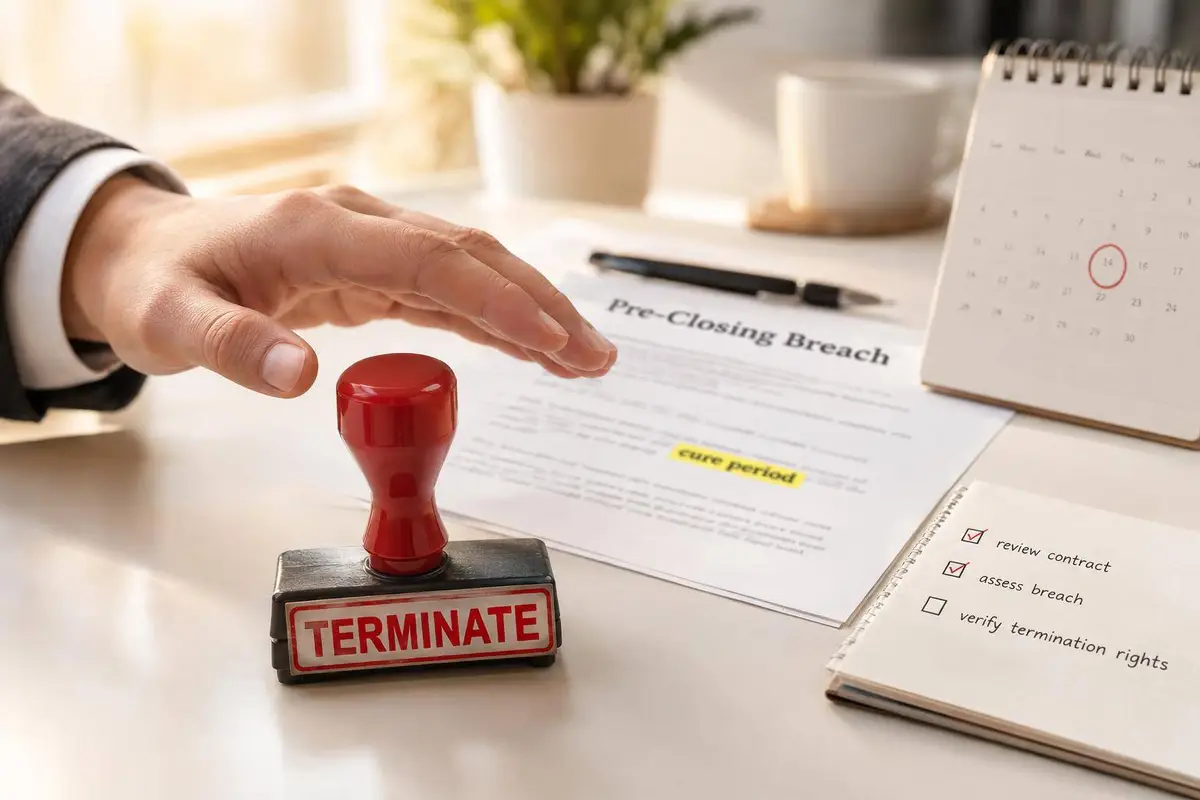
A breach before closing does not automatically let you end the deal. I start with three checks: Does it block a required closing condition? Can it be fixed within the contract’s deadline? Does the termination clause allow an exit?
Here’s what I check before treating a breach as grounds to terminate:
- Cure versus damage control: A fix must meet the contract’s requirements - not just reduce the loss.
- Notice and timing: Follow the notice rules and track cure, financing, and outside-date deadlines separately. A 30-day cure period does not automatically extend the outside date.
- Exceptions and separate exit rights: An express cure exception, a court-order clause, and an outside-date clause each need their own review.
- Fault and remedies: Check whether your own conduct limits termination and which claims, fees, or enforcement rights survive.
My bottom line: <u>Have counsel confirm the right to terminate before sending notice.</u> A mistaken exit can expose you to damages or a court order requiring you to close.

Pre-Closing Breaches: Check Before You Terminate
When Can a Buyer Walk Away From an Acquisition?

sbb-itb-a3ef7c1
Curable Breaches: Notice and Time to Correct
When a breach can still be fixed, check whether the agreement gives the breaching party time and a clear path to cure. The question is whether the breach still blocks closing when the cure period ends, not just whether it occurred.
Cure restores compliance with the contract. Mitigation only reduces harm. Paying costs, providing indemnification, or placing funds in escrow cannot replace a required consent unless the agreement allows it. Even after a cure, separate damages claims may remain unresolved.
Notice Rules and Cure Deadlines
Follow the notice clause, and calculate the deadline from the trigger stated in the contract - not automatically from the notice date. Check whether the period runs in calendar or business days, whether day one counts, and which time zone applies. A cure period does not, by itself, extend the outside date. Read both clauses together. If the cure requires a third party to act, documented efforts matter, too.
Hypothetical - missing consent that remains obtainable: A purchase agreement requires a key customer’s written consent before closing. The buyer delivers compliant notice on June 1; the agreement allows 30 calendar days to cure, with a July 15 outside date. The seller submits the required materials, follows up, and obtains written consent on June 20. That corrects the missing-consent failure within both deadlines. Assuming no other relevant failure remains, the original omission generally would not support termination. A promise to obtain consent after closing would not achieve the same result.
Required Efforts and Limits on Termination
Commercially reasonable efforts and reasonable best efforts are different obligations. Define the required steps in the agreement: submit complete applications, answer requests, escalate delays, and pay required fees. Keep dated submissions, correspondence, and approvals. These records help show that the breach remained fixable, rather than simply unresolved.
Before terminating, confirm that the breach remains uncured at the relevant time and meets the required closing-condition or materiality standard. An expired cure period alone may not be enough. Check whether the terminating party is itself in material breach or caused the condition to fail. Apply the agreement’s exact restriction, including whether withholding information or refusing to cooperate blocked the cure.
If the defect cannot be fixed before closing, the analysis turns to whether the breach is incurable.
Curable vs. Incurable Breaches
When a breach remains uncured, the next question is whether it can still be corrected before closing. A breach is incurable only if it cannot be fixed before closing in the form the agreement requires.
| Issue | Curable breach | Incurable breach |
|---|---|---|
| Correction | Compliance or the required condition can still be restored before closing | Compliance or the required condition cannot be restored before closing |
| Timing | Effective cure remains possible before closing and within the contract deadline | Effective cure cannot occur before closing within the contract deadline |
| Termination | Ordinarily requires compliance with applicable cure provisions | May proceed without a cure wait if the termination clause permits it |
The hardest cases involve acts that change the asset or the parties’ legal position before closing.
Irreversible Acts and Barriers to Closing
Hypothetical - sale of a unique operating asset: A seller transfers a one-of-a-kind operating asset without the buyer’s required written approval.
Even then, termination requires the breach to meet the agreement’s applicable thresholds; the unauthorized sale alone does not establish that right.
Recovery or replacement fixes the defect only if it satisfies both the covenant and the related closing condition. Otherwise, the breach may still prevent closing.
A court order blocking closing belongs in the no-closing-order clause, not the cure analysis. If that clause covers a final, nonappealable order blocking closing, the question is whether that specified order exists - not whether a covenant breach is incurable.
Even if correction remains possible, the contract may allow termination early or by the outside date.
Cure Exceptions and Outside-Date Rights
An express cure exception is not the same as an expired cure period.
In the 2014 C&J Energy Services–Nabors transaction, Nabors negotiated a separate right to terminate without a cure period for material breaches of specified window-shop and matching-right obligations. That exception did not replace the ordinary cure provision for other breaches.
Check the exception’s exact scope, materiality standard, and separate notice requirements.
An outside-date right is independent of both. Before invoking it, read the extensions, tolling provisions, and causation restrictions together.
In Akorn v. Fresenius, the agreement’s incapable-of-cure language supported termination without an additional cure opportunity - not a rule that the outside date always overrides cure rights.
Ready to Make Your Next Move?
Whether you're buying, selling, or investing — Clearly Acquired gives you the tools, data, and support to close with confidence.
Cure Disputes: Correction vs. Mitigation
A disputed cure plan should spell out what will be fixed, who must act, and when. The central question is whether the proposed fix restores the exact contractual condition before the deadline.
| Disputed issue | Party seeking to cure | Party seeking to terminate | Relevant evidence |
|---|---|---|---|
| Proposed fix | Restores compliance or the closing condition | Only reduces harm or substitutes performance | Cure plan, covenants, closing conditions |
| Feasibility before closing | Concrete steps support timely correction | Unresolved dependencies prevent timely correction | Consent status, third-party communications, implementation records |
| Responsibility | The counterparty impeded correction | The terminating party met its obligations | Cooperation records, notices, causation evidence |
Start with the contract’s exact closing condition - not the business outcome either party would prefer.
Does the Cure Satisfy the Closing Condition?
Compare the proposed result with the condition’s wording and the applicable termination threshold. Does the contract require a particular consent, an accurate representation, or covenant compliance? Partial correction, a substitute asset, a price reduction, or damages may need a written amendment or waiver rather than qualify as a cure. Document which obligations the agreed solution satisfies and whether termination rights remain.
Defective notice may prevent the cure period from starting. Track the notice date, cure deadline, scheduled closing, and outside date separately. If correction depends on a third party, get evidence of progress and expected completion. An assurance that approval is pending isn't enough.
Fault and Wrongful-Termination Risk
If the terminating party helped cause the failure, the dispute also puts its right to terminate at risk. Before sending a termination notice, review that party’s performance. Its own breach, withheld cooperation, or failure to use required efforts may limit pre-closing termination rights under the agreement’s material-breach or causation provisions.
Preserve consent requests, responses, and implementation records. An invalid termination may expose the terminating party to damages or specific performance where available. A party seeking enforcement should also preserve proof that it remains ready, willing, and able to close. The contract and governing law determine how these issues play out.
Remedies language can preserve or cut off pre-termination liability. Before terminating, read the termination-effect, exclusive-remedy, specific-performance, and surviving willful-breach provisions together.
Conclusion: Check Your Rights Before Terminating
Once you’ve separated curable from incurable breaches, check whether the contract permits termination.
Follow the contract - not the severity of the dispute. Confirm that the breach remains uncured, that the proposed fix meets the closing condition, and that all notice requirements, deadlines, and termination limits have been met.
| Drafting choice | Effect on buyer | Effect on seller |
|---|---|---|
| Broad cure rights | May delay the buyer’s exit after a seller breach; gives the buyer time to cure its own breach | May keep the deal alive by giving the seller time to cure; delays the seller’s right to terminate after a buyer breach |
| Defined exceptions to cure | May allow a faster exit for specified seller failures | May allow a faster exit for specified buyer failures |
These terms must match the closing condition and termination clause to work as intended.
Align Cure Terms, Deadlines, and Remedies
Spell out which breaches qualify for cure, what triggers notice, what efforts are required, which breaches are excluded, and whether partial correction counts. Cross-reference closing conditions, outside-date extensions, and any limits tied to the terminating party’s conduct.
State which claims, fees, damages, and enforcement rights survive termination. Don’t assume that ending the contract preserves - or wipes out - all liability.
Vintage Rodeo Parent, LLC v. Rent-A-Center, Inc. enforced the written-extension mechanism; calendar extension notice separately from the outside date.
Track Open Issues Before Closing
Keep every open issue in one shared, up-to-date tracker to help avoid a mistaken termination. Include consents, covenant compliance, financing deadlines, notice dates, and cure milestones. Assign each item an owner, supporting evidence, a linked closing condition, and a due date.
Clearly Acquired can help organize diligence, consent tracking, and deadline management. Counsel must decide cure eligibility, notice sufficiency, termination authority, damages, and surviving remedies.
FAQs
Who decides whether a disputed breach is incurable?
The agreement’s wording and dispute procedures determine whether a disputed breach can be cured. Terms to check include notice requirements, cure periods and deadlines, and closing conditions.
A breach may be incurable if no cure period applies, the cure deadline has passed, or fixing the breach would not restore the agreed-upon condition. Depending on the contract, this may allow termination or delay or withhold consideration.
Can I accept a partial cure without waiving termination rights?
Accepting a partial cure doesn’t automatically preserve or waive your right to terminate. That depends on the contract’s cure process and notice requirements. Many agreements allow a cure period - often 10–30 days after written notice - unless an exception applies.
The key question is whether the breach can be fully corrected before closing or an agreed outside date. Disputes often turn on whether full correction is still possible.
What if the cure deadline falls after the outside date?
The contract’s cure and termination terms determine whether a breach can still be corrected before closing. Some agreements offer no pre-closing cure right. Others shorten or limit the cure period. And some breaches simply can’t be fixed in time.
When correction is possible, disputes usually center on two questions: Was the required notice-and-cure process followed? And was the breach corrected before the applicable closing or lock date?
Related Reading
About the author
Principal & CEO/CIO
Samson Jagoras has 15+ years across finance, real estate, and business acquisitions. He began his career as a Futures & Commodities broker and later served as Chief Strategy Officer of an INC 500 marketing and technology firm, helping scale revenue from $1M to over $100M. Today he buys, builds, and advises a portfolio of companies with a focus on M&A, capital allocation, and operational strategy.