E-Verify and Form I-9 Rules in Business Acquisitions
A buyer must approve a written I-9 and E-Verify plan before closing to limit post-acquisition compliance exposure and liability.
 Samson JagorasPrincipal & CEO/CIOOctober 23, 2026
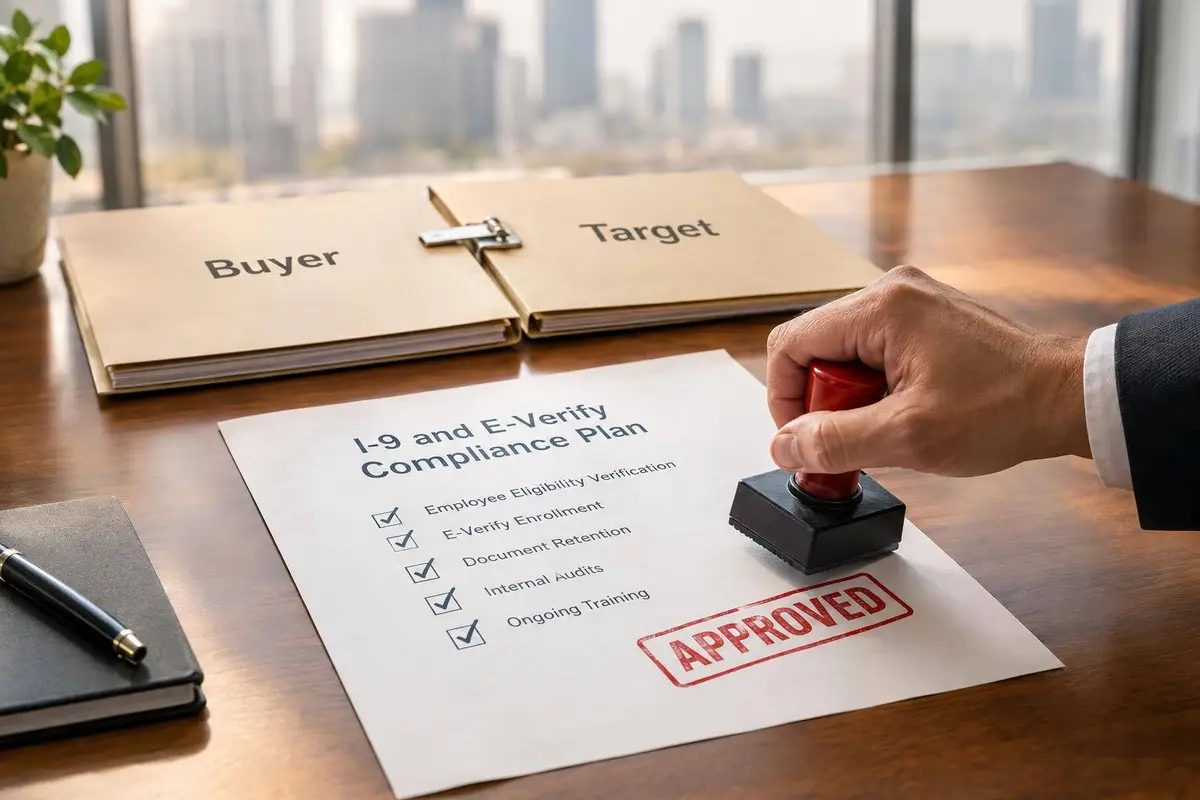
Before closing, I would settle two questions: Will you keep the seller’s Forms I-9, and who will handle verification after the deal? Keeping those forms means taking responsibility for their errors. E-Verify does not fix them or replace Form I-9.
My business acquisition checklist covers five areas:
- Forms and files: Choose whether to retain existing forms or complete new ones, review missing records and errors, and arrange secure access.
- Accounts and deadlines: Confirm the legal employer, E-Verify enrollment, account access, and named owners. Ordinary new-hire E-Verify cases are due within three business days after paid work begins.
- Contract and state rules: Check FAR 52.222-54 and workforce locations before deciding which employees need verification and when.
- Employee rights: Let employees choose acceptable documents, and follow required mismatch notice and contest procedures.
- Costs and follow-through: Set correction deadlines, retention procedures, a budget, and purchase-agreement terms for unresolved issues.
My bottom line: <u>approve a written verification plan before closing</u>, with counsel checking the rules that apply to your deal.
Choose How to Handle Acquired Employees’ Forms I-9
Keep Existing Forms or Complete New Ones
Decide before closing whether the buyer will keep the seller’s I-9 files or complete new forms. This choice affects post-close liability.
USCIS allows buyers to retain predecessor Forms I-9 or complete new forms for employees who continue working after a reorganization, merger, or similar transfer. Apply the chosen approach consistently across the acquired workforce - not based on citizenship, national origin, or perceived work authorization.
| Issue | Retain predecessor forms | Complete new forms |
|---|---|---|
| Employment continuity | Preserve uninterrupted employment and keep predecessor Forms I-9 | Treat acquired employees as new hires for Form I-9 purposes |
| Errors and liability | Take responsibility for inherited errors and omissions | Rely less on old forms without eliminating historical exposure |
| Acquisition date | Keep existing hire dates | Use the acquisition effective date as the first day of employment for a new Form I-9. |
| E-Verify | Follow acquisition and contractor rules before creating cases. | Follow acquisition and contractor rules before creating cases. |
| Retention | Keep predecessor forms under the applicable retention schedule | Keep new forms for three years after hire or one year after termination, whichever is later. |
An ownership change alone does not require reverification. Reverification applies only when work authorization expires.
Before choosing an approach, check what the files contain and identify any gaps.
Review Verification Records During Diligence
Check for inherited compliance risk by requesting I-9 files, supplements, correction logs, E-Verify records, contract files, state-law records, and audit trails. Compare those records with payroll and employee rosters. Flag missing forms, incorrect dates, unsigned sections, improper corrections, and records tied to the wrong legal employer. Keep the source records, and never backdate corrections.
Use a secure data room with role-based permissions. Limit access to counsel, HR compliance staff, and authorized reviewers. Report findings by employee identifier instead of circulating identity documents or Social Security numbers. Give each defect an owner and a documented correction plan.
Once the approach is set, document who is responsible for each deadline and correction.
Assign Owners and Deadlines
Deal labels, payroll changes, and transition-services agreements do not determine verification treatment. Before integration starts, the buyer must document the responsible employer, chosen approach, covered employees, and effective date. Name the people responsible for forms, corrections, notices, cases, and retention.
USCIS allows forms to be completed before closing after an employment offer is accepted - not to prescreen applicants. Do not assume every case is due at closing; contractor rules may change the deadline.
sbb-itb-a3ef7c1
E-Verify: How to Know If Your Business should Use It | HR Hot Topics September 2026

Confirm E-Verify Accounts and Federal Contractor Duties

E-Verify Acquisition Deadlines for Federal Contractors
Confirm the Employer and Account Setup
Once the I-9 approach is set, confirm who controls the E-Verify account and whether the buyer can use it after business acquisitions are finalized. The seller’s enrollment does not automatically cover the buyer. Check whether ownership or the EIN will change. Review the account, MOU, administrators, hiring sites, and pending cases or notices to determine whether the buyer can keep, update, or replace the account after closing.
Contact E-Verify before closing if the employer’s legal entity, EIN, participating locations, administrator, or federal-contractor status will change. At closing, transfer or replace administrator access, remove seller access, and name one person to oversee pending cases until they’re resolved.
Account control comes first. Next, check whether contract coverage adds E-Verify duties after closing.
Check Contracts for FAR 52.222-54
A federal customer alone does not trigger E-Verify. Review prime contracts, subcontracts, and modifications for FAR 52.222-54. Check whether the clause applies, where the work takes place, whether the business acts as a prime contractor or subcontractor, and whether an exception applies. Covered subcontractors may also face these requirements when the clause is properly flowed down. This review determines whether duties expand at closing or when a contract is assigned.
When the clause applies, the contractor generally must enroll within 30 calendar days after award.
If the contractor elected entire-workforce coverage, acquired nonexempt employees generally must be verified within 180 days of the acquisition’s effective date. Otherwise, the deadline is generally 90 days for acquired nonexempt employees assigned to covered contract work.
Assign Tasks Before and After Closing
Once coverage is confirmed, give each remaining E-Verify transition task an owner and a deadline. Before closing, the seller should provide account and pending-case records, and the buyer should confirm enrollment and administrator changes.
After closing, reconcile account access, payroll, contract assignments, and pending notices. Track any 30-, 90-, or 180-day deadlines that apply to enrollment and employee verification.
Ready to Make Your Next Move?
Whether you're buying, selling, or investing — Clearly Acquired gives you the tools, data, and support to close with confidence.
Check State Rules and Allocate Compliance Risk
After reviewing federal accounts and contractor requirements, map the state rules that apply to the acquired workforce.
Map State Requirements by Workforce Location
State E-Verify rules add to - not replace - federal Form I-9 duties. Build a workforce-location matrix that covers each employee’s work state, physical worksite, remote-work location, and any state or local filing trigger.
Record employer thresholds and counting rules, covered workers, public-contract triggers, notices, attestations, deadlines, retention periods, penalties, and effective dates. Keep state mandates separate from county, city, and sector-specific rules. Before closing, check every requirement against current official state agency, legislative, and procurement sources.
Set Recordkeeping and Audit Procedures
Once the state map is complete, assign a record owner and backup. Limit access to trained staff, and keep Forms I-9 separate from ordinary personnel files where practical.
Retain each form for three years after hire or one year after employment ends, whichever is later. For inherited forms, document the original hire date, prior employer, acquisition date, and any termination date. A change in ownership does not restart the retention clock. Keep records under legal hold even after their normal destruction date.
Compare state filings, notices, and audit records with the I-9 file to check state-law compliance. Treat missing forms, late cases, and unresolved mismatches as separate findings. Follow current USCIS correction procedures for any state-law findings. Train managers on state-specific notice, documentation, retention, and audit rules, and refer missed cases to qualified counsel.
Allocate Risk in the Purchase Agreement
Turn each state-law gap into a task with an estimated cost, owner, deadline, and proof of completion. Separate one-time remediation costs from recurring training and audit costs.
Use targeted representations and disclosure schedules to address missing records, state-rule gaps, contract obligations, and government inquiries. Require record preservation and specific pre-closing remediation. Negotiate indemnities and, when warranted, an escrow or holdback backed by the estimated exposure.
An indemnity assigns costs; it does not remove regulatory liability. Address post-closing record access, seller cooperation, agency communications, defense control, and funding for unfinished remediation. Check indemnity caps, exclusions, survival periods, and the seller’s ability to pay.
A workflow platform such as Clearly Acquired can help track diligence requests, remediation, and closing checklists. Qualified counsel should validate the applicable requirements and remediation. The platform does not replace immigration counsel or government verification systems.
Conclusion: Approve a Verification Plan Before Closing
Turn these rules into one signed implementation plan at closing. Approve a written verification plan - not just access to E-Verify. Decide whether to retain the seller’s Forms I-9 or complete new ones under USCIS’s M-274. That decision sets the starting point for the buyer’s post-close exposure.
E-Verify is separate from Form I-9. Confirm three items:
- Legal employer: Identify the buyer entity that will employ the workforce after closing.
- E-Verify account/MOU: Confirm the account and MOU status, then apply the acquisition rules and MOU requirements.
- FAR/state duties: Document any FAR 52.222-54 duties separately. Attach the workforce-location matrix and cite the current governing state authority for each requirement.
Before closing, management should approve a deadline calendar, named owners, and a remediation budget based on the diligence file review. Plan for day-one record transfer, a 30-day inventory checkpoint, a 60- to 90-day remediation review, and status reports. Internal checkpoints must not delay legal deadlines. Use the checklist to carry unresolved items into post-close tracking.
FAQs
What if inherited I-9 errors surface after closing?
If you find inherited errors, check the acquisition’s I-9/E-Verify responsibilities. Asset deals often involve rehiring employees and completing new Forms I-9. Enrolling in E-Verify doesn’t replace your duty to complete and retain Form I-9 or verify each employee’s identity and work authorization.
E-Verify electronically checks employment eligibility; Form I-9 documents it. Covered federal contractors may need to enroll in E-Verify. State requirements depend on where employees work.
Can we hire while our E-Verify account is being updated?
You must still complete and retain Form I-9 for new hires while your E-Verify account is being updated. E-Verify checks I-9 information electronically against federal records. It does not replace Form I-9.
In an acquisition, stock buyers inherit existing I-9 compliance gaps. Asset buyers may reduce that risk by completing new I-9s for all rehired employees instead of relying on the seller’s files.
How do state and federal contractor verification rules overlap?
Employers must complete and retain Form I-9 to verify each employee’s identity and permission to work. E-Verify checks that information against government records, but enrolling doesn’t replace Form I-9 duties. Federal contractor rules and state requirements may also require employers to use E-Verify.
Buyers must also address compliance during an acquisition. In a stock deal, existing I-9 records and potential liabilities stay with the acquired company. Asset deals often involve rehiring employees and completing new forms to reduce risks tied to earlier documentation.
Related Reading
About the author
Principal & CEO/CIO
Samson Jagoras has 15+ years across finance, real estate, and business acquisitions. He began his career as a Futures & Commodities broker and later served as Chief Strategy Officer of an INC 500 marketing and technology firm, helping scale revenue from $1M to over $100M. Today he buys, builds, and advises a portfolio of companies with a focus on M&A, capital allocation, and operational strategy.