What Is EBITDA? Formula, Adjustments, and Multiples
EBITDA explained for business buyers and sellers: the formula, how it differs from SDE and net income, which add-backs buyers accept, and how multiples turn earnings into a valuation.
 Samson JagorasPrincipal & CEO/CIOAugust 19, 2026
Sell your business for maximum value
Our sell-side advisors package, market, and negotiate your exit to qualified, verified buyers — confidentially.
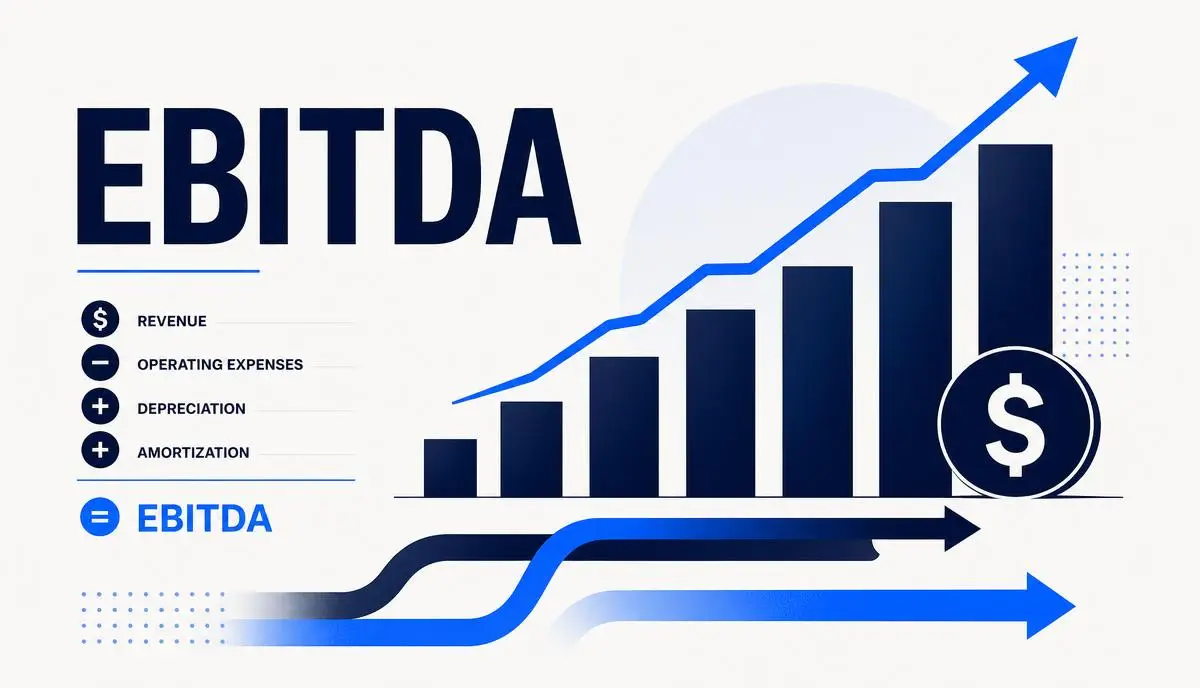
EBITDA is earnings before interest, taxes, depreciation, and amortization — a rough proxy for the cash a business produces from operations before financing choices, tax position, and accounting decisions get involved. In small business M&A it is the number most buyers, lenders, and appraisers start from when they set a price.
This hub explains the formula, how EBITDA differs from SDE and net income, how adjustments work, and what multiples look like by industry.
The EBITDA formula
There are two ways to get there, and they should reconcile:
- Bottom-up: Net Income + Interest + Taxes + Depreciation + Amortization
- Top-down: Operating Income (EBIT) + Depreciation + Amortization
Example: a business with $400,000 of net income, $90,000 of interest expense, $60,000 of taxes, and $150,000 of depreciation and amortization has EBITDA of $700,000.
EBITDA vs. SDE vs. net income
| Measure | What it includes | Typically used for |
|---|---|---|
| Net income | Everything, after interest, taxes, and non-cash charges | Tax returns, financial reporting |
| EBITDA | Operating earnings before financing, tax, and non-cash charges | Businesses above roughly $1M of earnings, lender underwriting |
| SDE | EBITDA plus one owner''s full compensation and discretionary spend | Owner-operated Main Street businesses |
The practical dividing line: if a single working owner is central to the business, buyers price on SDE. Once the company can pay a market-rate manager and still produce meaningful earnings, buyers price on EBITDA. We walk through that decision in detail in EBITDA vs. SDE: which method should home service owners use.
Adjusted EBITDA: what buyers will and won''t accept
Adjusted (or "normalized") EBITDA removes items a new owner won''t inherit. Common accepted add-backs include one-time legal fees, owner compensation above market, personal expenses run through the business, non-recurring moving or startup costs, and rent above or below market when the property is related-party.
Commonly rejected: recurring "one-time" items that appear every year, deferred maintenance, unfunded owner labor, and optimistic pro-forma revenue. A quality of earnings review is where these get tested — see how EBITDA adjustments impact business valuations.
What EBITDA misses
- Capital intensity. Adding back depreciation flatters asset-heavy businesses that must keep replacing equipment.
- Working capital. A growing business can post strong EBITDA and still consume cash.
- Debt service. Lenders convert EBITDA into a debt service coverage ratio; the multiple a buyer can pay is capped by what the cash flow will actually carry.
Get a Quality of Earnings analysis you can trust
Turning EBITDA into a valuation
Value = Adjusted EBITDA × Multiple. In the lower middle market, multiples generally run from roughly 3x for small, owner-dependent service businesses to 8x or more for scaled, recurring-revenue companies. Industry, size, customer concentration, and management depth drive most of the spread.
For current ranges, see EBITDA multiples by industry ($1M–$5M), EBITDA benchmarks for professional services, and EBITDA benchmarks for recurring revenue models.
Frequently asked questions
What does EBITDA stand for?
Earnings before interest, taxes, depreciation, and amortization.
Is a higher EBITDA always better?
Not on its own. Buyers discount EBITDA that depends on one customer, one owner, or deferred maintenance.
What is a good EBITDA margin?
It is industry-specific. Service businesses often run 10–20%, software and recurring-revenue models much higher, and distribution or asset-heavy models lower.
Do lenders use EBITDA or SDE?
SBA lenders typically underwrite cash flow available for debt service, which starts from SDE for owner-operated businesses and EBITDA for managed ones.
Related reading
- EBITDA Multiples by Industry ($1M–$5M)
- How EBITDA Adjustments Impact Business Valuations
- EBITDA vs. SDE for Home Service Owners
- EBITDA Benchmarks for Professional Services
- All valuation & finance articles
Sources
Sell with advisors who maximize your outcome
From valuation and positioning to closing the deal, we run a competitive process to get you the best terms.
About the author
Principal & CEO/CIO
Samson Jagoras has 15+ years across finance, real estate, and business acquisitions. He began his career as a Futures & Commodities broker and later served as Chief Strategy Officer of an INC 500 marketing and technology firm, helping scale revenue from $1M to over $100M. Today he buys, builds, and advises a portfolio of companies with a focus on M&A, capital allocation, and operational strategy.