Waste Permit Transfers: Liability and Seller Terms
Verify approvals, unresolved violations, and closure costs; use disclosures, indemnities, and escrows—contracts allocate costs, regulators retain enforcement.
 Samson JagorasPrincipal & CEO/CIOOctober 19, 2026
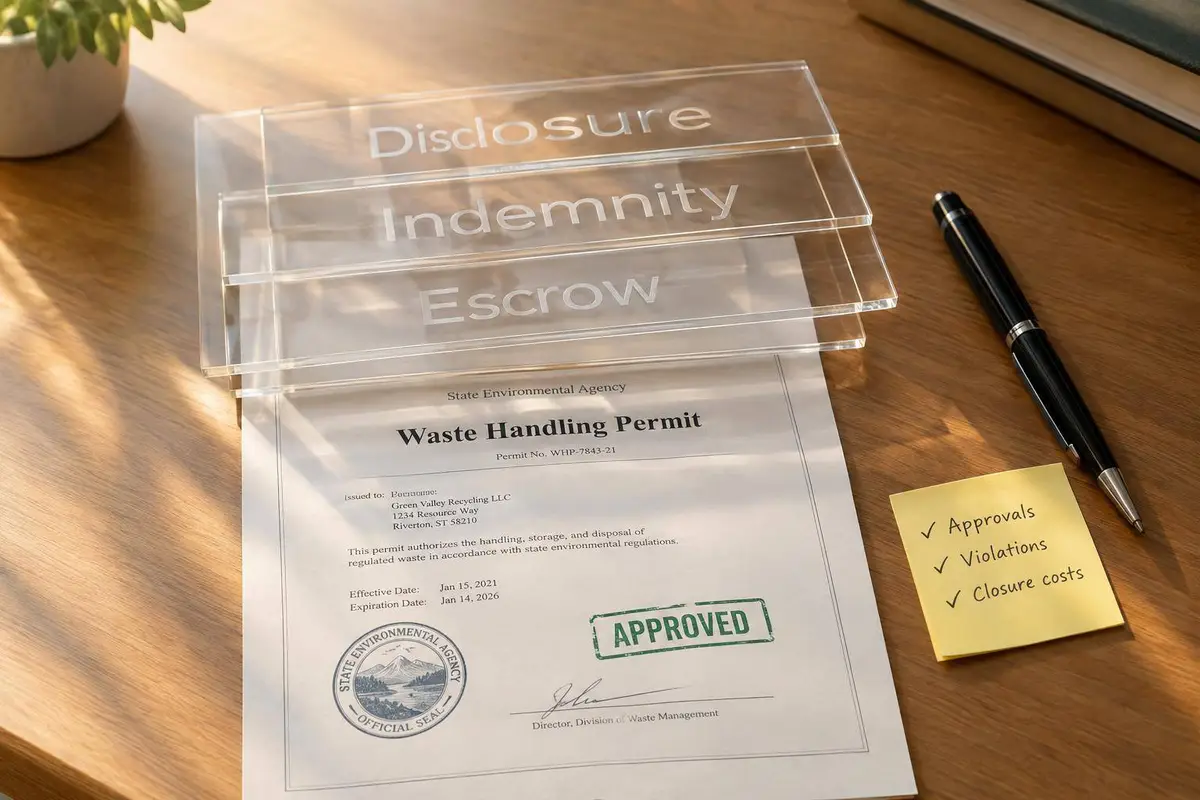
A waste permit transfer does not erase past liability. I’d start by checking agency approval requirements, unresolved violations, and closure costs - then use those findings to set the price, seller duties, and closing conditions.
For certain RCRA transfers under 40 C.F.R. § 270.40(b), the revised application is due at least 90 days before the planned transfer. That is a filing deadline, not an approval guarantee.
Here’s what I’d check before you close:
- Deal structure: How an asset purchase, equity purchase, merger, or change in control affects permit requirements.
- Liability and funding: Which past violations, cleanup costs, and closure duties need seller payment, price adjustments, or separate funding.
- Seller protections: What disclosures, indemnities, escrows, and holdbacks cover - and whether the seller can pay.
- The handoff: Who handles approval, financial assurance, records, reporting, and work after closing.
My bottom line: <u>contract terms divide costs between buyer and seller; they do not limit agency enforcement.</u> Confirm the transfer process with counsel and the permitting agency before setting the closing date.

Waste Permit Transfer: From Liability Review to Closing
Compliance Review and Closure Costs
Review Records and Enforcement History
Request the facility’s permits, amendments, renewals, applications, transfer correspondence, inspection reports, NOVs, orders, corrective-action plans, manifests, logs, sampling data, incident reports, claims, lawsuits, and complaints. Include records for any related entities tied to site liability.
The goal is clear: identify what the seller must disclose, what the buyer must fund, and what must block closing. Confirm which federal, state, and local agencies have jurisdiction, then search their public enforcement databases. Organize records by permit number, date, agency, affected unit, violation, response, and current status.
Compare seller disclosures with agency records and site conditions. Separate paperwork problems, such as late reports or incomplete renewal forms, from material issues such as waste handling without required authorization, improper storage, releases, or contamination.
Require proof that each matter is resolved. That might be a regulator’s written closure letter, final agency order, approved corrective-action completion report, amended permit, or correspondence expressly confirming that no further action is required. Paying a fine or submitting a response does not necessarily close the matter. Use the following as deal screens, not agency findings.
| Deal assessment | Supporting findings | Transaction response |
|---|---|---|
| Acceptable | Minor, fully corrected paperwork issues with no material cost, operating restriction, permit risk, or unresolved agency concern | Retain supporting records |
| Acceptable with conditions | Issues that can be addressed through a written corrective-action plan, agency acknowledgment, or a post-closing operating covenant | Require seller-funded work, escrow, written agency clarification, or another enforceable condition |
| Block closing | An unresolved violation or release that could prevent permit transfer, suspend operations, trigger material cleanup liability, require unavailable financial assurance, restrict financing, or create exposure that cannot be reasonably bounded before closing | Do not close until the exposure and required approvals or funding are resolved |
Carry unresolved items into the closure-cost and financial-assurance analysis.
Verify Closure Costs and Financial Assurance
Use the enforcement review to distinguish paperwork risk from cleanup obligations that need funding. Those obligations shape the price, escrow, and indemnity scope.
Review closure, post-closure, corrective-action, and cleanup obligations separately. Check estimates against contractor bids, waste volumes, monitoring needs, and possible off-site impacts. Closure estimates should generally reflect third-party costs and receive annual inflation updates. Post-closure estimates commonly cover 30 years, subject to agency adjustment.
Check each assurance instrument’s amount, expiration, cancellation terms, collateral requirements, and agency acceptance. Closure funding does not cover all historical contamination.
Make notice, the transfer agreement, and the financial-assurance handoff part of the closing checklist. Confirm the exact federal, state, and permit-specific procedures, including approval, application, timing, and disclosure requirements. A contract can allocate risk between buyer and seller, but it cannot replace agency approval or remove regulatory duties.
Use Findings to Set Price and Funding Terms
Maintain a risk register with each issue, source documents, estimated exposure and uncertainty range, responsible party, required evidence, deadline, and financing impact. Seek written agency clarification when an issue’s status is unclear.
Model cleanup spending, long-term monitoring, assurance collateral, and lost operating capacity separately. Each can reduce value, borrowing capacity, or available working capital.
Keep deal reserves separate from regulator-required assurance. Avoid counting the same exposure more than once through price adjustments, escrow, and seller-funded work. When exposure or required coverage is unbounded, do not rely on seller indemnity alone.
Use the risk register to draft seller disclosures, indemnities, and escrow triggers.
sbb-itb-a3ef7c1
Seller Disclosures, Indemnities, and Escrows
Define Seller Representations and Disclosures
Turn the risk register into contractual disclosures, indemnities, and escrows. Use separate representations for permit status, compliance history, enforcement matters, waste activities, releases, cleanup, closure and post-closure duties, financial assurance, insurance, and record accuracy.
Disclosure schedules should identify each issue by permit, location, date, status, and supporting document. A data-room reference alone isn't enough. Require the seller to identify missing records, certify accuracy at closing, and state whether each disclosed matter remains covered by a specific indemnity.
Define whose knowledge counts - for example, facility managers, environmental personnel, and outside consultants. Specify whether the standard is actual knowledge, constructive knowledge, or knowledge after reasonable inquiry by named individuals. Dollar-based materiality thresholds shouldn't exclude a permit lapse or unresolved order. Require updates through closing and spell out what follows: correction, additional security, a closing condition, or termination rights.
Link each risk to a contract requirement. Tie transfer defects to approval conditions and open violations to indemnities and remediation. Connect closure or post-closure shortfalls to cost estimates, escrows, release conditions, and performance covenants. Each provision should name the responsible party, deadline, proof of completion, and remedy.
Allocate Pre-Closing Liability
Base coverage on when the conduct or condition occurred. Cover pre-closing violations, legally indemnifiable penalties, contamination, corrective action, closure exposure, inaccurate disclosures, and missing records. Include later agency orders arising from earlier conditions. Use indemnities and escrow for pre-closing exposure, and covenants for post-closing operating compliance.
Define covered losses to include investigation, testing, consultants, reasonable legal fees, emergency work, and required remediation. Separate known matters from unknown liabilities. Match survival periods to the risk and applicable law, and negotiate higher caps or exceptions for known violations, required closure work, fraud, and intentional concealment. Baskets shouldn't delay urgent work or defeat specifically allocated obligations.
Set clear rules for notice, defense, settlement, access, and cooperation. Late notice shouldn't automatically defeat recovery unless it causes material prejudice. Without required buyer and agency approval, seller-controlled settlements shouldn't admit buyer liability, restrict operations, affect permits, or impose nonmonetary duties.
Preserve buyer control over urgent agency responses. For losses with both pre- and post-closing causes, agree on allocation rules or a technical expert process. An indemnity does not bind regulators or suspend required work and agency deadlines.
Use these allocations to set escrow and holdback amounts and release conditions.
Compare Contract Protections and Payment Security
| Protection | Deal problem addressed | Main limitation | Drafting focus |
|---|---|---|---|
| Representations | Establish permit, compliance, and record accuracy | Knowledge, materiality, disclosure, and survival limits | Specific schedules, evidence, and accuracy at signing and closing |
| Indemnities | Allocate pre-closing losses and remediation costs | Caps, baskets, exclusions, and seller solvency | Known matters, later orders, covered costs, and claim control |
| Escrows | Secure payment for identified or estimated risks | Fund size, release dates, and claim disputes | Documented exposure, contingency, inflation, and objective release conditions |
| Holdbacks | Retain purchase funds pending performance | Seller liquidity and completion disputes | Completion evidence, agency acceptance, transfer, or closure documentation |
| Purchase price adjustments | Reflect known risk in transaction value | Do not fund overruns or replace regulator approval | Valuation assumptions and no duplicate recovery |
Size escrow and other payment security based on documented exposure and seller creditworthiness. Set evidence-based release conditions, reserve funds for disputed claims, and define acceptable replacement security. A purchase-price escrow does not replace regulator-required financial assurance or separate permit-transfer approval requirements. These terms should match the approval conditions and handoff duties in the closing checklist.
Ready to Make Your Next Move?
Whether you're buying, selling, or investing — Clearly Acquired gives you the tools, data, and support to close with confidence.
Closing Conditions and Post-Closing Duties
Set Approval Conditions and Transfer Duties
Once seller terms are set, tie them to the permit-transfer timeline. Treat economic closing, operational control, and the permit-effective date as separate milestones. Make closing conditional on the approval, modification, reissuance, or acknowledgment the applicable program requires.
Keep submitted applications or notices, agency correspondence, approval letters, the transfer agreement, and written confirmation of the effective transfer date. Align closing with the agency’s required transfer filing and effective date. Check for stricter state deadlines.
Align lender funding, insurance, financial assurance, and possession with that effective date. Cover any assurance gap with accepted replacement coverage or an agency-authorized transition arrangement. The former owner remains responsible until replacement assurance is accepted.
Set an outside date and clear rights to delay or terminate the deal if approval is denied, delayed, or comes with material conditions. Any temporary seller operation needs agency authorization - permission in the contract alone isn’t enough.
Prepare Buyer, Seller, and Closing Checklists
Turn the negotiated duties into specific closing tasks.
- Buyer checklist: Verify permit status, transfer approval, effective and expiration dates, operating limits, open violations, closure funding, lender requirements, and funded escrow.
- Seller checklist: Deliver indexed records, signed transfer documents, updated disclosures, compliance calendars, and access to systems and records.
- Closing certificate: Record the permit number and status, agency approval, effective date, financial-assurance evidence, lender insurance and covenants, open violations and corrective-action items, closure obligations, escrow-release conditions, pending reports, waste inventories, and responsibility for pre-closing waste processed after closing.
Attach a responsibility schedule that names an owner, deadline, proof of completion, and remedy for each task. Include waste acceptance, manifests, inspections, monitoring, reporting, corrective action, agency meetings, personnel access, and access to historical records.
Send required notices on closing day without changing applicable regulatory deadlines. Identify the documents required for each escrow release.
Conclusion: Match Seller Terms to Regulatory Duties
Verify transfer requirements early. Use compliance records, unresolved violations, and closure obligations to shape disclosures, indemnities, escrows, and closing conditions. None of these replaces agency approval or transfer duties. Contract terms allocate costs; regulators control the permit and its requirements.
FAQs
What if contamination is discovered after closing?
If contamination turns up after closing, representations and warranties may give buyers a way to recover losses from undisclosed liabilities. Escrows can cover costs, while indemnities require sellers to compensate buyers for specified losses - but recovery depends on the sellers’ ability to pay. Compliance records, unresolved violations, and closure obligations help determine how these protections are written.
These contract terms assign financial responsibility - not regulatory duties. Buyers must still meet applicable licensing, safety, and environmental closure requirements, regardless of what the contract says.
How much environmental escrow should I require?
Set the escrow holdback based on potential liabilities found during due diligence. Review compliance history, unresolved violations, cleanup orders, and closure obligations. Check permit status and EPA communications to guide seller disclosures, warranties, and indemnities.
Escrow provides security for unresolved liabilities. Indemnities spell out how the buyer and seller divide defined losses. Neither changes duties owed to regulators or statutory requirements for transferring permits.
What if permit approval adds unexpected costs?
Sellers must disclose compliance records, unresolved violations, and closure obligations that could lead to added costs. Buyers can address these risks through representations and warranties in the purchase agreement, indemnification clauses, or escrow holdbacks. Escrows typically cover immediate, high-risk liabilities, while indemnities address broader or less certain long-term risks.
These protections divide costs between the buyer and seller. They do not change either party’s duties to regulators, who can enforce compliance regardless of private agreements.
Related Reading
About the author
Principal & CEO/CIO
Samson Jagoras has 15+ years across finance, real estate, and business acquisitions. He began his career as a Futures & Commodities broker and later served as Chief Strategy Officer of an INC 500 marketing and technology firm, helping scale revenue from $1M to over $100M. Today he buys, builds, and advises a portfolio of companies with a focus on M&A, capital allocation, and operational strategy.