Virginia Consumer Data Protection Act: SMB Deal Guide
Acquiring customer data without VCDPA checks creates legal risk—use a checklist to map coverage, preserve rights, and secure transfers.
 Samson JagorasPrincipal & CEO/CIOOctober 16, 2026
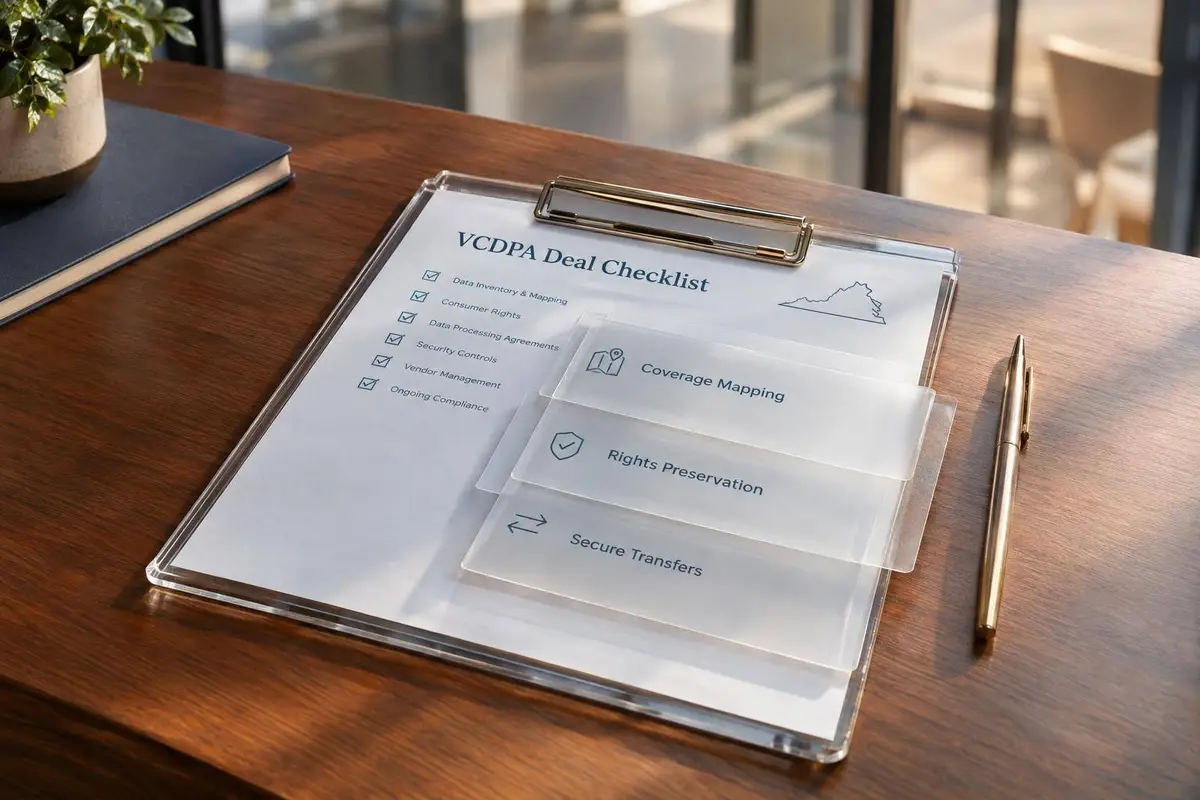
Buying customer data does not mean you can use it however you want. Before signing an SMB deal, I’d check VCDPA coverage, confirm permitted uses, and assign responsibility for requests still open at closing.
Coverage generally starts at 100,000 Virginia consumers per calendar year, or 25,000 consumers plus more than 50% of gross revenue from personal-data sales, subject to exemptions.
Here’s the deal checklist I’d use:
- Check coverage and roles: Assess buyer and target separately, then identify who controls each dataset.
- Review data limits: Check notices, consents, contracts, opt-outs, security gaps, and pending requests.
- Set deal terms: Tie restrictions and repair costs to price, closing conditions, escrow, and indemnities.
- Control the handoff: Transfer only approved records through secure channels, with permissions and request logs.
- Keep Day 1 duties intact: Preserve consumer choices and original deadlines. Requests generally require a response within 45 days.
- Finish integration: Use the first 90 days to complete remaining work - not delay compliance. Attorney General enforcement can bring penalties of up to $7,500 per violation.
My bottom line: the acquisition-transfer exception is not permission for every later use. <u>Check before combining databases, cross-selling, or starting new advertising.</u>

VCDPA SMB Acquisition: From Diligence to Day 90
Check VCDPA Coverage and Data Roles
Check Consumer Thresholds and Exemptions
Check whether the target falls under the VCDPA and what exposure the buyer will take on after business purchases. Track the target’s and buyer’s coverage separately. Count Virginia residents acting in an individual or household context, leave out employee and business contacts, and document how you calculated the totals.
| Coverage trigger or exclusion | Evidence to request | Deal relevance |
|---|---|---|
| Virginia business activity or resident targeting | Virginia sales, customer addresses, targeted campaigns | Establishes the Virginia nexus |
| At least 100,000 consumers in a calendar year | Deduplicated calendar-year consumer counts | Tests the main coverage threshold |
| At least 25,000 consumers and more than 50% of gross revenue from personal-data sales | Consumer counts, revenue ledger, data-sale agreements | Both conditions must be met |
| Employment or commercial contacts | HR and B2B classifications | Keeps excluded contacts out of the count |
| Entity exemption | GLBA, HIPAA, nonprofit, higher-education, or government status | May exempt the entity |
| Data-level exclusion | Data inventory, federal-law classifications | May exclude specific records without exempting the business |
An entity exemption is not the same as a data-level exclusion. Serving a regulated client does not exempt the vendor, and combining databases after closing can change coverage. Once you confirm coverage, identify who controls the data and who must respond after closing.
Identify Controllers, Processors, and Successors
Determine who will decide how data is used after the deal. That decision shapes notice changes, assignment needs, and responsibility for consumer requests. Personal data means information linked or reasonably linkable to an identifiable individual. Information found online is not automatically public, and removing names alone does not make data deidentified.
| Issue | Equity purchase | Asset purchase or merger | Documents to check |
|---|---|---|---|
| Decision authority | Entity usually retains control | Buyer or survivor may assume control | Purchase agreement, governance documents |
| Processor duties | Existing agreements generally continue, subject to their terms | Assignment, amendment, or replacement may be needed | Processing agreements, assignment clauses |
| Consumer-facing identity and uses | Entity may stay the same while practices change | Recipient entity, brand, or purposes may change | Privacy notices, customer terms, transition-services agreement |
| Transition responsibilities | Confirm continuing request and vendor duties | Allocate transferred and retained duties | Transition-services agreement, closing schedules |
Classify each activity by who actually decides its purpose and means, not by the contract label. A target may control its own customer records while processing client data under a controller’s instructions.
Processor agreements should spell out instructions, data types, duration, and each party’s obligations. These include help with consumer requests, security, breach duties, and data-protection assessments. Share ownership alone does not make the parent the controller. These roles determine whether closing documents need to assign, amend, or replace existing data obligations.
Separate Acquisition Transfers From Data Sales
Separate the acquisition transfer from any later secondary use. The VCDPA’s definition of a sale excludes personal-data transfers made as part of a merger, acquisition, bankruptcy, or similar transaction when the recipient assumes control of all or part of the controller’s assets.
Document the transfer’s connection to the transaction, limit diligence access to what is necessary, and preserve confidentiality. The exclusion does not override other duties: assignment restrictions, privacy promises, confidentiality duties, security obligations, and purpose limits still apply. Review later licensing, advertising, enrichment, and unrelated analytics separately rather than treating them as approved closing uses.
sbb-itb-a3ef7c1
Review Customer Data and Transfer Limits
Map Data, Permissions, and Contracts
Use the coverage and role analysis to check each dataset’s transfer limits. Build a record-level inventory of customer and prospect records, loyalty records, support tickets, analytics, location data, payment data, marketing lists, call recordings, and vendor-held records. For each dataset, document its source, purpose, Virginia-resident volume, retention period, recipients, and access permissions. Identify who controls it and who may continue processing it after closing.
Compare actual use with privacy notices, consent logs, and contract limits. Link each dataset to the exact notice, consent, and contract terms that govern its transfer and use. Review assignment and change-of-control clauses, processor agreements, and required data-protection assessments. Verify affirmative consent for sensitive-data processing, including data from a known child under 13.
Review data in stages rather than exporting the full customer database. Start with aggregate metrics: customer counts, retention, churn, and revenue concentration. Next, provide redacted samples. Limit access to needed identifiable records to approved reviewers, with multifactor authentication, download controls, access logs, and expiration dates. Use masked or tokenized identifiers for limited-field reviews.
An NDA protects confidentiality - it does not grant processing rights. Add purpose limits, no-contact rules, copying limits, incident-reporting duties, and return-or-deletion terms.
Test Consumer Rights and Data Security
Once the data is mapped, test which requests and controls must carry through closing. Trace open access, correction, deletion, portability, and applicable targeted-advertising, sale, and profiling opt-out requests from receipt through fulfillment. Check authentication, processor follow-through, suppression lists, denial notices, and appeals.
The standard deadline is 45 days. One 45-day extension requires notice and a reason. Appeals require a written response within 60 days. Give every request still open at closing a named owner and keep its original deadline - closing does not restart the clock.
Identify unresolved security issues and controls that must stay effective during the transfer. These include revoking access for departing employees and replacing shared administrator accounts. Assess incidents on two separate tracks: VCDPA compliance and breach-notice duties. Assign responsibility for investigations, notices, and remediation that remain open after closing. Obtain evidence of remediation, not just a statement that an incident is resolved.
Use Findings to Set Price and Closing Terms
Turn each restriction, request failure, and security gap into a pricing or closing term. Classify each issue by type, severity, scope, cost, and cure status. Assign an owner and a remediation deadline.
Price usable records, not raw record counts. Restricted data may justify a price reduction or exclusion. Required permissions or security fixes may warrant closing conditions. Known liabilities may call for escrow or specific indemnities, while integration reserves can fund deletion workflows, consent remediation, system segregation, and vendor changes.
Set Deal Terms and Plan the Data Transfer
Use the diligence findings to choose the deal structure, set closing protections, and plan the data transfer.
Compare Asset Purchases, Equity Purchases, and Mergers
Deal structure changes who controls the data - not the VCDPA limits on its later use. Certain acquisition transfers fall outside the VCDPA’s definition of a sale when the buyer assumes control of the assets. But that exception does not override privacy promises, opt-outs, or downstream processing limits. An acquisition does not automatically require new consumer consent.
| Structure | Post-close controller | Key transfer issue | Counsel review points |
|---|---|---|---|
| Asset purchase | Buyer may control acquired data; seller retains its entity. | Define acquired records, exclusions, recipients, and assigned contracts. | Successor liability; notices, consents, assignments, vendor approvals. |
| Equity purchase | Target remains controller unless decision authority changes. | Review new buyer or affiliate access. | Historical compliance, open requests, incidents, inquiries, notice accuracy. |
| Merger | Surviving entity, depending on structure. | Confirm inherited duties and database-combination limits. | Notices, consents, vendor approvals, processor amendments, inherited liabilities. |
Once the structure is set, turn the privacy findings into representations, covenants, and closing conditions.
Set Contract Protections and Closing Requirements
Require privacy representations backed by disclosure schedules that document unresolved diligence issues. Add interim covenants and closing conditions, with limits on material changes to privacy practices before closing. Tie known gaps to remediation duties and negotiated remedies, including notice, control, and cure procedures and survival periods. A broad compliance warranty alone is not enough.
- LOI: Identify customer data as a material asset, establish controlled diligence access, and reserve adjustments for material privacy findings.
- Diligence requests: Collect support for the representations: applicability and exemptions, dated notices, requests and appeals, consent and permissions, advertising and data sales, sharing arrangements, processor agreements, assessments, incidents, and regulator correspondence.
- Purchase agreement: Schedule included and excluded datasets, limit disclosures to transaction purposes, allocate historical liabilities and post-close cooperation, and specify remediation and closing conditions.
- Transition-services agreement: Define seller services, processing roles, authorized personnel, request routing, incident reporting, audit rights, and return or deletion requirements.
- Closing deliverables: Require the approved inventory, permissions and request records, processor list, incident handoff, transfer confirmation, and evidence that required notices, consents, and vendor approvals have been addressed.
Contract terms do not replace statutory duties. Indemnities cannot authorize prohibited processing, and seller processing during the transition requires controller–processor terms.
After signing, transfer only approved data on a controlled schedule.
Transfer Required Data Securely
Create a transfer schedule that names each included and excluded dataset, recipient entity, purpose, restriction, retention period, and responsible owner. Keep consumer rights, request handling, and security ownership in place throughout the handoff to the buyer.
Use an approved, encrypted transfer channel with role-based access, multifactor authentication, temporary credentials, and logs. Keep transition access separate from live production access. Include consent records, open requests, processor lists, and assessments with the transfer file, and carry forward opt-outs and pending appeals.
Before enabling routine access, reconcile source and destination counts, check file integrity, and obtain sign-off from privacy, security, and business owners.
Address seller-retained copies directly. Separate copies used for business operations from those retained for legal reasons, prohibit new commercial use, and set deletion dates. Specify backup isolation and rotation schedules rather than promising immediate deletion that the systems cannot support.
Rotate transferred credentials. Give transition staff separate, limited accounts and revoke access as their services end. Obtain evidence of return, deletion, or restricted retention when the law requires keeping the data.
Ready to Make Your Next Move?
Whether you're buying, selling, or investing — Clearly Acquired gives you the tools, data, and support to close with confidence.
Meet the Buyer’s Post-Closing Duties
Day 1: Preserve Consumer Rights and Permitted Uses
After closing, manage the acquired data according to the transferred inventory until each use has been revalidated. On Day 1, assign an owner to each transferred database and keep every pending request on its original deadline. Confirm controller and processor roles. Use the transferred request log to keep request and appeal channels working. Controllers generally must respond within 45 days, subject to permitted extensions. Preserve consent evidence, opt-outs, suppression records, and workflows for access, correction, deletion, and portability.
Before combining databases, cross-selling, or launching advertising, check the target’s privacy notice, consent records, contracts, and stated purposes against the buyer’s planned uses. Expand use only when the notice, consent, and contract terms support it. Pause unsupported uses, obtain required consent, and update notices as needed. An updated notice alone does not replace required consent.
First 90 Days: Complete Privacy Integration
Once Day 1 controls are stable, work through the remaining privacy integration tasks. The first 90 days are for completing integration - not postponing compliance.
- Days 1–30: Reconcile inherited notices, retention, access, and vendors.
- Days 31–60: Fix processor contracts, covering instructions, data types, duration, deletion or return, subcontractors, and assessment support. Fix contract defects that affect lawful processing immediately.
- By day 90: Test deletion and opt-out propagation, incident escalation, vendor oversight, and staff training. Remove obsolete access and document backup retention limits.
Review material processing changes. Before launching higher-risk processing - such as targeted advertising, sensitive-data processing, or certain profiling - complete any required data protection assessment.
Assign Owners and Plan for Enforcement
Name a privacy owner and set separate escalation paths for consumer requests, incidents, and regulator inquiries. The Virginia Attorney General has exclusive VCDPA enforcement authority. The statute provides a conditional 30-day notice-and-cure process. Uncured violations may lead to civil penalties of up to $7,500 per violation, and the VCDPA does not provide a private right of action. Retain evidence of remediation.
Conclusion: Buyer’s VCDPA Deal Checklist
Turn diligence findings into closing deliverables and Day 1 controls. The acquisition-transfer exception does not erase post-closing duties.
Use this checklist as the closing and Day 1 record. The deal milestones are not statutory deadlines; consumer-response and cure periods are noted separately. Assign a named owner to each item and keep supporting evidence in the deal file.
| Action | Required evidence | Owner | Deadline |
|---|---|---|---|
| ☐ Confirm VCDPA coverage, exemptions, and thresholds | Threshold analysis, exemption memo, Virginia-data estimate | Buyer’s privacy counsel | Before signing; update before closing |
| ☐ Map controller, processor, affiliate, and vendor roles | Role matrix and processing inventory | Privacy lead and IT lead | Before closing |
| ☐ Confirm transfer rights and permitted uses | Asset schedule, privacy notices, consents, opt-out and deletion logs | Deal counsel and privacy lead | Before closing |
| ☐ Review security and unresolved privacy issues | Security assessment, incident log, remediation tracker | CISO or IT lead | Before closing |
| ☐ Add representations, indemnities, escrow, and cooperation terms | Executed purchase agreement and disclosure schedules | Transaction counsel | Before signing/closing |
| ☐ Execute controlled data handoff | Transfer manifest, access logs, encryption record, deletion certificate | IT/security lead | Closing |
| ☐ Preserve Day 1 rights and permitted uses | Day 1 processing rules, opt-out suppression list, deletion workflow | Buyer privacy lead and marketing lead | Day 1 |
| ☐ Respond to consumer requests | Request logs and response records | Privacy operations owner | 45 days; one permitted 45-day extension; 60 days for appeals. |
| ☐ Complete privacy integration | Updated notices, contracts, systems, training, retention schedule, rights-request workflow | Buyer privacy lead | Days 1–90 |
| ☐ Keep enforcement readiness current | Compliance file and remediation log | Buyer legal and privacy teams | Keep current; 30-day cure period after Attorney General notice. |
FAQs
Could combining customer databases trigger VCDPA coverage?
Before combining customer databases after an acquisition, review the seller’s privacy commitments and VCDPA obligations. Check whether the original privacy notices permit your planned post-closing use of the data. Broader uses may require customers’ affirmative opt-in consent.
During due diligence, map customer data and review vendor contracts. Update privacy policies, limit system access, and spell out liability and remediation duties in the purchase agreement.
Can I use acquired data if consent records are missing?
Before using acquired data, verify the legal right to transfer it and review existing privacy notices. Under the VCDPA, buyers must honor existing privacy commitments. You cannot retroactively change how customer data is used without explicit customer consent.
Before closing, check that privacy notices match your planned use. If they don’t, prepare updated notices or obtain new consent. After closing, limit data access to what’s needed for Day One operations.
Could I inherit the seller’s VCDPA violations?
Privacy obligations and data-use limits still apply when ownership changes. Buyers must review the seller’s privacy notices, processor lists, retention schedules, and role as a controller or processor to spot compliance gaps. Using data in ways that differ from the seller’s privacy policy typically requires affirmative opt-in consent.
Confirm the right to transfer data before any transfer takes place. After closing, limit system access, update privacy notices, and formalize any transition service agreements.
Related Reading
About the author
Principal & CEO/CIO
Samson Jagoras has 15+ years across finance, real estate, and business acquisitions. He began his career as a Futures & Commodities broker and later served as Chief Strategy Officer of an INC 500 marketing and technology firm, helping scale revenue from $1M to over $100M. Today he buys, builds, and advises a portfolio of companies with a focus on M&A, capital allocation, and operational strategy.