Seller Phase I Reports: Buyer Reliance Documentation
Checklist to confirm a seller Phase I ESA covers your deal, secure written reliance, verify timing/changes, and record closing actions.
 Samson JagorasPrincipal & CEO/CIOOctober 13, 2026
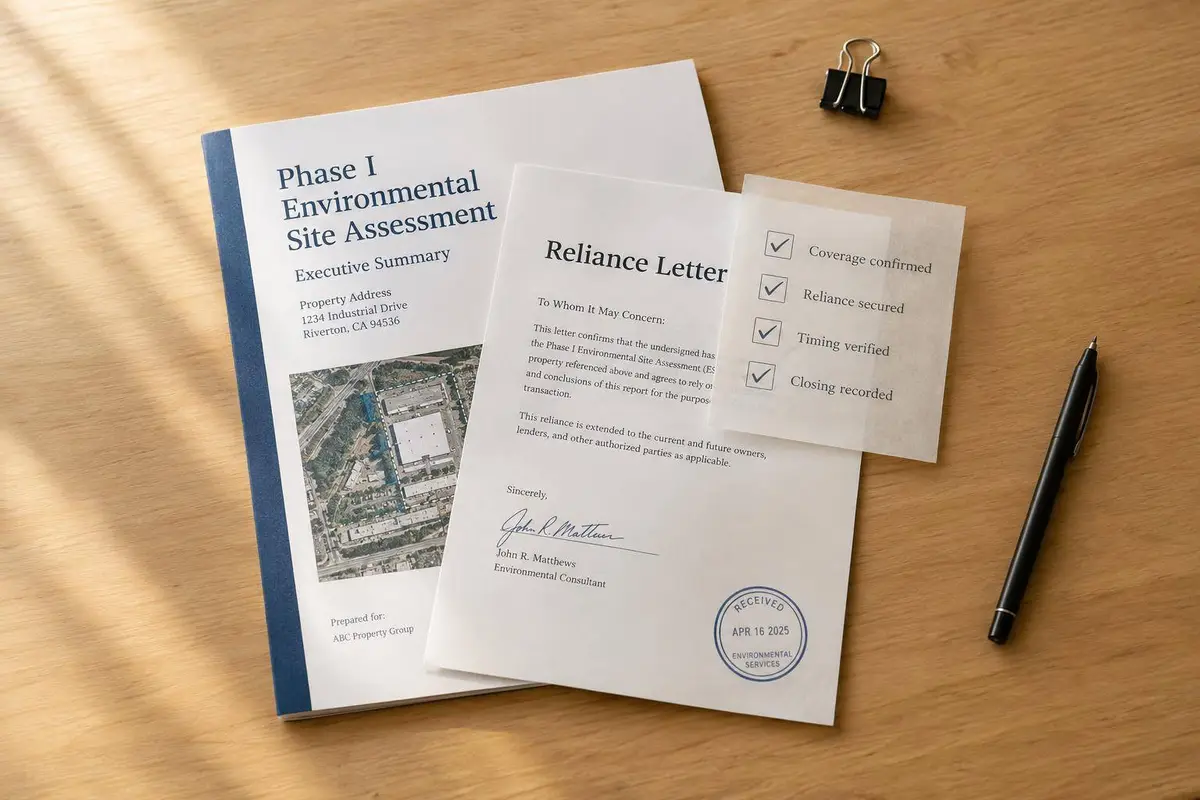
I don’t treat a seller’s Phase I report as permission to rely on it. Before closing, I check that it covers your purchase, get the consultant’s written consent, and confirm that the work is still current.
My checklist covers four steps:
- Check scope: Match the report to the property you’re buying, review findings and gaps, and document your buyer duties.
- Get written permission: Name the buyer and other relying parties, identify the report version, and have counsel review fees and liability terms.
- Check dates and changes: AAI generally has a one-year limit before acquisition; five required components have a 180-day limit. A reliance letter does not reset either clock. Ask the consultant whether updates or more testing are needed.
- Keep the closing record: Save the report, consent, date checks, disclosures, and follow-up decisions. Confirm lender requirements and assign post-closing duties.
<u>Permission, report quality, and legal protection are separate checks.</u> I would not treat written reliance alone as proof of CERCLA protection.

Seller Phase I Reports: 4 Buyer Reliance Checks
How Long Is a Phase I ESA Actually Good For? When Does It Expire? | Resource Management Associates

sbb-itb-a3ef7c1
Step 1: Check the Seller’s Report Scope
Start with scope. Reliance only works if the report covers the deal.
Get the full report package: appendices, maps, photographs, regulatory records, historical research, reliance letters, and later amendments. Record the client, consultant, environmental professional, report title, project number, date, revision number, intended users, and stated purpose. Confirm that the report identifies ASTM E1527-21 and states whether it was prepared to meet federal AAI requirements under 40 C.F.R. Part 312.
Check Property Coverage and Investigation Details
Compare the report’s property description with the purchase agreement, title commitment, survey, tax parcels, site plan, and leases. Check the street address, parcel identification numbers, legal description, acreage, boundaries, buildings, leased areas, easements, access areas, and operational areas.
Keep the subject property separate from the adjoining-property review. If the report covers only part of the acquisition, require written clarification or supplemental work before relying on it.
Use the log below to track dates and missing items. Confirm that the environmental professional’s qualifications and required declaration are included. Ask for an explanation of any inaccessible areas or incomplete research.
Check component dates - not just the cover date. Interviews, records reviews, the site inspection, and the environmental lien search generally must be dated within 180 days of closing. The remaining AAI components generally must be completed within one year.
| Component | Report location | Completion date | Buyer review status |
|---|---|---|---|
| Property description, parcels, and boundaries | Executive summary; site description; figures | MM/DD/YYYY | Confirmed / Issue noted |
| Records and historical-source review | Records and historical research sections | MM/DD/YYYY | Confirmed / Issue noted |
| Interviews with owners, operators, and occupants | Interviews section; appendices | MM/DD/YYYY | Confirmed / Issue noted |
| Site and adjoining-property inspection | Site reconnaissance section; photographs | MM/DD/YYYY | Confirmed / Issue noted |
| Environmental cleanup-lien search | User-responsibility or lien-search section | MM/DD/YYYY | Confirmed / Issue noted |
| Environmental professional declaration and qualifications | Certification; signature page | MM/DD/YYYY | Confirmed / Issue noted |
| RECs, CRECs, HRECs, and data gaps | Findings and conclusions section | MM/DD/YYYY | Confirmed / Issue noted |
Review Findings and Buyer Duties
These findings help the buyer decide whether to rely on the report or request more diligence:
- REC: A likely release or threatened release.
- CREC: A past release subject to activity-and-use limitations or other controls.
- HREC: A past release closed to regulator satisfaction with no required controls.
- Data gap: Missing information that prevents a conclusion.
Review exclusions and restrictions separately. A Phase I usually excludes soil, groundwater, vapor, or building-material sampling. Asbestos, lead-based paint, mold, radon, wetlands, and compliance issues often require separate work.
The buyer should also document its own AAI user responsibilities. These include specialized environmental knowledge, environmental cleanup liens, activity-and-use limitations, commonly known or reasonably ascertainable information, and whether the purchase price appears below uncontaminated fair market value.
Verify deed restrictions, caps, groundwater-use limits, monitoring obligations, and other controls before accepting them. Seller responses can support this review, but they do not replace the buyer’s independent obligations.
Step 2: Get Written Reliance Permission
Once the report scope matches the deal, get the consultant’s written permission. Request a signed reliance letter, assignment, or addendum before waiving diligence or closing on the report. ASTM E1527-21 does not transfer reliance rights on its own. Keep that authorization in the buyer’s closing file.
Identify Authorized Parties and Report Versions
Give the consultant the buyer’s legal name, acquisition entity, property address, report date, report number, and all parties that need reliance rights. Name every relying party up front, including the lender, investors, affiliates, successors, and assigns. The authorization must cover the acquisition entity and any lender-required users.
Ask the consultant to specify which revisions, updates, and addenda the authorization covers. If the original client must submit the request, keep a written approval trail connecting it to the consultant’s signed authorization. That authorization must name the buyer and identify the covered report.
A seller’s permission email is not enough unless the consultant’s contract expressly allows the transfer and counsel confirms that provision applies. Once you know who may rely on the report, review the terms.
Review Reliance Terms and Consultant Duties
Read the authorization alongside the consultant’s engagement agreement. The buyer needs direct rights to use the report for financing and closing, including its opinions and conclusions - not just its factual contents. Confirm whether the consultant is affirming the original work rather than performing a new assessment. A reliance letter alone does not create a new assessment.
| Term | What to check | Acceptable when… |
|---|---|---|
| Authorized parties | Named or clearly covered users | The acquisition entity and all required users are covered |
| Scope | Opinions, conclusions, exclusions, and permitted uses | Coverage meets acquisition and financing needs |
| Report version | Title, date, revision number, addenda, and updates | Authorization matches the closing-file report |
| Liability | Direct duties, standard of care, liability cap, and exclusions | Terms fit property risk and lender requirements |
| Expiration | How long reliance lasts and whether it survives transfer | Rights cover closing and any required transfer |
Before accepting the authorization, have counsel review the consent fee, governing law, venue, dispute resolution, and attorney-fee provisions. For any liability cap, check whether it applies per claim, per occurrence, or across all users. Also confirm whether payments to other relying parties reduce the amount available to you.
Resolve signatures, fees, and consent conditions before closing. If the consultant will not provide clear written reliance, treat the report as non-reliance material. Next, check investigation timing and property changes.
Ready to Make Your Next Move?
Whether you're buying, selling, or investing — Clearly Acquired gives you the tools, data, and support to close with confidence.
Step 3: Check Report Timing and Property Changes
Check Investigation Dates Against Closing
Once reliance rights are in place, confirm that the report will still be current at closing. Calculate timing from the expected acquisition date - not the report’s cover date. Start the 180-day window with the earliest of the five required component dates.
EPA’s All Appropriate Inquiries (AAI) generally must be conducted or updated within one year before acquisition. Five components must be completed or updated within 180 days before acquisition: interviews with owners, operators, and occupants; environmental cleanup-lien searches; government-record reviews; visual inspection of the property and adjoining properties; and the environmental professional’s declaration. A reliance letter does not restart these periods.
Ask for a written component date log and the consultant’s determination of which updates are needed. Keep the acquisition-date calculation in the closing file, and reassess it if the deal structure or closing date changes. Meeting these deadlines may not be enough: lenders, investors, and insurers may require newer or additional work.
Record Changes Since the Investigation
If the dates check out, review what has changed at the property since the investigation. Obtain updated seller disclosures for changes that could affect recognized environmental conditions, historical conclusions, or the reliability of the site inspection. Group those changes into:
- Operations: Tenancy, industrial activities, chemical or fuel storage, and spills or releases.
- Physical changes: Construction, demolition, tanks, drainage systems, and adjoining or nearby property conditions.
- Regulatory events: Inspections, notices, violations, enforcement actions, and cleanup demands.
- Controls: Remediation, monitoring, sampling, and activity-and-use limitations.
Record the disclosure date and source, along with supporting documents, photographs, permits, agency correspondence, and access restrictions. Send this change package to the environmental professional for an updated conclusion on whether the report still supports buyer reliance.
Decide Whether More Work Is Needed
Use the timing and change review to decide whether to rely on, update, or replace the report. Ask the environmental professional to recommend the next step based on timing, current conditions, and unresolved findings - not report age alone.
| Finding | Buyer reliance action |
|---|---|
| Timing is current; scope fits; no material changes or unresolved findings | Reliance without further technical work may be appropriate with written consultant confirmation |
| A required component will fall outside 180 days, but the assessment still supports closing | Update required components and document the current declaration and dates before relying |
| Inquiry is outside one year, changes are major, or scope gaps undermine the assessment | Obtain a new Phase I or consultant-supported replacement assessment |
| A discrete source, missing record, REC, or regulatory issue remains unresolved | Obtain targeted review or investigation before deciding whether to rely; consider Phase II sampling or regulatory consultation if warranted |
| Access restrictions or incomplete disclosures prevent reliable conclusions | Resolve gaps and obtain an update, replacement assessment, or targeted investigation before relying |
A recognized environmental condition (REC) does not automatically require Phase II sampling. The response depends on the available data, regulatory status, exposure pathways, and proposed use. A Phase I generally does not establish contaminant concentrations or the horizontal or vertical extent of contamination. Sampling may be needed to answer those questions.
Step 4 and Conclusion: Complete the Buyer’s Closing File
Keep Reports, Permissions, and Follow-Up Records
Once scope, reliance, and timing are set, assemble one indexed closing file. Keep the full Phase I ESA and appendices, addenda, signed reliance authorization, consultant correspondence, and follow-up records together.
Identify the final report by title, date, report number, address, and parcel numbers. Include property descriptions and maps, questionnaires and seller representations, access and interview records, regulatory searches, photos, and change disclosures.
The file should show how scope, written permission, timing, and change review were resolved, with legal review where appropriate. Attach a closing memo that summarizes the diligence conclusion and any unresolved items. Preserve the facts behind each decision - not just a “complete” checkbox.
Confirm Buyer, Lender, and Investor Requirements
Before signing off, turn unresolved items into a tracked closing checklist. Give each item an owner, deadline, supporting document, and closing decision. Mark each item as:
- Closed.
- Accepted with documented risk acceptance.
- Deferred under a post-closing compliance plan.
- Requiring a closing condition.
Before closing, retain proof of delivery and receipt confirmation from the acquisition entity, lender, and investors.
Reliance permission alone does not create CERCLA protection; AAI is only one requirement. Ask environmental counsel to review the applicable statutory criteria and continuing obligations. These include appropriate care and reasonable steps for hazardous substances, required notices, cooperation and access, land-use restrictions, institutional controls, and responses to government information requests.
Record continuing duties, responsible personnel, and monitoring dates in the post-closing compliance plan. Keep permission, technical sufficiency, timing, and follow-up as separate approvals in the closing file.
FAQs
What if the consultant refuses buyer reliance?
Buyers can’t automatically rely on a seller’s Phase I Environmental Site Assessment. They typically need to request a reliance letter from the consultant who prepared the report.
If the consultant declines, buyers may need to update the report or commission their own assessment. Approval depends on the report’s scope and age, along with any changes to the property. Physical alterations or an outdated assessment may call for more work, including a Phase II investigation to address possible contamination.
Who pays to update the seller’s Phase I?
Payment responsibility is not specified. Buyers should use seller-provided Phase I reports as a starting point, not a final answer. Confirm the scope - including the entity, site boundaries, timeframe, and environmental concerns - and review the findings with your advisory team.
Ask the seller for permission to rely on the report, and confirm the consultant’s approval. Request updates or additional work if the property has changed, documentation is incomplete, the scope is limited, or there are new facts, litigation, or regulatory inquiries.
Should unresolved environmental risks delay closing?
Address potential environmental liabilities before closing. Buyers can’t assume they can rely on a seller’s Phase I Environmental Site Assessment. They typically need a reliance letter from the consultant who prepared the report.
The consultant reviews the report’s scope, the property’s current condition, and any major changes since the report was issued. Physical changes to the property or an outdated assessment may call for more work, such as an update or a Phase II investigation.
Related Reading
About the author
Principal & CEO/CIO
Samson Jagoras has 15+ years across finance, real estate, and business acquisitions. He began his career as a Futures & Commodities broker and later served as Chief Strategy Officer of an INC 500 marketing and technology firm, helping scale revenue from $1M to over $100M. Today he buys, builds, and advises a portfolio of companies with a focus on M&A, capital allocation, and operational strategy.