Private Equity Due Diligence Checklist For SMB Deals
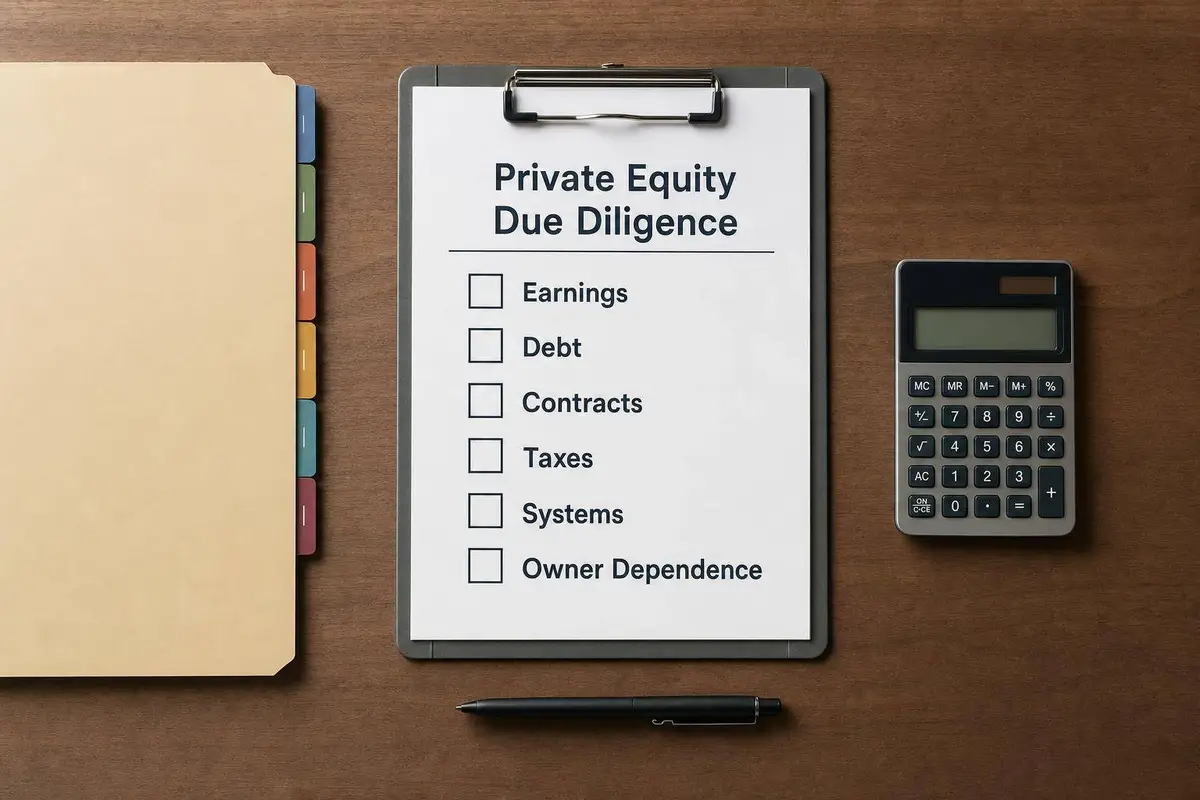
Buy the facts, not the story: verify earnings, debt, contracts, taxes, systems, and owner dependence before closing an SMB PE deal.
 Samson JagorasPrincipal & CEO/CIOSeptember 29, 2026
Get a Quality of Earnings analysis you can trust
Our QofE team validates earnings, normalizes add-backs, and de-risks your deal — flat-fee with fast turnaround.
Most SMB deals don’t break because of the pitch. They break when the numbers, contracts, taxes, or owner handoff don’t hold up.
If I were reviewing a small business deal, I’d focus on six things right away: earnings, debt, customers, tax and payroll, systems, and seller transition. The article’s main point is simple: in SMB deals, I can’t rely on polished reports. I need to test seller claims against source records like tax returns, bank statements, payroll files, and signed contracts.
Here’s the short version of what matters most:
- Verify earnings from the ground up. Reconcile revenue to bank deposits and test every EBITDA add-back.
- Check working capital and debt early. Hidden liabilities, unpaid taxes, deferred revenue, or liens can cut equity value fast.
- Review customer concentration. If one account drives 20% to 30%+ of revenue, risk goes up fast.
- Read contracts for assignment and change-of-control terms. A strong customer relationship means less if the contract can end at sale.
- Test tax, payroll, and worker classification. Old filing issues can turn into cash claims after close.
- Figure out whether the owner is the business. If the seller controls pricing, bank access, or top customer ties, I’d treat that like a deal risk.
- Use diligence in phases. LOI should screen out bad deals early, confirmatory diligence should price risk, and pre-close should make sure fixes are done.
A few numbers stand out:
- 46.6% of failed LOIs in the cited data were tied to diligence issues
- 21.3% were linked to QoE EBITDA gaps
- SMB lenders often look for about 1.15x to 1.25x DSCR
- A gap of more than about 5% between reported revenue and bank-backed revenue is a warning sign
If I had to sum up the article in one line, it would be this: buy the facts, not the story. What follows is a clear checklist for deciding whether to reprice, add deal protection, or walk away.

Private Equity SMB Due Diligence: 6-Phase Checklist Framework
Post-LOI: Navigating Due Diligence and Closing Your Private Equity Deal | M&A Masterclass Moment

sbb-itb-a3ef7c1
Financial And Debt Checklist
Start by checking whether reported earnings, cash flow, and debt capacity line up with the source records. One study found that 46.6% of failed LOIs were driven by diligence-related issues, and 21.3% were tied to QoE EBITDA gaps. So yes, this workstream matters A LOT.
Financial Statements, Quality Of Earnings, And EBITDA Add-Backs
Ask for 3–5 years of income statements, balance sheets, and cash flow statements. You should also get federal tax returns - Form 1120, 1065, or Schedule C, depending on the entity type - plus trailing 12-month (TTM) monthly financials.
From there, reconcile 24 months of bank deposits to reported revenue. If the gap between tax returns and bank-verified revenue is more than about 5%, treat that as a red flag and get a direct explanation from the seller.
Once the raw numbers are in hand, build a quality of earnings (QoE) analysis. The goal is simple: bridge reported net income to adjusted EBITDA, then test each adjustment one by one.
The add-backs that usually hold up fall into a few common groups:
- Excess owner compensation
- One-time charges, like legal settlements or transaction-related professional fees
- Related-party expenses above market rates, such as rent paid to a seller-owned property entity
- Personal expenses pushed through the business
Every add-back needs support from something concrete, like a payroll record, invoice, or contract. If support is missing, leave it out. And be careful when add-backs push EBITDA up by 20% or more. At that point, the normalization itself can become the problem, and it's often enough to kill a deal.
It also helps to test margins by both month and year. Stable gross margins usually point to pricing strength and decent cost control. But if margins jump around or keep sliding - and the seller's story doesn't match the math - that can signal weak revenue quality or cost pressure hiding under the hood.
Working Capital, Cash Conversion, And Balance Sheet Risks
A working capital review answers a blunt question: Can this business fund Day One without needing extra cash?
To figure that out, pull 24–36 months of monthly balance sheets and calculate net working capital (NWC) as current assets minus current liabilities, excluding cash and debt.
Review AR aging in buckets: current, 30, 60, 90, and 90+ days. Receivables older than 90 days come with real collection risk, so they should be heavily discounted or left out of the working capital calculation.
On the AP side, watch for stretched payables. If vendors are being paid much more slowly right before the sale, the seller may be making the cash balance look better than it is. For inventory-heavy businesses, check turnover and flag slow-moving or obsolete stock still sitting on the books at full value. And treat deferred revenue and customer deposits for what they are: future delivery obligations, not spare cash.
The working capital peg - the target NWC level at closing - is usually set using a trailing 12- to 24-month average, adjusted for seasonality, and then written into the purchase agreement with a true-up mechanism.
After you normalize working capital, map out every obligation that could change closing proceeds.
Debt Schedule, Liens, And Debt-Like Items
Build a complete debt schedule before you lock in valuation. Miss one obligation here and you've paid too much.
The schedule should include every category: term loans, lines of credit, overdrafts, equipment leases, shareholder loans, credit card balances, merchant cash advances, guarantees, earnouts, unpaid payroll or sales taxes, and customer deposits or deferred revenue that call for future service.
For each item, capture:
- Lender or creditor
- Outstanding balance
- Interest rate
- Maturity date
- Covenants
- Collateral
- Any change-of-control terms that could trigger repayment or consent needs upon sale
Run UCC lien searches at the state level to find perfected security interests, especially blanket all-assets liens that need to be paid off or refinanced at closing.
The table below lays out the debt and debt-like items that show up most often in U.S. SMB deals, along with the documents to review, red flags to spot, and the usual purchase price effect.
| Item | Documents To Review | Common Red Flags | Purchase Price Impact |
|---|---|---|---|
| Bank term loans | Loan agreements, amortization schedules, UCC filings | Near-term maturities, restrictive covenants, all-assets liens | Reduce equity value by outstanding principal; may require refinancing at close |
| Lines of credit | Credit facility agreements, monthly statements | Fully drawn facilities, covenant breaches, reliance on revolver for working capital | Outstanding balance treated as debt; may signal undercapitalized operations |
| Equipment leases | Lease contracts, asset schedules, UCC-1 filings | Non-cancelable terms, off-balance-sheet liabilities, high termination fees | Remaining payments are often treated as debt-like at present value; adjust enterprise value accordingly |
| Shareholder loans | Promissory notes, board minutes | No clear terms, demand repayment upon sale, high related-party interest | Typically deducted from purchase price unless converted to equity or forgiven at close |
| Unpaid payroll/sales taxes | Tax notices, payroll reports, Form 941, state filings | Penalties, liens, multi-period underpayment | Full liability treated as debt-like; negotiate price reduction or require seller payoff at close |
| Customer deposits/deferred revenue | Contracts, order forms, revenue schedules | Large balances with high future service cost, mismatched margins | Often treated as debt-like; may reduce enterprise value or require working capital adjustment |
| Earnouts/contingent liabilities | Prior acquisition agreements | Large contingent payouts tied to likely performance, unclear measurement terms | Discounted expected payouts treated as debt-like; adjust purchase price or set aside in escrow |
For deals financed with SBA 7(a) loans, lenders often look for DSCR of at least 1.15x on a historical or projected basis. Many bank lenders underwrite closer to 1.25x. That only works when EBITDA has been verified and the debt schedule is complete.
Once earnings and leverage are verified, move to customer concentration and contract assignability.
Customer, Contract, And Commercial Checklist
Customer Mix, Concentration, And Retention
Financial statements tell you what the company did earn. Customer diligence tells you what it’s likely to keep. That’s the next test: will the revenue still be there after closing? A lot depends on who the customers are, how much each account contributes, and whether those relationships belong to the company or sit mostly with the owner.
Start with customer-level revenue for the last 3–5 fiscal years plus trailing 12 months. Then calculate how much of total revenue comes from the top 1, top 3, top 5, and top 10 accounts. Don’t stop at a single snapshot. Track the trend over time. If concentration is rising, that’s a warning sign. If it’s falling, that usually points in the right direction.
Use these ranges as a simple guide:
- <10% = low risk
- 10%–20% = cautionary
- 20%–25% = pressured
- >30% = major structural risk
But concentration alone doesn’t tell the whole story. You also need to see how the revenue shows up. Recurring, contract-backed revenue usually transfers better than project work. And you should measure both logo retention and dollar retention. A company can keep most of its customer names on paper while those same customers spend less and less. That’s why the revenue view matters more.
The table below shows what lower-risk and higher-risk commercial profiles tend to look like, along with how buyers often react:
| Metric | Low-Risk Profile | High-Risk Profile | Likely Buyer Response |
|---|---|---|---|
| Top-1 Concentration | <10% of total revenue | >20% of total revenue | Request price reduction or significant earnout |
| Top-5 Concentration | <25% of total revenue | >50% of total revenue | Increase depth of customer interviews; verify contracts |
| Revenue Type | Recurring/contractual | Project-based/purchase-order driven | Adjust multiple downward for non-recurring revenue |
| Relationship Basis | Institutional/contract-led | Personal/owner-led | Require longer seller transition period or holdback |
| Retention Rate | >90% annual retention | High churn or "lumpy" history | Stress-test cash flow projections and working capital |
| Contract Terms | Assignable without consent | Change-of-control triggers termination | Escrow holdback for key accounts |
Customer, Vendor, Lease, And Other Material Contracts
Concentration shows where the exposure sits. Contracts show whether that exposure makes it through closing.
Gather every material agreement: customer contracts, supplier and vendor agreements, real estate leases, financing documents, software licenses, and any distributor or reseller arrangements. Once you have them, check the assignment clause first. In plain English: can the contract move to a new owner without the other party saying yes?
This is where small deals can get messy. Change-of-control terms are often one of the biggest hidden risks in SMB acquisitions. If a key customer contract ends on its own when ownership changes, that’s not just a legal headache. It hits value directly.
Review the contracts for:
- assignment
- change-of-control
- pricing resets
- minimum commitments
- renewal notice windows
- termination rights
- lease consent
- single-source exposure
Informal agreements rarely survive a sale.
That line matters. If management can’t produce a clean contract for a top-five customer or a critical vendor, treat that gap as its own risk signal. In many cases, the relationship is being held together by trust in the current owner, not by terms that can carry over after a sale. For that reason, key consents should be a closing condition, not something left for cleanup after signing.
Ready to Make Your Next Move?
Whether you're buying, selling, or investing — Clearly Acquired gives you the tools, data, and support to close with confidence.
Tax, Payroll, Compliance, And Systems Checklist
After contract assignability, turn to the liabilities and control points that can still follow the deal after closing. Tax, payroll, compliance, and systems problems can stall a transaction or blow up on Day One.
Federal, State, And Local Tax Review
Ask for at least 3–5 years of federal income tax returns, state income and franchise tax returns, sales and use tax filings, payroll tax filings, and any local business tax filings. Then reconcile those returns to the financials and flag any book-to-tax differences that don't make sense.
State exposure is often where hidden risk shows up. Employees, inventory, contractors, and remote sales can all trigger filing duties in states the company may have ignored. If the target never filed where it was supposed to, the bill can include back taxes, interest, and penalties that hit deal economics hard.
That kind of open tax risk can also make lenders more cautious and limit deal options.
In a stock deal, historical tax exposure usually stays with the business. In an asset deal, that risk is often lower, although some state successor liability can still stick.
| Tax Category | Key Records | What To Test | Common Exposure |
|---|---|---|---|
| Federal Income | 3–5 years of federal income tax returns | Reconcile to book income; identify timing differences | Aggressive deductions, unreported income |
| State Income/Franchise | State returns for all filing jurisdictions | Confirm filing in every state with employees or economic nexus | Unfiled returns, apportionment errors |
| Sales & Use Tax | State sales and use tax returns, exemption certificates | Nexus analysis; test out-of-state sales | Uncollected tax, missing registrations |
| Tax Notices & Audits | IRS/state correspondence, audit correspondence, payment plans, VDAs | Quantify open assessments and contingent liabilities | Unresolved audits, accrued penalties |
| Carryforwards | NOL schedules, credit carryforward summaries | Confirm availability; check IRC §382 limitations | Attributes lost or limited post-close |
Payroll, HR, Insurance, And Corporate Compliance
Pull payroll registers, quarterly Forms 941, annual Forms 940, W-2 and 1099 records, payroll tax account statements, and state unemployment filings. Reconcile total payroll expense to the general ledger, then match reported wages to the filed returns.
Worker classification needs a separate review. If the company treated workers as 1099 contractors when they should have been employees, the risk can include back taxes, overtime claims, and benefit liabilities. Review offer letters, bonus plans, PTO accrual policies, and whether exempt and nonexempt classifications hold up under the FLSA.
On the compliance side, confirm that the target is in good standing in its home state and every state where it operates. Make sure the legal entity signing contracts, running payroll, and holding licenses is the same entity being acquired. If that chain is broken, license transfers can get delayed and post-close enforcement issues can follow. Request current and past insurance policies for general liability, workers' compensation, property, cyber, and professional liability, along with loss runs for the past 3–5 years.
Once the filings and compliance items check out, test the systems behind the numbers.
Accounting Systems, Operating Software, And Cyber Controls
The main issue is simple: do the systems produce clean numbers without a lot of manual work? If the seller is the only person who can run reports or patch errors, the business is less stable than the financials may suggest.
List the accounting platform, CRM, ERP, POS, and payroll tools. Then map how data moves from those operating systems into the general ledger.
Cyber risk matters in SMB deals, especially when MFA, backups, and admin access are weak. Also confirm that software licenses sit in the target entity's name and can be assigned. A nontransferable payroll system or POS platform is a closing issue, not something to brush off for later. Split pre-close fixes from first-90-day tasks, and put a dollar amount on each.
With taxes, payroll, and systems mapped, the last diligence check is whether the business can run without the seller.
Owner Transition Checklist And Closing Priorities
Once you've mapped liabilities and systems, the next step is simple: find out whether the business can operate without the seller.
Key-Person Risk, Management Depth, And Seller Transition Plan
Start with an owner-dependency map. List every task, relationship, decision, and approval the owner controls.
That often includes customer relationships, pricing authority, vendor negotiations, bank access, payroll approvals, and undocumented know-how that never made it into an SOP. And here's the catch: if the seller owns those relationships, clean contracts alone won't remove transfer risk.
For businesses in the $3 million to $10 million EBITDA range, there should usually be a GM/COO, a finance lead, and a sales lead with real authority. If those roles don't exist, the transition plan needs to address them before close. In some cases, that means phased hiring. In others, it means temporary support before or right after closing.
Build the 100-day plan during diligence, not after close. Tie it to KPIs like revenue, margin, customer churn, and employee turnover, so the workstreams are already assigned when the deal is signed.
The seller's post-close role also needs to be spelled out in writing. A solid transition plan should define:
- Duration: usually 3 to 12 months for PE-backed SMB deals
- Hours per week by phase
- The seller's exact role and authority limits
- Compensation
- Termination terms
It's also smart to split the transition into two parts: an initial full-time training period, followed by a paid part-time consulting agreement. That consulting agreement should line up with any non-compete and non-solicit protections.
Before close or on Day 1, lock down admin credentials for:
- Accounting software
- CRM
- Payroll tools
- Bank access
- Email domains
- Website and domain control
The point isn't just to get access on Day 1. It's to have repeatable control after closing.
Make sure SOPs cover order-to-cash, procure-to-pay, payroll processing, financial close, customer onboarding, quoting and pricing approvals, and service dispatch. Update bank signatories, document ACH, wire, and credit card approval workflows, and put together a transition contact list for top customers, key vendors, the landlord, bank relationship manager, insurance broker, CPA, attorney, and IT provider.
Then look beyond the owner. Identify any employee whose exit would materially disrupt revenue or operations. In SMB PE deals, stay bonuses tied to 6- and 12-month milestones, updated compensation tied to clear KPIs, and title changes with defined authority often help keep key people in place. Announce promotions and retention packages soon after close.
Final Go/No-Go Review
Work through the findings in sequence.
Start with revised EBITDA. Remove overstated add-backs and add any costs needed to run the business without the owner, most often a market-rate manager salary.
Then layer in revenue risk from customer concentration and any contracts that failed the transferability review. Quantify the tax and payroll exposures found earlier and model the cash impact. After that, add hidden or quasi-debt items from the debt schedule, such as unpaid bonuses, litigation, deferred maintenance, and off-balance-sheet leases.
Treat unresolved owner dependence the same way you'd treat hidden debt or non-transferable contracts.
Then step back and ask a blunt question: how much operating strength is actually there once you factor in systems maturity and owner dependence?
Use the table below to separate manageable transition risk from deal-breakers.
| Risk Area | Common Finding | Likely Outcome |
|---|---|---|
| Overstated EBITDA | Aggressive add-backs; missing owner replacement cost | Reprice or restructure |
| Customer concentration | Owner is the sole contact for a major customer relationship | Earnout; lower price; or walk away |
| Non-transferable contracts | Change-of-control clauses; missing consent | Conditional close; walk away |
| Tax/payroll liabilities | Unfiled returns; misclassified employees; under-withholding | Escrow; indemnity; reprice |
| Hidden debt | Unpaid bonuses; litigation; deferred maintenance; off-balance-sheet leases | Reprice; restructure |
| Weak systems | Manual processes; limited documentation; weak controls | Conditional close; remediation plan |
| Owner dependence | Owner controls key relationships, pricing, and approvals | Longer transition; earnout |
If the risks are material but still manageable, the answer is often a reprice, an earnout, a seller note, or tighter reps and warranties.
But if the core deal thesis falls apart because EBITDA is fundamentally overstated, key contracts won't transfer, or tax exposure is severe, the disciplined move is to walk away.
Use the findings to decide whether to reprice, add protections, or walk away.
FAQs
What documents should I request first?
Start with the core diligence set:
- Financials: 3 to 5 years of statements, bank deposits, tax returns, EBITDA/SDE adjustments, working capital, A/R aging, and margins
- Customer mix and retention details
- Material contracts, leases, debt schedule, lender statements, and lien searches
- Tax filings, payroll records, Form 941, state filings, systems/SOPs, and owner-transition details
Then review owner dependency, key employee retention, and change-of-control risks.
How do I spot seller-dependent risk?
Look for signs that the business leans too much on the owner. Start with the big ones: customer concentration, the quality of recurring revenue, customer retention, and how much the company depends on key employees, vendors, or the seller to keep relationships and day-to-day work running.
Then check the numbers and the nuts and bolts. Verify earnings, debt, contracts, tax compliance, and system infrastructure to see if the business can keep performing the same way after ownership changes hands.
When should I reprice vs. walk away?
Reprice the deal when diligence turns up specific, fixable problems that lower value but don't kill the deal. That can include weaker earnings, customer concentration, debt, or contract risk.
Walk away when the findings point to major legal, tax, compliance, or operating problems that can't be verified or fixed without too much risk.
Keep your attention on what diligence confirms across financials, contracts, debt, tax, payroll, systems, and owner transition.
Related Reading
De-risk your deal with a Quality of Earnings report
Independent, deal-ready earnings analysis that buyers, sellers, and lenders trust.
About the author
Principal & CEO/CIO
Samson Jagoras has 15+ years across finance, real estate, and business acquisitions. He began his career as a Futures & Commodities broker and later served as Chief Strategy Officer of an INC 500 marketing and technology firm, helping scale revenue from $1M to over $100M. Today he buys, builds, and advises a portfolio of companies with a focus on M&A, capital allocation, and operational strategy.