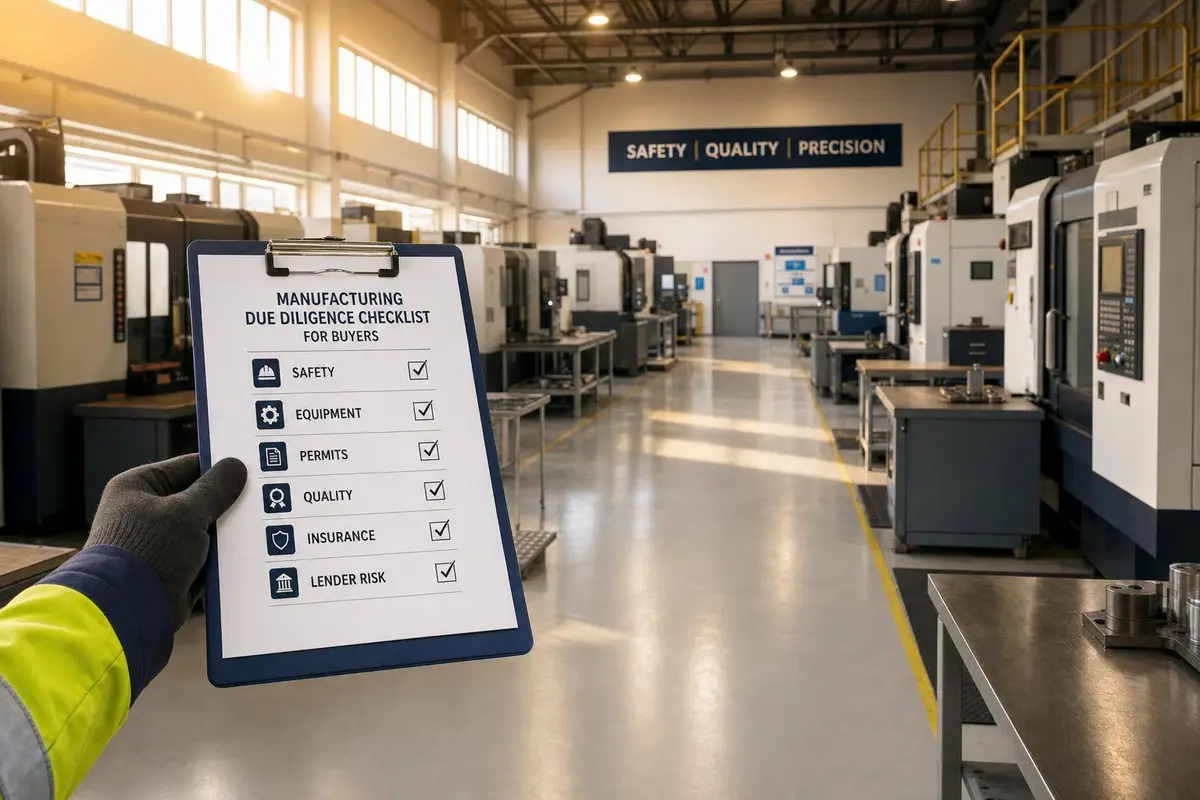
Manufacturing Due Diligence Checklist for Buyers
Checklist to screen safety, equipment, permits, quality, insurance, and lender risks before buying a manufacturing plant.
 Samson JagorasPrincipal & CEO/CIOSeptember 15, 2026
Get a Quality of Earnings analysis you can trust
Our QofE team validates earnings, normalizes add-backs, and de-risks your deal — flat-fee with fast turnaround.
Buying a plant can go bad fast if you miss safety, equipment, permit, quality, insurance, or lender issues. I’d screen six things first: injury history, machine condition, permit status, site contamination risk, customer-spec control, and business interruption gaps.
Here’s the short version: if I see open OSHA items, deferred machine replacement, Phase II site findings, lost quality certs, or weak insurance tied to long repair times, I assume the deal may need a lower price, escrow, seller paper, or added closing conditions. For SBA or bank debt, I’d also expect lender reviews like a questionnaire, records search, and sometimes a Phase I site report.
Before and after LOI, I’d focus on:
- Safety: OSHA logs, training gaps, machine guards, lockout/tagout, forklift and chemical controls
- Equipment: asset ownership, liens, PM records, downtime, bottlenecks, and 1–3 year capex needs
- Permits and site risk: air, wastewater, stormwater, waste, tanks, agency notices, and contamination flags
- Quality and customer specs: ISO/IATF/AS scopes, scrap, rework, warranty trends, drawing revision control, PPAP or FAI records
- Insurance: 3–5 years of loss runs, open claims, replacement-cost limits, and BI limits tied to repair lead times
- Lender close items: reports still pending, fixes due at close, and a short plant risk memo with price and debt impact
If I had to boil it down even more, I’d ask four plain questions:
- Can the plant run safely?
- Can it make parts to spec without scrap or returns?
- Will I get hit with near-term capex?
- Will the risk profile still fit the loan and insurance package?
| Area | What I’d check first | Why it matters |
|---|---|---|
| Safety | OSHA logs, citations, training, guards, exits | Injuries, fines, post-close fixes |
| Equipment | Asset match, liens, age, PM, downtime | Hidden capex, weak output, transfer issues |
| Permits & site | Permits, notices, tanks, site reports | Fines, cleanup cost, loan delays |
| Quality | Certs, scrap, returns, revision control | Margin loss, customer trouble |
| Insurance | Loss runs, BI, open reserves, endorsements | Higher premiums, close delays, cash-flow risk |
| Lender view | Plant risk memo, conditions to close | Price, leverage, escrow, covenants |
I’d use this checklist in two passes: a fast screen before LOI, then a deeper workplan after LOI.

Manufacturing Due Diligence Checklist: 6 Key Risk Areas for Buyers
How to Use a Factory Visit Checklist to Assess Manufacturers?

sbb-itb-a3ef7c1
Facility Safety and Plant Risk Checklist
Start by checking whether the plant can run safely and whether any safety gaps will turn into immediate post-close capex. That gets to the first buyer question from the introduction: can the plant operate safely?
OSHA Records, Incident History, and Emergency Readiness
Ask for at least 3–5 years of OSHA 300 logs, 300A annual summaries, and 301 incident reports for each plant location. Under 29 CFR 1904, most manufacturing employers with more than 10 employees must keep these records for 5 years, so the information should usually be there.
When you review it, don’t get distracted by one-off events. The bigger issue is pattern. Repeat hazards, the same injury showing up again and again, or slow abatement usually tell you more than a single isolated incident.
Willful OSHA violations can bring penalties of up to $161,323 per violation, and cases with several serious violations at one plant have led to total proposed penalties from $145,000 to $400,000. If there are open citations or abatement items still hanging around, treat them as buyer-funded fixes after close, not as old seller baggage.
On the site walkthrough, verify the core life-safety items yourself. Don’t just rely on what’s in a binder. Check:
- Fire suppression systems with current inspection tags
- Clearly marked, unobstructed egress routes
- Working eyewash stations in chemical areas
- Audible alarm systems
- Machine guards and interlocks on presses and conveyors
- Lockout/tagout devices and signage
- Physical separation between forklift traffic and pedestrian walkways
Take photos and give each finding a priority rating. Critical life-safety issues like missing guards on high-energy equipment or blocked emergency exits need immediate post-close action. Lower-priority issues can move into a 6–12 month fix plan.
Hazardous Materials Handling and Safety Training Records
Cross-check the plant’s Safety Data Sheet (SDS) library against the current chemical inventory. Every hazardous substance on-site must have a current, easy-to-access SDS under OSHA’s Hazard Communication Standard (29 CFR 1910.1200). Also review labels, chemical segregation, flammable storage, and ventilation.
For training, ask for a training matrix that links each role to the safety training it needs and shows completion dates. This is where gaps tend to hide in plain sight. Expired forklift certifications, missing confined space entry records for workers who often go into tanks or pits, or missing lockout/tagout training for employees near energized equipment can all come back to bite during an OSHA inspection or a workers’ comp claim.
Tie those training gaps back to loss runs and e-mod. If the e-mod is above 1.2, workers’ compensation costs go up, and it also points to claim risk.
Use the checklist below to split document review from what you see on the floor.
| Safety Record | What to Request | Red Flag |
|---|---|---|
| OSHA 300/300A/301 logs | 3–5 years per establishment | Repeat citations, slow abatement |
| Incident reports | All recordable and near-miss events | Clusters of similar injury types |
| SDS library | Current SDS for every chemical on-site | Missing or outdated sheets |
| Training matrix | All roles, trainings, and completion dates | Expired forklift certs, gaps in confined space training |
| Workers' comp loss runs | 3–5 years of claims history | High frequency, open large claims |
| E-mod | Current and prior 3 years | E-mod above 1.2 |
Once safety is clear, move to equipment condition and maintenance history, which drive uptime and near-term capex.
Equipment, Maintenance, and Capacity Checklist
Once life-safety is cleared, the next step is simple: make sure the production assets are actually there, owned the way the seller says they are, and able to support forecast output without near-term capex.
Equipment Condition, Ownership, and Remaining Useful Life
Start with the fixed-asset register, depreciation schedule, and any equipment schedules in the purchase documents. Then match that paper trail to what is physically on the floor.
Do a line-by-line audit by asset tag, serial number, make/model, location, and ownership status. A photo log and exception list help a lot here. You’re looking for a few common problems:
- Assets that are missing
- Assets listed on the books but not on the floor
- Leased or encumbered assets that won’t transfer free and clear
That last issue can create closing risk fast. Search UCC-1 filings and county liens, and ask for all lease schedules, loan agreements, equipment financing statements, and payoff letters before assuming anything transfers free and clear.
Ownership is only part of the story. You also need a clear view of each critical machine’s age, condition, and remaining useful life. Watch unsupported controls and obsolete PLCs closely. A machine may still run today, but once the controller is obsolete, spare parts can turn into a serious problem.
Also flag any asset where one failure would stop the whole line. For each single-point-of-failure machine, assign a risk rating and a replacement cost. Then sort assets into four buckets - run, watch, repair, replace - with a cost and timeline tied to each one.
Preventive Maintenance, Downtime History, and Capex Backlog
Ask for 12 to 36 months of maintenance records, including PM schedules, completed work orders, breakdown logs, calibration records, spare-parts inventory, CMMS exports, and maintenance staffing records.
Those records tell you whether the plant follows steady preventive maintenance or just fixes things after they break.
A high share of corrective versus preventive maintenance usually points to deferred upkeep and unstable operations. Chronic breakdowns can chip away at EBITDA in ways that don’t show up cleanly in the financials. Weak maintenance data also affects EBITDA quality, forecast reliability, and lender confidence.
Next, compare claimed capacity with sustained throughput over more than one period. Sellers often quote nameplate capacity, not sustained output. The gap usually comes from changeover time, unscheduled downtime, scrap, or labor limits.
Here’s the practical test: if the plant says it is at full capacity, but production logs show it usually runs at 75%, that gap matters. It changes your revenue forecast, and it changes how a lender looks at the deal.
Build a 1- to 3-year capex backlog that separates must-do safety and compliance repairs from end-of-life replacements, control-system upgrades, and utility assets - compressors, boilers, HVAC - that support production. Then test management’s capex forecast against that list to see whether it covers the need or leaves major holes.
| Verification Item | Source Document / Action | Risk Mitigated |
|---|---|---|
| Asset-register reconciliation | Fixed-asset register, depreciation schedule, equipment schedules, and physical walk-through by asset tag/serial number | Phantom or missing assets; ownership misrepresentation |
| Ownership and lien status | UCC-1 and county lien searches, lease schedules, loan agreements, equipment financing statements, payoff letters | Encumbered assets that don't transfer at closing |
| Equipment condition and age | Maintenance logs, CMMS exports, plant walk-through, maintenance manager review | Hidden end-of-life or unsupported-controls risk |
| Single-point-of-failure assets | Bottleneck mapping, production flow review | Catastrophic downtime from one machine failure |
| PM program quality | PM schedules, completed work orders, overdue PM list | Deferred maintenance and capex surprise |
| Downtime and reliability | Breakdown logs, MTBF/MTTR, shift reports, production logs | Overstated throughput and hidden EBITDA drag |
| Capex backlog | Management capex plan vs. independent asset assessment | Underfunded replacement needs post-close |
If the assets and uptime hold up, move next to permits, quality systems, and customer-spec compliance.
Ready to Make Your Next Move?
Whether you're buying, selling, or investing — Clearly Acquired gives you the tools, data, and support to close with confidence.
Compliance, Quality, and Customer Requirements Checklist
After safety and equipment, turn to permits and quality controls. Compliance and quality can wreck a deal just as fast as a bad machine.
Environmental Permits, Site Condition, and Regulatory Status
Start with a permit register for air, wastewater, stormwater, waste, and reporting duties. For each permit, log the issuer, expiration date, renewal timing, and operating limits. That should cover air permits under the Clean Air Act, wastewater discharge permits such as NPDES or industrial user permits for discharge to a publicly owned treatment works (POTW), stormwater permits for industrial activity, solid and hazardous waste registrations under RCRA, and EPCRA Tier II and TRI filings.
Permit issues can lead to daily fines that hit lender underwriting and closing terms. Clean Air Act civil fines can reach $113,740 per day of violation. Clean Water Act violations can run up to $64,618 per day. RCRA hazardous waste noncompliance can reach $70,117 per day. One expired permit or an open consent order can slow funding or become a condition to close.
Ask for any Phase I Environmental Site Assessment and make sure it fits lender timing rules. SBA and bank lenders usually want a Phase I completed within 6 to 12 months of closing. If the Phase I flags Recognized Environmental Conditions (RECs) tied to past industrial use, documented spills, or nearby contamination, a Phase II with sampling data is usually needed to size up cleanup exposure.
You should also pull underground storage tank (UST) and aboveground storage tank (AST) registrations, tightness tests, and spill response records. For older facilities, asbestos and lead-based paint surveys matter as well, especially if renovation or expansion is part of the plan.
Request at least three to five years of regulatory correspondence, including notices of violation, warning letters, inspection reports, consent orders, and self-disclosures from EPA and state agencies. A one-off reporting miss that was self-disclosed and formally closed is not the same as repeated stormwater exceedances with half-finished corrective action. Score each item by severity and remediation status. Then test whether the plant’s quality system can hold up under customer review.
Quality Systems, Certifications, and Customer Specifications
Confirm whether the plant has a documented QMS with controlled procedures, training records, and management review minutes. Check the certification scope as well: ISO 9001, AS9100, IATF 16949, or ISO 13485, depending on the business. Pull current certificates, recent surveillance and recertification audit reports, and any open major or minor nonconformities.
Certification gaps matter. OEM customers in automotive and aerospace often require active certification as a supply condition. If a plant loses IATF 16949 status after a change of control, for example, that can trigger OEM requalification and temporarily freeze purchase orders. That is a direct revenue risk, and lenders will price it into underwriting.
For performance data, ask for three to five years of scrap and rework rates by product line, first-pass yield, warranty claims, and customer returns. Combined scrap and rework can consume up to about 2% of annual revenue. If scrap trends are rising or warranty claims are climbing with a key customer, you're looking at margin pressure and possible contract trouble. Those are exactly the kinds of issues that push lenders toward lower leverage or tighter covenants.
Then make sure current production matches approved customer specs. Verify drawing revision control and customer approval records. In automotive, that means PPAP documentation. In aerospace, it means First Article Inspection Reports (FAIR/FAI).
Spot-check several high-revenue parts:
- Trace the current revision from the customer’s drawing to the plant’s internal records
- Confirm process parameters and inspection plans match the approved PPAP or FAI
- Check that engineering changes were put in place on time
Bad revision control can lead to returns or even line shutdowns. Ask for two to three years of customer scorecards and any formal supplier audit findings. Consistently high scores across several customers support valuation and financing. On the flip side, a supplier placed on new-business hold status with a major OEM is a material underwriting risk that needs attention before close.
| Verification Item | Source Document / Action | Risk Mitigated |
|---|---|---|
| Permit register (air, water, stormwater, waste) | EPA, state agency, and local authority records; permit transfer requirements | Operating without a permit; shutdown orders; lender conditions precedent |
| Regulatory enforcement history | NOVs, consent orders, inspection reports, self-disclosures (3–5 years) | Unresolved liability; post-close capex surprises |
| Phase I/II ESA and site condition | ESA reports, UST/AST records, asbestos/lead surveys | CERCLA cleanup liability; blocked financing |
| QMS documentation and certifications | Quality manual, procedures, audit reports, current certificates | Loss of OEM certification; customer requalification risk |
| Scrap, rework, and warranty trends | 3–5 years of quality metrics by product line | Margin compression; hidden cost of poor quality |
| Drawing revision control and approvals | PPAP records, FAIR/FAI, revision logs, change notices | Parts made to outdated specs; customer returns or line shutdowns |
| Customer scorecards and supplier status | 2–3 years of scorecards, audit findings, corrective actions | Revenue instability; lender discount on projected cash flows |
Insurance, Lender Concerns, and Final Diligence Summary
After safety, equipment, and compliance, the next step is simple: turn plant risk into insurance terms and lender terms.
Insurance Policies, Loss Runs, and Business Interruption Exposure
Ask for 3–5 years of updated loss runs and full policies for each major coverage line, plus endorsements and supporting schedules. That usually includes:
- commercial property
- general liability
- product liability
- workers' compensation
- umbrella/excess
- commercial auto
- environmental or pollution liability, if applicable
Loss runs tell you how often claims happen, how large they get, and what exposure is still open. Underwriters use them to judge the trend before they quote or renew coverage.
As you review the loss runs, sort claims by cause and by location. That makes patterns easier to spot. Frequent small workers' comp claims in the same department usually point to a repeating safety issue. One large property claim can point to a gap in equipment condition or fire protection. Open claims with reserves deserve extra attention because those amounts can grow after close and may lead to escrow or indemnity terms in the purchase agreement.
Business interruption risk needs its own review. Manufacturing downtime can cost an average of $260,000 per hour. That number gets expensive fast. A plant can look fine on paper, then one failed machine turns into a major earnings problem.
To size BI exposure in a way that matches the plant, build a scenario model that ties revenue by production line to the time needed to repair or replace the most critical equipment. If a key asset has a long repair or replacement lead time, the BI coverage period should match that reality. A generic 90-day restoration window may not come close.
Also check that policy limits are based on replacement cost, not depreciated book value. And make sure the lender is named the right way: as mortgagee or loss payee on property policies, and as additional insured on liability policies. If that setup is wrong, it can slow or block closing.
How to Build a Lender-Ready Plant Risk Memo
Keep the memo tight: 3–7 pages is usually enough. Organize it by risk area. Start with an overall risk rating - low, medium, or high - followed by the main mitigants and any closing conditions that need to be met.
Then move through the plant by topic: safety and OSHA history, equipment condition and capex backlog, site and environmental compliance, quality systems and customer requirements, and insurance backed by 3–5 years of loss run data.
For each section, spell out three things:
- the finding
- the risk it creates
- what reduces that risk
Be clear about which third-party reports are finished - like a Phase I ESA, equipment appraisal, or property engineering report - and which ones are still pending. End with a table of conditions precedent to close. That might include binding updated insurance with lender endorsements, clearing an open consent order, or committing to a first-year safety capex plan.
The memo should do one job well: isolate the few issues that change price, leverage, or closing conditions.
Conclusion: The Checklist Items That Most Affect Price and Close Certainty
These are the items that most often change price, leverage, and closing conditions. The table below shows the findings most likely to affect price and close certainty.
High EMR pushes up workers' comp cost and points to higher claim risk. Deferred maintenance on critical equipment can cut collateral advance rates and shift part of the deal toward seller financing or earn-outs. Environmental liabilities can lead to escrows or indemnity terms that change the deal structure. And a weak contingency plan - like no written backup production option - can increase BI risk and trigger lender reserves or covenant terms.
| Finding | Likely Lender or Deal Impact |
|---|---|
| High EMR / repeat workers' comp claims | Higher insurance costs; possible leverage reduction |
| Open OSHA citations or consent orders | Closing condition; remediation plan required |
| Deferred capex on critical equipment | Lower advance rates; seller note or earn-out adjustment |
| Phase II environmental findings | Escrow holdback; indemnity provisions; potential re-trade |
| No documented contingency plan for a major equipment outage | Higher BI reserve; lender covenant or condition |
| BI coverage gap vs. actual restoration time | Coverage condition; reserve requirement at close |
FAQs
When should I do plant diligence before vs. after LOI?
Handle the top-level plant diligence before LOI so you can spot major operational, compliance, environmental, and equipment risks early. Those issues can change valuation or even shift the way the deal is structured.
Then, after LOI, move into deeper diligence. That usually includes site inspections, inventory checks, permit and insurance review, workflow analysis, and the documents lenders may ask for, along with support for indemnities, escrows, or purchase price adjustments.
Which manufacturing risks most often change price or deal terms?
The risks most likely to change price or terms are facility and equipment issues, compliance problems, and operational weak spots.
That means buyers need to look closely at the basics that can quietly derail a deal:
- Equipment condition
- Inventory accuracy
- Maintenance records
- OSHA/EPA history
- Permits
- Insurance loss runs
- Customer specs
- Vendor concentration
- QA systems
These problems can hit valuation, financing, and closing certainty in a direct way. Inaccurate inventory can distort what the business is worth. Environmental exposure can bring cleanup costs and lender concerns. Recurring safety claims can push insurers and buyers to change terms. And unstable operations can make the whole deal feel shaky, even if the numbers looked fine at first glance.
What documents should I request first from the seller?
Start with documents that cover the main manufacturing risk areas:
- Facility and equipment: maintenance logs, inventory records, and facility information
- Compliance: OSHA reports, EPA audits, permits, licenses, and workers’ compensation claims
- Operations and QA: vendor contracts, quality records, defect and rework data, customer specifications, and IT/cybersecurity records
- Insurance and lender concerns: five years of loss runs, plus materials that explain key risks that could affect asset quality or cash flow
Related Reading
De-risk your deal with a Quality of Earnings report
Independent, deal-ready earnings analysis that buyers, sellers, and lenders trust.
About the author
Principal & CEO/CIO
Samson Jagoras has 15+ years across finance, real estate, and business acquisitions. He began his career as a Futures & Commodities broker and later served as Chief Strategy Officer of an INC 500 marketing and technology firm, helping scale revenue from $1M to over $100M. Today he buys, builds, and advises a portfolio of companies with a focus on M&A, capital allocation, and operational strategy.