Manufacturing M&A Trends: 2026 Study
U.S. manufacturing M&A 2026: fewer deals but strong megadeals; buyers favor reshoring, automation, defense and lender-ready targets.
 Samson JagorasPrincipal & CEO/CIOSeptember 25, 2026
Get matched with the right lender for your business
Compare offers from our vetted network. Pre-qualify in minutes — no impact to your credit.
If you want the short version: U.S. manufacturing M&A in 2026 is a split market. Big deals are keeping total value up, while smaller deals face tighter lending, more pricing pressure, and fewer closed transactions.
I see three clear takeaways from the data:
- Deal count is down, but dollar value is still holding up. In Q3 2025, industrial manufacturing deal value hit $217.4 billion even as deal count fell 10.9%. Through the first three quarters of 2025, deal volume was down 21% year over year, while deal value was up 58%.
- Buyers still want good manufacturing companies. Demand is strongest for firms tied to reshoring, automation, defense, infrastructure, and niche production skills.
- Quality and financing now decide who gets to close. Clean financials, low customer concentration, solid equipment, and lender-ready cash flow matter more than ever in deals under $100 million.
Here’s what that means for you in plain English:
- If you’re a seller, weak books, old equipment, owner dependence, or one customer making up more than 20% of revenue can drag price down.
- If you’re a buyer, you need to underwrite for tighter credit, more equity in the deal, and lender focus on DSCR of 1.25x to 1.40x+.
- If you’re in the Main Street range, expect more SBA-driven deals and more friction.
- If you’re in the lower middle market, expect more interest from family offices, sponsors, and corporate buyers.
A few numbers stand out:
- 69% of total deal value in Q3 2025 came from large corporate buyers
- Family offices made up about 30% of lower-middle-market deals in 2025 year to date, up from 16% in 2024
- Seller notes appeared in 75% to 90% of deals under $5 million
- Manufacturing SBA lending reached about $3.65 billion in FY2025

2026 U.S. Manufacturing M&A: Key Stats & Market Snapshot
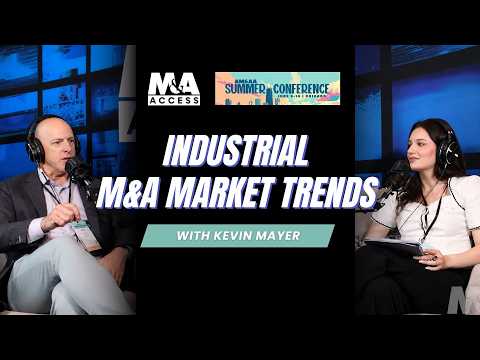
M&A Access - Industrial M&A Market Trends | Kevin Mayer
sbb-itb-a3ef7c1
Quick Comparison
| Area | What’s happening in 2026 |
|---|---|
| Deal volume | Lower than prior periods |
| Total deal value | Still strong due to larger deals |
| Best-selling targets | Clean books, mixed customer base, good margins, usable equipment, steady backlog |
| Weakest targets | Under-invested shops, heavy owner reliance, old equipment, messy financials |
| Active buyers | Searchers, family offices, sponsors, and corporate buyers |
| Main financing pressure | Tighter lending, more scrutiny, more buyer equity needed |
| Main pricing driver | Earnings quality and deal readiness, not size alone |
Bottom line: I’d read this market as selective, not frozen. Good manufacturers still sell. But in 2026, preparation, buyer fit, and financing certainty matter as much as the business itself.
Buyer Demand: What Buyers Want in 2026
Manufacturing M&A demand in 2026 is driven by the deal thesis. Buyers want control, better efficiency, and less supply chain risk, not just top-line growth. In practice, demand is clustering around five clear themes.
The Main Themes Driving Manufacturing Acquisitions
Reshoring, automation, defense exposure, infrastructure-linked revenue, and niche capabilities with sticky customer relationships are the five forces pulling buyers toward manufacturing targets in 2026.
Reshoring is the biggest long-term shift. In a 2025 survey, nearly 50% of respondents said lower freight and duty costs or being closer to engineering teams were key reasons for reshoring, while 38% pointed to avoiding geopolitical risk. That shows up in the market too: U.S.-targeted industrial deal value almost doubled to $72 billion in fiscal year 2025. If a manufacturer has domestic capacity, regional customers, and short lead times, buyers are often willing to pay more.
Automation is another major driver. According to a 2025 Deloitte survey, 80% of manufacturing executives planned to put at least 20% of their improvement budgets into smart manufacturing efforts such as automation, analytics, sensors, and cloud. And buyers aren't only chasing companies that already look modern. Many are just as interested in targets where post-close gains are easy to spot. A shop with older but usable equipment and clear throughput bottlenecks may be just as attractive as a more updated operation. That widens the field beyond the most polished targets.
Defense and infrastructure-linked manufacturers also stand out because government-backed demand tends to be steadier. Strategic and financial buyers lean toward automation, defense, and energy transition targets because policy support can push valuations higher. In 2026, aerospace and defense manufacturing, electronic equipment, and industrial automation technology are among the segments seeing the strongest buyer activity.
How Demand Differs by Buyer Type
The same broad themes matter across the board, but each buyer type tends to look for something a little different.
| Buyer Type | Target EBITDA Band | Primary Financing | What They're Looking For |
|---|---|---|---|
| Searchers / Owner-Operators | Under $2M | SBA 7(a) loans / Seller Note | Stable cash flow, manageable size, operator control |
| Family Offices | $3M – $5M | Equity / Conventional | Long-duration yield, resilience, direct ownership |
| Independent Sponsors | $1M – $10M | Private Credit / Equity | Buy-and-build platforms, operational upside |
| Strategic Corporates | Varies | Balance Sheet / Debt | Vertical integration, capacity, supply chain control |
Family offices and independent sponsors are taking a bigger share of lower-middle-market activity. Family offices made up about 30% of lower-middle-market deals in 2025 year-to-date, up from 16% in 2024, pulled in by steady cash yield and long-term wealth preservation. Independent sponsors also accounted for about 30% of transactions in that same segment. Among them, 79% were targeting companies with $2 million to $5 million in EBITDA, and 64% were also targeting $5 million to $10 million.
Put simply, searchers want control. Family offices want staying power. Sponsors want upside. Strategics want integration.
Why Smaller Manufacturers Still Attract Buyers
Buyer interest remains strong at the smaller end of the market because that part of manufacturing keeps renewing itself. The sector is still fragmented, and many smaller sellers are retirement-driven boomers. So even when total deal volume cools off, there are still businesses coming to market.
Another reason: buyers can often see the improvement plan before the LOI is even signed. Revenue per employee in the $200,000–$400,000 range and inventory turns of 4–12x can point to a business with room to scale. On the flip side, customer concentration above 20% often leads to valuation discounts of 20%–40%. That's a big haircut.
Smaller manufacturers that have spread revenue across a broader customer base tend to get more buyer attention and smoother financing. For owners, that's one of the clearest pre-sale levers to work on before going to market.
What buyers want is only half the picture; deal size, pricing, and financing decide what actually gets done.
Target Size, Deal Volume, and Pricing in 2026
Fewer Deals, Higher Average Deal Size
Those demand themes don’t play out the same way across the market. In 2026, target size shapes who shows up to buy, how the deal gets financed, and where pricing lands. Even with softer deal volume, well-run businesses still attract more bids.
How Target Size Shapes the Deal
Main Street deals are usually priced on SDE. Larger businesses are usually priced on EBITDA. That change matters because it shifts the buyer pool too. Smaller deals tend to attract individual buyers and searchers. As size goes up, the field opens to private equity, family offices, and strategic buyers.
For SBA-backed deals with goodwill, a formal appraisal is often needed once the amount goes above $250,000.
As target size rises, the buyer pool moves from owner-operators to institutional capital.
| EBITDA / SDE Band | Typical Multiple | Buyer Profile |
|---|---|---|
| Under $1M | 2x – 4x SDE | Individual buyers, searchers |
| $1M – $3M | 4x – 6.5x EBITDA | lower-middle-market PE, searchers |
| $3M – $5M | 5.5x – 8x EBITDA | PE funds, family offices, strategic acquirers |
| $5M – $10M | 6.5x – 10x EBITDA | middle-market PE, strategic acquirers |
| $10M – $25M | 7.5x – 12x EBITDA | Upper middle-market PE, large strategics |
Valuation Multiples and Quality Discounts
In the lower middle market, manufacturing businesses often sell at 3.0x–5.0x EBITDA. That’s usually above similar businesses in construction or home services, partly because buyers put weight on asset intensity and equipment value.
But buyers don’t just look at headline earnings. They price off normalized earnings, then mark down weak operators for issues like customer concentration, deferred maintenance, and owner dependence. Put simply: the cleaner the story, the better the price discussion tends to go.
Customer concentration stands out here. If one customer makes up more than 20% of revenue, buyers usually apply a discount. Sellers who have already normalized earnings and can clearly support the numbers tend to have a stronger hand in diligence and pricing talks.
| Valuation Driver | Risk Factor (Discount) |
|---|---|
| Modern, well-maintained equipment | Customer concentration above 20% |
| Diversified customer base | Heavy owner dependency, thin management bench |
| Recurring contracts and strong backlog | Deferred maintenance or aging equipment |
| Proprietary processes or licensed IP | Volatile or cyclical earnings history |
Price bands still hinge on capital structure, and that becomes the next constraint in 2026. Even strong targets still need to compare SBA 7(a) loans vs other financing to get to the finish line.
Lender Appetite and Buyer Mix
Credit Conditions for Manufacturing Acquisitions in 2026
After valuation, financing is the next big hurdle. Lenders are still backing U.S. manufacturing acquisitions in 2026, but they're picking deals more carefully than they did a year ago. SBA lending to manufacturers hit about $3.65 billion in FY2025, up 16.7% year over year, with 4,456 SBA 7(a) loans and 538 SBA 504 loans going into the sector. Manufacturing also remains a below-average default risk sector, which helps lenders stay open to well-built deals.
What gets funded more easily is pretty straightforward: steady cash flow, hard assets with current appraisals, DSCR of 1.25x–1.40x or higher, a diverse customer base, and clean financials. When a deal checks those boxes, underwriting tends to move with less friction and better pricing. When it doesn't, things get harder. Volatile revenue, heavy customer concentration, older equipment with weak resale value, or messy books can lead to tighter covenants, more cash in the deal, or smaller loan proceeds. In many cases, that means 10%–25% cash equity from the buyer.
Different loan types fit different deal shapes. SBA 7(a) is often a good match for owner-operators buying cash-flowing companies where goodwill makes up part of the purchase price and collateral is thin. SBA 504 is a better fit when real estate or large fixed assets sit at the center of the deal, using a bank first lien and a CDC second lien with long-term fixed rates. Conventional bank debt usually works best for lower-leverage deals backed by strong collateral and buyers with a solid track record. Equipment financing can pull machinery into a separate secured loan, which helps protect senior debt capacity. And seller notes are still a big part of the market, showing up in 75%–90% of sub-$5 million deals and 40%–60% of deals between $5 million and $50 million.
| Lender Type | Typical Products | Best Fit For |
|---|---|---|
| SBA Lenders | SBA 7(a), SBA 504 | Main Street deals; goodwill-heavy acquisitions; owner-operators with strong DSCR but limited collateral |
| Conventional Banks | Term loans, revolving lines of credit | Lower middle market deals with strong collateral, conservative leverage, experienced buyers |
| Equipment Finance Companies | Secured equipment loans, sale-leaseback | Asset-intensive shops; carve-out financing for machinery; modern, appraised equipment |
| Non-Bank / Credit Funds | Unitranche, mezzanine debt | Sponsor-backed deals needing flexible structures or faster execution |
| Seller / Vendor Financing | Seller notes, earnouts | Bridging valuation gaps; signaling seller confidence; supporting post-close cash flow |
| Private Investors / Family Offices | Structured equity, preferred equity | Independent sponsor deals; growth-oriented manufacturers needing follow-on capital |
Those credit standards don't just shape loan terms. They also shape who can win the deal.
Who Is Buying Manufacturing Businesses in 2026
Buyer mix changes with deal size. Main Street is still driven by searchers, while lower middle market deals pull in sponsors, family offices, and strategic buyers. As lenders get stricter, that split becomes even more pronounced. Buyers with more equity, better collateral, and cleaner underwriting simply have an edge.
Strategic buyers account for 57%–69% of manufacturing deal volume and often pay the highest multiples because synergies help justify the premium. Private equity now makes up about 42% of invested capital but only 38.5% of deal count, which points to a more selective approach to platform deals.
First-time buyers are still in the market, but they tend to do best when handoff risk is low. That usually means a retiring owner is willing to stay on for a transition period, processes are documented, and the workforce is stable.
When lenders tighten up, the buyer pool gets smaller. It's that simple.
What This Means for Buyers and Sellers at Close
Buyers need to underwrite to what lenders will support, not just to the seller's asking price. That means stress-testing DSCR against 10%–20% revenue declines and weaker margins. After the LOI, diligence needs to move fast and stay organized: tie financials back to tax returns, confirm equipment condition and titles, validate inventory, and dig into key employee retention risk. Buyers who run financing alongside diligence - and keep lenders posted as issues come up instead of dropping surprises at the end - tend to close more often and face fewer retrades.
Sellers, on the other hand, need clean normalized financials, support for add-backs, and a tidy data room. If the file is messy, lenders notice fast.
In 2026, lender fit, diligence speed, and capital structure often decide whether a manufacturing deal gets across the finish line.
Conclusion: What the 2026 Manufacturing M&A Study Means for Buyers and Sellers
The 2026 market is rewarding quality, preparation, and financing certainty. There may be fewer deals on the board, but strong ones are still getting done. And that pattern shows up in both Main Street and lower middle market deals. Different deal sizes, same filters.
Buyers tend to do best when they line up their thesis, underwriting, and financing early. Strategic buyers can still pay 25%–40% more than financial buyers when synergies are real. The buyers in the best spot usually come in with a clear thesis, hands-on operating experience, and a capital stack that’s already lined up.
You can see that same discipline in pricing, too. Clean books, a diversified customer base, and documented operations still support pricing power. In plain English: pricing follows readiness, not just earnings. Businesses that cut risk before going to market tend to get stronger outcomes than those that show up half-prepared.
In this market, speed to close comes down to preparation, lender fit, and clean diligence. Clearly Acquired helps buyers and sellers move faster with integrated advisory and capital support.
FAQs
Why is deal value up if deal volume is down?
Buyers are narrowing their focus. Instead of chasing lots of manufacturing companies, they’re zeroing in on fewer targets that look stronger on paper and in practice, especially tech-enabled and specialized producers with defensible cash flow and solid operating efficiency.
That shift is pushing prices up. The businesses that check those boxes are now getting premium valuations, with multiples recently climbing to 11.1x.
At the same time, getting deals across the finish line has become harder. Tighter lending standards and higher DSCR requirements are shrinking the pool of financeable transactions, even as buyers piece together SBA loans, seller notes, and equity to close valuation gaps.
What makes a manufacturing business attractive in 2026?
In 2026, the manufacturing companies getting the most buyer interest tend to have tech-enabled operations, steady cash flow, and solid operating KPIs. Buyers are also paying close attention to defensible EBITDA multiples as valuations keep settling down from the highs seen in 2021.
These businesses also have an edge when they can support flexible deal structures, like seller financing, equity rollovers, and earnouts. In a tighter lending and underwriting market, those options can help close valuation gaps without forcing either side too far off track.
How are lenders financing smaller manufacturing deals?
Lenders are still picky with smaller manufacturing deals. They want steady cash flow they can count on and stronger businesses overall. Underwriting has also tightened, with DSCR floors often landing in the 1.30x to 1.60x range.
At the same time, competition for A-quality assets is keeping premiums in place. Valuation gaps are getting smaller, and demand is still strong even as more capital goes after a smaller pool of deals.
Related Reading
Find the right lender for your business
Whether it's working capital, an SBA loan, or acquisition financing — we'll match you with the right capital partner.
About the author
Principal & CEO/CIO
Samson Jagoras has 15+ years across finance, real estate, and business acquisitions. He began his career as a Futures & Commodities broker and later served as Chief Strategy Officer of an INC 500 marketing and technology firm, helping scale revenue from $1M to over $100M. Today he buys, builds, and advises a portfolio of companies with a focus on M&A, capital allocation, and operational strategy.