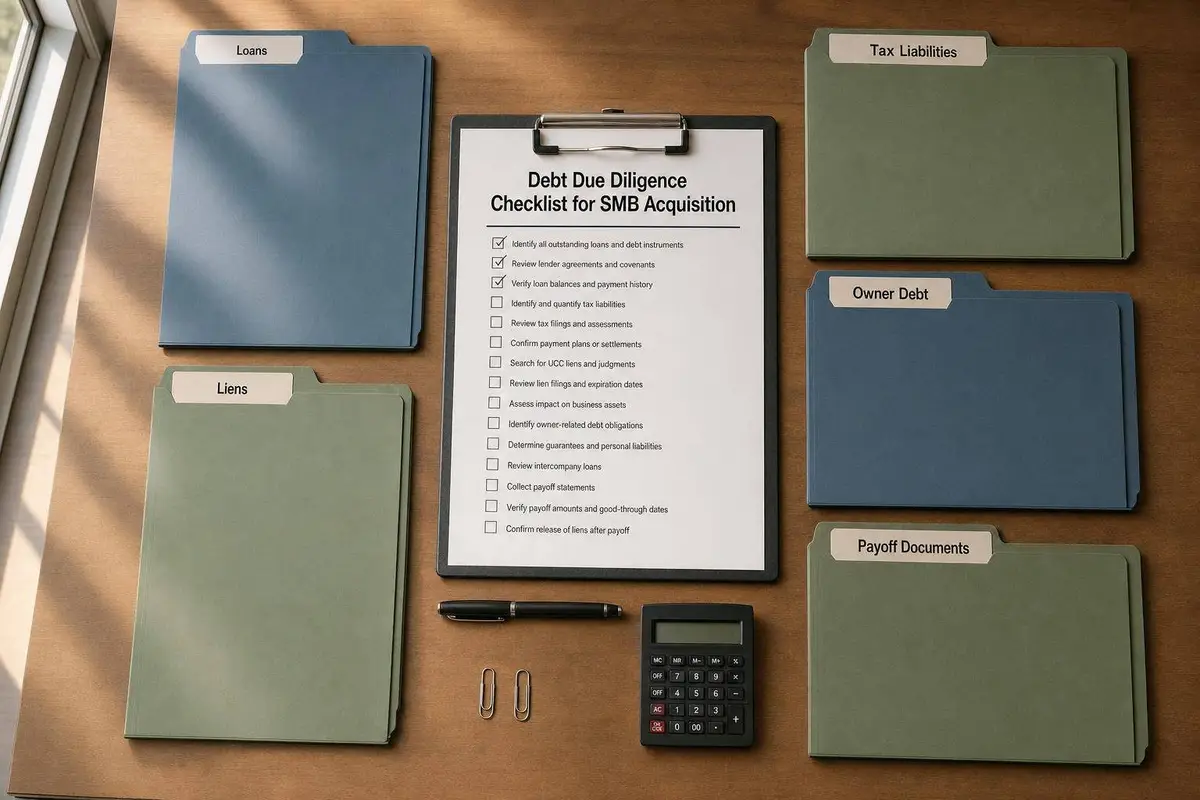
Debt Due Diligence Checklist for SMB Acquisitions
A step-by-step checklist for cataloging loans, leases, tax balances, liens, and owner debt — and collecting the payoff letters and releases you need before funding an SMB acquisition.
 Samson JagorasPrincipal & CEO/CIOAugust 23, 2026
Get a Quality of Earnings analysis you can trust
Our QofE team validates earnings, normalizes add-backs, and de-risks your deal — flat-fee with fast turnaround.
Miss one debt item, and your deal price can change fast. In an SMB deal priced at 5x EBITDA, a hidden $50,000 cost can hit you like $250,000 in effective value.
If I were buying a small business, I’d focus on five things right away:
- List every debt and debt-like item
- Check payment status and default risk
- Review change-of-control and consent rules
- Separate owner debt and tax exposure
- Collect payoff letters, lien releases, and backup docs before funding
This article boils debt diligence down to the parts that affect price, lender approval, and closing. I’d use it to catch hidden liens, unpaid payroll or sales tax, stretched payables, lease issues, and seller-related balances before money goes out. If you are just starting your search, you can find business opportunities that already have clean financial records.
A few points matter most:
- In a stock purchase, I may take the company with its old liabilities.
- In an asset purchase, I may leave many liabilities behind, but some tax claims can still follow the deal.
- SBA 7(a) and bank financing can get blocked if debt service gets too tight.
- A UCC-1 search, county lien search, Form 941 review, and state tax-clearance request can help spot problems early.
Quick comparison
| Area I’d review | What I’d check | Why it matters |
|---|---|---|
| Loans and credit lines | Balances, rates, maturity, guarantees | Affects payoff cash and lender risk |
| Leases and equipment notes | Amendments, transfer rules, end fees | Can delay closing or add cost |
| Payables and accruals | Aging, payroll, deposits, reserves | Can cut value dollar for dollar |
| Taxes | Payroll, sales, property, franchise tax | Can create buyer exposure after close |
| Liens and collateral | UCC-1, county filings, payoff letters | Can block clean asset transfer |
If I can tie each liability to a document, a payoff plan, or a release, I’m in a much better spot before closing.
3 Must-Check Financial Steps Before Buying a Small Business with an SBA Loan
Step 1: Catalog Every Debt and Debt-Like Obligation
Use the data room you already built to create one master schedule of every obligation. Pull from lender statements, leases, tax records, and internal reports. Then list each item with its balance, due date, guarantor, and planned closing treatment.
The goal here is simple: get everything in one place so nothing slips through the cracks.
Loans, Lines of Credit, and SBA Facilities
Start with the debt that's easiest to spot: term loans, revolvers, MCAs, and SBA loans and other financing options.
For each item, tie the current balance directly to a lender statement and reconcile it against bank statements. Don't rely only on the seller's internal records. Those records can help, but they shouldn't be your only source.
For each facility, record:
- The committed limit
- The amount drawn
- The interest rate
- The amortization schedule
- The maturity date
- Whether there's a personal guarantee
These terms shape payoff amount, recourse, and closing risk.
Equipment Financing, Real Estate Leases, and Operating Leases
Equipment notes, vehicle loans, and copier leases should all go on the schedule too.
Pull the original lease and every amendment. That's where deal trouble often hides. An amendment may include renewal rights, consent rules, or termination terms that change what needs to happen at closing.
For each lease, record the monthly payment, expiration date, and any termination penalty.
Payables, Accruals, Tax Balances, and Off-Balance-Sheet Items
This is where buyers often get burned.
Accounts payable, accrued payroll, customer deposits, purchase commitments, and warranty reserves can act like debt even when they don't show up on a standard debt schedule.
Review AP aging reports covering at least the last 24–36 months. If vendor payments drop late in the process, that's a warning sign. It can point to stretched payables.
Flag unpaid sales tax, payroll tax, property tax, and franchise tax balances on their own. These items can create successor liability. Request tax-clearance letters in every operating state.
Also reconcile payroll records to Form 941 and state unemployment filings. That's one of the best ways to catch unpaid payroll taxes or worker misclassification before closing.
| Liability Category | Specific Items to Catalog | Verification Source |
|---|---|---|
| Financial Debt | Term loans, SBA loans, lines of credit, MCAs | Lender statements, bank statements |
| Leases | Real estate, vehicles, equipment, copiers | Original lease + all amendments |
| Operational | AP aging, accrued payroll, customer deposits | General ledger, vendor statements |
| Tax | Sales, payroll, property, franchise taxes | Tax-clearance letters, Form 941 |
| Contingent | Litigation, environmental, warranty claims | Case files, Phase I ESA, UCC-1 search |
Before you lock the schedule, run a UCC-1 search and a county lien search.
These searches can turn up liens on equipment or other assets that never showed up in the seller's records. If an asset is encumbered, flag it for payoff or lien release.
Once the schedule is done, move to payment history, covenant compliance, and closing risk.
Step 2: Verify Payment Status, Covenant Compliance, and Closing Risk
Once your master debt schedule is done, the next job is to confirm that every obligation is current and see whether the deal could trigger a default, payoff, or consent issue that could slow or block closing. Keep the focus on what has to be cleared before funds go out - across loans, leases, and tax balances. Then separate owner debt from the rest and spot any deal-structure risk.
Payment History, Delinquencies, and Amendments or Forbearance Terms
Pull lender statements, lease statements, and any tax payment-plan records to confirm that each obligation is current. At the same time, check for past-due amounts, defaults, amendments, or forbearance terms. Pay close attention to late payments, skipped payments, forbearance agreements, and any other change to the original repayment schedule.
If you find amendments or forbearance terms, ask for the original agreement, every amendment, and each waiver in writing. Those documents can change how a lender responds to a change-of-control request.
Financial Covenants and Operating Restrictions
Review every loan agreement for financial covenants, reporting duties, guarantees, and operating restrictions. Request the full loan agreement, any compliance certificates, and any waiver letters the seller has received. Then recalculate the covenant tests using the company’s financials and the definitions in the agreement.
That matters because a deal can look fine in seller materials and still fail once you run the numbers yourself. Any unresolved breach or waiver should be flagged before closing.
Change-of-Control Clauses, Payoff Fees, and Lender Consents
Review loans, leases, and other material contracts for change-of-control clauses that may require consent, allow termination or renegotiation, or trigger a mandatory payoff. Also check for prepayment penalties and payoff fees, because they affect how much cash you need at closing.
For each obligation, confirm:
- whether it will be assumed or paid off at closing
- whether a payoff letter or third-party consent is needed
- what the closing cash impact will be
Assign payoff letters and consents to the seller, then verify that each item is cleared before funding.
| Obligation | Assumed or Paid Off | Possible Fee or Penalty | Consent / Release Needed | Estimated Closing Cash Impact |
|---|---|---|---|---|
| Loan or credit facility | Assumed or paid off per agreement | Prepayment fee, if any | Payoff letter or consent if required | Principal balance plus any fee |
| Lease | Assumed or terminated per agreement | Termination fee, if any | Landlord consent if required | Legal/admin costs plus any fee |
| Equipment note | Assumed or paid off per agreement | Prepayment fee, if any | Payoff letter or consent if required | Balance plus any fee |
| Line of credit / revolver | Assumed or paid off per agreement | Termination fee, if any | Lender confirmation if required | Drawn balance plus any fee |
| Seller note | Per deal structure | Per note terms | Confirm subordination or payoff terms | As negotiated |
Once third-party debt is mapped to closing, move to owner debt, seller financing, and tax exposure.
Step 3: Review Owner Debt, Tax Exposure, and Deal-Structure Effects
Once you’ve mapped third-party debt, turn to owner-linked obligations, deal terms, and taxes that can shift value at closing. These are the items buyers miss most often, and they can change the numbers in a hurry.
Owner Notes, Shareholder Loans, and Intercompany Balances
Owner and company money often get mixed together on the ledger. Go through the general ledger for shareholder loans, owner draws, and personal expenses charged to the business.
Then verify what’s behind those entries. Use a UCC-1 search and payoff letters to confirm whether any related-party loans are secured by business assets. For each balance, spell out whether it will be paid off, assumed, or reclassified before signing.
If these items stay unresolved, they can affect both closing payoffs and the post-close debt stack.
Seller Notes, Earnouts, and Subordination Requirements
Seller financing is common in SMB deals, but it adds another debt-service burden that lenders review closely. SBA and conventional lenders underwrite seller notes as part of total debt service. If coverage is thin, they may require subordination or standby.
Earnouts can help bridge gaps tied to customer concentration, owner dependence, or disputed add-backs. But they can also lead to post-close price changes through the working capital peg.
That’s why it helps to stress-test the full debt stack, including:
- Senior debt
- Seller note
- Any deferred payments
Run that test against normalized earnings after a market-rate manager salary and recurring capital expenditures.
Tax Liabilities and Asset-vs.-Stock Purchase Exposure
Taxes matter here because the purchase structure decides whether the buyer takes them on. Match each tax issue to the deal structure and confirm what transfers at close.
In an asset purchase, you usually take only the liabilities you explicitly agree to assume. In a stock purchase, you usually inherit the company’s past liabilities, including unpaid taxes and other legacy exposure.
| Tax Category | What to Request | Key Risk |
|---|---|---|
| Federal payroll taxes | Payroll records, tax filings, lien search | Unpaid payroll tax balances |
| Sales and use tax | State returns, tax balance detail | Delinquent filings or assessments |
| State income tax | State filings and account notices | Hidden pre-close tax exposure |
| Tax liens | Federal, state, and county lien search | Claims that may complicate closing |
Ready to Make Your Next Move?
Whether you're buying, selling, or investing — Clearly Acquired gives you the tools, data, and support to close with confidence.
Step 4: Collect the Documents Buyers Need Before Close
With your debt map done and tax risk pinned down, the next job is turning that work into a clean closing file for each obligation. Every item you flagged should have backup on hand: the agreement, latest statement, payoff letter, or lien filing.
Core Agreements and Third-Party Proof
Start with the paperwork that shows the liability is real and spells out what it will take to clear it.
Gather the original signed agreements for each obligation, including loan agreements, promissory notes, security agreements, personal or corporate guaranties, and UCC-1 filings. For leases, pull the original lease plus every amendment.
Request current payoff letters shortly before signing, then update them again before funding. If a lien will be released at closing, add the related UCC-3 termination statement and any escrow instructions tied to that release. For tax exposure, ask for state tax-clearance letters and Form 941 filings so you can verify payroll tax status.
Internal Reports That Validate Balances and Obligations
Next, make sure the company’s books match what outside parties are reporting.
Pull the debt schedule, accounts payable aging, and general ledger detail for each debt account. Then reconcile the debt schedule against bank and lender statements so balances, interest, fees, and payment status line up. Keep board or owner approvals that authorized the debt in the file too. When it makes sense, include UCC-1 and county-level lien search results to confirm collateral and spot any liens that didn’t show up earlier.
Final Pre-Close Debt Summary for Buyers, Lenders, and Counsel
Once the documents are in, roll everything into one pre-close debt summary that the lender, attorney, and seller can all use, or leverage specialized consultation services to ensure accuracy. The goal is simple: one working document for payoffs, assumptions, and releases.
| Debt Summary Item | Details to Include | Purpose |
|---|---|---|
| Loan/Credit Facility | Balance, interest rate, maturity date | Confirm payoff or assumption terms |
| Collateral and Liens | Specific assets pledged, UCC filing status | Ensure clear title at closing |
| Guarantors | Names of personal or corporate guarantors | Coordinate releases of liability |
| Covenants | Financial and non-financial restrictions | Identify potential defaults triggered by the sale |
| Closing Treatment | Payoff, assumption, or refinance | Direct funds flow and legal documentation |
| Document on File | Executed agreement, payoff letter received | Track readiness for closing |
If a lease or loan agreement includes a change-of-control clause, flag whether lender or landlord consent is needed before closing. Each row in the summary should show a clear document status and a confirmed closing treatment before the deal goes to final signature.
Conclusion: The Minimum Debt Checklist to Complete Before Funding
Before funds are wired, complete five checks: catalog every obligation, verify payment status, review change-of-control clauses, isolate tax and related-party exposure, and collect payoff-ready documents.
Once the schedule, review, and document collection are done, there’s one last step left. Do a final pass and make sure every item in the debt schedule has a closing document or release tied to it.
Use this final pre-close check:
| Verification Item | Source Document / Action | Risk Mitigated |
|---|---|---|
| Debt Payoffs | Payoff letters; UCC-1 and county lien searches | Hidden liens; encumbered assets; post-close debt claims |
| Tax Balances | State tax-clearance letters; Form 941; sales tax returns | Successor liability for unpaid payroll, sales, or state taxes |
| Lender Consents | Loan agreements; change-of-control review | Default triggers; non-transferable financing |
| Owner Debt | Shareholder loan agreements; GL detail; add-back schedule | Inflated EBITDA; hidden owner-dependent costs |
| Collateral Status | UCC-1 searches; title searches | Hidden liens or encumbered equipment |
Debt diligence shapes price, financing, and timing. A missed payroll tax balance or an undisclosed equipment lien can force a price renegotiation or delay the closing date.
For buyers organizing diligence and financing, Clearly Acquired can help centralize the process.
FAQs
What counts as debt-like items?
Debt-like items can include deferred revenue, customer deposits, related-party payables, unpaid taxes, and other liabilities that can change the purchase price or hit cash flow after closing.
To verify them, go back to the source records instead of relying only on the seller’s summaries. That means checking loan agreements, UCC-1 and lien searches, tax filings, payroll records, bank statements, and accounts payable aging.
How do taxes still follow an asset deal?
Taxes can still stick to an asset deal if the business has unpaid tax bills. That’s why it helps to verify tax status with state tax-clearance letters and compare tax returns with bank deposits. If the numbers don’t line up, that’s a red flag.
More broadly, confirm liabilities from source documents, search for liens, review debt-like items, and check employee obligations and contract terms that could carry over to the buyer after closing.
When should payoff letters be ordered?
Order payoff letters late in due diligence, close to closing, after you’ve checked every debt against source documents.
Before that, verify short- and long-term debt, tax balances, hidden liabilities, employee accruals, and asset liens. Don’t rely on seller summaries alone.
Related Reading
- Loan Covenant Risks for Business Buyers
- SBA 7(a) Loans: The Complete Guide for Business Buyers
- 5 Seller Note Structures for SMB Acquisitions
- Historical Cash Flow Analysis During Due Diligence
- Fraud Risk in Due Diligence Processes
- SBA Loan Liquidation Guidelines
Sources & Further Reading
De-risk your deal with a Quality of Earnings report
Independent, deal-ready earnings analysis that buyers, sellers, and lenders trust.
About the author
Principal & CEO/CIO
Samson Jagoras has 15+ years across finance, real estate, and business acquisitions. He began his career as a Futures & Commodities broker and later served as Chief Strategy Officer of an INC 500 marketing and technology firm, helping scale revenue from $1M to over $100M. Today he buys, builds, and advises a portfolio of companies with a focus on M&A, capital allocation, and operational strategy.