HR Due Diligence Q&A: Handbooks and Policies
Checklist for reviewing employee handbooks, policies, and acknowledgments in M&A, plus lookback guidance, counsel triggers, and deal impacts.
 Samson JagorasPrincipal & CEO/CIOSeptember 13, 2026
Get a Quality of Earnings analysis you can trust
Our QofE team validates earnings, normalizes add-backs, and de-risks your deal — flat-fee with fast turnaround.
If I had to boil this down to one point, it’s this: a missing or old handbook can turn a small HR review into a deal risk. In most cases, I’d ask for the current handbook, all key stand-alone policies, acknowledgment records, and at least 3 years of prior versions right away. If there are wage issues, multi-state teams, or active claims, I’d push that lookback to 5 years or more.
Here’s the short answer for buyers, sellers, and investors:
- Ask early for the current HR policy set
- Check signed employee acknowledgments
- Review older versions tied to claims, terminations, and pay practices
- Send weak or risky policy language to employment counsel
- Treat policy gaps as deal-term issues, not just admin issues
A handbook does more than explain rules. It can show whether the company had written guidance on overtime, leave, harassment, discipline, safety, and complaint handling when past events happened. That matters because wage and hour claims can reach back up to 3 years under the FLSA for willful violations, and missing records often lead buyers to ask for price cuts, escrows, or special indemnities.
My read: good handbook diligence should tell you two things fast:
- Are the HR gaps mostly filing and recordkeeping problems?
- Or do they point to legal risk that could cost money after close?
Here’s a quick snapshot:
| Item to Review | What I’d Look For | Why It Matters |
|---|---|---|
| Current handbook | Effective date, state addenda, core policy coverage | Shows present HR rules |
| Stand-alone policies | Leave, wage, safety, remote work, conduct | Fills gaps outside the handbook |
| Acknowledgments | Signed forms or completion rates | Shows employees got notice |
| Prior versions | At least 3 years; 5+ for higher-risk deals | Ties policy language to past events |
| Counsel review | At-will, overtime, leave, complaint language | Can affect reps, escrow, and close timing |
So if you’re reviewing an acquisition, selling a company, or backing a deal, I’d treat handbook diligence as a fast way to check whether HR risk is small, fixable, or expensive.
HR's Role In M&A: Due Diligence, Culture, and Integration | with Diane Dooley

sbb-itb-a3ef7c1
Core HR Documents to Request in Due Diligence
Start by asking for the full current HR policy set. This request should go out early. Buyers and investors need a complete set of current, written HR documents to judge legal exposure and how well the company manages people.
Current Handbook, Policy Manuals, and Acknowledgment Forms
Request the current employee handbook, any manager or supervisor manuals, and stand-alone policies outside the handbook.
The handbook shows how the company explains the basics to employees: at-will employment, equal employment opportunity commitments, wage and hour rules, leave policies, discipline steps, complaint channels, and safety practices. Manager manuals usually go a level deeper. They can show how leaders are told to handle performance issues, document problems, run investigations, and escalate concerns. That matters when a buyer is sizing up employee risk and turnover.
Stand-alone policies also tell you a lot. Policies on information security, remote work, social media, or incentive compensation can show whether the company relies on informal habits or uses written, repeatable processes.
Signed employee acknowledgments are a big deal. They show that employees received the handbook and key policies, which helps support notice and enforcement arguments. Without them, employees can say they were never told about the rules. That can weaken the defense and push up the cost of settling claims. Missing or uneven acknowledgments are worth flagging early.
Compliance-Critical Policies for Wage, Leave, Conduct, and Safety
Some policies carry more legal weight than others. The table below covers the areas that most directly affect exposure and lender confidence in U.S. deals.
| Policy Category | Why It Matters in Diligence |
|---|---|
| Wage & hour / timekeeping | Supports FLSA compliance; gaps here are a common source of class and collective actions |
| Overtime & classification | Helps assess exempt/non-exempt misclassification risk, which can trigger purchase price adjustments or escrow requirements |
| PTO, vacation & sick leave | State-specific payout and accrual obligations can create balance sheet liabilities |
| FMLA & state leave analogs | Required for covered employers; missing language raises interference and retaliation risk |
| Anti-harassment, anti-retaliation & EEO | Foundational for Title VII defense; lenders in higher-risk industries often ask about these directly |
| Code of conduct & discipline | Shows structured process over ad hoc decisions; reduces wrongful termination exposure |
| Safety & workers' compensation | Buyers and lenders evaluate injury trends, OSHA compliance, and return-to-work programs |
| Remote work & social media | Increasingly standard; gaps raise cybersecurity, reputational, and data protection risk |
If the company operates in more than one state, ask for state addenda too. A one-size-fits-all handbook can be a red flag. State rules often differ on meal breaks, paid sick leave, anti-harassment training, and other day-to-day issues.
What Sellers Should Organize Before the Data Room Opens
Before the data room opens, sellers should line up these files in the same order buyers are likely to review them. Teams that prepare HR materials ahead of time tend to move through diligence with fewer delays. The steps are simple: mark current versions clearly with effective dates, and pull out drafts or old versions that could muddy the record.
It also helps to prepare a policy index. That index should list each document, its effective date, and prior versions with their date ranges. Why does that matter? Because buyers need to know which rules were in place at the time of a past employee issue or claim.
Along with the index, gather signed acknowledgments. Be ready to share either the full set or a documented summary of completion rates, such as the percentage of current employees who signed the latest handbook acknowledgment.
How Far Back to Review Handbook and Policy Versions
How Many Years of Handbook Versions to Request
Start with the current handbook. Then work backward to the dates tied to any claim, complaint, or major policy change.
For most SMB acquisitions, ask for at least 3 years of handbook and material policy versions. That lines up with the FLSA lookback period for wage claims, which can stretch to three years for willful violations.
Some deals need a longer window. For multi-state operations, complex pay plans, unionized operations, or businesses with a heavy complaint record, push that request to 5 years or more.
If there are pending or threatened claims, don't rely on a standard lookback alone. Ask for the policy versions that were in effect during those exact periods. And if records are spotty, get whatever versions still exist plus any informal practices that worked like policy in day-to-day use.
Why Older Versions Matter in Claims and Price Discussions
The current handbook shows where the company stands now. Older versions show what rules were in place when the problem happened.
That's the part that matters for valuation and indemnity analysis. Version history can either support the company's story or poke holes in it, because it shows whether the written rules matched what people were doing during the exposure period.
An old handbook with gaps or weak language can point to looser compliance habits. If those older versions show missing or thin policies during a time linked to known complaints, buyers often react in a few common ways:
- asking for a purchase price adjustment
- seeking targeted indemnities
- setting up escrows sized to the possible exposure
Keep every version with its effective date. Also keep the version tied to each termination, discipline event, or wage decision. Any versions tied to disputes should go to employment counsel next.
Ready to Make Your Next Move?
Whether you're buying, selling, or investing — Clearly Acquired gives you the tools, data, and support to close with confidence.
When Legal Counsel Should Review HR Policies
Issues That Should Trigger Employment Counsel Review
An internal HR review can confirm that the right documents exist. Employment counsel looks at something different: whether the wording creates legal duties, weakens the company’s position, or runs into state or federal law.
After the documents are gathered, the next step is to check whether the language is legally safe. Counsel review should be triggered when a handbook is missing an adequate at-will disclaimer or when it includes promises about discipline, termination, severance, or bonuses. Courts have treated handbook language as potentially enforceable even when disclaimer language is present.
Counsel should also review any policy that deals with overtime and exemption status, leave administration, contractor classification, or anti-harassment and complaint procedures. In some states, employers must maintain written harassment policies and complaint forms. For multi-state companies, this gets tougher fast. A handbook that works in one state may not hold up in another where wage, leave, and notice rules are stricter.
| Policy Area | Counsel Focus |
|---|---|
| At-will disclaimer | Evaluates whether it is effective under applicable state law |
| Leave policy | Determines whether the policy may create enforceable rights beyond statutory minimums |
| Overtime/classification | Evaluates FLSA, exemption, and misclassification exposure |
| Harassment/complaint procedures | Assesses whether language meets state-specific requirements |
That legal review often decides whether the matter stays a diligence issue or turns into a deal issue.
How Counsel Findings Flow Into Reps, Indemnities, and Close Conditions
When counsel finds a real problem, the deal terms should shift with it. Buyers often ask for broader employment reps covering overtime, minimum wage, meal and rest break compliance, and worker classification. Known issues should be spelled out in the disclosure schedules, not tucked away. Where the risk is harder to measure, buyers often seek special indemnities with longer survival periods or an escrow sized to expected defense costs and settlement exposure.
Serious problems can also become closing conditions. That may mean the seller has to fix the issue before funding, which can lead to lender resistance and slow the closing timeline. Sellers that clean up these problems before opening the data room sidestep that pressure.
How Missing or Outdated Policies Affect Deal Risk and Close Certainty

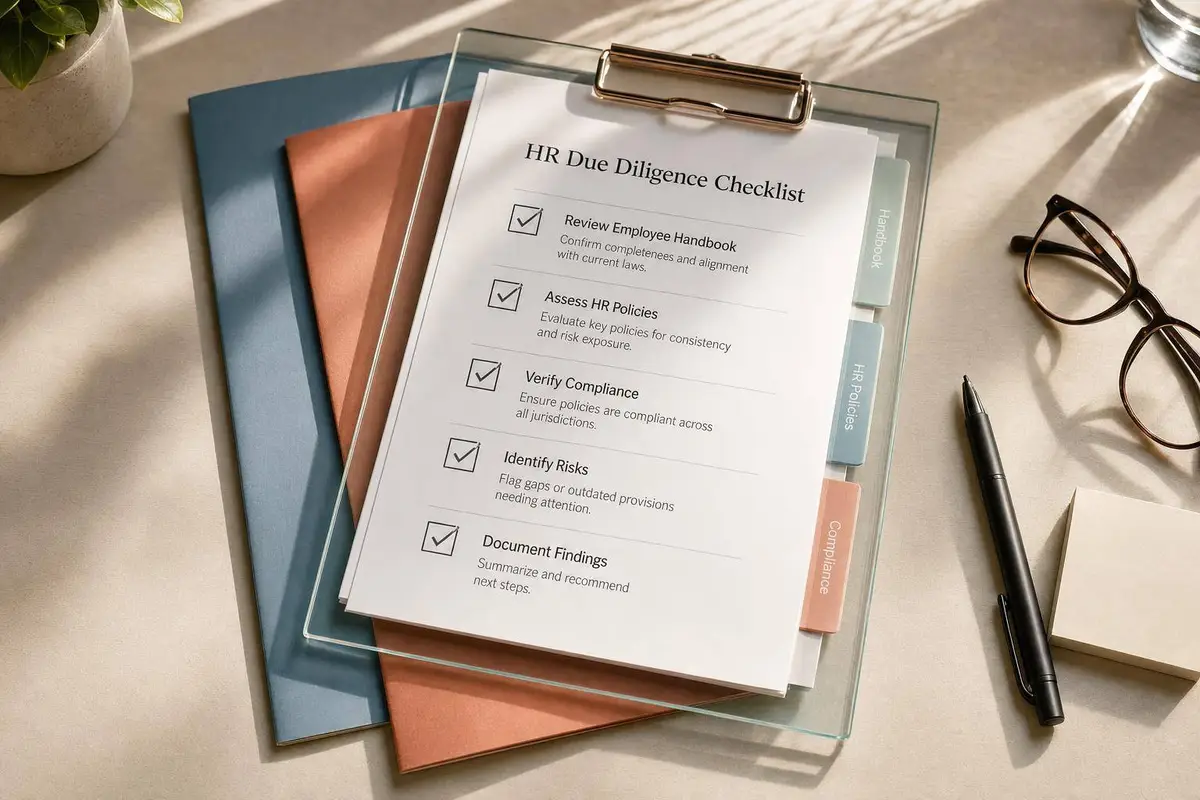
HR Due Diligence: Policy Gaps vs. Deal Risk Impact
What Missing Policies Signal Beyond the Handbook Itself
A missing or outdated handbook is rarely just a paperwork issue. Sometimes it’s a fixable documentation gap, especially if the company’s day-to-day practices are steady and backed up in other records. But when those gaps line up with messy overtime, leave, or conduct practices, the problem runs deeper. At that point, diligence teams start asking a tougher question: are HR decisions being handled in a standard, lawful way at all?
The clearest warning signs show up when you compare policy gaps against operating records. No written overtime policy plus payroll records with manual adjustments or uneven overtime treatment? That points to more than missing paperwork. No formal leave policy plus personnel files showing different leave decisions for similar employees? That can trigger discrimination and leave-compliance concerns. The handbook gap gets attention, but the real story sits underneath it.
| What's Missing | What It May Signal |
|---|---|
| No written overtime or exemption policy | Potential FLSA misclassification and unpaid overtime exposure |
| No leave policy (FMLA, ADA, state sick leave) | Inconsistent approvals, possible discrimination claims |
| No anti-harassment or complaint procedure | Elevated harassment risk and weaker legal defenses |
| No signed acknowledgment forms | Employees may dispute awareness of key policies |
| No clear disciplinary documentation standards | Ad hoc manager decisions and harder termination defenses |
How Policy Gaps Change Valuation, Terms, and Lender Confidence
In lower-middle-market deals, missing or outdated HR policies can affect valuation because buyers are trying to price two things at once: the cost to clean it up and the risk of hidden liability. If the business looks mostly compliant but the documentation is thin, buyers may still move ahead at the original price. They may just add a few buffers, like higher working capital targets, limited earn-outs tied to clean post-close operations, or closing conditions that require updated policies before funding. If the gaps point to bigger exposure, buyers are more likely to push for price cuts, higher escrows, or holdbacks.
Lenders notice this too. In SBA and bank-backed deals, clear HR policies can ease concerns around contingent liabilities and cash flow disruption. When diligence turns up missing wage-and-hour policies or other signs of weak HR controls, lenders may ask for legal opinions or HR consulting reports. They may also make funding subject to remediation, tighten covenants, reduce leverage, or require cleanup before close. A solid remediation plan can keep the deal on track, but messy HR records usually shrink lender appetite and make the closing timeline less certain.
Conclusion: What Good Handbook Diligence Should Accomplish
Good handbook diligence should answer one central question: are the HR issues mainly organizational, or are they legal at the core? That line matters because it shapes price, deal structure, escrow sizing, lender confidence, and post-close integration planning.
For buyers, that usually means starting with the current handbook and core policies, then reviewing older versions with a sensible lookback. It also means sampling personnel files and payroll records to see whether practice matches policy. For sellers, clean and current HR documentation cuts friction, lowers re-trading risk, and helps support a stronger valuation. For investors and lenders, solid policies point to disciplined operations and lower execution risk.
Platforms like Clearly Acquired can help organize diligence findings, coordinate employment counsel and HR specialists, and help buyers shape deal terms and financing around what the HR review turned up. That way, policy gaps become a cleanup plan instead of a closing problem.
FAQs
What if acknowledgments are missing?
Missing acknowledgments can turn into a due diligence problem fast, especially when policies are old, patchy, or missing altogether. Start by asking for the current handbook and all current policies, along with prior versions from the last three to five years. Then review them for compliance gaps and any risks that still haven’t been fixed.
Counsel should get involved early on issues like restrictive covenants, severance, and worker classification. If policies or acknowledgments are missing, that can lower close certainty. In practice, buyers may deal with that through purchase price adjustments, escrow holdbacks, or closing conditions.
How do policy gaps affect valuation?
Start by reviewing current employee handbooks, employment contracts, contractor agreements, and payroll summaries. At a minimum, make sure the latest versions line up with current federal and state rules, including wage and hour, anti-harassment, and leave policies.
Bring in legal counsel early for worker classification, restrictive covenants, or union agreements. Missing or outdated policies can create successor liability and may lead to price adjustments, indemnification, or pre-closing conditions.
When should employment counsel step in?
Employment counsel should get involved early in HR due diligence. That matters most when reviewing restrictive covenants, worker classification, and other job-related liabilities that can change deal structure or valuation.
Missing or outdated handbooks and policies can also make closing less certain. In some cases, they lead to post-closing fixes, escrow holdbacks, or indemnification clauses.
Related Reading
De-risk your deal with a Quality of Earnings report
Independent, deal-ready earnings analysis that buyers, sellers, and lenders trust.
About the author
Principal & CEO/CIO
Samson Jagoras has 15+ years across finance, real estate, and business acquisitions. He began his career as a Futures & Commodities broker and later served as Chief Strategy Officer of an INC 500 marketing and technology firm, helping scale revenue from $1M to over $100M. Today he buys, builds, and advises a portfolio of companies with a focus on M&A, capital allocation, and operational strategy.