LOI Q&A: Binding Terms in Business Acquisitions
Treat LOIs as split documents: process clauses (exclusivity, confidentiality, expenses, deposits, venue) often bind immediately.
 Samson JagorasPrincipal & CEO/CIOSeptember 17, 2026
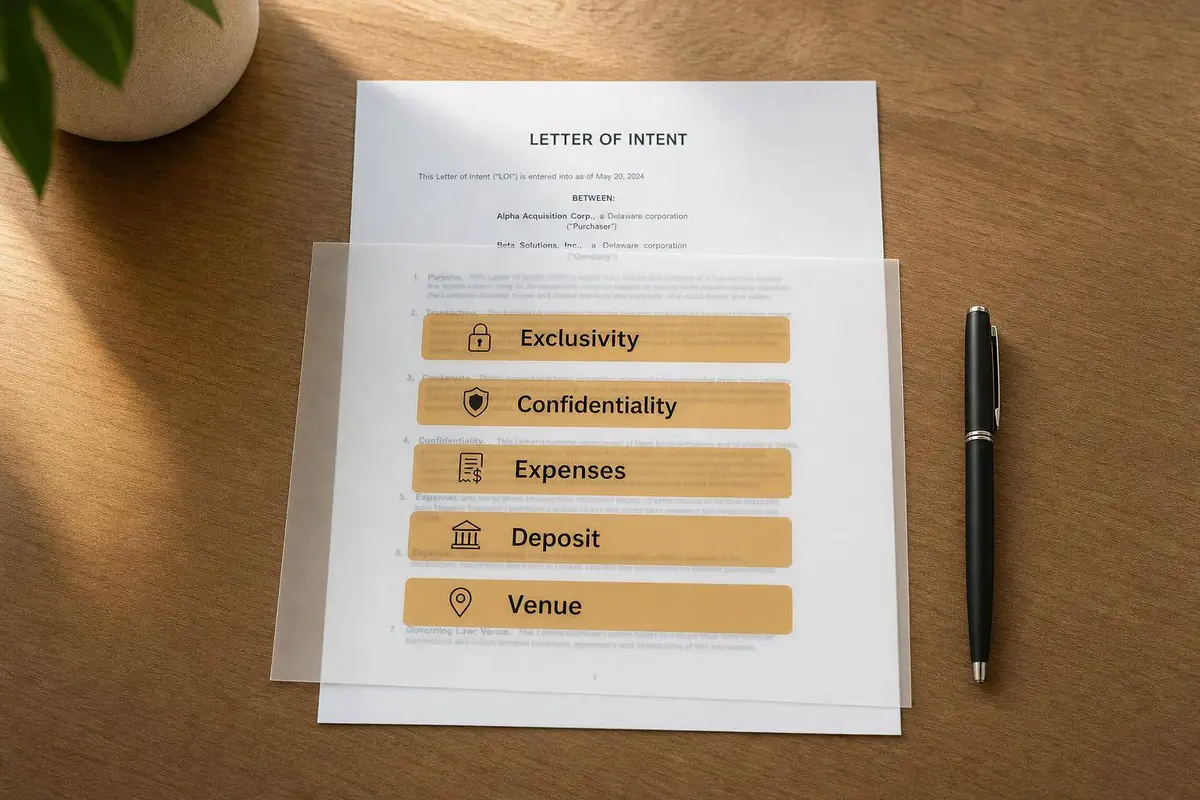
A “non-binding” LOI can still bind you right away. In many U.S. business deals, the money terms often wait for the purchase agreement, but process terms like no-shop, confidentiality, expenses, venue, and deposits may apply as soon as the LOI is signed.
If I were reviewing this article fast, here’s what I’d want to know first:
- Price and deal structure are usually not final
- Exclusivity and confidentiality often are final for now
- Words like “shall” and “must” can create duties
- A no-shop clause can block the seller from taking other offers
- Confidentiality may last 1 to 3 years after the LOI ends
- Expense clauses and deposits can put real money at risk before closing
- Governing law and venue can shape where a fight happens
Bottom line: I’d treat an LOI as a split document. One part sketches the deal. The other part controls conduct before closing. If that split is not clear, one side can end up bound in ways it did not expect.
A useful fact from the article: working capital is often a deal pressure point, and confidentiality periods in small and lower-middle-market deals often run 1 to 3 years. That means even a short LOI can carry duties long after talks stop.
| LOI term | Usual treatment |
|---|---|
| Purchase price | Non-binding |
| Deal structure | Non-binding |
| Closing conditions | Non-binding |
| Exclusivity / no-shop | Binding |
| Confidentiality | Binding |
| Diligence access | Binding |
| Expenses | Binding |
| Deposit / break fee | Binding |
| Governing law / venue | Binding |
| Public statements | Binding |
So if you sign an LOI, don’t focus only on the headline price. I’d check the process clauses first, because that’s where legal and cash risk often starts.

LOI Terms: Binding vs. Non-Binding in Business Acquisitions
Key Terms to Know When Negotiating a Letter of Intent

sbb-itb-a3ef7c1
Which LOI terms are actually binding in a business acquisition?
Once you separate business terms from process terms, the next issue is simple: which parts bind right away, and which parts wait for the final purchase agreement?
That matters because some LOI clauses can limit what each side does before diligence is done.
| Clause | Typical Status |
|---|---|
| Purchase price | Usually non-binding |
| Deal structure (asset vs. stock, consideration mix) | Usually non-binding |
| Closing conditions | Usually non-binding |
| Exclusivity / no-shop | Often binding |
| Confidentiality | Often binding |
| Diligence access | Often binding |
| Expenses | Often binding |
| Deposit / break fee | Often binding |
| Governing law / venue | Often binding |
| Public announcements | Often binding |
Commercial terms that are usually non-binding
Price, deal structure, and closing conditions are the commercial points most likely to stay non-binding in a properly drafted LOI. Just because those terms are detailed doesn't mean they bind.
For example, an LOI might spell out a cash-at-close setup and an earnout tied to future performance. Even then, those terms can still be non-binding if the document says they remain subject to the definitive agreement. Financing terms can move during underwriting, so parties often leave room to adjust them until the final agreement is signed.
In practice, the drafting standard is pretty clear. For commercial terms, parties usually use conditional language such as the parties currently intend, the anticipated purchase price, or subject to adjustment. They avoid mandatory words like shall or agrees to when they do not want those points to bind.
Process and transaction terms that are often binding
In day-to-day deal work, the clauses that tend to matter most are exclusivity and confidentiality. But they are not alone. Exclusivity, confidentiality, diligence access, expense allocation, deposits, governing law, venue, and limits on public announcements are often written as binding in most LOIs. That means they apply right away and can survive even if the LOI itself ends.
Once a clause says the seller must stop shopping the deal, keep shared data private, or pay certain costs, that promise can create actual risk. Courts can enforce binding process clauses even when the LOI, taken as a whole, is described as non-binding, as long as the clause itself is specific enough. A seller that shops the deal during an exclusivity period can face breach claims.
The safest move is to label binding clauses plainly and directly so neither side confuses them with the non-binding business terms.
How no-shop and confidentiality clauses work in practice
No-shop and confidentiality clauses create the fastest legal exposure in an LOI. One controls the deal process. The other controls information. Start with exclusivity, because it limits what the parties can do before diligence is done.
No-shop clauses: what the seller can and cannot do
A no-shop clause bars the seller from soliciting, encouraging, or negotiating competing offers during the exclusivity period.
That sounds simple. In practice, the friction usually starts with inbound interest. If another buyer shows up on their own, what happens next? The LOI should say whether that interest must be disclosed, rejected, or put on hold until exclusivity ends. If that process is fuzzy, you're leaving room for a fight.
Exclusivity can also be tied to milestones instead of a fixed end date. For example, it may last until diligence items are delivered or SBA 7(a) financing is approved. That gives the buyer more protection while diligence is still active. But the seller needs to read those triggers closely, because the event that extends the period and the event that ends it can shift leverage in a big way.
Long exclusivity with no checkpoints can tilt the process toward the buyer, especially if diligence drags on.
Exclusivity controls conduct during diligence. Confidentiality controls information after the process stops.
Confidentiality after the deal dies: what stays protected
Confidentiality duties usually survive the LOI. So even if the deal falls apart, the information shared during the process is still protected. In many small business and lower-middle-market transactions, that survival period runs 1 to 3 years after termination, and trade secrets may stay protected longer under the law.
The clause often covers financials, customer lists, employee data, lender materials, operational data, and even the fact that the LOI exists. That last piece can become the flash point when a deal dies. A lot of seller-buyer disputes start over what can still be used or disclosed after termination.
One point that gets missed: an LOI confidentiality clause often adds to a standalone NDA instead of replacing it. If the parties signed an NDA before the LOI was executed, both documents may apply.
| Clause Feature | Buyer Impact | Seller Impact | Typical SMB Treatment |
|---|---|---|---|
| No-shop / exclusivity | Gives protected time for diligence and financing | Limits the seller's ability to work with competing bids during the exclusivity period | Often tied to a fixed period or milestones |
| Unsolicited inbound interest | Buyer expects notice and continued exclusivity protection | Seller should have clear notice and handling protocols | Should be addressed directly in the LOI |
| Confidentiality scope | Gives access to proprietary financials, customer lists, and operational data | Protects sensitive data from competitors and employees if the deal fails | Covers financials, lender materials, and even the LOI's existence |
Ready to Make Your Next Move?
Whether you're buying, selling, or investing — Clearly Acquired gives you the tools, data, and support to close with confidence.
Where legal risk starts in a non-binding LOI
A non-binding LOI can still create enforceable duties. The risk usually starts when the document uses mandatory language for process terms.
Good-faith negotiation, ambiguous wording, and unintended obligations
The main issue isn't the label. It's the wording that creates duties even when the LOI says it's non-binding.
The biggest drafting trap is mixed language. If an LOI calls itself "non-binding" in one section but uses mandatory terms like "shall" or "must" somewhere else, you've got ambiguity. That's where trouble begins.
Promises to negotiate in good faith can be enforceable. So if you don't want a duty to keep negotiating, don't write one by accident. If one side walks away without a solid reason, that kind of language can create actual exposure.
A safer approach is simple:
- Mark binding clauses clearly
- Keep commercial terms expressly non-binding
Expense clauses, deposits, access rights, and forum selection
The risk doesn't stop with negotiation language. A few standard boilerplate clauses can create immediate financial and procedural exposure, even if the deal never closes.
Expense reimbursement clauses can require one side to pay the other side's legal, accounting, or diligence costs if the deal ends under stated conditions. Without a dollar cap and a clear trigger, a party that ends negotiations could get stuck with uncapped third-party fees. The usual fix is to set a specific cap and tie payment to objective events.
Deposits can create instant risk too. A deposit puts buyer cash on the line before diligence is done. Put the money in escrow and spell out the refund terms with precision.
Diligence access rights can be tough on sellers. Broad access can disrupt day-to-day operations and create data-security risk if the deal falls apart. Sellers should limit the scope and timing of access. They should also require confidentiality protections for advisors and lenders before sharing sensitive materials.
Governing law and venue selection clauses decide which state's law applies and where disputes will be heard. That can change cost, location, and how a court reads the binding parts of the LOI. The safer move is to pick a familiar, practical forum that doesn't tilt the field too far for either side.
| Clause | Risk Type | Typical Exposed Party | Common Drafting Fix |
|---|---|---|---|
| Good-faith negotiation language | Unintended duty to keep negotiating; damages for ending negotiations | Buyer | Use aspirational language like "currently intends"; avoid "shall negotiate" |
| Expense reimbursement | Uncapped out-of-pocket costs if the deal terminates | Buyer or seller, depending on who agrees to reimburse | Set a specific dollar cap; tie payment to clear trigger events |
| Nonrefundable deposit | Cash loss before diligence is complete | Buyer | Use escrow; define precise refund conditions; avoid nonrefundable deposits at the LOI stage |
| Diligence access rights | Operational disruption; data leakage; confidentiality breach | Seller | Limit scope and schedule; require confidentiality protections for advisors and lenders |
| Governing law / venue selection | Litigation cost; venue disadvantage; unfamiliar legal standards | Whichever party would be forced into an unfavorable forum | Choose a familiar jurisdiction and keep the forum practical for both sides |
The key point is simple: the label doesn't bind anyone on its own. The clause wording does.
Conclusion: How to structure binding LOI terms without overcommitting
The last drafting step is simple in theory but easy to botch in practice: separate binding process terms from non-binding deal terms. Most of the risk comes from fuzzy language.
Once you've decided which LOI terms should bind, the next move is to draft those carve-outs with care.
Label each binding clause clearly. Say outright that exclusivity, confidentiality, governing law, and expenses are binding. Then state that price and deal structure are non-binding unless you mean for them to bind.
Match the no-shop period to the diligence and financing schedule, or add extension rights tied to objective milestones. That keeps the timeline grounded in what the deal actually needs.
Be specific about confidentiality and expenses. Say which document controls after signing - the original NDA or the LOI's confidentiality clause - and whether that obligation survives if the deal dies. For expenses, set a clear cap and define what triggers reimbursement.
Key points to carry into the next LOI
Use this checklist before you send or sign an LOI:
- Review governing law and forum selection before signing. Those terms belong in the binding carve-out and can shape how a dispute plays out.
- Treat the LOI as the setup for later talks on indemnities, earnouts, and working capital.
- Get the binding terms right early to cut down on later disputes.
- Keep the LOI clean and direct so the deal can keep moving without avoidable friction.
FAQs
Can an LOI be enforceable even if it says non-binding?
Yes. In an SMB acquisition, an LOI is often mostly non-binding. But two parts are often binding: confidentiality and exclusivity/no-shop.
Confidentiality usually stays in force even if the deal falls apart. In many cases, it lasts around 2–5 years and includes rules on returning or destroying materials and using the information only for limited purposes.
The legal risk tends to show up when the LOI includes binding promises or uses loose wording. A common example is undefined exclusivity, which can create room for disputes.
How long do confidentiality obligations usually last after an LOI ends?
Confidentiality duties often stay in place after an LOI ends, but only if the clause is binding and clearly says how long it continues. Most other LOI terms, by contrast, are non-binding.
Exclusivity, often called a no-shop clause, is also usually binding. In most deals, it runs for 30 to 90 days. Once parties sign binding terms, legal risk starts because those terms create formal obligations.
What should buyers and sellers negotiate hardest in an LOI?
Buyers and sellers need to pay the closest attention to the binding terms in an LOI, especially confidentiality, exclusivity, and good-faith negotiation.
Exclusivity, often called a no-shop clause, usually stops the seller from weighing other offers for 30 to 90 days while the buyer finishes due diligence. Confidentiality often stays in place even if the deal talks fall apart, which can include returning or destroying sensitive information.
Related Reading
About the author
Principal & CEO/CIO
Samson Jagoras has 15+ years across finance, real estate, and business acquisitions. He began his career as a Futures & Commodities broker and later served as Chief Strategy Officer of an INC 500 marketing and technology firm, helping scale revenue from $1M to over $100M. Today he buys, builds, and advises a portfolio of companies with a focus on M&A, capital allocation, and operational strategy.