Representations and Warranties in SMB Acquisitions
If diligence finds a risk and the contract doesn't address it, the buyer usually keeps that risk—tighten reps, caps, baskets, and escrows.
 Samson JagorasPrincipal & CEO/CIOSeptember 15, 2026
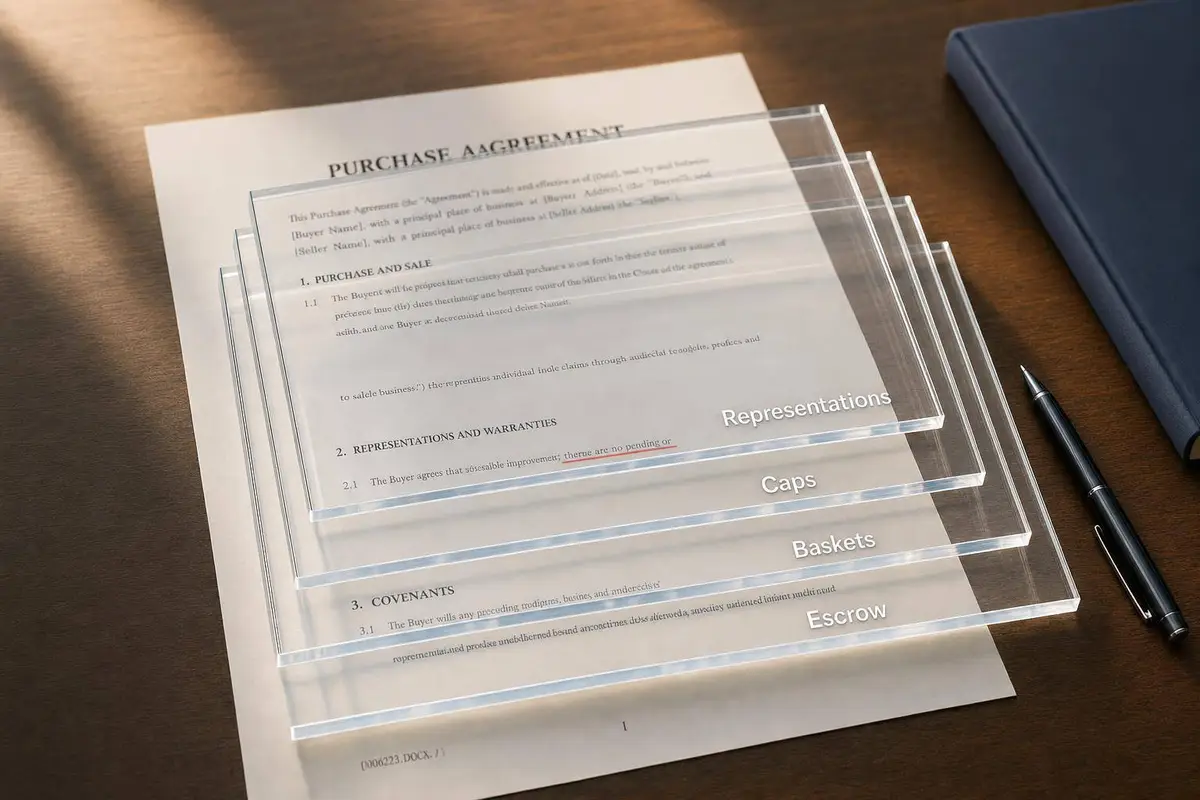
If I miss weak reps, I can end up paying for the seller’s old problems after closing.
Here’s the short version: reps and warranties tell me what facts the seller is standing behind, and the indemnity section tells me whether I can get paid if those facts are wrong. In a small business deal, that matters fast. A hidden $150,000 sales tax bill on a $3,000,000 acquisition can hit cash flow, debt service, and working capital on day one.
Before I sign, I want to check four things right away:
- Core reps: financials, taxes, customers, employees, compliance, and authority
- Claim mechanics: baskets, caps, fraud carve-outs, survival periods, escrows, and setoff rights
- Drafting traps: soft materiality language, weak knowledge limits, and vague disclosure schedules
- Diligence fit: every known issue should show up in a rep, schedule, covenant, price change, or escrow term
A few numbers matter here:
- General rep survival is often 12 to 24 months
- Escrows in SMB deals often run 5% to 15% of purchase price
- Baskets often land around 0.5% to 1.5%
- A 20% cap on a $3,000,000 deal limits many general rep claims to $600,000
My bottom line: if diligence found a risk and the agreement does not deal with it, I’m probably keeping that risk.
This article explains how I read the rep package, where buyers often get stuck, and what I would tighten before signing.
Representations and Warranties in Mergers and Acquisitions (M&A)

sbb-itb-a3ef7c1
The Core Seller Reps Buyers Should Review First
Some reps matter a lot more than others.
A few are basic cleanup items. Others are there for one reason: to keep the buyer from eating a big pre-closing problem after the deal is done. At a basic level, every rep answers the same question: if there was a hidden issue before closing, should the seller still be on the hook for it afterward?
The reps in this section - financials, taxes, customers, employees, and authority - deserve the first pass because that's where many serious fights start. Claims data shows most post-closing disputes come from rep breaches, led by tax issues, then employee matters and undisclosed liabilities. So if you're triaging risk, start where the cash exposure is most likely to show up: financials, taxes, customers, employees, and authority.
Financial Statements, Undisclosed Liabilities, and Working Capital
This rep says the seller's financial statements - usually the last two to three fiscal years plus year-to-date numbers - were prepared the same way as in prior periods, fairly present the company's financial condition, and don't contain material misstatements. That sounds simple. In practice, it can get messy fast.
A lot of SMBs run on QuickBooks and use cash accounting. That can blur the picture. Liabilities may sit in the shadows, and EBITDA can look better than it should.
Once the buyer has the books framed the right way, the next step is obvious: what's missing from them?
That's where the undisclosed liabilities rep comes in. It covers obligations that never showed up on the balance sheet at all, such as unrecorded vendor payables, pending but unbooked lawsuits, informal promises to employees, or accrued expenses that were never entered into the books. A solid version says the business has no liabilities except for:
- liabilities shown on the balance sheet
- liabilities incurred in the ordinary course after the balance sheet date
- liabilities listed on a disclosure schedule
That middle carve-out matters. Buyers should read "ordinary course" language with care. If it's drafted too loosely, it can give cover to large accrued expenses that should have been called out.
Working capital is a separate test. It asks whether the company has enough current assets to keep operating without the buyer having to plug a cash hole on day one. In plain English: are the receivables collectible, is the inventory usable, and are the current liabilities fully reflected?
| Rep Category | What It Covers | Primary Risk Mitigated |
|---|---|---|
| Financial Statement Accuracy | Historical P&L and balance sheet correctness; consistent accounting application | Overpaying based on inflated EBITDA or manipulated margins |
| Undisclosed Liabilities | Obligations not shown on the balance sheet (off-book debts, pending litigation, unrecorded accruals) | Unexpected post-close cash outflows for pre-closing events |
| Working Capital | Quality of current assets (AR collectability, inventory condition) and completeness of current liabilities | Paying for uncollectible receivables or inheriting a cash-starved operation |
Taxes, Customers, and Supplier Concentration
Tax reps should cover five specific points: timely filing of all required federal, state, and local returns; payment of all taxes shown as due; proper withholding and remittance of payroll taxes; compliance with sales and use tax rules that apply to the business; and no active audits or written notices of deficiency.
This is one of those areas where a problem can sit quietly for years and then land all at once.
Multi-state service businesses are often exposed here. A company may serve customers across state lines, collect sales tax only in its home state, and never register or file in nearby states. That can turn into a multi-year assessment after closing. And if the buyer used debt to fund the deal, that kind of tax bill can hit debt service hard.
Taxes create direct liability. Concentration creates revenue shock.
Customer and supplier reps deal with revenue fragility. A standard version lists the top customers and suppliers and says none has threatened to terminate the relationship or make a material cut in volume. That's a start, but buyers usually need more. They should press for wording that covers discussions about price cuts, RFP activity, or expected volume reductions - not just formal notices of termination.
A simple rule of thumb helps here:
- one customer above 20%–25% of revenue
- one supplier above 30%–40% of key inputs
Once a business crosses those levels, tighter drafting and a detailed disclosure schedule make sense. If concentration is high, buyers can also use customer-specific earnouts or escrow holdbacks so the seller still has skin in the game after closing.
Employees, Legal Compliance, and Authority to Sell
Employee reps in SMB deals should cover worker classification, wage-and-hour compliance, accrued PTO, benefit plan status, and pending employment claims.
Worker misclassification is a classic example of a problem that looks small until someone does the math. Picture a home services company with 15 technicians paid on a 1099 basis even though they work set hours, drive company vehicles, and follow company procedures. That's a flashing red light under federal and state law. If the rep only says something broad like "compliance with employment laws", and the schedules don't spell out these arrangements, the buyer may inherit exposure for back wages, unpaid overtime, payroll taxes, and penalties.
PTO can be another trap. If the policy allows carryover but the balance sheet shows only part of the actual PTO liability, the buyer may face a working capital adjustment right at closing. It's one of those line items that sounds minor until it isn't.
Legal compliance, licenses, and authority reps complete the core package. Authority matters because a deal can go sideways if a contract, permit, or license limits transfer and no one surfaces that issue in time.
The authority rep says the seller is legally organized, validly existing, and has the power to sign the purchase agreement and transfer the business. It also says that doing so doesn't violate any contract, governing document, or law.
Other reps in this group serve their own jobs. Litigation reps should disclose all pending or threatened claims. Intellectual property reps confirm ownership of key assets. In data-heavy businesses, privacy and security reps cover compliance with data protection laws that apply and the absence of material breaches.
Misclassification, lawsuits, and transfer restrictions all threaten day-one stability. If these reps are drafted well and backed by full schedules, the buyer has a much better shot at taking over a business that can operate cleanly from the start.
The next issue is how these reps turn into actual post-close dollars through indemnity, baskets, caps, and escrows.
How Reps and Warranties Shift Post-Close Risk

SMB Acquisition: Rep & Warranty Risk Terms at a Glance
A rep breach does not automatically put money back in the buyer’s pocket. What matters is the indemnification section. That’s the part of the deal that decides whether a breach turns into a paid claim - and how much the buyer can actually recover. In plain English, it separates a hidden problem that costs money from a breach that looks bad on paper but leads nowhere.
Indemnification, Baskets, Caps, and Fraud Carve-Outs
Indemnification is the seller’s contract duty to reimburse the buyer for losses, costs, and expenses caused by a false or inaccurate rep. But that duty usually comes with limits. The two big ones are baskets and caps. For small buyers that can’t shrug off a big post-close hit, those limits can make or break the value of the claim.
A basket is the minimum total loss the buyer must eat before indemnification starts.
- With a deductible basket, the buyer can recover only the amount above the threshold.
- With a tipping basket, once losses pass the threshold, the seller pays from dollar one.
On a $3,000,000 acquisition with a $75,000 deductible basket, $60,000 in losses means no recovery. $150,000 in losses means $75,000 is recoverable. With a tipping basket at that same $75,000 threshold, $80,000 in losses means the buyer can recover the full $80,000. In SMB deals, basket sizes often land between 0.5% and 1.5% of the purchase price.
A cap sets the upper limit on the seller’s total indemnity exposure. On that same $3,000,000 deal, a 20% cap means the seller’s max exposure for general rep breaches is $600,000, even if the buyer proves more damage than that. Fundamental reps - like title and authority - are often capped at 100% of the purchase price or not capped at all.
Fraud carve-outs are the big exception. In many private M&A agreements, they override baskets and caps. One analysis found an express fraud carve-out in about 85% of deals. So if a seller deliberately hid a $1,200,000 liability in a $3,000,000 deal, the buyer usually would not be boxed in by the $600,000 general rep cap and could seek more, subject to applicable law.
Survival Periods, Escrows, and Holdbacks
Survival periods set the clock for bringing claims. Once the survival period ends, the buyer usually loses the right to claim breach, even if the problem comes from pre-closing conduct. General reps often survive 12 to 24 months, and 18 months is a common marker.
Escrows and holdbacks give the buyer a source of payment if a claim shows up. Part of the purchase price - often 5% to 15% in SMB deals - is placed with an escrow agent or held back at closing. On a $3,000,000 deal with a 10% escrow, that means $300,000 is held back and released later if no claims eat into it.
If the escrow is thin, a seller note with setoff rights can add another layer of protection. That lets the buyer offset indemnity claims against future note payments instead of chasing the seller for cash after closing.
General Reps, Fundamental Reps, and Tax Reps Compared
These three rep categories can look similar at first glance, but the economics are often very different. The wording of the agreement decides where the risk lands.
| Feature | General Reps | Fundamental Reps | Tax Reps |
|---|---|---|---|
| Survival Period | 12–24 months | 3–6 years or statute of limitations | Statute of limitations, often 3–7 years |
| Indemnity Cap | 10%–25% of purchase price | 100% of purchase price or uncapped | Often higher than general reps, and sometimes uncapped |
| Escrow Treatment | Usually covered during the general survival window | May require extended or separate escrow | Often tied to the tax statute of limitations; sometimes a separate holdback |
| Basket Applies? | Yes | Often excluded | Often excluded or reduced |
| Fraud Protection | Yes | Yes | Yes |
This gap between general reps and fundamental reps is where buyers often get burned. If a seller transfers a business without clear title to a key asset, that’s a fundamental rep failure, and the buyer’s loss can run all the way up to the full purchase price. But if the seller merely overstated a customer relationship, the basket and cap for general reps will usually soak up much of that risk before the buyer recovers a dime.
Ready to Make Your Next Move?
Whether you're buying, selling, or investing — Clearly Acquired gives you the tools, data, and support to close with confidence.
What Buyers Should Negotiate and Document Carefully
Once the rep package is set, the draft does the heavy lifting. This is where buyer protection either holds up or starts to crack. If the rep section uses loose wording, gaps can show up later that no basket or escrow will solve after closing.
Knowledge Qualifiers, Materiality Qualifiers, and Disclosure Schedules
A knowledge qualifier limits a rep to what the seller knew, or should have known after reasonable inquiry. Buyers should press for a knowledge definition tied to named people: the owner, bookkeeper or CFO, operations manager, and key HR or compliance staff. It should also reach what sits in company records and the data room.
Materiality qualifiers cause a different issue. If most reps are limited by in all material respects and the indemnity section also uses a basket, the buyer ends up dealing with two filters at once. Small but actual losses can slip under both and never get paid. The usual fix is a materiality scrape. That removes materiality qualifiers from the indemnity analysis when breach and damages are measured.
Disclosure schedules often decide where the risk lands in practice. Vague entries like "various vendor contracts" or "typical employee disputes" can bury real exposure in plain sight. Buyers should check every schedule item against the data room, tax returns, and diligence memos before signing.
Matching the Rep Package to Diligence Findings
Rep language should match what diligence found, not what a template assumes. If diligence turns up a problem, that issue should show up in the reps, the schedules, or the closing structure.
| Diligence Finding | Rep Adjustment | Structural Response |
|---|---|---|
| Customer concentration | Rep that key customers have not given written notice of termination or material reduction | Revenue-based earn-out or escrow holdback tied to customer retention |
| Messy or cash-basis books | Enhanced financial statement accuracy rep; no knowledge or materiality qualifiers | Larger escrow (10–20% of purchase price); quality-of-earnings report as a closing condition |
| Tax exposure | Strong, unqualified tax reps; detailed tax schedule listing all open periods and notices | Separate tax escrow covering pre-close periods; seller cooperation covenant for post-close audits |
| Worker misclassification | Explicit rep on compliance with wage, hour, and classification laws; schedule listing all independent contractors | Standalone indemnity for employment law claims; extended survival period for labor reps |
| Permit or licensing gaps | Rep that all required permits are in full force and effect | Pre-closing covenant to cure; closing condition tied to key approvals |
The point is simple: turn diligence findings into exact rep edits, schedule entries, and escrow terms before signing. Think of this as the last hard review before the ink dries.
Common SMB Drafting Mistakes That Weaken Buyer Protection
The same drafting mistakes show up again and again in Main Street deals, and they can leave buyers holding the bag.
Overbroad materiality qualifiers are the most common problem. Adding in all material respects to core accuracy reps like financial statements, legal compliance, and undisclosed liabilities makes breach claims much harder to prove. The indemnity basket already does that job. In most cases, the qualifier inside the rep is extra baggage and should come out.
Vague customer reps are another weak spot. Saying major customer relationships are good sounds nice, but it is hard to enforce. A better rep uses something objective, like stating that no Key Customer has delivered written notice of termination or intent to materially reduce purchases. That can be tested. That can be proved.
Missing undisclosed liabilities language is the kind of gap buyers often notice only after closing. ABA deal data shows that 88% of deals now include a No Undisclosed Liabilities rep, up from 79% in 2018. If that rep is missing - or buried under materiality qualifiers - the buyer may have no clean contract claim when a pre-close obligation pops up later.
Misaligned working-capital targets can also trigger closing fights and leave the business short on cash on day one. Targets built without using historical monthly or quarterly data tend to create disputes. Buyers should also confirm that the purchase agreement, loan documents, and seller note all permit setoff for indemnity claims.
Conclusion: A Practical Checklist for Reading Reps and Warranties
Before signing, run the draft through this checklist.
Reps and warranties allocate post-close risk in the contract. Read the rep package and the indemnification section together. Each rep states a contract fact. Indemnification tells you who pays if that fact turns out to be false.
Use this checklist to make sure the draft lines up with diligence. And pay close attention to the economic terms, because those decide whether a breach claim can actually be collected.
The checklist below pulls together the terms that matter most in SMB deals.
| Review Area | Check | Key Risk If Missed |
|---|---|---|
| Financial statements | Match valuation accounting; no hidden liabilities | EBITDA overstatement; hidden obligations |
| Taxes | All returns filed and paid; no open audits; sales/use tax compliance by state | Successor liability; unexpected tax assessments |
| Customers & contracts | No material customer or supplier loss; no undisclosed side agreements; no default or material disputes under key contracts | Revenue loss post-close; unenforceable contracts |
| Employees & HR | Correct worker classification; wage/hour compliance; no pending disputes | Misclassification penalties; labor claims |
| Legal & compliance | Licenses in good standing; no material litigation; authority to sell confirmed | Deal unwinding; regulatory fines |
| Disclosure schedules | Every known exception fully listed; schedules match diligence findings | Converts known issues into post-close surprises |
| Qualifiers | Knowledge and materiality qualifiers narrowed or removed on core reps | Double-filter effect that blocks legitimate claims |
| Economic terms | Survival, cap, basket, and escrow matched to the risk | Protection that looks real but doesn't pay out |
Here’s the simple test: if diligence found a risk, the agreement needs to deal with it somewhere. Every material diligence finding should show up in at least one place in the agreement:
- a tightened rep
- a specific disclosure schedule entry
- a covenant
- a price adjustment
- an escrow term
If a known issue doesn't appear in at least one of those spots, the buyer is, in plain English, eating that risk with no discount.
FAQs
Which reps matter most in a small business deal?
The most important representations and warranties are the seller’s promises about the company’s condition and the risks the buyer might take on after closing.
These reps usually cover the financial statements, any undisclosed liabilities, tax compliance, legal compliance and permits, employees and benefits, and litigation. If any of them turn out to be untrue, the seller may need to indemnify the buyer. That duty is often limited by caps, survival periods, and escrow holdbacks.
How do baskets, caps, and escrows affect my recovery?
In small business acquisitions, representations and warranties give buyers a way to seek indemnification if the seller’s disclosures turn out to be untrue. Put simply, they help move some post-close risk from the buyer to the seller.
What a buyer can recover often comes down to the indemnification terms in the deal, any escrows set aside to pay claims, and deal limits like caps or baskets that control when a claim can be made and how much can be recovered.
What should I do if diligence finds a specific risk?
Use representations and warranties to deal with it. These are seller promises about key parts of the business, including financial statements, taxes, undisclosed liabilities, compliance, employment, and litigation.
If a representation is breached after closing, the buyer may seek indemnification. The buyer can also add more protection with escrow holdbacks, longer survival periods, and representation and warranty insurance.
Related Reading
About the author
Principal & CEO/CIO
Samson Jagoras has 15+ years across finance, real estate, and business acquisitions. He began his career as a Futures & Commodities broker and later served as Chief Strategy Officer of an INC 500 marketing and technology firm, helping scale revenue from $1M to over $100M. Today he buys, builds, and advises a portfolio of companies with a focus on M&A, capital allocation, and operational strategy.