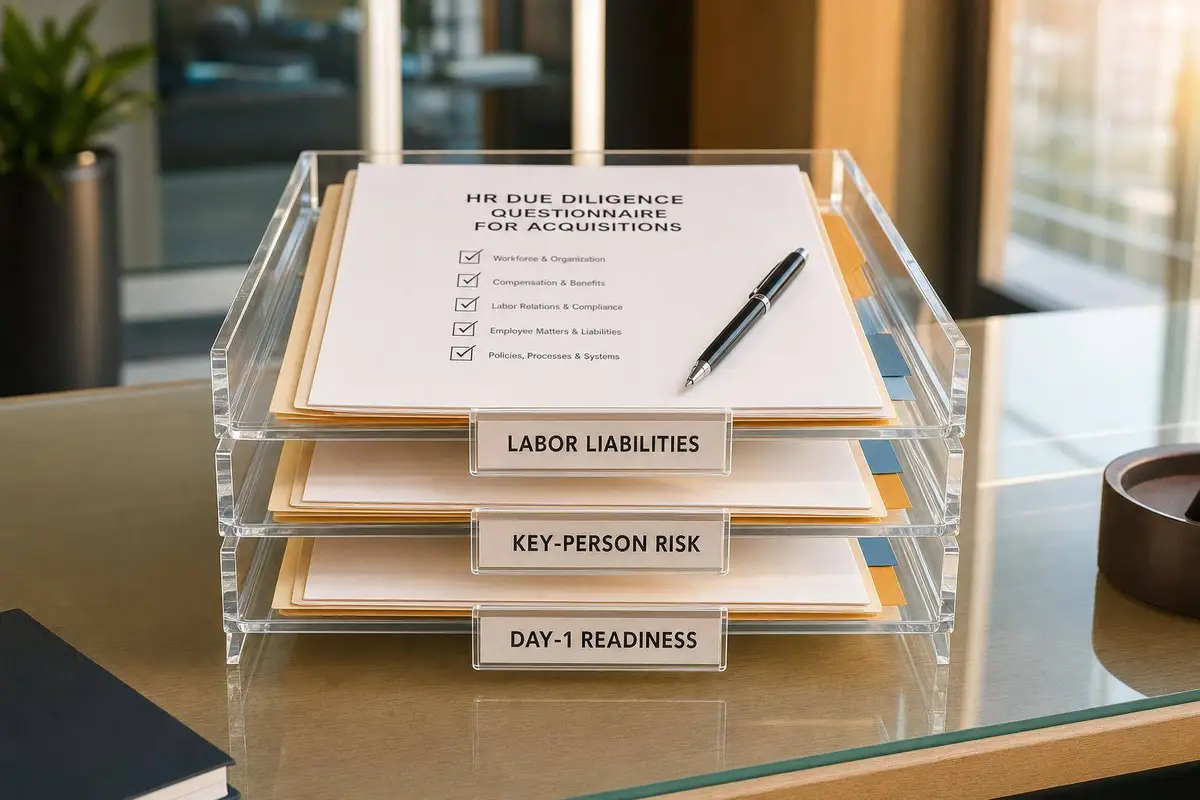
HR Due Diligence Questionnaire For Acquisitions
Checklist and document requests to uncover labor liabilities, key-person risk, and Day‑1 readiness that affect acquisition price and transition.
 Samson JagorasPrincipal & CEO/CIOSeptember 15, 2026
Get a Quality of Earnings analysis you can trust
Our QofE team validates earnings, normalizes add-backs, and de-risks your deal — flat-fee with fast turnaround.
Most HR deal problems are expensive because buyers find them too late. If I were buying a company, I’d use an HR due diligence questionnaire to check four things up front: labor cost, compliance risk, key-person risk, and Day 1 setup.
Here’s the short version:
- I’d start with a tight 4-part checklist:
- workforce and org chart
- pay and benefits
- contracts and compliance
- HR systems and retention
- I’d pair each question with a document request so answers can be checked fast.
- I’d focus on issues that change the deal, such as:
- accrued PTO
- unpaid bonuses or commissions
- contractor misclassification
- wage-and-hour claims
- owner dependence
- weak payroll or HR records
- I’d turn findings into three outputs:
- purchase price or EBITDA adjustments
- escrow, indemnity, or other deal protections
- a Day 1–100 transition plan
A few numbers show why this matters. The article points to cases where HR issues led to $600,000 to $900,000 in adjustments and escrow, and some wage-and-hour matters can reach about $1,000,000 before penalties and legal fees. It also notes that 47% of key employees may leave within 12 months after a deal if retention is not handled well.
What I like about this approach is that it keeps HR tied to underwriting, lender questions, and post-close work, instead of treating it like a side task.
If I had to sum up the article in one line, it would be this: use HR diligence to price risk, shape deal terms, and keep the business stable after close.

HR Due Diligence Questionnaire Framework for Acquisitions
Why HR Diligence Can Make or Break Your M&A Deal | Lynette Buitt | MYM Podcast Ep.5

sbb-itb-a3ef7c1
How to define the scope and sections of the HR due diligence questionnaire
Use the questionnaire to pressure-test Day 1 readiness, hidden labor liabilities, key-person risk, and the state of the HR and payroll setup. For most SMB deals, a simple framework with four sections works well:
- workforce and organization
- compensation and benefits
- contracts and compliance
- culture and HR systems
That structure keeps the process focused. Skip the giant enterprise checklist. It usually adds noise, slows review, and makes it harder to spot what matters.
Workforce, organization, and key-role coverage
Start with an employee census. You want a roster that shows each employee's role, department, location, full-time or part-time status, exempt or nonexempt classification, hire date, base compensation, and any open roles. Then match that with a basic org chart that shows reporting lines up to the owner or CEO.
Put those two documents side by side and a lot becomes clear fast. You can see who actually runs the business, where teams are thin, and where a single departure could cause a mess.
Request turnover data by department for the past 12 to 24 months. Also ask this directly: "List all roles whose vacancy would materially impact revenue, operations, or customer relationships." That wording helps because it doesn't ask the seller to guess what "critical" means. It pushes them to name the jobs that would hurt the business if left empty.
Buyers use that data to figure out whether the deal needs retention bonuses, earn-outs, or interim management hires.
Compensation, benefits, contracts, and compliance coverage
Compensation questions should cover current salary ranges by role, bonus and commission formulas, historical payout data, overtime practices, and accrued PTO balances along with the company's termination payout policy.
That matters because accrued but unpaid PTO, earned bonuses, and unpaid commissions can act a lot like debt. If those amounts exist, they should be dealt with through purchase price adjustments or closing mechanics, not left to surprise the buyer in year one.
For benefits, request health plan documents, retirement plan details, and employer contribution schedules.
For contracts, gather:
- independent contractor and 1099 arrangements
- executive employment agreements
- severance and change-in-control terms
- any non-compete or non-solicit agreements
On the compliance side, be direct. Ask for prior Department of Labor audits, OSHA logs and citations, workers' compensation loss runs for the past three to five years, and a list of any pending or threatened claims. That list should include administrative matters with the EEOC or DOL, even if they haven't turned into formal litigation yet.
Wage-and-hour issues need plain, pointed questions. General requests often miss the problem. This is where labor cost, rule-breaking, and liability exposure tend to show up.
Culture, HR systems, and retention coverage
Ask for the HRIS and payroll platform names, contract terms, and payroll frequency. Request a sample payroll run, redacted as needed, so you can check whether earnings codes, deductions, and tax withholdings are set up the right way.
This part sounds basic, but it tells you a lot. A company running payroll through a standard platform with clean records usually carries far less Day 1 risk than one still relying on manual spreadsheets.
Also ask how performance reviews are handled, why employees leave, and how turnover has shifted by role over the past 12 to 24 months. If the seller has done employee satisfaction surveys, even informal ones, request those results too.
| Section | Core Data Requested | Underwriting Question It Answers |
|---|---|---|
| Workforce & organization | Census, org chart, tenure, turnover, open roles | Can the business operate without the seller? |
| Compensation & benefits | Pay bands, bonuses, PTO accruals, health and retirement plans | Are labor costs accurately reflected in the financials? |
| Contracts & compliance | Employment agreements, contractor arrangements, OSHA, claims | What contingent liabilities need deal protection? |
| Culture & HR systems | HRIS, payroll platform, performance management, retention concerns | How much integration friction and attrition risk exists post-close? |
Once the scope is set, turn each bucket into specific questions and matching document requests.
How to build the questionnaire and document request list
Once the HR sections are set, turn each topic into a specific question tied to a specific document request. Every item should map to one of three things: a data room file, a follow-up path, or a deal-term action for buyer diligence, lender review, and close prep.
Think of it like an operating checklist that runs from the first request all the way to close. Use the four HR buckets from the last section as the rows in your request list.
A simple tracking sheet or deal management system works well here. Each row should stand for one question-document pair. Track:
- item number
- category
- question
- required document
- folder path
- owner
- due date
- status
- risk rating (Low / Medium / High)
That setup helps the deal team spot blockers before lender submission.
How to write questions that produce usable answers
The way you phrase a question shapes the answer you get. Use closed questions when you need something countable or easy to verify, like headcount, pay rates, bonus history, benefits participation counts, and pending claims. Use open questions when you need management's view and the documents won't tell the whole story.
| Question Type | Best For | Example |
|---|---|---|
| Closed | Headcount, pay, claims counts | As of [MM/DD/YYYY], how many active W-2 employees does the company have, broken down by full-time and part-time? |
| Closed | Benefits cost | What is the average monthly employer cost in USD per enrolled employee for the group health plan over the last 12 months? |
| Open | Morale and retention | Describe morale issues or turnover hotspots from the last 12 months and management's response. |
| Open | Succession gaps | Name the successors or succession plans for key roles such as plant manager or head of sales. |
A good rule of thumb is 60–70% closed questions for modeling and 30–40% open questions for context. And don't leave open questions hanging on their own. Pair each one with a follow-up document request.
Once you've picked the question type, attach the exact file request and folder path.
How to attach each question to a specific document request
Each question should say exactly what file to upload and exactly where it belongs. No guesswork.
For example, the headcount question above should be paired with: Upload an employee census export from your HRIS or payroll system in Excel or CSV format to Data Room > HR > Workforce & Organization > Employee Census. Ensure total headcount reconciles to the most recent payroll register.
Common requests include payroll registers, signed agreements, bonus plans, PTO accrual reports, benefit summaries, I-9 records, handbook versions, and claims schedules. Each request should do two jobs: verify the answer and show where the gaps are.
Use matching folder names such as Workforce & Organization, Compensation & Benefits, Compliance & Safety, HR Systems & Policies, and Litigation & Claims. That way, reviewers can see missing items fast.
How to prepare follow-up questions when the first response is incomplete
Incomplete or inconsistent answers happen all the time. In practice, they often tell you more than a neat first response. The most common triggers for second-round questions include headcount mismatches between the census and payroll register, unexplained payroll spikes, large accrued PTO balances, missing signed agreements, contractor-heavy workforces, and benefits that do not match what the handbook promises.
Follow-ups should be narrow and tied to a date. If the employee census shows 82 active employees but the payroll register for the same period shows 89 paid, the follow-up should ask: Please reconcile the difference by providing a list of employees hired or terminated between those dates, any temporary workers included in payroll but excluded from the census, and confirmation of the correct active headcount as of [MM/DD/YYYY].
A payroll spike should trigger this: Total gross payroll for [month] increased by [X]% versus the prior month. Please provide a schedule in USD breaking down payroll by category - regular wages, overtime, bonuses, commissions, severance, retro pay - and explain any one-time items or structural changes such as wage increases or new hires.
Set each follow-up due date to an underwriting milestone. If an item stays unresolved, it should delay close or change deal terms. The response file should then be used to size liabilities, normalize labor costs, and set deal protection terms.
Ready to Make Your Next Move?
Whether you're buying, selling, or investing — Clearly Acquired gives you the tools, data, and support to close with confidence.
How to use HR responses in underwriting and deal terms
Once HR diligence is done, the next step is simple: turn those answers into pricing, structure, and transition decisions.
How to quantify liabilities and normalize labor costs
Start by sorting each HR finding into one of three groups:
- A one-time deal or integration cost
- A recurring run-rate change
- A balance-sheet item
The balance-sheet items show up again and again. The usual ones are accrued PTO, unpaid bonuses and commissions, severance obligations, change-in-control payments, and benefit funding deficits.
For accrued PTO, the math is pretty direct. Multiply each employee's accrued hours by their current hourly-equivalent wage, then apply the company's payout policy. That gives you the payout exposure. In one acquisition, contractor misclassification, overtime errors, missing I-9s, and accrued PTO led to a $600,000–$900,000 adjustment and escrow.
Misclassification should be modeled in two ways. First, treat it as a retroactive liability reserve. Second, reflect it as a higher payroll cost going forward. If you only price one side of that issue, you're missing half the story.
Unpaid bonuses and commissions also need a clean schedule by amount, period, and pre-close versus post-close responsibility. Pre-close amounts belong to the seller, so they should be paid at closing or netted from the purchase price. Change-in-control payments are different. They're one-time cash costs that affect what you need at close, and they're usually carved out of EBITDA for valuation.
Those outputs flow straight into deal terms and the risk matrix below.
How to adjust deal terms for key-person and compliance risk
Some HR issues hit the purchase price. Others change the control terms, retention setup, or both.
When HR responses show owner dependency, buyers usually tighten the structure instead of making only a dollar adjustment. A common example is when the seller owns the key customer relationships or is the only person who knows a mission-critical process. In that case, buyers often ask for a seller employment or consulting agreement for a set post-close period, a non-compete and non-solicitation covenant, and sometimes an earnout tied to milestones that depend on the seller staying involved.
Compliance issues call for a different toolkit. Pending EEOC complaints, wage-and-hour claims, or payroll tax exposure can turn into claim-specific protections. Systemic overtime miscalculations can create potential class-action exposure approaching $1,000,000 in back wages, excluding penalties and attorneys' fees.
When that kind of risk shows up, buyers usually push for:
- Specific indemnities tied to the known claim
- Escrows or holdbacks sized to the likely exposure
- Tighter reps and warranties confirming employees were classified and paid properly
- Pre-close fixes, such as reclassification, tax cleanup, or curing missing I-9s
High regrettable turnover or weak HR documentation can also justify broader reps, even if the headline valuation doesn't move.
How to build a simple HR risk matrix for lenders and investors
Lenders and investors don't want a pile of raw notes. They want a one-page summary they can scan fast.
A simple matrix works well here. Use one row per issue, then add columns for issue type, severity, estimated USD impact, deal response, and post-close owner action. Here's what that can look like:
| Issue Type | Severity | Est. USD Impact | Deal Response | Post-Close Action |
|---|---|---|---|---|
| Accrued PTO liability | Medium | About $180,000 | Debt-like deduction at close | Monitor accrual policy |
| Benefits cost underpriced vs. market | Medium | $75,000/yr | Reduce normalized EBITDA; revise working capital target | Renegotiate plan or adjust employee contributions within 90 days |
| Pending wage-and-hour claim | High | Nearly $1,000,000 (est.) | Specific indemnity + escrow; stress-test debt capacity | Engage employment counsel; resolve or settle |
| Owner controls key relationships | High | Revenue at risk | Seller employment agreement + earnout | Transition relationships; document account history |
| Six misclassified contractors | Medium | $180,000 retroactive | Contingent liability reserve; reclassify pre-close | Reclassify on Day 1 |
Each row should tie back to a questionnaire response and a document in the data room. That link matters. If a lender or investor asks, "Where did this number come from?" you should be able to point to the source right away.
How to turn HR diligence findings into a Day 1-100 transition plan
Use the risk matrix to move diligence findings into clear owners, due dates, and post-close actions. Every high- and medium-risk item should become a dated task before the deal closes. The questionnaire isn't the final deliverable. It should drive execution.
Day 1 readiness: payroll, benefits, communication, and legal notices
Day 1 is about continuity.
Before close, reconcile pay rates, FLSA status, PTO balances, and direct-deposit elections. Run a dry payroll test before close, and keep the legacy system live for 60–90 days in parallel.
Confirm that health, dental, and any other coverage stays active through the transition with no gaps. If the deal creates a COBRA qualifying event, handle notice requirements fast. Update required labor-law postings and any employer name or contact changes. Turn state-specific issues - paid sick leave, final pay rules, and wage-statement formats - into a pre-close checklist.
Hold a Day 1 all-hands meeting led by the buyer or transition lead. Be clear about what will not change right away: pay, schedules, and core benefits. Name one contact for questions. Give managers a one-page talking sheet so the message stays consistent.
After Day 1 is steady, shift to retention and cleanup work that can wait until after close.
Day 30-100 priorities: retention, org design, and policy cleanup
Retention comes first. Research shows that 47% of key employees leave within 12 months of a transaction, and targets can lose over 55% of their workforce by the end of the second year post-acquisition. Use diligence findings to spot the top 5–10 critical people and put retention agreements in place fast. Keep it simple with one- or two-page retention letters that spell out the period, bonus, and payment date. Schedule one-on-ones with those people within the first two weeks.
Use Days 30–100 to correct misclassifications, tighten timekeeping and overtime approvals, update the handbook, deliver training, and standardize performance documentation.
Keep org design steady for the first 30 days. Then cross-train backups, clarify reporting lines, and document critical workflows based on what diligence uncovered.
Use the following timeline to assign ownership and timing.
| Timeframe | Priority Focus | Key Actions |
|---|---|---|
| Day 1 | Payroll, benefits, communication, legal notices | Reconcile pay rates, run parallel payroll, send COBRA notices, hold all-hands meeting |
| Day 30–60 | Retention and compliance | Deliver retention packages, correct misclassifications, fix overtime practices |
| Day 60–90 | Policy and training | Update handbook, conduct harassment and safety training |
| Day 90–100 | Org design and performance management | Standardize reviews and disciplinary steps where diligence found weak documentation, document critical workflows, finalize reporting structure |
Conclusion: what a strong HR diligence process should deliver
A strong HR diligence process should give the buyer a clear Day 1–100 roadmap. Each major finding needs an owner, a deadline, and a practical next step. That way, payroll stays stable, benefits stay active, compliance risk goes down, and the workforce is set up to support the business after close.
FAQs
What documents should I request first?
Start with core HR documents across five areas:
- employee data
- contracts
- compensation and benefits
- operations
- legal compliance
Ask for org charts, payroll records, employment agreements, handbooks, and records of past or pending disputes.
These documents help you spot red flags early. For example, they can reveal worker misclassification, pay equity gaps, or heavy turnover in key roles.
That, in turn, helps shape underwriting, deal terms, and transition planning.
How do HR findings affect the purchase price?
HR findings can expose hidden liabilities in workforce data, legal compliance, and day-to-day operations. Buyers look closely at issues in pay practices, worker classification, contracts, benefits, I-9s, union matters, and dependence on key people. If they spot problems, they may change their underwriting, renegotiate the price, or ask for holdbacks.
Clearly Acquired helps keep this process organized with secure data rooms, automated document management, and advisory support.
What HR issues matter most before Day 1?
An HR due diligence questionnaire helps you size up workforce risk, compliance, and company culture before the deal closes.
The main areas to review are:
- Employee data, org charts, turnover, and pay
- Contracts, I-9s, wage and hour compliance, and contractor classification
- Benefits, PTO, insurance, leadership, and engagement
- Key-person dependencies, workflows, and systems
It also helps to ask for documents early. That usually includes handbooks, employee rosters, and litigation records.
Why does that matter? Because HR issues can change the economics of a deal. Problems like worker misclassification or high attrition don't just sit in the background. They may lead to price adjustments, escrows, or specific indemnities.
Related Reading
De-risk your deal with a Quality of Earnings report
Independent, deal-ready earnings analysis that buyers, sellers, and lenders trust.
About the author
Principal & CEO/CIO
Samson Jagoras has 15+ years across finance, real estate, and business acquisitions. He began his career as a Futures & Commodities broker and later served as Chief Strategy Officer of an INC 500 marketing and technology firm, helping scale revenue from $1M to over $100M. Today he buys, builds, and advises a portfolio of companies with a focus on M&A, capital allocation, and operational strategy.