How to Structure Seller Note Amortization
Define seller note terms, choose amortization (fully, balloon, or interest‑only), build a period-by-period schedule, and align closing docs.
 Samson JagorasPrincipal & CEO/CIOSeptember 27, 2026
Get matched with the right lender for your business
Compare offers from our vetted network. Pre-qualify in minutes — no impact to your credit.
A seller note works only if the payment schedule fits the business. In most small U.S. deals, that means I need to line up 6 basic terms - principal, rate, term, maturity date, payment timing, and any standby or interest-only period - then choose between 3 payment setups: fully amortizing, balloon, or interest-only that later converts to principal and interest.
Here’s the short version:
- Fully amortizing notes pay down to $0 by maturity
- Balloon notes keep payments lower but leave a lump sum due at the end
- Interest-only notes keep early payments low, but principal does not drop at first
- Seller note rates often land around 6% to 8%
- Terms often run 3 to 7 years, with 5 years common
- Lenders often want DSCR around 1.25x to 1.35x, so payment size matters from day one
If I were setting up a seller note, I’d keep one rule front and center: the note, amortization table, underwriting model, and closing documents all need to match exactly. Even a small date or payoff mismatch can slow a closing or change the payoff math later.
A simple way to think about it: pick the terms, pick the payoff structure, build the schedule, and match every document to that schedule.
How to Buy a Business With a Seller Note

sbb-itb-a3ef7c1
Quick Comparison
| Structure | Payment Level | Principal Paydown | End-of-Term Balance | Main Tradeoff |
|---|---|---|---|---|
| Fully amortizing | Highest | Starts right away | $0.00 | More pressure on monthly cash flow |
| Balloon | Lower | Slower | Lump sum due | Refinance or payoff risk at maturity |
| Interest-only to amortizing | Lowest at first, then higher | Delayed | Often lower later, but depends on term | Payment jump after the interest-only period |
In short, seller note amortization is not just about the monthly payment. It sets seller risk, buyer cash flow, lender approval, and the amount still owed over time.
The Core Seller Note Terms That Drive the Repayment Schedule
Before you build an amortization table, six inputs need to be set in stone: principal amount, annual interest rate, term length, maturity date, payment frequency, and any special terms such as standby or interest-only periods. If any of these are fuzzy, the schedule can drift away from the note, underwriting file, or closing documents.
Principal Amount, Interest Rate, and Term Length
The principal amount is the opening balance the buyer owes. The promissory note should spell it out in words and figures - for example, Three Hundred Thousand Dollars ($300,000.00).
The annual interest rate is usually stated as a nominal annual rate. In small business acquisitions, seller notes often fall in the 5% to 9% per year range, with many deals landing between 6% and 8%. The note should also say whether the rate is fixed or variable. For example: 8.0% per annum.
Term length sets the outside date for repayment. Most seller notes run 3 to 7 years, and 5 years is often the most common setup. The note should include both the total number of months and the exact maturity date - for example, 60 months, maturing September 1, 2031. That maturity date needs to line up EXACTLY with the amortization table and any lender credit memo.
Payment Frequency and First Payment Date
Monthly payments are the norm in U.S. seller notes. Quarterly payments do show up now and then, mostly in businesses with lumpier cash flow, but they change both the cash flow pattern and the interest accrual math.
The first payment date should connect directly to closing, plus any standby or interest-only period, and it needs to be written clearly in the promissory note. A common setup is this: the first payment is due on the first day of the month after 30 days have passed from closing.
Here’s what that looks like in practice. If closing happens on September 15, 2026, the first payment would be due on November 1, 2026, with interest prorated from the funding date. If the first payment date in the note doesn’t match the amortization schedule or the lender’s model, you end up with different accrued interest and payoff numbers. That’s the kind of small miss that can bog down a closing fast.
Special Terms That Change the Payment Math
Once the main loan terms are locked in, special provisions decide when amortization actually starts. These terms affect when principal begins to pay down and how lenders look at the note.
| Special Term | Effect on Amortization | Lender Impact |
|---|---|---|
| Interest-only period | Principal stays flat; higher P&I payments begin after | DSCR tested at the step-up payment, not the initial payment |
| Partial principal deferral | A portion of principal is deferred until a balloon date or trigger event | Balloon amount must appear in the schedule at maturity |
| Full standby | No scheduled principal or interest payments during the standby window; principal balance stays flat | Lender verifies the schedule against the subordination agreement |
With those terms set, the next move is turning them into a payment schedule and amortization table.
How to Choose the Right Amortization Structure

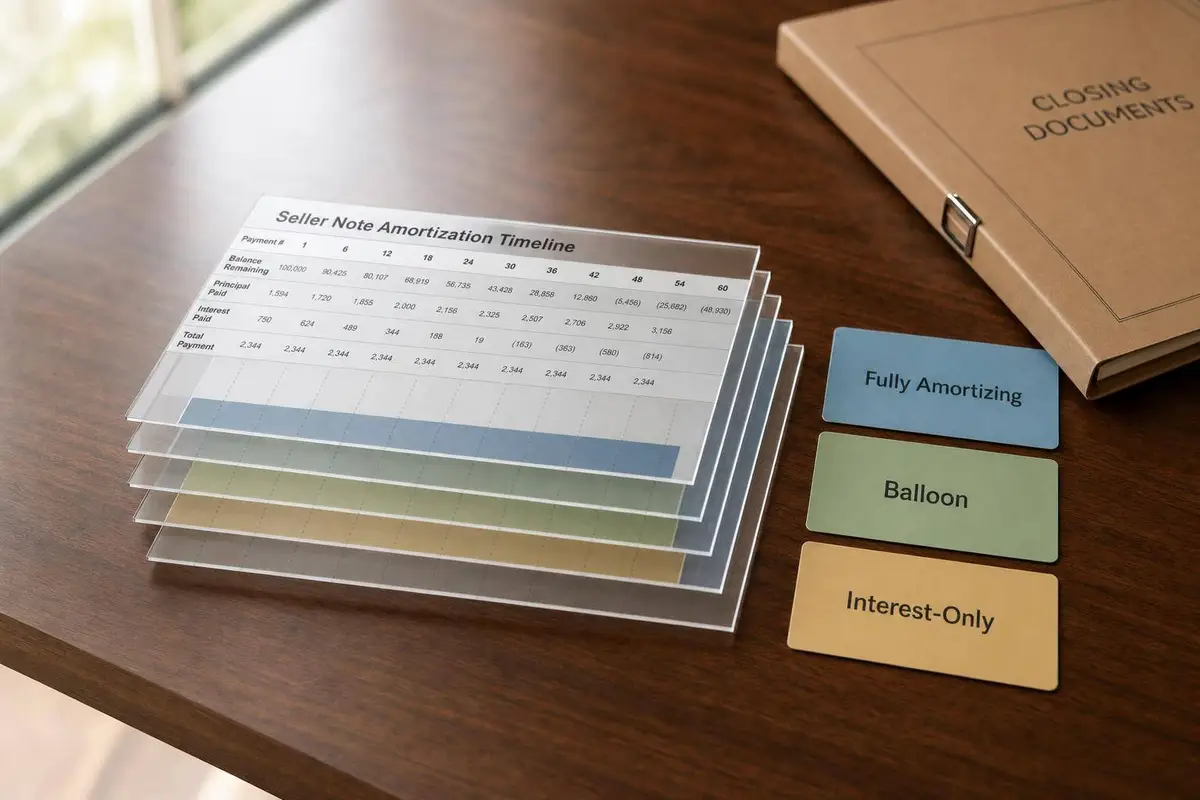
Seller Note Amortization Structures: Side-by-Side Comparison
Once the core terms are set, the next call is how the balance gets paid down over time.
In seller-financed business sales, you usually have three main paths: a fully amortizing note, a note with a balloon payment, or an interest-only period that later shifts to principal and interest. Each one changes the monthly payment, the seller’s risk, and how much balance is still sitting there when the note matures.
This isn’t just a paperwork detail. It shapes how much breathing room the business has after closing. If cash flow is steady, one structure may fit just fine. If the business needs time to settle in, another may make more sense.
Fully Amortizing Note
A fully amortizing note is the most straightforward setup.
The payment stays level, but the mix changes over time: early payments lean more toward interest, and later payments lean more toward principal. By maturity, the balance is paid down to zero.
Use this when cash flow is stable and both sides want a clean payoff. The amortization schedule should show a $0 balance at maturity.
Amortizing Note With a Balloon Payment
If the buyer needs a lower monthly payment, a balloon structure is often the next move.
A balloon note amortizes over a longer period than its legal term, which cuts the monthly payment and leaves a lump sum due at maturity. Put simply, the note acts like it has a long runway, but it comes due much sooner.
Use this when a shorter fully amortizing note would push the payment too high. The schedule should show a remaining balance due at maturity.
Interest-Only Period That Converts to Principal and Interest
If the deal needs the lightest payment during the transition, an interest-only period can help.
During that period, the buyer pays only interest on the outstanding balance. After that, the note converts to a standard principal-and-interest schedule for the rest of the term. This works when the buyer needs more cash flow early on, such as right after closing when the business is still settling down.
The tradeoff is simple: the balance does not shrink during the interest-only window. Principal paydown gets pushed back. The schedule should show interest-only payments first, followed by a step-up to principal and interest.
| Feature | Fully Amortizing | Amortizing with Balloon | Interest-Only to Amortizing |
|---|---|---|---|
| Monthly Payment | Higher (includes principal) | Lower (based on longer term) | Lowest (interest only initially) |
| Principal Reduction | Immediate and steady | Slow (due to long schedule) | Zero during initial phase |
| Maturity Risk | None | High (requires lump sum) | Moderate (payment jump at conversion) |
| Seller Risk | Lowest | Higher | Highest |
| Buyer Cash Flow | Most constrained | Preserved | Maximized |
Any balloon or interest-only term should spell out the conversion date, maturity date, and post-conversion payment formula with no wiggle room.
How to Build the Payment Schedule and Amortization Table
Once the structure is set, turn it into a period-by-period amortization schedule that every party can read the same way. Use that same schedule to reconcile the note, the loan model, and the closing package.
How Each Payment Splits Between Principal and Interest
In a fixed-rate, fully amortizing seller note, the payment stays level. What changes is the mix of interest and principal each period.
Interest = beginning balance × monthly rate. Principal = payment − interest. Ending balance = beginning balance − principal.
Amortization Table Fields
A practical seller note schedule usually includes these seven columns: Payment #, Payment Date, Beginning Balance, Scheduled Payment, Interest, Principal, and Ending Balance.
Add a header block above the table with the main inputs: principal, rate, term, payment frequency, first payment date, and maturity date. That gives anyone reviewing the file a quick way to reconcile the schedule against the signed promissory note as part of your business acquisition checklist. The table must match the signed note exactly.
Below is a hypothetical fully amortizing $500,000 seller note at 8.0% interest over 7 years, with the first payment due 11/01/2026:
| Payment # | Payment Date | Beginning Balance | Scheduled Payment | Interest | Principal | Ending Balance |
|---|---|---|---|---|---|---|
| 1 | 11/01/2026 | $500,000.00 | $7,836.06 | $3,333.33 | $4,502.73 | $495,497.27 |
| 2 | 12/01/2026 | $495,497.27 | $7,836.06 | $3,303.32 | $4,532.74 | $490,964.53 |
| 3 | 01/01/2027 | $490,964.53 | $7,836.06 | $3,273.10 | $4,562.96 | $486,401.57 |
| 4 | 02/01/2027 | $486,401.57 | $7,836.06 | $3,242.68 | $4,593.38 | $481,808.19 |
| … | … | … | … | … | … | … |
Interest drops over time while principal paid each period goes up. The full schedule runs through all 84 payments, and the ending balance reaches $0.00 at maturity.
How Standby Periods and Balloon Maturity Appear in the Schedule
If the note includes standby, use the exact deferral dates from the promissory note. For full standby, show $0.00 for principal and interest, with the balance unchanged. Label those rows so the closing team can tie each nonstandard period back to the note. A Period Type or Notes column can mark them as Full Standby, which makes the structure easy to spot.
For a balloon maturity, label the final row Balloon Payment and show the remaining principal as the principal paid, with the ending balance reduced to $0.00. Label those rows so the closing team can trace each nonstandard period to the note. If the maturity terms are unclear, fix that before closing.
That schedule becomes the reference point for underwriting, payoff checks, and closing documents.
Aligning the Amortization Schedule With Underwriting and Closing Files
Once the amortization schedule is done, treat it as the source of truth for the note, underwriting, and closing file. From there, the job is simple in theory but easy to mess up in practice: every closing document needs to match the same payment math.
Documents That Must Match the Amortization Schedule
The amortization table is the drafting reference for the closing file. Each key document should mirror the same economic terms.
| Document | What Must Match |
|---|---|
| Promissory Note | Principal amount, interest rate, payment frequency, first payment date, and maturity date |
| Payment Schedule Exhibit | Every payment date, payment amount, and remaining balance |
| Balloon Language | Balloon date and the remaining principal due at maturity |
| Interest-Only or Standby Provisions | Timing, payment amount, and whether principal or interest is deferred or suspended |
| Subordination and Intercreditor Agreements | Payment priority, standby period, and any remedy limitations tied to the same repayment pattern |
Even small mismatches can cause problems. A start date that slips by 30 days or a balloon amount that doesn’t tie out can send the file back to underwriting and lead to corrected documents at closing. The cleanest move is to lock the schedule before drafting starts. That way, lender models and closing documents stay in sync.
How Lenders and Investors Use the Amortization Table
Lenders take the periodic payment amount straight from the amortization table to calculate total debt service. That number flows into the Debt Service Coverage Ratio (DSCR), and many lenders look for 1.25x–1.35x DSCR. Change the seller note term or repayment setup, and you change DSCR too, which can affect loan size. In plain English: the rows in the schedule shape DSCR, payoff math, and refinance analysis for the life of the deal.
Family offices, search funds, and independent sponsors use that same table in investment committee materials. They use it to stress-test cash flow under fully amortizing notes, balloon notes, and interest-only structures, then compare how each one changes coverage and equity returns.
Conclusion: A Simple Framework for Structuring Seller Note Amortization
Define the terms, build the schedule, and make every closing document match. Start with the main inputs - principal amount, interest rate, term length, and payment frequency. Then pick the repayment structure based on cash flow and lender requirements.
After that, build the period-by-period schedule showing how each payment splits between principal and interest. If the note includes standby periods or other special terms, model them directly with clear dates and dollar amounts. Once the numbers are reconciled, lock that version into the closing file so future payoffs and reporting start from an accurate record.
FAQs
How do I choose between fully amortizing, balloon, and interest-only terms?
Choose terms based on four things: term length, interest rate, payment schedule, and the business’s cash flow.
In many cases, seller notes run for 3 to 7 years with interest rates in the 5% to 10% range. They’re often paired with amortization tables that show how each payment is split between principal and interest. That matters for two big reasons:
- lender review
- IRS installment sale reporting
For SBA-backed deals, there’s an extra layer to watch. The note may need to be subordinated and follow full standby rules. In plain English, that can push back payments of principal, interest, or both for a period of time.
What can go wrong if the note and amortization schedule do not match?
If the promissory note and amortization schedule don’t match, payments can get split the wrong way between principal and interest. And that throws off more than just the math.
It can create confusion about the payment schedule, any balloon payment, and the balance still owed. One small mismatch on paper can turn into a much bigger headache later.
There’s also a tax angle. Buyers may deduct interest expense, and sellers need to report taxable income the right way. If the numbers don’t line up, tax reporting can get messy fast.
How does seller note amortization affect DSCR and lender approval?
Seller note amortization sets the recurring payment by spreading principal and interest across the note term.
That payment matters because it flows straight into DSCR. If the payment is too high, debt coverage gets tighter. If it’s lower, the deal may look easier to support on paper. That’s why lenders usually review the amortization table. They want to see the principal-and-interest split and match it against the file’s support documents.
Common setups include:
- Terms of 3 to 7 years
- Interest rates from 5% to 10%
- Interest-only or deferred payment periods
- Balloon payments
- For SBA-related deals, full standby when the note is treated as equity
Related Reading
Find the right lender for your business
Whether it's working capital, an SBA loan, or acquisition financing — we'll match you with the right capital partner.
About the author
Principal & CEO/CIO
Samson Jagoras has 15+ years across finance, real estate, and business acquisitions. He began his career as a Futures & Commodities broker and later served as Chief Strategy Officer of an INC 500 marketing and technology firm, helping scale revenue from $1M to over $100M. Today he buys, builds, and advises a portfolio of companies with a focus on M&A, capital allocation, and operational strategy.