How Seller Notes Secure Collateral in SMB Deals
Seller notes secure assets only when the lien, security agreement and UCC-1 perfection align; lender consent and priority rules decide recovery.
 Samson JagorasPrincipal & CEO/CIOSeptember 15, 2026
Get matched with the right lender for your business
Compare offers from our vetted network. Pre-qualify in minutes — no impact to your credit.
A seller note is only secured if the seller gets a lien and files it the right way. If not, the note is just delayed deal price with no direct claim on business assets.
Here’s the short version:
- The promissory note does not create a lien by itself
- The seller usually needs a security agreement to grant the lien
- The seller often needs a UCC-1 filing to protect that lien against other creditors
- In many SMB deals, the seller is junior to a bank or SBA lender
- That means the seller may have rights on paper, but recovery can still be limited to leftover collateral value
- If a senior lender blocks asset liens, the seller may look to:
- an equity pledge
- a personal guarantee
- or stay unsecured
I’d look at seller-note collateral in 3 steps:
-
Can the seller take collateral at all?
Senior lender consent usually comes first. -
What is the collateral?
That may be:- all business assets
- only named assets
- buyer equity interests
- personal assets under a guarantee
-
Was the lien done right?
For most business assets, that means:- attachment under UCC Article 9
- perfection through a UCC-1
- correct debtor name
- correct filing state
- matching language across all deal papers
A few facts matter a lot here:
- A UCC-1 usually lasts 5 years unless continued
- For some collateral, such as deposit accounts, filing alone is not enough; control is often required
- In many SBA 7(a) deals, seller notes are put on standby and made subordinate to the SBA loan
- Under basic priority rules, the party that files first often has the better claim

How Seller Notes Become Secured in SMB Deals
Secured Transactions Bar Review (UCC Article 9): Most Tested Areas of Law on the Bar Exam [PREVIEW]

sbb-itb-a3ef7c1
Quick comparison
| Structure | What the seller gets | Main limit |
|---|---|---|
| Junior lien on business assets | Claim on assets after senior debt | Senior lender gets paid first |
| Equity pledge | Claim on buyer’s shares or LLC interests | Value depends on whether the business still works |
| Unsecured note + guarantee | Right to sue on the note and guarantee | Recovery depends on the guarantor’s assets |
Bottom line: I’d treat a seller note as secured only when the debt terms, lien grant, filing, and subordination rules all match. If one piece is missing, the seller can end up far less protected than expected.
What Collateral a Seller Can Realistically Take
The first thing to check is simple: does the senior lender allow the seller to take collateral at all? If the answer is no, there’s no point drafting lien language yet. Lender consent comes first.
Business Asset Liens: Blanket vs. Specific-Asset
Under UCC Article 9, a seller can take a security interest in most business personal property the buyer owns. That usually includes equipment, inventory, receivables, contracts, IP, and general intangibles. Real estate is a separate matter. Land and buildings fall under mortgage or deed-of-trust law, not Article 9, so they need their own documents.
A blanket (all-assets) lien covers everything the business owns now and anything it acquires later. A specific-asset lien is narrower. It applies only to named collateral, like a listed group of equipment or a defined IP portfolio. That narrower scope also limits what the seller can go after if the buyer defaults.
In plain English, the structure usually works like this:
- If there’s no senior lender, or the lender says yes, the seller will often take an all-assets junior lien
- If the lender says no to that, the seller may get only carved-out specific collateral
Equity Pledges, Personal Guarantees, and Other Credit Support
If a senior lender blocks asset liens, sellers often look for other ways to protect themselves.
One common option is an equity pledge. That gives the seller a security interest in the buyer’s LLC membership interests or corporate stock. If the buyer defaults, the seller can foreclose on that equity and take control of the entity. Once that route is on the table, the next issue is how the pledge gets documented and perfected.
Another option is a personal guarantee. That makes the buyer personally liable on the note. In some cases, the guarantee is also backed by liens on personal assets, such as home equity, investment accounts, or personal vehicles.
How Senior Lenders and SBA Rules Limit Seller Collateral
Senior lenders, especially SBA 7(a) lenders, usually take a first-priority blanket lien (see SBA 7(a) loan terms vs. other financing options) on all business assets. In SBA-backed deals, seller financing is generally required to be on standby and subordinated to the SBA loan. That means the seller may still hold a junior lien or an equity pledge, but the seller’s payment and enforcement rights are limited until the senior debt is paid off or brought current.
That leaves the seller in one of a few common positions:
- unsecured
- holding a junior lien on carved-out specific assets
- holding an equity pledge that sidesteps the asset-lien conflict
In each case, recovery is still limited by the subordination terms the senior lender requires.
Once collateral is identified, the next step is making the lien enforceable through the note, security agreement, and UCC filing.
How Security Interests Work Under UCC Article 9
UCC Article 9 governs secured transactions involving personal property in every U.S. state. Once the seller picks the collateral, Article 9 decides whether the lien will actually hold up. For a seller carrying a note, two things matter: the security interest must attach, and then it must be perfected.
Attachment: When a Security Interest Becomes Enforceable
Attachment is the point when the lien becomes enforceable. To attach, three things must exist: value, buyer rights in the collateral, and a signed security agreement that describes the collateral clearly enough to identify it. Miss just one, and the seller does not have an enforceable lien.
In this setting, value is the seller’s agreement to finance part of the purchase price. The buyer gets rights in the collateral at closing. The last piece is the security agreement, which must clearly grant the lien and describe the collateral with enough detail to be enforceable.
This is where deals often slip. A line like “Seller is secured by the business” is too vague. A better description uses UCC-style collateral categories, such as accounts, inventory, equipment, general intangibles, and proceeds, or broader wording tied to the assets used in the acquired business. If the wording is messy or inconsistent, the seller builds in enforcement risk that did not need to be there.
And attachment, by itself, is not enough. The seller also has to perfect the lien.
Perfection: How a UCC-1 Filing Protects the Seller's Position
Perfection protects the seller against other creditors and later lenders.
For most business assets - accounts, inventory, equipment, and general intangibles - perfection happens by filing a UCC-1 financing statement with the Secretary of State in the right state. The debtor name must match the entity’s exact legal name from its formation documents. A trade name or DBA can make the filing ineffective. Filing in the wrong state can do the same. For registered organizations, the right filing jurisdiction is usually the state of organization, not always the state where the business operates.
Without perfection, the seller may have a lien on paper and still lose to later creditors. Two other details matter here:
- A UCC-1 usually stays effective for five years unless a continuation statement is filed before it lapses.
- For some collateral, like deposit accounts, filing alone does not work. Control is required, usually through a control agreement with the bank.
After that, priority usually comes down to who filed first and whether the documents line up with the deal.
Priority and Remedies After Default
Once perfected, the first filer or first perfected party usually wins. In most SMB deals, the senior lender filed first, so the seller’s secured position is junior. That means the seller gets paid only after the senior debt is paid off.
Even so, a perfected junior lien is much better than being unsecured. It gives the seller a claim on whatever value is left after the senior lender is paid. Priority turns on filing order, but enforcement turns on whether the note, security agreement, and UCC-1 describe the same collateral. That’s why those three documents need to be drafted as one package.
How the Note, Security Agreement, and UCC Filing Work Together
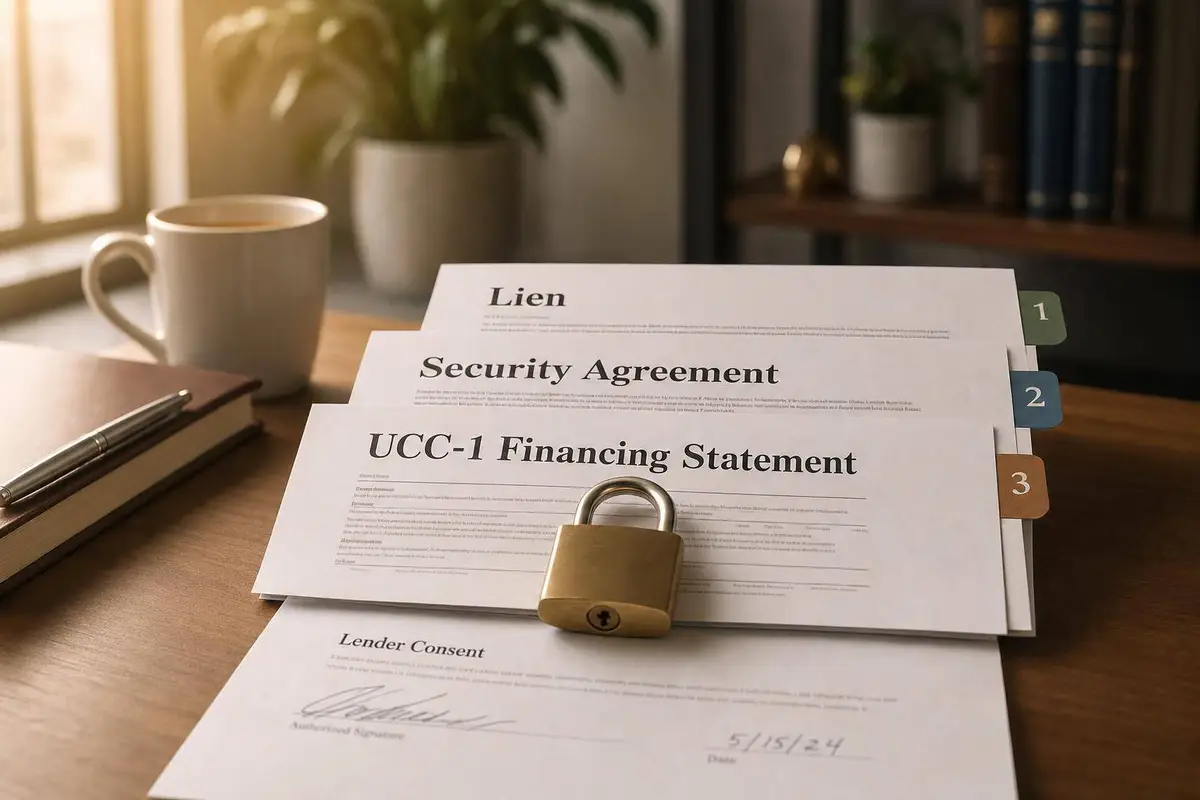
After collateral and priority are set, the deal comes down to one thing: the documents have to line up. The note states the debt, the security agreement grants the lien, and the UCC-1 perfects that lien.
| Document | What It Does | What Breaks Without It |
|---|---|---|
| Promissory Note | States the debt terms | No repayment or default framework |
| Security Agreement | Grants the lien on collateral | No security interest, even with a UCC-1 filed |
| UCC-1 Filing | Perfects the lien and gives public notice | Seller loses priority to later creditors |
Promissory Note Terms That Define the Debt
The note needs to spell out the debt terms in plain, exact language: principal amount, interest rate, payment schedule, maturity date, any balloon payment, late charges, default triggers, and cure periods. It should also cross-reference the security agreement, any personal guarantees, and any subordination or standby obligations so the full document set stays in sync.
A balloon payment can add refinancing risk at maturity. If that risk is part of the deal, the note needs to match the seller’s collateral position and any guarantee backstops.
Security Agreement Language That Grants the Lien
The security agreement is the document that actually gives the seller rights in the collateral. This is the paper that creates the lien. It must expressly grant that lien and clearly describe the collateral. Loose or vague wording won’t do the job.
That collateral description also has to fit within what the senior lender allows. If the bank already holds a first-priority blanket lien on operating assets, the seller may have to accept a junior lien on named assets or move to an equity pledge of the buyer entity instead. If the papers promise collateral the senior lender already locked up, the deal documents stop matching the facts on the ground.
Once the lien is granted, the UCC filing should track that same collateral language.
UCC-1 and Subordination Language That Matches the Deal
After the security agreement is signed, the UCC-1 filing protects the seller’s position against other creditors. The filing must use the debtor’s exact legal name, the secured party’s name and address, and a collateral description that matches the security agreement.
In SBA-backed deals, subordination sets the rules for payment and enforcement. A standby agreement can leave the seller perfected on paper while stopping collections during the SBA standby period.
That’s why the next step is checking common deal structures and document consistency before closing.
Common Structures, Diligence Checks, and Key Takeaways
Common Deal Structures and Their Tradeoffs
Once the lien package is drafted, the next step is seeing how it holds up in the actual deal structure. In SMB acquisitions, seller notes usually show up in three main forms. Which one you can use often comes down to what the senior lender will allow.
| Structure | Typical Use Case | Enforcement Path | Realistic Recovery |
|---|---|---|---|
| Junior blanket lien (junior to a bank or SBA lender) | SBA 7(a) or conventional deals where senior debt fills most of the purchase price | Seller waits for senior payoff, then pursues any residual collateral value | Usually limited to residual collateral value after senior payoff |
| Equity pledge (membership interests or shares) | Senior lender prohibits junior asset liens, or the existing lien package is already complex | Foreclose on the equity, take control of the business, then stabilize or sell | Depends on whether the business still has going-concern value |
| Unsecured note + personal guarantee | Small deals, competitive processes, or situations where senior covenants block any lien | Enforce the note and guarantees through judgment and collection | Limited to guarantor collectability |
In some deals, sellers stack more than one layer of protection, such as a lien, an equity pledge, and a guarantee. But that only works if the senior lender consents and the subordination terms allow it.
Pre-Close Lien Searches and Document Consistency Checks
Before closing, pressure-test the lien package against existing claims and document errors. A UCC lien search in the target entity's state of organization should be non-negotiable. That search needs to cover the debtor's exact legal name, any prior names, and any doing-business-as variations. On top of that, tax lien and judgment searches at the state and county level often turn up claims that can jump ahead of, or otherwise complicate, a seller's lien.
Once you know what liens already exist, the payoff and termination process needs to run as one coordinated sequence:
- Get payoff letters that spell out the exact payoff amount, per diem interest, and wire instructions.
- Hold signed UCC-3 termination statements in escrow.
- File those terminations at the same time as the new UCC-1 filings once payoff is confirmed.
- Run a post-closing UCC search to confirm the terminations are actually on record.
This is one of those areas where small mistakes can cause big problems.
Document consistency is where many seller collateral packages quietly break down. The debtor's legal name, state of organization, and entity type need to match across the promissory note, security agreement, UCC-1, subordination agreement, and any guarantees. One typo in a UCC-1 filing can make the filing seriously misleading and put perfection at risk altogether. Collateral descriptions also need to line up exactly between the security agreement and the UCC-1. If the language is vague or doesn't match, the lien can end up narrower than expected or miss assets the seller thought were covered.
What Makes a Seller Note Truly Secured
After structure and diligence, the last test is simple: can the seller actually enforce the position?
If the lien is not granted, filed, and compliant with junior-priority rules, the note is secured in name only. Sellers who know where they sit in the priority stack, and shape their collateral package, guarantee terms, and subordination provisions around that spot, are far more likely to hold a note that matters if the deal goes sideways.
FAQs
Is a seller note automatically secured?
No. A seller note is not secured by default.
To secure it, the seller needs to attach it to business assets or real estate.
The promissory note sets out the payment terms. A security agreement gives the seller a security interest. Then a UCC-1 filing perfects that interest and helps set priority against other creditors.
What collateral can a seller take?
In seller financing, the seller can secure the deal with business assets like inventory, machinery, equipment, or accounts receivable. The promissory note lays out the payment terms. The security agreement spells out which assets serve as collateral.
To protect that interest, the seller will usually file a UCC-1 financing statement. That filing helps establish the seller’s place in line against other creditors. In SBA-backed deals, the seller note is often subordinated to the bank.
What makes a UCC-1 filing invalid?
A UCC-1 filing can fall flat if it doesn’t line up with the security agreement and the collateral listed in the note. Those documents should match. That way, the seller’s security interest is clear and enforceable.
The filing also needs to go to the right state or county office. That public notice matters because it helps establish priority over other creditors.
Related Reading
Find the right lender for your business
Whether it's working capital, an SBA loan, or acquisition financing — we'll match you with the right capital partner.
About the author
Principal & CEO/CIO
Samson Jagoras has 15+ years across finance, real estate, and business acquisitions. He began his career as a Futures & Commodities broker and later served as Chief Strategy Officer of an INC 500 marketing and technology firm, helping scale revenue from $1M to over $100M. Today he buys, builds, and advises a portfolio of companies with a focus on M&A, capital allocation, and operational strategy.