Bank Loan Documents for Business Acquisitions
Lender-ready checklist for acquisition loans: buyer and target financials, deal papers, equity proof, and common causes of delay.
 Samson JagorasPrincipal & CEO/CIOSeptember 15, 2026
Get matched with the right lender for your business
Compare offers from our vetted network. Pre-qualify in minutes — no impact to your credit.
Most acquisition loan delays come from missing, old, or mismatched documents - not from the deal itself.
If I were getting a business acquisition loan, I’d focus on four things first: buyer financials, target company financials, deal papers, and proof of down payment. Banks want to see that the business can cover debt at about 1.25x DSCR or more, that interim numbers are usually within 60 to 90 days, and that equity funds can be traced with 60 to 90 days of account history.
Here’s the short version of what matters:
- Buyer file: personal financial statement, personal tax returns, debt details, bank or brokerage statements
- Target file: 3 years of business tax returns, P&Ls, balance sheets, debt schedule, AR/AP aging, current interim financials
- Deal file: LOI or purchase agreement, seller note terms, earnout terms, lease, source-and-use schedule
- Equity file: statements, wire records, gift letters, or other proof showing exactly where the cash came from
A bank is checking three simple things:
- Can the business pay the loan?
- Can I handle a rough period?
- Do the deal terms support payback?
The biggest problems are usually simple: unexplained add-backs, unsigned deal papers, debt schedules that don’t match, missing interim financials, and cash that can’t be traced. If I send a clean file up front, the review is far less likely to stall.
This article walks through what goes in the loan file and what banks look for before they say yes.

Business Acquisition Loan: Complete Document Checklist
SBA Business Acquisition Loan Documents EXPLAINED + SBA Form 413 Made Easy
sbb-itb-a3ef7c1
Buyer Documents: Personal Financial Strength and Guarantor Support
The buyer file is the first hard proof in the underwriting package. It shows whether your personal finances can help support the loan if the business hits a rough patch and cash flow slips.
Personal Financial Statements and Debt Disclosures
The core document here is the Personal Financial Statement (PFS), usually on the lender’s own form. Each 20%+ owner and any guarantor needs to submit one, and it usually must be dated within 90 to 120 days of the application. The PFS should lay out your cash, investments, real estate, business interests, vehicles, and all liabilities, including contingent obligations.
Lenders also look closely at the schedule of real estate owned. That schedule should show the property address, ownership percentage, current market value, loan balance, monthly payment, taxes, insurance, and any rental income. Banks use this debt data to check DTI and post-closing liquidity.
Contingent liabilities need to be listed in full. That means every co-signed loan or guarantee, even if the payments are current. Leave one out, and you can end up with verification mismatches. Lenders often compare your disclosures with IRS transcripts and other source documents, and gaps can slow down the process or put the approval at risk.
Personal Tax Returns and Bank or Brokerage Statements
Lenders usually ask for 2 to 3 years of complete, signed personal federal tax returns for each 20%+ owner and guarantor, including Form 1040 and all schedules. These returns help underwriters check income trends, spot K-1 pass-through income or losses from other businesses, and understand total household cash flow.
They also compare the tax returns against the PFS. For example, if a business interest shows up on the PFS as a high-value asset but throws off a large K-1 loss on the tax return, expect follow-up questions.
Many lenders also pull IRS tax transcripts directly through Form 4506-C or 8821 to confirm that the returns you submitted match what was filed. Along with that, they often want 1 to 3 months of personal bank and brokerage statements. Those statements should show current balances in U.S. dollars, regular income deposits, and the liquid funds you plan to bring to closing.
Proof of Equity Injection and Source of Funds
For SBA 7(a) acquisition loans, lenders generally expect at least a 10% equity injection based on total project cost, with at least 5% coming straight from the buyer’s own cash. Conventional loans and other financing options without SBA backing often call for 20% to 30%, depending on cash flow strength and collateral.
Whatever the required amount is, lenders want to trace every dollar. The paper trail has to show where the money came from and how long you’ve had it. In many cases, lenders want at least 60 to 90 days of account history before the funds are pulled, and any large or unusual deposits during that period usually need an explanation.
Common acceptable sources include:
- Unborrowed personal cash
- Seasoned checking or savings funds
- Documented gifts
- ROBS retirement rollovers
- In some cases, HELOCs, if the HELOC payment can be covered by income outside the business being acquired
The equity proof also has to match the source-and-use schedule exactly. If the numbers don’t line up, underwriters may treat that as a sign of undisclosed borrowed funds or hidden investors.
Once the buyer file is clean, lenders move to the target company’s financials.
Target Company Documents: Historical Performance and Existing Obligations
With the buyer file done and your search to buy a business complete, lenders shift to the target company’s cash flow and debt. They usually start with tax returns because those returns ground the rest of the financial package.
Business Tax Returns, Profit and Loss Statements, and Balance Sheets
Lenders usually ask for three full years of the seller’s business tax returns - IRS Form 1120, 1120-S, or 1065, based on entity type - along with matching year-end P&L statements and balance sheets for each of those years. They also want a current interim P&L and balance sheet.
That three-year window gives underwriters enough history to check trends and match reported revenue against the company’s internal numbers. If revenue on the P&L is much higher than what was reported to the IRS, that’s going to draw attention.
Owner add-backs get extra scrutiny. Sellers often normalize earnings by removing personal or one-time expenses like auto, travel, or excess compensation to present a higher normalized EBITDA. Each add-back needs to tie to the exact line item and show that it’s discretionary or nonrecurring. If an add-back can’t be backed up, it can inflate EBITDA and skew DSCR.
Debt Schedule, Accounts Receivable Aging, and Accounts Payable Aging
A debt schedule lists every loan, lease, and credit facility, including the lender, balance, rate, payment, maturity, collateral, and guaranty status. Lenders use it to figure out the company’s current debt service before adding a new loan on top.
It also brings hidden leverage into view - equipment loans, merchant cash advances, or shareholder loans that may not stand out from the balance sheet alone. If existing secured debt conflicts with the lender’s lien priority, it may need to be refinanced, subordinated, or paid off at closing, especially in SBA 7(a) deals.
AR aging shows when invoices are due by bucket, and large balances over 60 days may get discounted. AP aging shows whether the business is stretching vendors, which can point to tighter working capital.
If these reports don’t line up with the tax returns or the P&L, lenders will ask for source-level support.
Supporting Diligence When Financials Need Validation
Not every seller has clean books. When financials are informal, heavily tax-minimized, or built around large owner adjustments, lenders often want more support before they’ll move ahead. Business bank statements - usually 6 to 12 months - are the most common place they start. Lenders use them to check that deposits match reported revenue and that operating expenses line up with the P&L.
For businesses that rely heavily on card payments, merchant-processing reports give a closer look at revenue volume, average ticket size, and chargebacks. Payroll summaries help confirm headcount, wage levels, and whether add-backs tied to owner compensation make sense.
For larger or more complex deals - often those with loan requests above $2 million - lenders more often require an independent Quality of Earnings (QoE) report from a third-party CPA firm. Those findings feed straight into DSCR and loan sizing. If normalized EBITDA comes in lower than the seller claimed, the lender may cut the loan amount, ask for more buyer equity, or pass on the deal altogether.
Transaction Documents: Purchase Terms Lenders Underwrite
Once the buyer and the company's numbers make sense, lenders turn to the deal terms. This is where the purchase agreement, seller note, lease, and sources-and-uses schedule come into play. Together, they show what is being bought and how the deal will be funded.
Letter of Intent or Signed Purchase Agreement
The LOI or signed purchase agreement is one of the main deal documents in the loan file. Lenders use it to confirm the purchase price, the buyer entity, whether the deal is an asset sale or stock sale, which assets are included or excluded, the working-capital target, and any closing conditions that could slow things down. They also review non-competes, transition support, and reps and warranties because those terms affect both closing certainty and repayment risk.
The asset-versus-stock issue matters more than many buyers think. SBA rules allow both asset and stock purchases for 7(a) financing, but a stock purchase has to transfer full ownership at closing. If the seller keeps ownership after closing, that can create eligibility issues. Banks often lean toward asset deals because those deals can reduce carryover liabilities and give the lender clearer collateral in the business assets. Stock deals still show up in some licensed or regulated businesses, or in cases where contracts are tough to assign, but they usually come with more paperwork and a closer review.
A lender-ready agreement should spell out the full purchase price by piece, including cash at closing, seller note, and any earnout. It should also state whether real estate is part of the sale or leased on the side, the minimum working-capital peg, and any conditions that could delay closing, like landlord consent or assignment of a key contract.
Those terms need to line up with the seller note, the lease, and the sources-and-uses schedule. If they don't, the lender will catch it.
Seller Note, Earnout, and Lease Terms
Seller financing is now a standard part of many deals.
With seller notes, lenders zero in on subordination and standby terms. SBA lenders usually want seller notes to be fully subordinated and placed on standby for about 24 months after closing. Conventional banks may allow some payments during that period, but they still usually require a signed subordination agreement and the right to stop payments if the borrower defaults.
Earnouts need to be documented on their own. Keep the earnout separate from the promissory note to avoid SBA compliance problems. Lenders also test the earnout against normalized earnings to make sure the business can handle those payout terms without hurting debt-service coverage.
If the buyer is not purchasing the real estate, the lease gets close attention. Lenders review:
- Base rent
- Time left on the lease
- Renewal options
- Escalation clauses
- Assignment rights
A lease with only two or three years left and no renewal options can lead to a requirement to extend the term before closing. In SBA deals, the full lease term, including renewal options, often needs to be at least as long as the SBA loan term. Above-market rent in an insider lease, where the landlord is tied to the seller, also gets a hard look because it cuts into cash flow and DSCR.
The last step here is simple: does the full capital stack still balance?
Source and Use of Funds Schedule
The sources-and-uses schedule shows where every dollar comes from and where every dollar goes. Sources list the incoming money, such as senior loan proceeds, the seller note, the buyer's equity injection, and sometimes investor equity. Uses show where that money is spent, including the purchase price, closing costs, working capital, debt payoffs, lender fees, and other items that need to be cleared at closing.
| Category | Common Line Items |
|---|---|
| Sources | Senior bank/SBA loan, seller note, buyer cash equity, investor equity |
| Uses | Purchase price, closing costs (legal, appraisal, lender fees), working capital, existing debt payoffs, escrow/reserves |
Every line item should tie out exactly. Payoff figures should include any prepayment penalties or payoff fees, not just the principal balance. For SBA deals, the equity injection is typically 10% to 20% of total project cost. This schedule helps confirm that the buyer is meeting the minimum equity requirement, debt levels fit bank policy, and there are no funding gaps hiding in the deal.
If a transaction document changes after credit approval - say the seller note goes up, the lease gets renegotiated, or an earnout is added - the lender will run debt-service coverage again and may change the loan amount or add new conditions.
How to Assemble a Lender-Ready File and Avoid Delays
A messy acquisition loan file is one of the biggest reasons deals get stuck. And it happens a lot.
An SBA Office of Inspector General review of 60 sampled 7(a) Recovery Act loans found documentation deficiencies in 40% of files, contributing to an estimated $869.5 million in inappropriate or unsupported approvals. That’s a big warning sign. When documents are missing, outdated, or don’t match, underwriting slows down fast.
Document Submission Order: A Simple Checklist
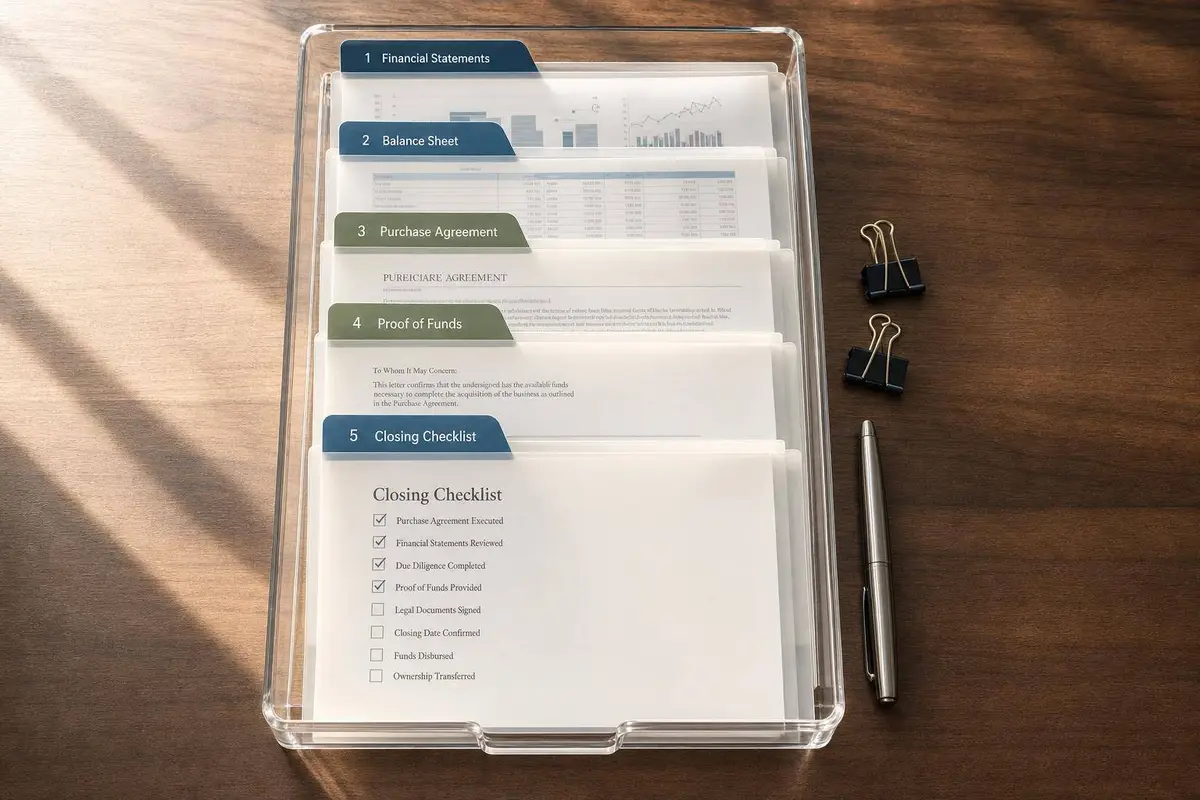
Once you’ve gathered the buyer, target, and deal documents, package everything in the same order the lender will review it.
- Buyer: Personal financial statement, personal debt schedule, personal tax returns, bank or brokerage statements
- Target: Business tax returns, P&L statements, balance sheets, debt schedule, AR aging, AP aging, current year-to-date P&L
- Transaction: Signed LOI or purchase agreement, seller note terms, earnout terms, lease terms, sources-and-uses schedule
- Equity: Bank and brokerage statements, wire receipts, trade confirmations, or gift letters tracing the down payment to the closing account
Submit one labeled package in four folders: Buyer, Target, Transaction, and Equity.
Most delays come from the same small set of issues. It’s usually not one giant problem. It’s a handful of loose ends that force the lender to stop, ask follow-up questions, and wait for clean backup.
Common File Problems That Slow Approval
Here are the file problems that stall deals most often, and what to fix before you send anything over.
| Problem | Why It Stalls the File | Fix Before Submitting |
|---|---|---|
| Missing interim financials | Lender can't assess current-year performance | Include a P&L and balance sheet dated within 60 days of application |
| Unexplained add-backs | Normalized EBITDA can't be trusted without detail | Attach a schedule with line-item explanations and supporting invoices |
| Unsigned purchase documents | Lender can't model a deal that isn't legally committed | Ensure the LOI or purchase agreement carries both parties' signatures |
| Debt schedule mismatches | Balances that don't tie to the balance sheet force a pause | Reconcile every obligation to the financial statements before submission |
| Untraceable equity funds | Large deposits without support raise compliance flags | Provide two to three months of statements plus wire receipts, trade confirmations, or a gift letter if the funds are gifted |
One detail that trips people up: add-backs. If you claim an expense should be added back, show your work. Back every add-back with invoices or a written explanation so credit review moves faster.
FAQs
What documents should I gather first?
Start with the core lender documents: 3 years of personal and business tax returns, current balance sheets, profit and loss statements, cash flow projections, a business plan, a third-party valuation, a signed LOI or purchase agreement, and a debt schedule.
You’ll also need proof of your equity injection - typically 10% to 25% - plus documents that show exactly where those funds came from.
Why do banks ask for interim financials?
Banks ask for interim financials to finish the loan package and update their credit review. They look at these statements alongside personal financial statements and tax returns, business financials, purchase terms, debt schedules, target valuation, and proof of equity.
Put simply, the bank is trying to verify a few core things before approval and closing:
- The buyer’s creditworthiness and liquidity
- The business’s earnings and ability to repay the loan
- The purchase price and deal structure
- The full capital stack and any existing obligations
Taken together, these documents give the lender a current snapshot of both the buyer and the business before the deal moves forward.
How do I prove my down payment source?
Provide proof of equity injection that shows where your down payment is coming from, plus the financial documents that back it up. Lenders use this to make sure the money is available and properly sourced.
To support credit review and repayment, you’ll usually include:
- Tax returns
- Current financial statements
- A signed purchase agreement
- Cash flow projections
- A debt schedule
Related Reading
Find the right lender for your business
Whether it's working capital, an SBA loan, or acquisition financing — we'll match you with the right capital partner.
About the author
Principal & CEO/CIO
Samson Jagoras has 15+ years across finance, real estate, and business acquisitions. He began his career as a Futures & Commodities broker and later served as Chief Strategy Officer of an INC 500 marketing and technology firm, helping scale revenue from $1M to over $100M. Today he buys, builds, and advises a portfolio of companies with a focus on M&A, capital allocation, and operational strategy.