Fraud Risk in Due Diligence Processes
Due diligence without fraud-focused checks is asking to overpay and inherit hidden liabilities. Learn the schemes, red flags, and frameworks to protect every acquisition.
 Samson JagorasPrincipal & CEO/CIOMay 26, 2026

Get a Quality of Earnings analysis you can trust
Our QofE team validates earnings, normalizes add-backs, and de-risks your deal — flat-fee with fast turnaround.
Fraud Risk in Due Diligence Processes
Fraud risk in due diligence is the potential for sellers to hide or misrepresent critical information during a business acquisition. This can lead to buyers overpaying, inheriting hidden liabilities, or facing legal and financial setbacks after the deal closes. Common schemes include inflating financial statements, concealing debts, or transferring assets to related parties.
Key takeaways:
- Small and midsize businesses often have higher fraud risks due to limited oversight and unaudited financials.
- Fraud detection during due diligence can lead to renegotiating the price, restructuring the deal, or walking away entirely.
- Warning signs include cash flow mismatches, delayed document delivery, and vague financial adjustments.
- Tools like forensic Quality of Earnings (QoE) reports, escrow agreements, and Representation & Warranty Insurance (RWI) help mitigate risks.
- Technology, such as AI-driven financial analysis, can identify anomalies in financial data and improve fraud detection efficiency.
Fraud risk management should be integrated into financial, legal, and operational due diligence to protect buyers and ensure informed decisions, often with the help of specialized consultation services.
Common Fraud Schemes Found During Due Diligence
Main Fraud Categories in Acquisitions
Fraud in business acquisitions often hides in plain sight, buried in financial records, vendor dealings, or ownership structures. To uncover it, buyers need to know where to focus their attention.
One of the most prevalent schemes is financial statement manipulation. Sellers might inflate profitability by prematurely recording revenue, capitalizing operating expenses to boost EBITDA, or hiding liabilities like unpaid taxes or accrued payroll. These tactics are designed to make the business look more profitable than it really is.
Another common issue is asset misrepresentation. For example, sellers may transfer valuable assets — like equipment or intellectual property — to related parties at below-market prices before the sale. They may also list obsolete inventory at full value. A notable case occurred in January 2013 when Caterpillar had to write off $580 million in goodwill shortly after acquiring ERA Mining Machinery. An investigation revealed that ERA's subsidiary, Siwei, had manipulated inventory figures for years to inflate profitability before the sale closed.
Vendor and customer collusion is another sneaky tactic. This involves insiders working with suppliers to submit inflated invoices in exchange for kickbacks or giving customers undisclosed price breaks that don't show up in accounting records.
| Fraud Category | Methods | Red Flags |
|---|---|---|
| Financial Manipulation | Premature revenue recognition; capitalizing expenses | Revenue surges at quarter-end; margins differ from industry norms |
| Asset Misconduct | Related-party transfers; phantom fixed assets | Inventory growing faster than sales; missing asset records |
| Liability Concealment | Hiding litigation; unpaid taxes | Vague pending claims; missing environmental reports |
| Collusion | Kickbacks; backdated contracts; hidden discounts | High supplier reliance; frequent manual journal entries |
| IP Fraud | Inflated patent ownership; undisclosed co-ownership | IP not registered to the company; absent source code logs |
Where to Find Fraud in Due Diligence Workflows
Spotting fraud means diving deep into financial, legal, and operational processes. The challenge is that fraud rarely stands out — it's often a series of small inconsistencies that, when pieced together, reveal a bigger issue.
In financial reviews, cash flow inconsistencies are a major red flag. For instance, if a company reports strong profits but struggles to generate positive operating cash flow, something might be off. Other signs include accounts receivable aging past 90 days without proper write-offs or flat expenses despite rising revenue — both of which suggest revenue manipulation or misclassified expenses. High-risk indicators also include owner add-backs exceeding 30% of stated EBITDA.
"Financial statements are the start, not the truth." — David Deeds, Schulze Professor of Entrepreneurship, University of St. Thomas
In legal and operational reviews, hidden liabilities are a key concern. Sellers may fail to disclose lawsuits, environmental obligations, or side agreements buried in vendor contracts. Operationally, high customer concentration is risky — if a single customer accounts for more than 20% of revenue, or the top five customers make up more than 50%, it could signal dependency on a few accounts or even fabricated revenue.
Behavioral clues from sellers during due diligence can also reveal potential problems. Delayed document delivery, frequent revisions to financials, or pressure to speed up the diligence process are all red flags that experienced buyers take seriously.
Building a Fraud-Focused Due Diligence Framework
Core Components of a Fraud Risk Framework
Identifying fraud is just the beginning. The real challenge lies in creating a structured process to detect it early — before finalizing a deal.
A strong fraud-focused framework starts with assembling the right team. This should include members from finance, legal, operations, IT, and HR. For smaller targets, consider hiring external specialists like forensic accountants to prepare a Quality of Earnings (QoE) report, which typically costs between $15,000 and $50,000. This report plays a key role in uncovering revenue recognition issues that might slip through standard reviews.
Beyond forming the team, take steps that go beyond reviewing documents. For instance, extract raw general ledger data while the seller is present to prevent potential tampering later. Conduct surprise site visits to verify inventory and fixed assets, and directly contact top customers to confirm revenue. If a seller resists these external verifications — such as avoiding customer calls — it can be a warning sign of possible fraud.
To safeguard the deal, include protective measures in the agreement. For example, set aside 10%–15% of the purchase price in escrow or holdback for 12–24 months to cover any undisclosed liabilities. Additionally, consider Representation & Warranty Insurance (RWI), which transfers residual risk with a one-time premium of 1%–3%. Between 2015 and 2023, 18.2% of North American RWI policies resulted in claims, showing how common post-close issues can be.
Connecting Fraud Risk to Broader Due Diligence
Fraud risk assessment should not stand alone — it works best when woven into a comprehensive due diligence process. This ensures that both obvious and subtle warning signs are addressed.
In the financial track, complete the QoE report before signing the Letter of Intent. In the legal track, go beyond state-level checks by running lien searches in every county where the business has operated. On the operational track, interview employees at all levels — not just management — to identify potential issues like misclassified contractors, unpaid overtime, or unrecorded vendor relationships.
| Issue Severity | Example | Recommended Action |
|---|---|---|
| Minor | Small accounts receivable write-offs | Negotiate a closing credit |
| Material | Add-backs over 30% of EBITDA | Adjust the price or include an earnout |
| Structural | Contingent liabilities or IP disputes | Restructure the deal as an asset purchase |
| Fatal | Evidence of intentional fraud | Walk away from the deal |
"It's not the problem that kills deals — it's how the seller responds to the problem." — Acquisition Stars
The way a seller handles red flags can reveal as much as the issue itself. Sellers who are transparent, provide documentation, and actively work toward resolutions are far more trustworthy than those who deflect or delay.
Mastering the 7-Step Fraud Risk Assessment: A Comprehensive Guide

Ready to Make Your Next Move?
Whether you're buying, selling, or investing — Clearly Acquired gives you the tools, data, and support to close with confidence.
Fraud Red Flags to Watch During Due Diligence
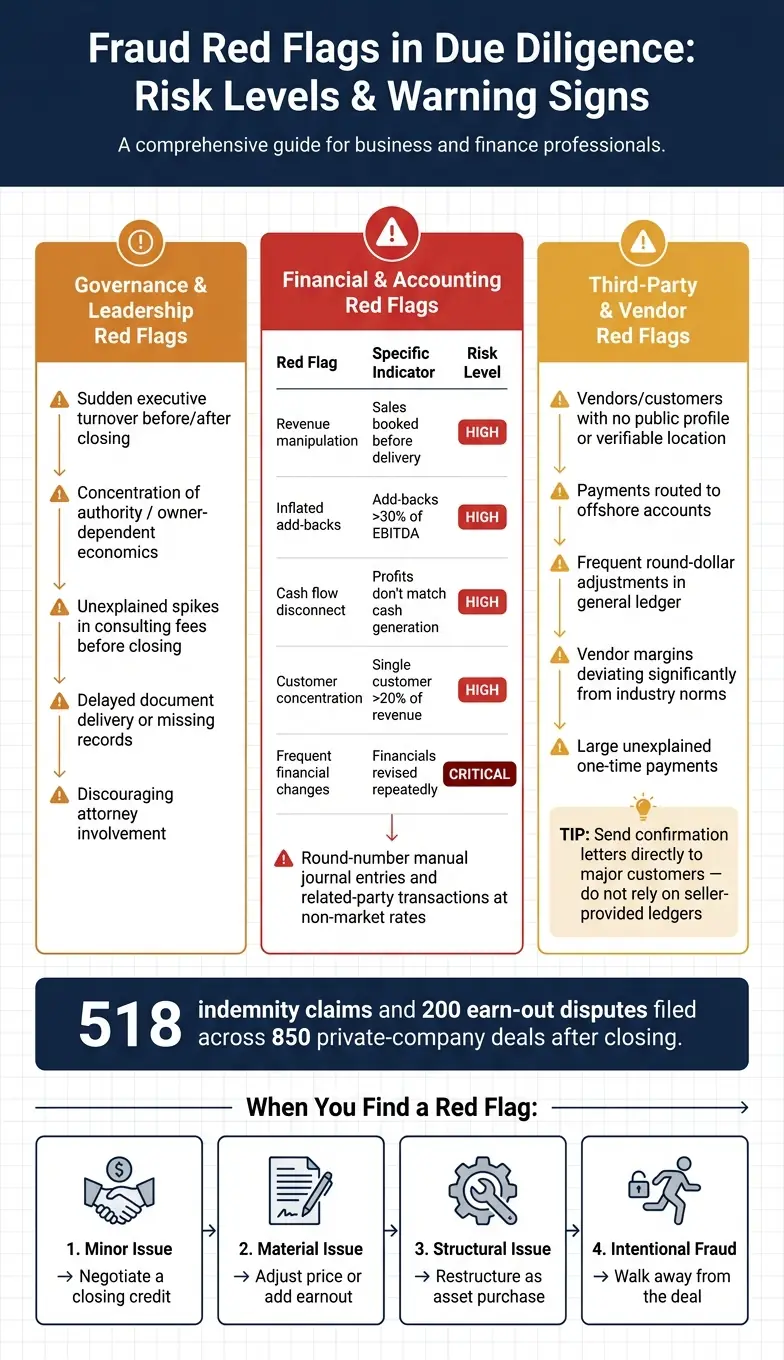
Fraud Red Flags in Due Diligence: Risk Levels & Warning Signs
When conducting due diligence, spotting potential fraud early can save significant time and resources. Identifying red flags tied to governance, financial practices, and third-party relationships is a critical part of this process.
Governance and Leadership Red Flags
Leadership behavior often reveals more about a company's integrity than its financial statements. A major warning sign is sudden executive turnover, such as key personnel resigning or being terminated just before or after a deal closes. This can sometimes be a tactic to avoid exposing internal misconduct.
Pay attention to concentration of authority — for instance, when profitability heavily depends on the owner's personal relationships, unusually low salaries, or minimal costs. This pattern, often referred to as "owner-dependent economics", can obscure the business's actual earnings potential. Likewise, unexplained spikes in "consulting fees" or vague "other compensation" right before closing could indicate cash being siphoned off.
"Sudden key personnel resignations or terminations right before or after closing [can be used] to prevent disclosures." — Financely
Delays in providing documents, claims of "missing" records, or discouraging attorney involvement should be treated as serious red flags, not minor inconveniences. Conducting background checks on key executives and speaking with mid-level employees can provide a clearer picture of the company culture and potential risks.
Financial and Accounting Red Flags
Governance failures often pave the way for financial manipulation. One of the most common tactics is revenue recognition manipulation — for example, recording sales before delivery or tying revenue to entities with unverifiable business activity. Another strategy involves capitalizing routine expenses, like maintenance or overhead, as capital expenditures to artificially inflate EBITDA.
A persistent disconnect between reported profits and cash flow is another red flag. If the cash flow statement doesn't align with the income statement, it's essential to investigate further.
| Red Flag | Specific Indicator | Risk Level |
|---|---|---|
| Revenue manipulation | Sales booked before delivery or unverifiable revenue sources | High |
| Inflated add-backs | Add-backs exceeding 30% of EBITDA | High |
| Cash flow disconnect | Profits don't match cash generation | High |
| Customer concentration | Single customer represents >20% of revenue | High |
| Frequent financial changes | Financials revised repeatedly during due diligence | Critical |
Other warning signs include round-number manual journal entries in accounts payable or receivable, and transactions involving entities owned by the seller's family members at non-market rates. These can suggest kickback schemes or cash diversion.
Third-Party and Vendor Red Flags
Vendor and customer relationships can also conceal fraud. Be wary of vendors or customers lacking public profiles, verifiable locations, or operating histories. These could be fictitious entities created to fabricate revenue or funnel money out of the business.
Unusual payment patterns demand attention — such as payments routed to offshore accounts or frequent round-dollar adjustments in the general ledger. To verify third-party relationships, send confirmation letters directly to major customers rather than relying solely on seller-provided ledgers. Reviewing UCC filings can also help uncover hidden liens on assets like equipment or real estate that the seller may not disclose.
If vendor margins deviate significantly from industry norms or there are large, unexplained one-time payments, these should be treated as serious concerns rather than minor discrepancies.
How Technology Supports Fraud Detection in Due Diligence
AI and Data Automation in Fraud Detection
Detecting fraud manually can be like finding a needle in a haystack. The sheer volume of financial data involved in acquisitions — think thousands of transactions, invoices, and journal entries — makes subtle patterns nearly impossible to catch without help. This is where automation steps in, transforming how fraud detection is handled during due diligence.
Take general ledger analytics, for example. These tools scan every transaction to flag potential red flags, such as round-number entries, repeated corrections, or an unusually high number of manual adjustments. These kinds of anomalies often slip through standard reviews but can be strong indicators of deeper issues.
Another game-changer? Pulling raw data directly from source accounting systems instead of relying on emailed Excel files. Seller-provided files can sometimes be tampered with before delivery, but direct extraction ensures the data remains untouched.
"Fraudsters hate outside contact. A quick five-minute call to a few top buyers can disarm a deal set up on fake revenue faster than any model." — Financely
Technology also enables cross-system reconciliation, comparing data from systems like ERP or CRM platforms against physical records such as shipping logs or bills of lading. This can reveal issues like premature revenue recognition. Automated searches for liens or state tax-clearance verifications are another tool to uncover hidden liabilities.
For intellectual property, automated tools take it a step further by analyzing GitHub repositories, version-control histories, and trademark registrations. This ensures that the company — not an individual founder or contractor — truly owns the IP.
How Clearly Acquired Supports Fraud Risk Management

Clearly Acquired builds on these technological advancements to simplify fraud risk management, tailored specifically for Main Street and Lower-Middle-Market acquisitions.
The platform offers AI-assisted financial analysis and risk screening, which applies anomaly detection to financial data during underwriting. Instead of relying on a seller's polished summaries, buyers access verified deal data in a secure data room with strict permission controls, reducing the risk of manipulated or incomplete disclosures.
These tools go beyond fraud detection — they ensure the integrity of the entire deal. For instance, the platform's AI Lender Match tool prevents fraud by connecting deals with lenders based on verified underwriting criteria. This ensures that financing is based on accurate financials, not inflated projections. Lenders using the platform work from the same vetted data, adding another layer of scrutiny.
Conclusion: Making Due Diligence Stronger with Fraud Risk Management
Fraud risk management takes due diligence beyond just reviewing documents — it actively safeguards against losing value, ensuring you're getting what you're paying for.
Consider this: out of 850 private-company deals, buyers filed 518 indemnity claims and 200 earn-out disputes after closing. A striking example from 2024 is the VitalCaring vs. Encompass case, where a Delaware judge ordered 43% of future profits into a constructive trust after founders concealed related-party debts and off-balance-sheet liabilities. These kinds of outcomes highlight what can happen when fraud risks are ignored.
Having a structured approach gives buyers clear signals to walk away when red flags appear. For example, a forensic Quality of Earnings (QoE) report, which typically costs between $15,000 and $50,000, can save buyers from the much greater financial loss of closing a deal based on inaccurate information.
"Trust, but verify. And when verification reveals problems, pay close attention to whether the seller helps you understand or tries to distract you." — Acquisition Stars
Advanced technology strengthens these efforts even further. Platforms like Clearly Acquired streamline the process by integrating AI-driven financial screening, verified deal data, and secure data rooms. This approach reduces the risk of manipulated disclosures from the outset, offering buyers — especially those in Main Street and Lower-Middle-Market transactions — a way to avoid unpleasant surprises after closing.
FAQs
How can I tell if reported EBITDA is inflated?
To spot if reported EBITDA might be overstated, take a close look at the financials for red flags. Watch for discrepancies between EBITDA and cash flow, unusual adjustments, or aggressive revenue recognition practices. It's crucial to dig deeper by conducting thorough due diligence. This includes verifying supporting documents and performing a quality of earnings (QoE) analysis to detect any potential manipulation.
What are the fastest fraud checks to run before signing an LOI?
The fastest way to spot fraud involves a few key steps: checking the accuracy and consistency of financial records, reviewing legal compliance and unresolved issues, and evaluating the overall operational health of the business. Pay close attention to areas like customer concentration and contingent liabilities, as they can reveal potential risks early in the process.
When should I use escrow or RWI to protect the purchase?
When a transaction involves notable risks — like legal liabilities, hidden debts, or uncertainties about operations that might impact the deal's value or completion — using tools like escrow accounts or Representation and Warranty Insurance (RWI) can be a smart move. These options help address potential problems that may arise during thorough due diligence, offering protection and reducing financial exposure.
De-risk your deal with a Quality of Earnings report
Independent, deal-ready earnings analysis that buyers, sellers, and lenders trust.
About the author
Principal & CEO/CIO
Samson Jagoras has 15+ years across finance, real estate, and business acquisitions. He began his career as a Futures & Commodities broker and later served as Chief Strategy Officer of an INC 500 marketing and technology firm, helping scale revenue from $1M to over $100M. Today he buys, builds, and advises a portfolio of companies with a focus on M&A, capital allocation, and operational strategy.