Lower Middle Market Growth Credit: Key Players
Match lower-middle-market growth deals to the right lender by screening EBITDA, facility size, underwriting style, and sponsor fit.
 Samson JagorasPrincipal & CEO/CIOAugust 25, 2026
Get matched with the right lender for your business
Compare offers from our vetted network. Pre-qualify in minutes — no impact to your credit.
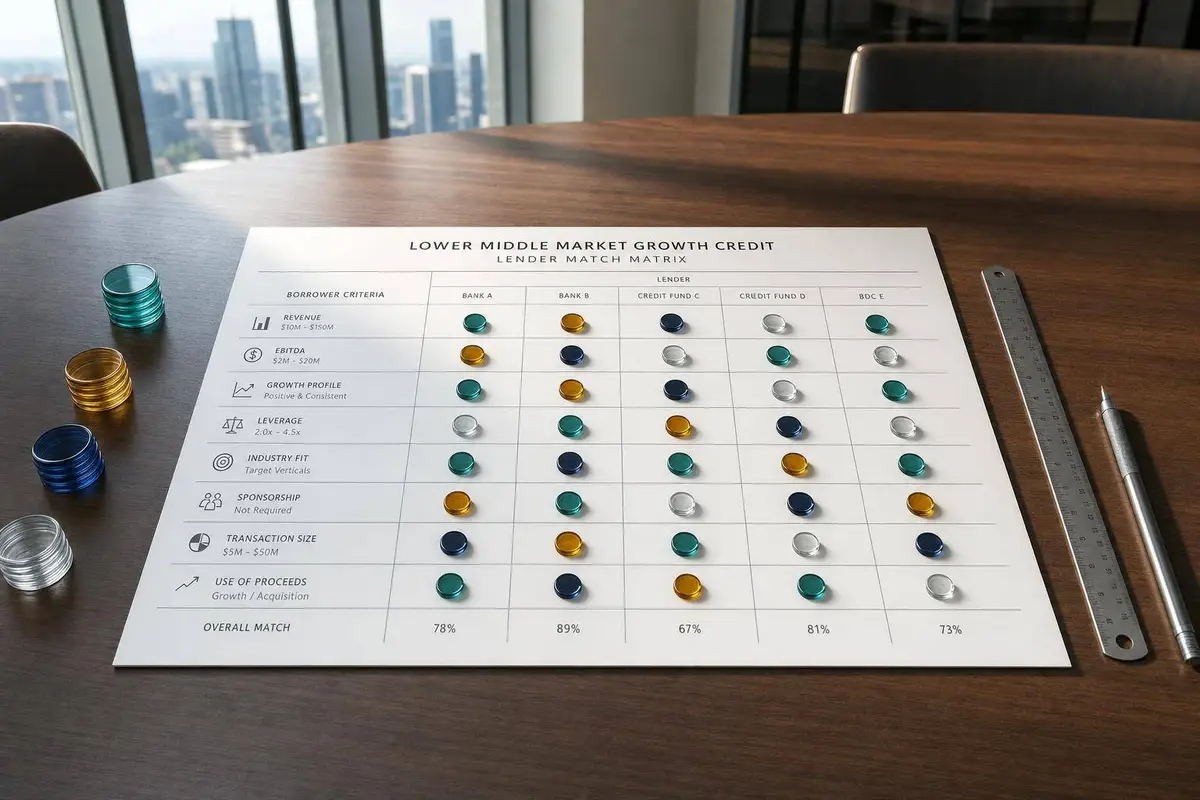
If you’re looking for lower middle market growth credit, the main job is simple: match your deal to the right lender type. In this market, capital is deep - $1.21 trillion was available for North American LMM private credit in June 2026. So the issue usually isn’t access to money. It’s fit.
I’d narrow the field fast by using buyer tools to look at four things first:
- Company size: most lenders here look at roughly $1 million to $15 million EBITDA, though some go higher
- Facility size: bank deals often sit around $5 million to $50 million, while unitranche funds often start near $10 million
- Deal type: growth, add-on acquisition, recap, working capital, or cash-out all screen differently
- Underwriting style: some lenders care most about EBITDA, others about ARR, and ABL groups care more about receivables, inventory, and equipment
Here’s the short version:
- Broad direct lenders like Twin Brook, Monroe, Antares, Golub, Churchill, Blue Owl, and Ares are often a fit for sponsor-backed cash-flow deals
- Recurring-revenue and structured credit lenders like SG Credit Partners, Reveille Capital, and ORIX Growth Capital can fit SaaS or tech-enabled businesses with thin EBITDA but strong recurring revenue
- Bank sponsor finance and ABL groups like Huntington, PNC, and Fifth Third can work well for lower-cost senior debt or asset-heavy companies
One filter matters more than most people think: sponsor fit. Some lenders want an institutional PE sponsor. Some will work with independent sponsors. Some bank and SBA paths work better for non-sponsored deals. If you need help navigating these options, our acquisition financing team can help match your deal to the right lender.
… Let’s Talk Lower Middle Market Direct Lending

Quick Comparison
| Lender group | Best fit | Typical size band | Main lens |
|---|---|---|---|
| Broad direct lenders | Sponsor-backed buyouts, recaps, add-ons | Usually $3 million+ EBITDA and $10 million+ facilities | Cash flow and leverage |
| Recurring-revenue / structured credit | SaaS, tech-enabled services, low EBITDA profiles | Often works when 60%+ revenue is recurring | ARR, retention, runway |
| Bank sponsor finance | Stable companies seeking lower-cost senior debt | Often $5 million+ EBITDA | Coverage, history, bank credit metrics |
| ABL lenders | Manufacturing, distribution, working-capital-heavy deals | Varies by collateral base | Assets and borrowing base |
In other words: don’t build your list by brand name alone. I’d screen by size, structure, industry, and ownership first. Then I’d compare pricing across senior debt, unitranche, and mezzanine at the same time before making calls.
What to Compare Before Contacting a Growth Credit Provider
Minimum company size, check size, and structure type
Start with three things: EBITDA, facility size, and deal structure.
Lower-middle-market growth credit usually serves companies with $1M to $25M in EBITDA. But lenders don't all sit in the same part of that range. Monroe Capital, for example, focuses on companies in the $3M to $15M EBITDA band.
Then look at check size. This is where a lot of lists fall apart fast. SBA 7(a) loan terms vs. other financing options are capped at $5M. Regional banks usually write checks from $5M to $50M. Unitranche providers tend to work in the $10M to $100M range. So if you need an $8M facility, SBA is off the table. If you are under that threshold, you should learn how to use SBA 7(a) loans for business purchases.
Structure is the third screen. Senior bank debt is usually the lowest-cost choice, but it often comes with tighter requirements. In most cases, that means 3+ years of audited financials and a fixed-charge coverage ratio of 1.25x to 1.35x. Unitranche debt can work with lower coverage, often around 1.10x, but you'll pay more for that flexibility and speed. Mezzanine sits between senior debt and equity and usually comes with 11.5% to 14% cash coupons, 1% to 3% PIK, and warrants.
If a lender doesn't match your size, your ask, or your structure, it's probably not worth the intro.
Industry focus and underwriting style
Once size and structure line up, the next thing to check is how the lender underwrites the deal.
Generalist cash-flow lenders - including firms like Twin Brook and Monroe Capital - usually lean toward steadier sectors like business services, manufacturing, and distribution. They underwrite against EBITDA and free cash flow conversion. A common screen is CapEx below 5% of EBITDA.
Specialist lenders look at different numbers. Some software-focused credit funds care more about Annual Recurring Revenue than EBITDA. They may support leverage of 5x to 7x when recurring revenue is more than 60% of total revenue. Asset-based lenders look at a different picture altogether. They focus more on receivables, inventory, and equipment, while growth credit and unitranche lenders are usually driven more by cash flow and enterprise value.
Customer concentration also comes up all the time. Most providers want no single customer to account for more than 25% of revenue. If one customer is well above that mark, deal with it before outreach - or go after lenders that can live with concentrated revenue.
Sponsor appetite and transaction fit
Your sponsor profile changes the lender pool more than many founders expect.
Some lenders want a funded PE firm behind the deal. Others are open to independent sponsors. Monroe Capital falls into that second group. For non-sponsored deals, the path usually runs through SBA lenders for sub-$5M facilities, or regional banks and specialist lenders for larger transactions.
The table below gives you a quick way to line up lender type with deal size and sponsor profile.
| Provider Type | Min EBITDA | Check Size | Structure | Sponsor Appetite |
|---|---|---|---|---|
| SBA Preferred Banks | <$1M | $500K–$5M | Senior Term | Non-sponsored / Search Funds |
| Regional Banks | $2M–$5M | $5M–$50M | Senior / ABL | Strategic / Independent Sponsors |
| Unitranche Funds (BDCs) | $3M–$5M | $10M–$100M | Unitranche | Institutional PE / Independent Sponsors |
| Mezzanine Funds | $3M+ | $3M–$25M | Subordinated + PIK | Sponsored / Independent Sponsors |
| Direct Lenders | $2M+ | $5M–$50M | Hybrid / Cash Flow | Independent Sponsors / Family Offices |
A simple move here can save time: run senior debt, unitranche, and mezzanine quotes at the same time. The best term sheet usually sets the pricing floor.
Key Players in Broad Lower Middle Market Direct Lending
Use the size and sponsor filters above to narrow this list to lenders that actually fit the deal.
Ares Capital and Blue Owl Capital
Ares Capital and Blue Owl Capital sit at the larger end of LMM direct lending. They tend to matter more once a deal is too big for small-balance financing.
In November 2024, Ares Capital provided unitranche financing for Waud Capital Partners' recapitalization of Ivy Rehab, a $200M+ healthcare services transaction. Blue Owl plays in much the same part of the market, with typical checks from $10M to $200M+ and a focus on upper-end lower middle market and middle-market sponsor-backed deals.
Antares Capital, Golub Capital, and Twin Brook Capital Partners
These three firms sit in the heart of the sponsor-finance market for LMM deals. Antares Capital manages over $30 billion in assets and has a dedicated sponsor coverage team.
Golub Capital tends to favor unitranche structures for platform acquisitions. In March 2025, it provided unitranche financing for Silver Oak Services Partners' acquisition of the HomeVestors franchise portfolio, a deal valued at about $95M.
Twin Brook Capital Partners is the most LMM-focused of the group. It deployed $8.9 billion in LMM commitments in 2025.
Monroe Capital, Churchill Asset Management, and Comvest Credit Partners
Monroe Capital focuses on family- and founder-owned businesses, especially those working with independent sponsors. It targets companies with $3M to $15M in EBITDA and uses a debt-plus-equity model, with combined checks from $15M to $200M. In some cases, that includes senior debt plus a 20% to 30% equity stake. That ability to pair debt with minority equity is what makes Monroe stand out in a growth-credit setting.
Churchill Asset Management and Comvest Credit Partners serve sponsor-backed acquisition and growth-capital deals.
| Firm | Typical EBITDA Range | Common Use Cases | Sponsor Orientation |
|---|---|---|---|
| Monroe Capital | $3M – $15M | Buyouts, roll-ups, recapitalizations | Independent & funded sponsors |
| Churchill Asset Management | LMM to middle market | Unitranche, acquisition financing | Primarily sponsor-backed |
| Comvest Credit Partners | LMM to middle market | Senior, unitranche, growth capital | Primarily sponsor-backed |
| Twin Brook Capital Partners | $3M – $50M | LMM buyouts, add-on acquisitions | Dedicated sponsor coverage |
Deals driven by recurring revenue, asset coverage, or bank-style underwriting usually fit the next lender group better.
Recurring Revenue, Structured Credit, and Sponsor-Finance Players
When EBITDA underwriting isn't the right lens, a different set of lenders comes into play.
SG Credit Partners, Reveille Capital, and ORIX Growth Capital
If an EBITDA-first approach doesn't fit, recurring-revenue and asset-backed lenders start to make more sense. SG Credit Partners, Reveille Capital, and ORIX Growth Capital are often a match for SaaS and tech-enabled services businesses with visible ARR, steady retention, and low trailing EBITDA.
The best fit is usually SaaS and tech-enabled services businesses with 60%+ recurring revenue and a stable cash runway.
Bank sponsor finance and asset-based lending groups
Regional and super-regional banks like Huntington, PNC, and Fifth Third lend into LMM sponsor deals, usually at $5 million+ EBITDA and around SOFR + 300 to 425 bps. For stable, high-margin service businesses, this is often the lowest-cost senior capital on the table.
Asset-heavy businesses work a bit differently. A manufacturer or distributor may have a hard time meeting the EBITDA coverage a cash-flow lender wants. But if that business has meaningful receivables, inventory, or equipment, those assets can back an asset-based revolving credit facility.
In that setup, ABL lenders size availability against a borrowing base, not an earnings multiple. That makes ABL a better match for businesses with uneven cash flow or growth that eats up working capital.
Where Clearly Acquired fits for smaller operators and deal teams
For smaller operators and deal teams, the job is simple in theory but tricky in practice: match the deal to the right capital stack.
Clearly Acquired helps connect transactions to the right mix of:
- SBA
- bank debt
- private credit
- mezzanine
- equity
Conclusion: How to Build a Shortlist of Lower Middle Market Growth Credit Providers
No lender fits every lower middle market growth deal. The best shortlist comes from matching four deal factors - EBITDA size, cash-flow profile, industry fit, and ownership structure - with the lender type that lines up with them.
Start by screening for size, cash-flow strength, industry fit, and ownership structure before you reach out. Once that fit is clear, check whether the fund still has room for follow-on capital.
Fund vintage matters. A late-life fund may not have enough reserve capacity for follow-on capital. That last check can narrow the shortlist in a hurry.
Use SBA, bank, unitranche, mezzanine, or family-office capital only when the deal’s size, leverage, and ownership profile match the lender.
After you narrow the list, price senior debt, unitranche, and mezzanine at the same time. Locking in equity first can add 300 to 500 bps to blended cost. Clearly Acquired structures the stack and matches deals to SBA, bank debt, private credit, mezzanine, and equity.
FAQs
How do I know which lender type fits my deal?
Lower-middle-market growth financing usually comes with a layered capital stack.
That often means senior debt from SBA 7(a) lenders or regional banks, unitranche or mezzanine debt to cover funding gaps, and equity from sponsors or sellers.
Here’s how that can look in practice:
- Senior and unitranche lenders: Twin Brook, Monroe, Antares, Golub, Churchill, Apogem, and Barings
- SBA 7(a) lenders: Live Oak, Byline, Newtek, and Huntington
- Mezzanine providers: NewSpring, Star Mountain, Northstar, and Audax
It’s a mix-and-match setup. One lender may anchor the deal, while another fills the space between bank debt and equity. That structure gives buyers and operators more room to fund growth without relying on a single source of capital.
What if my business has strong ARR but low EBITDA?
In lower-middle-market growth and acquisition deals, financing usually comes together as a layered capital stack instead of leaning on EBITDA alone.
That stack often includes senior debt, junior capital, and equity. Clearly Acquired helps operators and investors put that mix together and work through sourcing, diligence, and financing across the full deal lifecycle.
Does being non-sponsored limit financing options?
Not necessarily. Active lower-middle-market growth credit providers show up across the capital stack. That includes SBA 7(a) lenders, regional and cash-flow banks, unitranche direct lenders, and mezzanine/junior capital providers.
Clearly Acquired can also support lower-middle-market acquisitions through deal flow and debt/equity matchmaking, including SBA loans.
Related Reading
- Mezzanine Debt for Acquisitions: 2026 Guide
- Private Credit vs Bank Loans: Pros and Cons
- Bank Loan for SMB Acquisitions: 7 Steps
- SBA Loan Pre-Approval for Business Acquisitions
- EBITDA Multiples by Industry ($1M-$5M)
Sources & Further Reading
Find the right lender for your business
Whether it's working capital, an SBA loan, or acquisition financing — we'll match you with the right capital partner.
About the author
Principal & CEO/CIO
Samson Jagoras has 15+ years across finance, real estate, and business acquisitions. He began his career as a Futures & Commodities broker and later served as Chief Strategy Officer of an INC 500 marketing and technology firm, helping scale revenue from $1M to over $100M. Today he buys, builds, and advises a portfolio of companies with a focus on M&A, capital allocation, and operational strategy.