HIPAA Compliance in Healthcare M&A Deals
Manage HIPAA risk in healthcare M&A: limit PHI, verify BAAs and security, map data flows, and require Day-1 controls.
 Samson JagorasPrincipal & CEO/CIOAugust 29, 2026
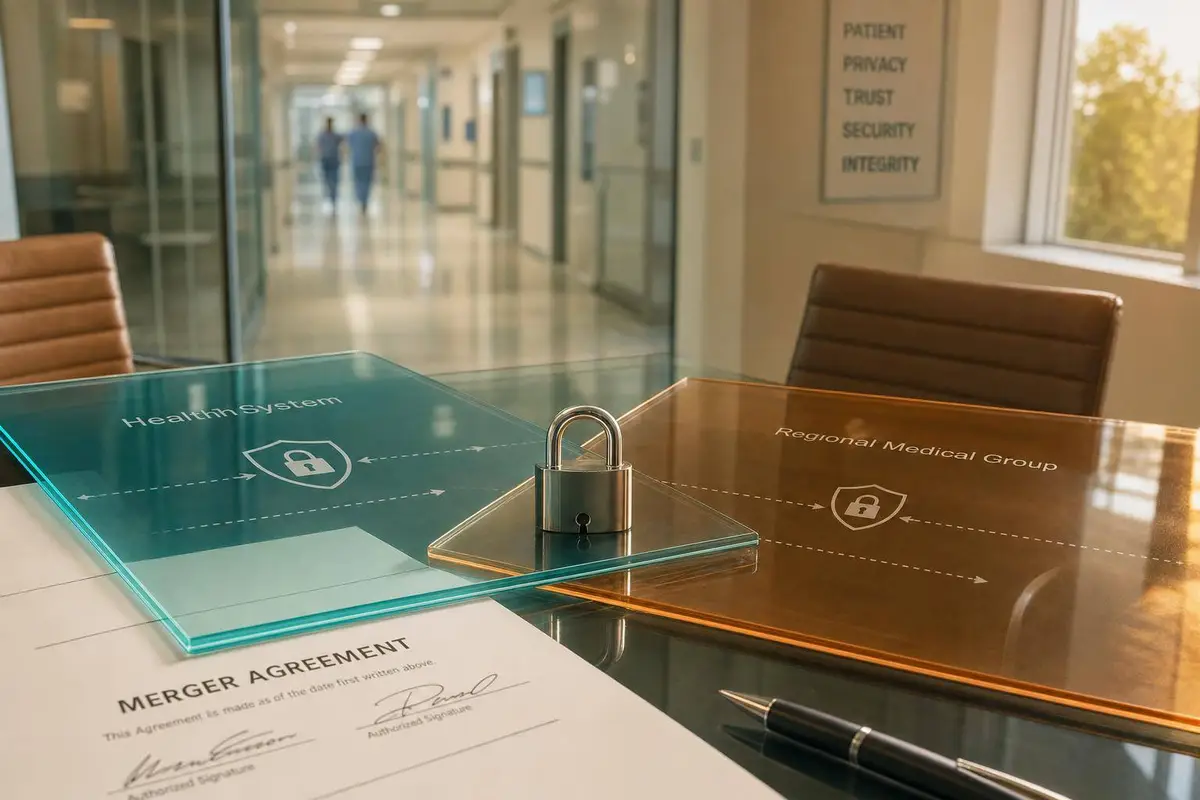
If HIPAA is handled late in a healthcare deal, the buyer can inherit hidden breach risk, missing vendor contracts, and delay at close. I’d sum it up this way: limit PHI from the start, test security before signing, tie gaps to price and closing terms, and lock down Day 1 transfer and training.
Here’s the article in plain English:
- HIPAA affects the whole deal, not just post-close cleanup.
- PHI can be shared in M&A, but only within HIPAA rules and often with state-law limits.
- The minimum necessary rule still applies during diligence.
- Buyer access should move in steps:
- de-identified data first
- limited data sets under a DUA next
- identifiable PHI only when there is a clear need and a BAA is in place
- Data rooms need tight controls like MFA, encryption, access limits, watermarking, and audit logs.
- BAA review is a core diligence task, especially for EHR vendors, billing firms, cloud providers, and MSPs.
- Deal structure changes the risk:
- in an asset deal, vendor contracts often need to be redone before Day 1
- in a stock deal, the buyer may take on past HIPAA issues, including unreported breaches
- Security diligence must test proof, not just paper, including:
- Security Risk Analysis
- risk management steps
- MFA
- encryption
- access logs
- breach history
- HIPAA gaps should change deal terms, such as price cuts, escrow, indemnities, and closing conditions.
- At close and after close, PHI transfer, NPP updates, training, access cleanup, and incident response all need to be set.
A few facts stand out:
- HIPAA breach notices generally must go out without unreasonable delay and no later than 60 days after discovery.
- Breaches affecting 500 or more people can trigger notice to the media and HHS.
- HIPAA records like policies, BAAs, and risk analyses must usually be kept for at least 6 years.
- OCR fines can reach millions of dollars per instance in some cases.
If I were using this article as a deal guide, I’d treat it like a simple rulebook: share less data, document each step, verify each control, and do not let open HIPAA issues drift into Day 1.

HIPAA Compliance Roadmap for Healthcare M&A Deals
The HIPAA Rules That Apply In A Healthcare Transaction
Three HIPAA rules shape a healthcare deal: the Privacy Rule, the Security Rule, and the Breach Notification Rule.
The Privacy Rule controls how Protected Health Information (PHI) may be used or disclosed. The Security Rule sets national standards for protecting electronic PHI (ePHI) through administrative, physical, and technical safeguards. The Breach Notification Rule says covered entities must notify affected individuals, HHS, and, when a breach affects 500 or more people, the media without unreasonable delay and no later than 60 days after discovery.
These rules apply to covered entities and business associates. So if a buyer will handle PHI after closing, the needed HIPAA controls have to be in place before the deal closes.
When PHI Sharing Is Permitted During A Sale Or Merger
HIPAA does allow PHI sharing during a transaction, but only in narrow situations. Under the Privacy Rule, due diligence and change-of-ownership work count as health care operations. In plain English, that means a seller may disclose PHI to a prospective buyer without getting patient authorization first, as long as the disclosure is tied to the deal and the buyer is or will become a covered entity.
HIPAA also has a specific exception to the general ban on the sale of PHI. Usually, payment for PHI needs patient authorization. But disclosures made as part of a bona fide sale, transfer, merger, or consolidation of all or part of a covered entity are exempt.
State law can be stricter. Some types of information, like HIV status, mental health records, and substance use disorder treatment records governed by 42 CFR Part 2, may still need added patient authorization under state law or other federal rules, even when HIPAA would allow the transfer.
The Minimum Necessary Standard Still Applies
Even when PHI sharing is allowed in a deal, that doesn't open the floodgates. The Minimum Necessary Standard requires sellers to limit disclosures to the least amount of PHI reasonably needed for the diligence or integration task.
In practice, that usually means a stepped approach:
- Start with de-identified data
- Use limited data sets under a Data Use Agreement when needed
- Reserve identifiable PHI for cases properly covered by a Business Associate Agreement
Those limits define what buyer access should look like during diligence.
sbb-itb-a3ef7c1
Buyer Access To PHI During Diligence
Give buyers access in stages. That way, they see only the PHI they need to evaluate the deal. The idea is simple: apply the minimum-necessary rule at each step, not just in theory but in the way access is built.
De-Identified Data First, Limited Data Sets Second, Identifiable PHI Last
Start with de-identified data. In most cases, that handles early diligence just fine. A buyer can review aggregate patient volumes by specialty, payer mix, collection rates, days in accounts receivable, and HIPAA compliance artifacts like risk assessments and training records. None of that calls for patient identifiers.
If the buyer needs more detail, move to a Limited Data Set (LDS). This is often enough for work like checking revenue quality or looking at claims patterns, since it can include details such as admission and discharge dates or zip codes. Direct identifiers are removed, but the data still has enough detail to be useful. Before sharing an LDS, the parties need a Data Use Agreement (DUA) in place.
Use identifiable PHI only when there's a clear reason for it. Think of cases like auditing a billing compliance issue or checking a high-risk clinical claim. By that stage, a Business Associate Agreement (BAA) should already be signed.
Put plainly: use the least sensitive data that still answers the diligence question.
| Data Type | Permitted Identifiers | Risk Level | Typical Diligence Use Case |
|---|---|---|---|
| De-identified Data | None (Safe Harbor or Expert Determination) | Lowest | Aggregate patient volumes, payer mix, and clinical utilization trends |
| Limited Data Set (LDS) | Dates (admission/discharge) and zip codes | Medium | Revenue quality, claims analysis, and payer mix evaluation; requires a DUA |
| Identifiable PHI | Full identifiers (names, SSNs, medical record numbers) | Highest | Deep-dive billing audits and specific compliance risk reviews; requires a BAA |
Data Room And Clean Team Controls To Put In Place
Once PHI enters diligence, the virtual data room needs to be locked down. Before any upload happens, the seller should already have a signed BAA with the data room provider.
From there, the main controls are pretty straightforward:
- Role-based access control (RBAC) so people see only what fits their role
- Multi-factor authentication (MFA) for account access
- Encryption for data at rest and in transit
- Watermarking on all documents
- Downloads disabled by default
- Immutable audit logs that track every view, download, and export, with review before close
Access should also expire on its own at phase gates or when a bidder drops out of the process. That one step can save a lot of cleanup later.
Clean teams add a second layer of protection when the data is more sensitive. In practice, a clean team is a small group of the buyer's advisors who can review sensitive PHI but are kept separate from post-close operating decisions. It helps apply the minimum-necessary standard in a concrete way and keeps sensitive information from spreading across the full deal team.
If the deal does not close, the transaction documents should require secure return or destruction of all PHI, backed by certificates of destruction.
Map PHI Flows Before Expanding Buyer Access
Before access moves past de-identified data, both sides should know exactly where PHI sits. That means mapping every system that stores, sends, or backs up ePHI, including the EHR, billing systems, PACS, labs, cloud storage, file shares, and backups.
It also means tracing how data moves across entities and out to third parties. That work can surface shadow IT, show where PHI leaves the main stack, and confirm which vendors need BAAs.
BAAs, Security Rule Diligence, And Deal Structuring
After you map how PHI moves through the business, the next step is simple: check the BAAs and test the security controls that are supposed to protect that data. Each contract review and each control check should connect back to a specific PHI flow.
Review BAAs By Vendor, Assignability, And Deal Type
Use the PHI map to confirm every vendor that touches PHI - EHR and EMR platforms, third-party billing services, IT managed service providers (MSPs), cloud storage providers, transcription services, and professional advisors such as legal and accounting firms that handle patient data. Then match that list against signed BAAs. If a vendor handles PHI and there is no BAA in place, that's a red flag.
Focus on the terms that tend to slow a close or create post-close risk: notice deadlines, subcontractor flow-downs, and assignability. Look at breach notice timing, cooperation and investigation duties, and whether the business associate is required to bind its subcontractors to the same PHI protections. In M&A, you also need to check for change-of-control language that could require vendor consent or trigger termination at closing.
Deal structure matters here. In an asset purchase, BAAs usually don't move over to the buyer, so the buyer needs new agreements with all vendors that touch PHI before Day 1. In a stock purchase, the BAAs usually stay in place because the legal entity survives. But you still need to review change-of-control clauses.
| Feature | Asset Purchase | Stock Purchase |
|---|---|---|
| Contract Continuity | Low; existing BAAs generally do not transfer to the buyer | High; the legal entity and its contracts survive the transaction |
| Consent/Execution | Buyer must negotiate and execute fresh BAAs with all vendors that touch PHI | Buyer inherits existing BAAs; must check for change-of-control clauses |
| Liability | Buyer generally does not assume pre-close HIPAA liabilities | Buyer inherits historical HIPAA liabilities and breach history |
| Remediation Priority | High; establish a new compliance program before Day 1 | High; audit inherited BAAs and update outdated terms |
| Patient Records | Transferred records require fresh notices and vendor agreements | Remain with the same legal entity; the NPP should be updated for new ownership |
Once the contract stack is in order, the next job is to see whether the target's controls line up with those paper promises.
Test The Target's Security Rule Program, Not Just Its Policies
Policies by themselves don't tell you much. The key issue is whether the target can show proof that those policies are working in day-to-day operations. Start with the latest Security Risk Assessment (SRA), then review the related Risk Management Plan and corrective action tracker. If high-risk items are still open, that is a major diligence problem.
Don't just take someone's word for it on encryption, MFA, or logging. Verify them directly. Confirm encryption for data at rest and in transit, including AES-256 at rest and TLS 1.2+ in transit, and confirm that MFA is enforced for remote and administrative access. Then spot-check access logs to see whether minimum-necessary use is happening in practice.
It also helps to compare the target's breach log against the HHS OCR database to see if there are reportable breaches that were never reported. In a stock deal, an unreported breach can become a material diligence issue fast.
Turn HIPAA Findings Into Price Adjustments, Covenants, And Transition Plans
If diligence uncovers gaps, don't leave them sitting in a punch list. Put them into the deal terms. HIPAA issues affect value. Weak privacy controls, missing BAAs, or an unresolved SRA should feed straight into pricing, covenants, and closing requirements.
Escrow and holdback amounts should match the risks you've found. They should also include special indemnities for undisclosed breaches or past noncompliance that survive closing for the full statute of limitations period. And if a problem is serious enough - like a missing SRA or a key vendor operating without a BAA - make remediation a closing condition instead of a post-close promise.
From there, build a 30/60/90-day remediation plan tied to the diligence record:
- Day 1: Name the Privacy and Security Officers and freeze nonessential ePHI changes.
- Days 30–60: Verify BAAs, MFA, and directory cleanup.
- By day 90: Unify incident response and complete workforce training.
Ready to Make Your Next Move?
Whether you're buying, selling, or investing — Clearly Acquired gives you the tools, data, and support to close with confidence.
Closing, PHI Transfer, And Post-Close Integration
After close, the work shifts to PHI migration, patient notices, and control consolidation. At this stage, the main issue is pretty simple: how PHI moves, who has control of it, and what changes on Day 1.
This isn't a separate process from diligence. It's the last part of the same PHI control process. That means the same minimum-necessary standard still applies, and the same access controls need to stay in place.
Transfer And Migrate PHI Records Securely
HIPAA allows PHI to move to a successor covered entity for treatment, payment, and operations without patient authorization. But that permission is not a free pass. PHI should move through encrypted, access-controlled channels, and the transfer at close should include only the PHI needed for cutover.
Each transfer should also be checked. Use checksum or hash validation to confirm the files arrived intact. Track chain of custody for every device, backup, and export. If legacy systems are being shut down, sanitize the media with recognized disposal methods and get documented certificates of destruction. A verbal confirmation isn't enough.
It's also smart to name a records custodian for subpoenas, access requests, and continuity-of-care inquiries. And state law matters here too. California, Texas, and New York, for example, often impose tighter rules for sensitive data such as mental health records, HIV status, and genetic information. In some cases, that may mean getting specific patient consent before transfer.
Keep the migration inside the same access-controlled workflow used during diligence.
Update Governance, Notices, Training, And Breach Procedures After Close
A change in ownership triggers updated patient notice duties. In an asset purchase, the buyer becomes a new covered entity and must issue a new Notice of Privacy Practices (NPP). In a stock purchase, the current NPP stays in effect, but it should be updated to show the new ownership and contact details.
| Task | Specific Action | Primary Owner |
|---|---|---|
| Governance | Confirm named Privacy & Security Officers on Day 1 | Executive Leadership / Legal |
| Vendor Management | Execute new BAAs (asset) or amend existing BAAs (stock) | Compliance / Procurement |
| Patient Notices | Update and distribute revised NPP | Privacy Officer |
| Access Control | Consolidate directories; enforce MFA and RBAC | IT / Security Officer |
| Workforce Training | Deliver role-based HIPAA training; capture attestations | HR / Compliance |
| Incident Response | Centralize incident intake; update response runbooks | Security Officer |
| Legacy Systems | Decommission old systems; secure media destruction | IT / Data Steward |
Training matters on Day 1. All workforce members should be trained on the combined entity's HIPAA policies, with extra attention for higher-risk roles like registration, billing, and IT administration. Breach procedures should also be centralized, with one incident intake process, shared escalation paths, and aligned cyber insurance and forensics contacts.
HIPAA records, including policies, BAAs, and risk analyses, must be kept for at least 6 years.
Carry those governance changes into the same control structure used for the deal.
Use Secure Deal Infrastructure To Keep The Process Controlled
Keep integration work inside the same logged environment used during diligence. That keeps control continuity in place from the first access request through the final system cutover.
Conclusion: A Practical HIPAA Checklist For Healthcare M&A
HIPAA compliance starts with the first diligence request and keeps going through final system cutover. The rule stays the same the whole way: limit PHI, check controls, and document what happened. Use this checklist as a gate-by-gate review of the controls covered above.
Use the phase-by-phase checklist below as a closing-ready review.
| Phase | Key Actions |
|---|---|
| Pre-Diligence | Review the latest Security Risk Analysis, Risk Management Plan, corrective actions, and incident logs. |
| Data Room | Use de-identified data first, then limited data sets under a DUA, then identifiable PHI only under a BAA. |
| Deal Structuring | Inventory BAAs, confirm assignability, and refresh vendor agreements based on deal type. |
| At Close | Move PHI over encrypted channels, validate transfers, and name records, privacy, and security owners for Day 1. |
| Post-Close (Days 1–90) | Update the NPP before the first post-close patient interaction, unify identity access, verify BAAs, migrate ePHI only after BAAs are verified, train high-risk roles, and centralize incident response. |
Treat each row as a go/no-go checkpoint, not paperwork for the file.
Policies matter less than proof. A written policy, by itself, doesn't show that the control works. Spot-check access logs, confirm immutable backups, and verify MFA enforcement.
HIPAA is the federal floor. State law can go further. California, Texas, and New York apply tighter consent rules for sensitive record types like mental health, HIV, or genetic information, so that layer needs to sit on every diligence checklist.
The payoff is pretty straightforward: simpler closes, less post-close cleanup, and less risk carried into Day 1.
FAQs
When is a BAA required in M&A diligence?
A BAA is required when someone in the diligence process handles PHI for a covered entity or business associate. That can include deal vendors, like a data room provider, if they receive or manage that information as part of the transaction.
The article also says buyers should keep PHI access tight. In practice, that means following the minimum-necessary standard, using clean-team rules where needed, and making sure BAAs and access permissions are updated after closing.
How does an asset deal affect HIPAA risk?
In an asset deal, the buyer is usually treated as a new covered entity. That means it does not automatically take on the seller’s pre-closing HIPAA liabilities.
That said, PHI still needs careful handling during due diligence. The buyer should follow the Minimum Necessary Standard and use strong safeguards for any identifiable PHI that gets shared.
After closing, the buyer needs to put new BAAs in place with vendors that will keep handling PHI. It also needs to update privacy and security compliance for the new operation.
What should be fixed before Day 1?
Before Day 1, fix any HIPAA issues that could spill into closing or interrupt day-to-day work. Start with the basics: review breach history, OCR investigations, security risk assessments, and current BAAs.
You’ll also want to confirm that the right data-sharing controls are in place during diligence. Then get ready for post-close alignment across privacy practices, security controls, record custodianship, and the Notice of Privacy Practices.
Related Reading
About the author
Principal & CEO/CIO
Samson Jagoras has 15+ years across finance, real estate, and business acquisitions. He began his career as a Futures & Commodities broker and later served as Chief Strategy Officer of an INC 500 marketing and technology firm, helping scale revenue from $1M to over $100M. Today he buys, builds, and advises a portfolio of companies with a focus on M&A, capital allocation, and operational strategy.