Goodwill Allocation: Section 197 Tax Guide
How Sections 197 and 1060 determine goodwill allocation, Form 8594 reporting, and the 15-year amortization schedule in asset, stock, and deemed asset sales.
 Samson JagorasPrincipal & CEO/CIOAugust 28, 2026
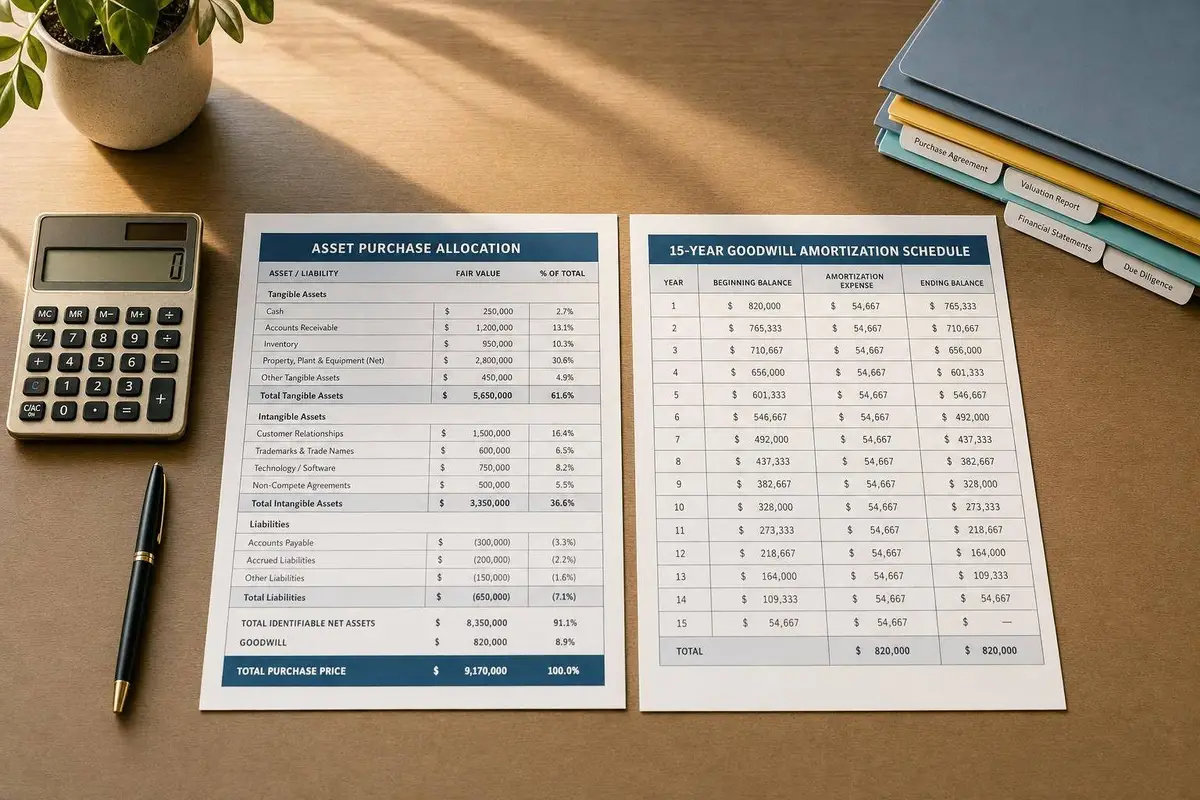
If you buy a business for more than its named assets are worth, the leftover is usually goodwill - and for tax purposes, I treat that amount as a Section 197 intangible with a fixed 15-year write-off.
Here’s the short version:
- In an asset sale or deemed asset sale, I allocate the price under Section 1060.
- Assets go through Classes I–VI first, based on fair market value.
- The amount left over goes to Class VII goodwill.
- The buyer usually amortizes that goodwill over 180 months.
- The seller usually wants amounts taxed at capital gains rates, while amounts tied to inventory, recapture, or noncompetes may be taxed as ordinary income.
- Both sides must report the same allocation on Form 8594.
- A plain stock sale usually does not give the buyer a new goodwill deduction unless there is a Section 338(h) or 336(e) election.
A fast example: if the buyer pays $2,500,000 and the named assets total $1,750,000, the extra $750,000 is generally goodwill. If goodwill is $450,000, the monthly tax deduction is $2,500 for 15 years.
Quick comparison
| Deal type | Goodwill allocated for tax? | Buyer result | Seller result |
|---|---|---|---|
| Asset sale | Yes | New basis and 15-year amortization | Mix of capital gain and ordinary income items |
| Stock sale | Usually no | No new goodwill write-off | Gain often sits at shareholder level |
| Deemed asset sale | Yes | New basis and 15-year amortization | Tax result can look like an asset sale |
I’d keep three points in mind: set the allocation before closing, match Form 8594 on both sides, and watch for anti-churning and post-close price changes.
IRS Section 197: Amortization of Goodwill and Intangible Assets

Purchase Price Allocation: Where Goodwill Fits
In an asset deal, goodwill doesn’t get assigned first. It shows up last.
Under IRC Section 1060, the purchase price has to be assigned across seven IRS asset classes in a set order. Whatever is left after Classes I through VI is treated as Class VII goodwill. That step decides how much of the deal price ends up as goodwill for tax purposes.
Section 1060 and the Seven IRS Asset Classes
Section 1060 is meant to stop buyers and sellers from pushing too much value into classes that give them a better tax result. Each class is limited to its FMV. So you fill one class up to FMV, then move to the next. Only the amount left after Classes I through VI goes into goodwill.
| IRS Asset Class | Typical SMB Assets | Allocation Order |
|---|---|---|
| Class I | Cash and bank deposits | 1 |
| Class II | Marketable securities, CDs | 2 |
| Class III | Accounts receivable, notes | 3 |
| Class IV | Inventory | 4 |
| Class V | Equipment, vehicles, furniture | 5 |
| Class VI | Customer lists, patents, non-competes | 6 |
| Class VII | Goodwill, going-concern value | 7 |
Once those earlier classes are filled, the leftover amount becomes the buyer’s goodwill basis. That’s the amount the buyer reports and amortizes.
How the Residual Method Produces Goodwill
Here’s what that looks like in practice.
Say a buyer pays $2,500,000 for a service business. The identifiable assets - cash, receivables, equipment, a customer list, and a non-compete - are appraised at a combined FMV of $1,750,000 across Classes I through VI. The remaining $750,000 becomes Class VII goodwill.
It’s a simple residual approach: deal price minus the FMV of identifiable assets equals goodwill.
Form 8594 and Allocation Reporting
After the parties agree on the allocation, both sides need to report the same numbers on their tax filings. The buyer and seller each file IRS Form 8594, the Asset Acquisition Statement, showing how the purchase price was split across the seven classes.
The IRS compares the two forms, so mismatches can draw scrutiny. If the purchase price changes after closing, that update must be reported on a supplemental Form 8594 for the year of the adjustment.
Who Can Amortize Goodwill and How the 15-Year Write-Off Works
Buyers Can Amortize Acquired Goodwill
After the goodwill amount is set, the next issue is simple: who gets the deduction?
In a taxable asset purchase, the buyer gets the amortization deduction. But that write-off starts only after the purchase price allocation gives basis to Class VII goodwill.
A stock purchase works differently. The buyer does not get a new deduction unless a Section 338(h) or 336(e) election treats the deal like an asset sale for tax purposes — see stock vs. asset sales, 338(h)(10), F reorgs, and QSBS explained.
Sellers don't amortize goodwill. Instead, they usually report capital gain or loss based on the amount allocated to goodwill.
The Fixed 15-Year Amortization Schedule
Section 197 says acquired goodwill must be amortized on a straight-line basis over 180 months, starting in the month the goodwill is acquired. There isn't any shorter elective period. The rule is set by statute.
So if a deal includes $450,000 of goodwill, the monthly deduction is $2,500 for 180 months.
Anti-Churning Rules and Early-Disposition Limits
Getting goodwill in a deal doesn't always mean the deduction is available. Two rules can still shut it down.
First, the anti-churning rules can block amortization if that same goodwill was held by the taxpayer or a related person at any point between July 25, 1991, and August 10, 1993. For this rule, related-person status uses the 20% ownership test.
Second, if a buyer disposes of one Section 197 intangible from a single acquisition but keeps the others, the loss usually isn't taken right away. Instead, that basis gets added to the remaining intangibles in the same pool.
That setup explains why buyers and sellers often push for very different goodwill allocations.
Buyer and Seller Tax Treatment in Practice
How Goodwill Affects Buyer Tax Economics
Once goodwill is allocated, the buyer gets a tax deduction through amortization. And that matters a lot. Goodwill allocation isn't just a line on a form. It's one of the main levers in the deal's tax math.
A larger Class VII allocation means bigger annual amortization deductions over 15 years. That lowers the buyer's taxable income, which can help cash flow and make debt service easier to handle.
Here's the catch: the buyer's deduction comes from the seller's allocation decision.
Why Sellers Often Prefer Goodwill Allocation
The same allocation that helps the buyer can help or hurt the seller after taxes.
Gain on Class VII goodwill is taxed at long-term capital gains rates. The top federal rate is 20%, and high earners may also owe the 3.8% Net Investment Income Tax, for a top federal rate of 23.8%. That's a clear edge over ordinary income rates, which can go as high as 37%.
Other asset classes don't get the same treatment:
- Inventory is taxed as ordinary income.
- Equipment can trigger depreciation recapture, which is also taxed as ordinary income.
- Noncompete payments are ordinary income to the seller.
So if part of the price shifts away from goodwill and into inventory or a noncompete, the seller's net proceeds can change in a big way.
For C-corporation owners, personal goodwill may sometimes be sold separately to avoid double taxation. Why? Because the sale can skip the corporate-level tax and be taxed only once at the shareholder level.
Asset Sale vs. Stock Sale vs. Deemed Asset Sale
Deal structure decides whether goodwill becomes a buyer tax asset in the first place.
| Deal Type | Is Goodwill Allocated for Tax? | Buyer Outcome | Seller Outcome | Typical Use |
|---|---|---|---|---|
| Asset Sale | Yes (Class VII) | Stepped-up basis; 15-year amortization deduction | Capital gains on goodwill; ordinary income on recapture | Default for most LLC/S-Corp deals under $10M |
| Stock Sale | No | No step-up; no new goodwill tax amortization | Entire gain typically taxed as long-term capital gain | Strategic acquisitions of C-Corps |
| Deemed Asset Sale (Section 338(h) or 336(e) election) | Yes (Class VII) | Stepped-up basis; 15-year amortization deduction | Treated as asset sale; potential double tax for C-Corps | S-Corp targets where buyer wants step-up |
A deemed asset sale election sits in the middle. It gives the buyer the step-up in basis and the 15-year amortization deduction, even though the deal is done as a stock sale on paper.
For the seller, though, the story can look very different. Recapture can come into play. And if the seller is a C-corp, double taxation may still be on the table. That's often where the friction starts in negotiations.
This split is exactly why goodwill allocation needs to be worked out before the closing terms are locked in.
Ready to Make Your Next Move?
Whether you're buying, selling, or investing — Clearly Acquired gives you the tools, data, and support to close with confidence.
Applying Goodwill Allocation When Structuring and Closing SMB Deals
Negotiating Allocations, Earnouts, and Post-Close Adjustments
Once goodwill is identified, the next step is simple in theory and messy in practice: lock the allocation before signing.
That work should start in the LOI and carry all the way through closing. Sophisticated buyers often include a purchase price allocation (PPA) framework in the Letter of Intent so the intended tax treatment is clear before the purchase agreement is finalized.
A few deal terms can change the final goodwill figure.
Working capital true-ups change the residual directly. If closing working capital comes in below the peg, the seller pays back the shortfall. That lowers total consideration and, in turn, reduces the goodwill allocation.
Earnouts can also shift the math. See our guide to earnout tax treatment for how contingent payments are taxed. Only the earnout’s fair value at closing goes into purchase consideration. Later changes usually run through the P&L, not the original goodwill basis.
This is why the final purchase agreement needs to spell it all out. Don’t leave these items open to post-close debate. Include a purchase price allocation exhibit in the definitive agreement. At closing, both sides should sign the same allocation schedule and file matching Forms 8594.
Goodwill-Heavy SBA and Lower-Middle-Market Deals
In service-heavy SMB deals, goodwill often makes up most of the purchase price. When that happens, the tax treatment matters a lot more.
Section 197 amortization can have a direct effect on SBA underwriting and after-tax cash flow in these deals. That matters in SBA 7(a) transactions and sponsor-backed deals because goodwill treatment affects reported earnings, cash-tax impact, and debt-service coverage. Section 197 amortization also improves after-tax cash flow through annual deductions.
Conclusion: Key Rules to Remember
A few rules should guide any purchase agreement that includes goodwill:
- Set the allocation early. Put it in the LOI, then carry it through the definitive agreement and closing documents.
- Asset sales and 338 elections allow 15-year straight-line amortization under Section 197 - but only when the deal is structured and documented the right way.
- Allocation shifts can change seller after-tax proceeds in a big way.
- Form 8594, independent appraisals, and a signed allocation schedule — backed by a quality of earnings review — are the core records behind a defensible result.
Get the allocation right before closing. It’s much harder - and more expensive - to fix later.
FAQs
How is goodwill calculated in a business purchase?
In a small or mid-sized business acquisition, goodwill is the leftover value after you assign the purchase price to tangible assets and identifiable intangibles.
Under Section 197, acquired goodwill is usually amortized in equal amounts over 15 years. This often applies in asset purchases or certain stock deals with tax elections. But in a standard stock sale, the buyer usually can't amortize goodwill.
When does a stock deal qualify for goodwill amortization?
Goodwill can be amortized under Section 197 over 15 years only when the stock purchase is treated as an asset acquisition for tax purposes. That usually happens through an election like Section 338(h)(10) or Section 336(e).
In a standard stock sale, goodwill usually is not amortizable. That’s because the buyer generally steps into the seller’s existing tax basis instead of getting a new basis in the assets.
What triggers IRS issues with goodwill allocation?
IRS issues can come up when buyers and sellers split the purchase price in different ways. This happens a lot because goodwill is a Class VII residual asset, and each side often wants a different tax result. Even so, both parties have to report the same allocation on Form 8594.
For buyers, goodwill is usually amortized over 15 years in asset deals and in certain stock deals that use tax elections. In a standard stock sale, there’s no new goodwill amortization.
Related Reading
- What Purchase Price Allocation Means for Seller Tax in a Business Sale
- Stock vs. Asset Sales, 338(h)(10), F Reorgs, and QSBS Explained
- Tax Implications of Selling an S Corporation via Asset Sale
- Tax Treatment of Earnouts in SMB Deals
- Seller Notes and Installment Sales: Tax Treatment
Sources
- 26 U.S.C. § 197 — Amortization of goodwill and certain other intangibles
- 26 U.S.C. § 1060 — Special allocation rules for certain asset acquisitions
- IRS — About Form 8594, Asset Acquisition Statement
- 26 U.S.C. § 338 — Certain stock purchases treated as asset acquisitions
- IRS Topic No. 559 — Net Investment Income Tax
About the author
Principal & CEO/CIO
Samson Jagoras has 15+ years across finance, real estate, and business acquisitions. He began his career as a Futures & Commodities broker and later served as Chief Strategy Officer of an INC 500 marketing and technology firm, helping scale revenue from $1M to over $100M. Today he buys, builds, and advises a portfolio of companies with a focus on M&A, capital allocation, and operational strategy.