Employee Alignment In Rebranding After Acquisition
Compare keeping a legacy brand vs a full rebrand after acquisition—how each affects employee morale, training, customer risk, and timing.
 Samson JagorasPrincipal & CEO/CIOSeptember 9, 2026
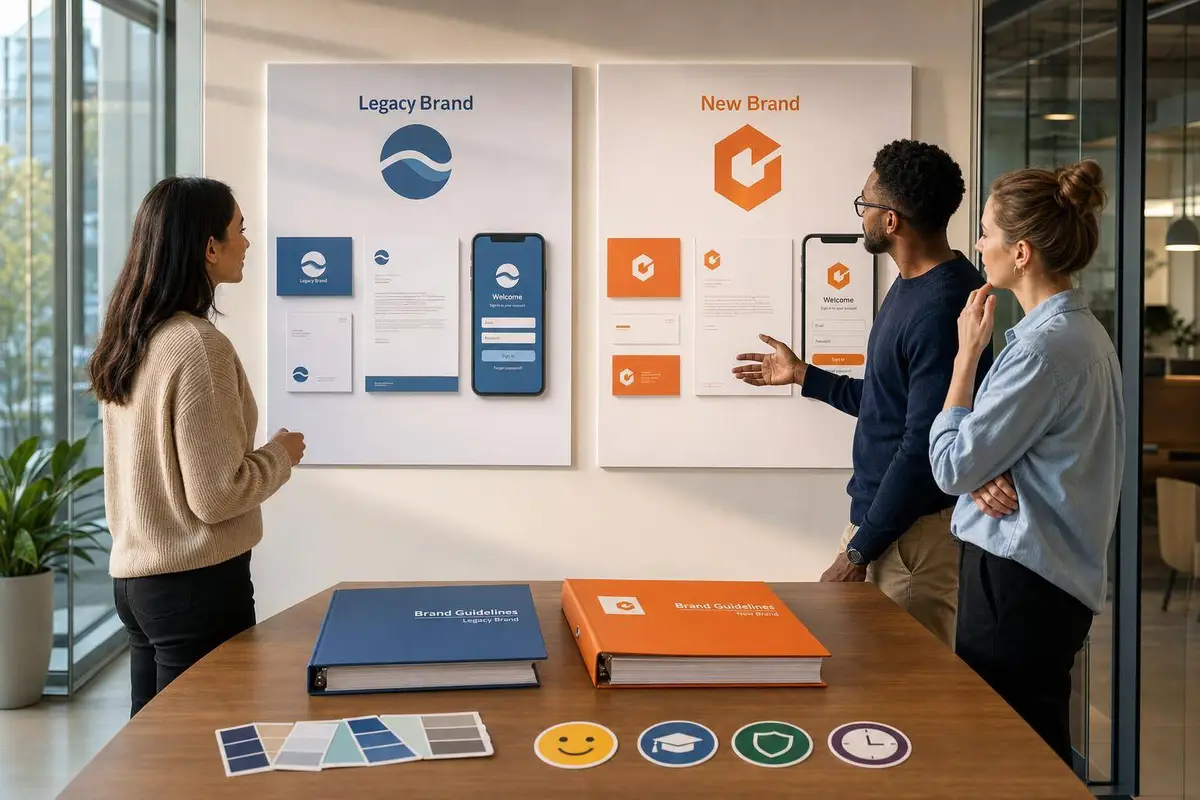
The brand choice after an acquisition shapes employee buy-in, customer trust, training time, and post-acquisition workflow timing from day one.
If I had to sum up the article in plain English, it’s this:
- Keep the legacy brand if you want less disruption at first
- Roll out a new brand if you want one shared identity, but can handle more change
- The decision affects internal communication, training load, customer confusion risk, and timing
- Employee communication matters a lot: one cited study found 75% of executives rank it as the top post-deal integration priority, and 81% of employees stay engaged when change is handled well, versus 42% when it is not
- Rebranding is common after deals: one study found 74% of S&P Global 100 companies rebrand after acquisition
If you’re deciding between the two paths, here’s the short version:
- Legacy brand: lower short-term stress, less retraining, fewer customer questions
- New brand: more work up front, more pressure on managers and frontline teams, but a clearer long-term identity
The Rebrand Reckoning: Building a Unified Brand After a Merger Without Losing Your Voice

sbb-itb-a3ef7c1
Quick Comparison

Keep vs. Rebrand: Employee Alignment After Acquisition
| Factor | Keep the Legacy Brand | Roll Out a New Brand |
|---|---|---|
| Employee morale | Usually steadier at first | Can unite teams, but can also create worry |
| Training effort | Lower | Higher |
| Customer risk | Lower, if ownership is explained well | Higher, if employees give mixed answers |
| Timing | Easier to stage after close | Needs strong internal prep before public launch |
| Main tradeoff | Less friction now | More alignment under one brand later |
So this is not just a marketing choice. It’s a people and execution choice. The right answer depends on how much change your team can carry at one time, how attached customers are to the old name, and how clear the buyer’s plan is after close.
1. Keep the Legacy Brand
Keeping the acquired company’s name and logo sends a simple message: the business people know is still here. That sense of continuity can cut disruption for employees. People keep working under a familiar identity, and that signals the new owner respects what the team has built instead of wiping the slate clean.
Internal Communication
Even if the brand stays the same, employees still need a plain-English explanation of what changes now and what does not. Say that early. Draw a clear line between decisions already made and issues still under review.
A Day 1 announcement, a first-week all-hands, and manager FAQs should come before the public rollout. That order matters. Managers are often the people employees trust most, so giving them answers first helps stop the rumor mill from doing its thing.
Keep the legacy brand in the lead, with the new owner in a secondary role.
Once that message lands, the next issue is practical: how much retraining the team has to take on.
Training Load
Keeping the legacy brand removes one big source of training pressure. There’s no need to teach a new visual identity or a new customer message.
That gives buyers room to spend time on the training that matters after close: updated reporting procedures, new financial or CRM systems, compliance changes, and revised service expectations. In the first 90 to 180 days, it helps to keep the focus tight and limit training to two or three main areas.
Customer Risk
The biggest customer risk here usually isn’t the brand. It’s confusion about ownership. If customers don’t realize the business has changed hands, they can be blindsided by policy updates or new points of contact. And that can chip away at trust.
Front-line employees should have a simple script for the transition. They should explain that the brand remains the same under new ownership, with a focus on continuity. Email signatures and invoices should also mention the new owner. The point is to frame the deal as added backing and support, not as a red flag.
That lower level of customer risk gives leadership more room to stage the rest of the integration.
Timing
Keeping the legacy brand lets leadership separate brand choices from the rest of integration work. Fewer changes hit employees all at once, which can improve alignment during the first 90 to 180 days. Instead of juggling everything at the same time, the team can focus on the tougher operating shifts first:
- HR
- Finance
- IT
- Governance
Branding can wait until the business is more stable.
When the buyer wants a full reset, the communication, training, and rollout burden grows fast.
2. Roll Out a New Brand
When continuity is off the table, a new brand becomes a test of alignment. People aren’t just learning a new logo or name. They’re taking in new ownership, a new plan, and a new identity at the same time. Done well, this can pull employees behind the buyer’s vision. Done poorly, it can drag out confusion and pushback for months.
Internal Communication
Compared with keeping the legacy brand, this route asks employees to learn the story before the market hears it. Internal first, external second. Leadership needs to answer three questions in plain English: why the change is happening, what will change, and what will stay the same.
That message should show up everywhere in the same form: a CEO announcement, town halls, FAQs, manager talking points, and a brand hub. Repetition matters here. If the wording shifts from one channel to another, people start filling in the gaps on their own. Pulse surveys and open Q&A sessions can help spot confusion early, before it spreads.
Frontline supervisors have a huge role because employees often trust them more than formal company messages. Give those supervisors scripts, Q&A guides, and a clear path for escalation before the rollout starts. That way, they can reinforce the same story instead of improvising under pressure.
Once people understand the message, the next challenge is helping them use it in day-to-day work.
Training Load
Unlike a legacy-brand rollout, this path calls for both operational training and brand-message training. Customer-facing teams may need new scripts, pitch decks, email templates, and a plain-language explanation for customers. In regulated businesses, even a name change can trigger updates to disclosures, contracts, and legal language.
It helps to phase training over several weeks in short sessions built around each role. That keeps the load from feeling too heavy and makes it easier for teams to retain what they need. A merger-integration study found communication explained 64% of training effectiveness. Put simply, the internal message is not just an announcement. It is part of the training itself.
This hits hardest in the places where customers will notice the change first.
Customer Risk
Employee alignment matters most here because customers read a rebrand through frontline behavior. A new brand puts customer-facing employees under a bright light. Customers notice rebrands fast, and they draw conclusions even faster. In one consumer survey, 98% of people noticed when a favorite brand rebranded, 87% formed assumptions about what the change meant, and 12% suspected problems behind the scenes. If employees are unsure or inconsistent, that uncertainty can turn into churn risk.
The safest move is a simple explanation that people can repeat without sounding scripted. Employees should be able to explain that the company has a new name and identity, but the same team, with stronger support and better resources behind it. That kind of message lowers friction and gives customers something steady to hold onto.
A few visible cues help too during the first three to six months:
- Outbound calls that explain the change
- Updated email signatures
- On-site signage
Those small touches can cut confusion and rebuild customer confidence faster.
Timing
A new brand works best when employee readiness comes before the public launch. The strongest sequence is simple: leadership alignment first, then employee briefings, then frontline training, and only then the external launch across signage, digital assets, and marketing. If the brand goes public before employees are ready, mixed signals can spread fast and are tough to pull back.
Timing also needs to reflect seasonality. Businesses with peak periods, such as tax preparation firms or HVAC companies in summer, often avoid major brand changes during their busiest months to protect revenue and lower stress. In those cases, it makes sense to hold the public launch until after peak season and use the gap for employee alignment, system updates, and pilot tests. A clear milestone schedule gives employees a better sense of what’s ahead and when it will happen.
Ready to Make Your Next Move?
Whether you're buying, selling, or investing — Clearly Acquired gives you the tools, data, and support to close with confidence.
Pros and Cons of Each Brand Path
After looking at communication, training, customer risk, and timing, the tradeoffs come into focus.
No brand path is risk-free. In plain English, this choice is about what kind of pain you want to take on now versus what kind of fit you want later. It depends on the deal thesis, the pull of the legacy brand, and how much change the company can handle at once. A quantitative study of S&P Global 100 companies found that 74% rebrand after acquisition; among consumer companies, just under 60% do, which suggests that many companies choose to keep some of the acquired brand equity.
From an employee-alignment angle, the tradeoffs are pretty direct:
| Factor | Keep the Legacy Brand | Roll Out a New Brand |
|---|---|---|
| Employee Morale | Usually stronger in the short term because it keeps identity and pride in place. | Can bring people together around a shared future, but it can also trigger anxiety and a sense of identity loss. |
| Training Effort | Lower; scripts, assets, and day-to-day behavior change less. | Higher; employees need to learn new messaging, tone, visual standards, and how to explain the shift to customers. |
| Operational Complexity | Lower in the short term; current signage, collateral, and systems stay mostly intact. | Higher; every customer-facing touchpoint needs to change in a consistent way. |
| Market Clarity | Can weaken over time if several legacy brands leave the market story feeling split. | Stronger when the goal is one unified identity across markets. |
| Rollout Risk | Lower right away, but old reputational problems can stick around if the legacy brand clashes with the new direction. | Higher, especially when communication is rushed or employee readiness gets skipped. |
Conclusion
Once you weigh communication, training, customer risk, and timing, the brand choice after an acquisition stops looking like a marketing call. It’s an operating decision. It affects how well employees line up around the plan, how customers react, and how fast integration moves.
Keeping the legacy brand usually cuts down on friction in the short term. Employees can stick with familiar routines and a known identity. Customers still see the name they know, which helps preserve continuity and recognition. And leadership can spend more time on operational integration instead of running a full-scale change effort. The downside is pretty simple: alignment with the new ownership story can take longer unless leadership keeps reinforcing it.
When change is handled well, employees are more likely to stay engaged and stick around. That’s why execution capacity matters just as much as brand strategy. A new brand can support long-term unity, but only if leadership can carry the extra communication and training work that comes with it.
The best path comes down to four variables: acquisition strategy, employee readiness, customer sensitivity, and post-close execution capacity. Pick the path the team can carry out with consistency. The brand decision should follow the acquisition plan.
FAQs
How do we choose between keeping the old brand and launching a new one?
Keeping the old brand usually signals stability and causes less disruption. It tends to be the easier path on the surface, both for employees and customers.
A new brand is different. It asks for stronger employee buy-in, more training, and much more careful communication to cut uncertainty and internal friction. If that work doesn’t happen, people can feel like the ground is shifting under them.
Customer risk is also often higher with a new brand, especially if the change feels rushed. Keeping the old brand lowers disruption on the outside, but that doesn’t mean the work is done. Teams still need to line up around the new parent company’s values.
When should employees hear about the rebrand after an acquisition?
Employees need to hear the news early enough to stay aligned. But the timing should match the brand plan.
If the company is keeping the current brand, the shift is usually easier. There’s more continuity, less confusion, and fewer internal changes to explain.
A new brand is a different story. It takes more communication, more training, and more change management. People need time to understand what’s changing, why it’s changing, and what that means for their day-to-day work.
Announcements should happen before confusion starts. They also need to stay consistent and synced across every channel. If one team says one thing and another says something else, things can go sideways fast.
A full rebrand also brings more customer risk. That’s why customer-facing updates, like billing, support, and other service touchpoints, need careful coordination.
How can teams reduce customer confusion during a brand change?
Teams cut customer confusion by keeping the message consistent, training employees well, and choosing the right moment for announcements.
If the old brand stays in place, it’s usually easier to hold onto customer trust and keep employees grounded. Things feel more familiar, which makes the shift easier to explain.
If a new brand comes in, the bar is higher. Staff need tighter alignment so they can explain the change in a clear, steady way. Otherwise, customers hear one thing from marketing, another from sales, and something else from support. That’s where confusion starts.
A phased rollout can help lower risk, especially when the legacy brand already carries strong trust. In both cases, coordinated communication matters. It keeps teams on the same page and helps avoid mixed messages and uncertainty.
Related Reading
About the author
Principal & CEO/CIO
Samson Jagoras has 15+ years across finance, real estate, and business acquisitions. He began his career as a Futures & Commodities broker and later served as Chief Strategy Officer of an INC 500 marketing and technology firm, helping scale revenue from $1M to over $100M. Today he buys, builds, and advises a portfolio of companies with a focus on M&A, capital allocation, and operational strategy.