EBITDA Margin Calculator
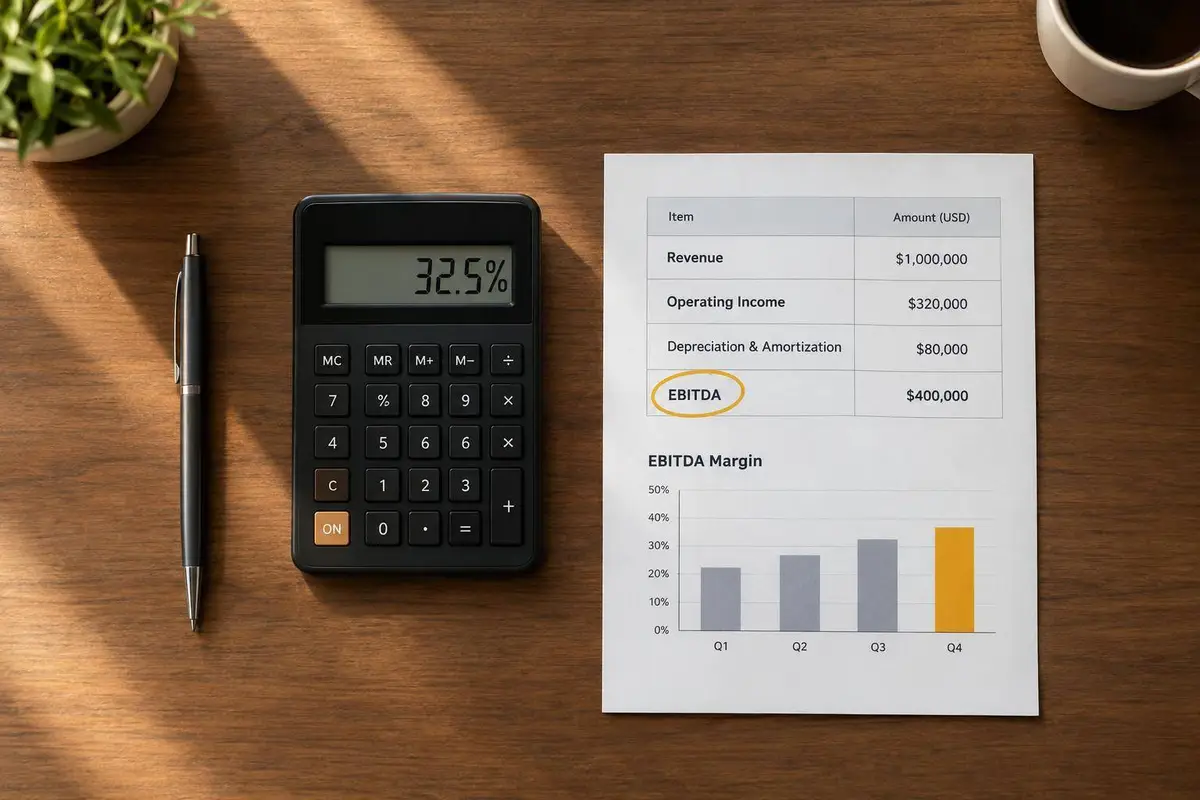
Calculate EBITDA margin fast with revenue and EBITDA inputs, or build EBITDA from operating income, depreciation, and amortization.
 Samson JagorasPrincipal & CEO/CIOOctober 17, 2026
Sell your business for maximum value
Our sell-side advisors package, market, and negotiate your exit to qualified, verified buyers — confidentially.
Understand Operating Profitability at a Glance
An EBITDA Margin Calculator helps you see how efficiently a business turns revenue into operating profit before interest, taxes, depreciation, and amortization. That makes it a useful shortcut for owners, analysts, and finance teams who want a quick read on performance without digging through a full model. Enter revenue and EBITDA directly, or calculate EBITDA from operating income, depreciation, and amortization when needed.
Why This Metric Matters
EBITDA margin is often used to evaluate operating efficiency because it shows profit as a percentage of sales. A negative result can point to pressure on core operations, while a positive result may suggest the business is keeping costs under control. Still, there isn't one universal "good" margin. Ideal levels vary widely by industry, business model, and growth stage.
A Simple Way to Compare Periods
This calculator also makes trend analysis easier. If you enter a prior-period margin, you can quickly see the percentage-point change and understand whether profitability is improving or slipping. For anyone reviewing internal performance, investor materials, or monthly financials, an EBITDA margin calculator offers a fast, practical way to turn raw numbers into a clearer story about operating health.
Get a Quality of Earnings analysis you can trust
FAQs
What does EBITDA margin tell me?
EBITDA margin shows how much of each dollar of revenue is left after core operating expenses, before interest, taxes, depreciation, and amortization. In simple terms, it helps you gauge operating profitability and efficiency without the noise of financing choices or certain accounting items. It's useful for spotting trends over time and comparing performance, but it works best when you view it alongside other financial metrics too.
Should I enter EBITDA directly or calculate it from operating income?
If you already have a reliable EBITDA figure from your financials, entering it directly is usually the quickest option. If you don't, calculating it from operating income plus depreciation and amortization is a practical alternative. This tool supports both approaches, which is helpful when different reports present the numbers in different ways.
Is a higher EBITDA margin always better?
Generally, a higher margin suggests stronger operating efficiency relative to revenue, but context matters. A lower margin may be normal in industries with heavier operating costs, while a very strong margin might be typical in businesses with more scalable models. That's why this calculator gives a simple interpretation without forcing a rigid benchmark. If you have a prior-period margin or an industry comparison, you'll get a more meaningful read on performance.
Related Reading
Sell with advisors who maximize your outcome
From valuation and positioning to closing the deal, we run a competitive process to get you the best terms.
About the author
Principal & CEO/CIO
Samson Jagoras has 15+ years across finance, real estate, and business acquisitions. He began his career as a Futures & Commodities broker and later served as Chief Strategy Officer of an INC 500 marketing and technology firm, helping scale revenue from $1M to over $100M. Today he buys, builds, and advises a portfolio of companies with a focus on M&A, capital allocation, and operational strategy.