Selling Your MSP: Recurring Revenue Exit Preparation
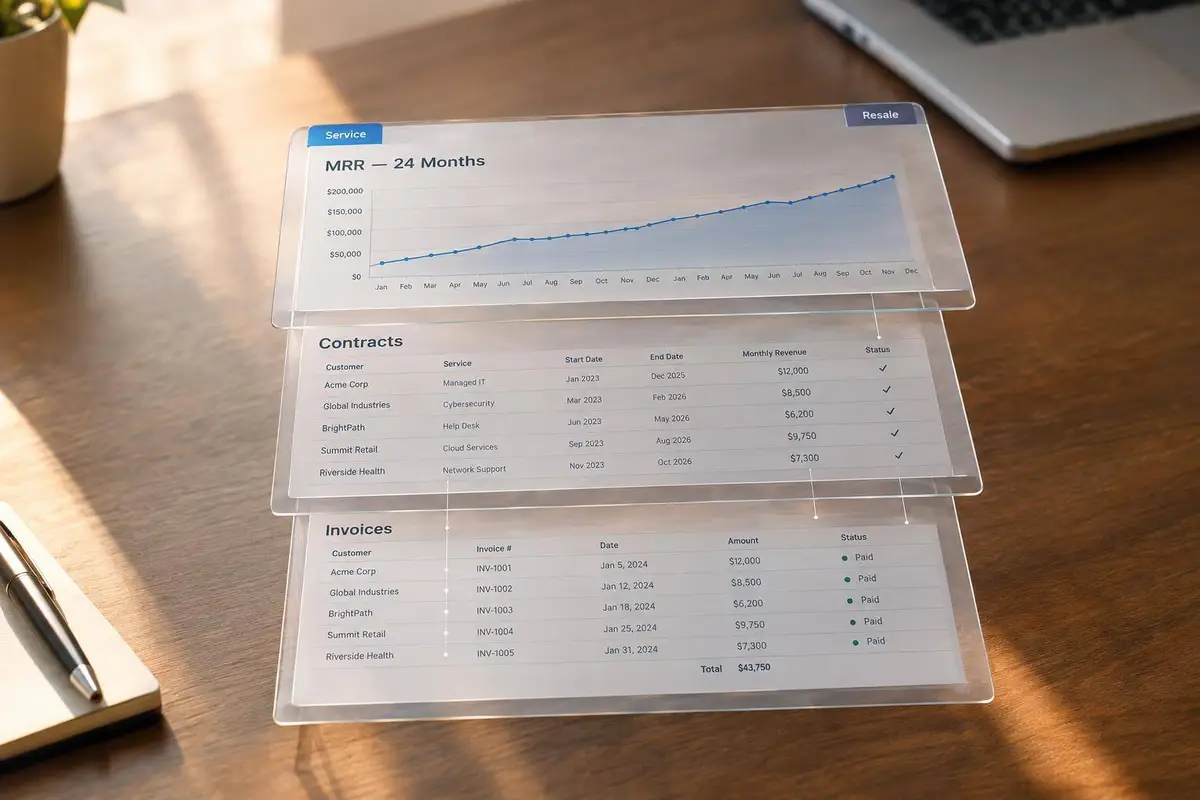
Prepare 2-3 years before selling: reconcile 24 months of contract-level MRR, link contracts to invoices, and separate service vs resale revenue.
 Samson JagorasPrincipal & CEO/CIOOctober 12, 2026
Get matched with the right lender for your business
Compare offers from our vetted network. Pre-qualify in minutes — no impact to your credit.
Selling your MSP? I’d start preparing 2–3 years before the sale, with 12–24 months of records that connect recurring revenue to signed contracts, invoices, and payments. The goal: show buyers what revenue will last, what it costs to deliver, and whether the contracts can transfer.
Here’s the checklist I’d use:
- Organize the paperwork: Link customer contracts, renewal terms, transfer restrictions, and financial records in a secure data room.
- Check the numbers: Build a 24-month customer-contract MRR schedule and explain differences between billed, collected, and booked revenue.
- Show retention and risk: Track renewals, churn, customer concentration, and contract length. Report GRR and NRR together - NRR above 100% can still mask customer losses.
- Separate revenue and margins: Split managed services, resale, and one-time work, then check direct costs and gross-versus-net accounting.
- Prepare for diligence: Include reconciled financial statements, an adjusted EBITDA bridge, and a log of unresolved issues.
My rule: <u>make every number traceable</u>, and keep the file current through closing.

Selling Your MSP: Recurring Revenue Exit Checklist
Top 10 Essential Moves Before You Sell Your MSP

sbb-itb-a3ef7c1
Build and Reconcile Contract-Level MRR
Use the contract register and file index to build a 24-month contract-level MRR schedule, with one row per customer-contract-month. Classify each revenue stream as contractual recurring, repeat but noncontractual, or one-time project revenue. Within each contract, separate managed services, resale, and variable fees. Treat the schedule as contract analysis - not booked revenue.
Buyers underwrite recurring cash flow at the contract level, not just topline revenue. This schedule gives them a baseline for their review.
Record Fees and Contract Status
Record start and end dates, renewal and termination terms, auto-renewal rights, and payment history. Keep the original contract documents organized and ready for buyer review.
Match Contracts, Invoices, and Accounting Records
Use the cleaned MRR schedule to connect contract terms with billing and the general ledger. Reconcile each contract’s MRR against invoices and contract documents, and explain any gaps between billed, collected, and booked amounts. Check for lapsed contracts and revenue recognized too early.
Resolve slow-paying accounts and disputed balances before going to market. Buyers will review A/R aging for recurring customers.
Document Renewals, Retention, and Churn
Once MRR is reconciled, show how that revenue renews, stays, or churns. Buyers use this history to judge how well recurring revenue holds up over time.
Track Customer Renewal Outcomes
Add renewal history and current status to each customer row in the MRR schedule. Record service start dates, renewal dates, pricing changes, and reasons for cancellations or downgrades. This helps buyers distinguish long-standing revenue from newer accounts.
Label each agreement as renewed, auto-renewing, or month-to-month. Flag cancellation notice deadlines and pending assignment consents separately. Include the actual renewal decision date and any pricing change.
Each customer row should also show tenure, ARR share, and the next renewal date. A single large customer creates concentration risk. Include weighted average contract length (WACL) to show how long revenue is contractually committed, and keep month-to-month revenue separate from longer-term commitments.
Calculate Retention for a Starting Customer Cohort
Define the reporting period and lock the starting customer cohort on day 1. Use starting MRR as the denominator, excluding new customers added during the period. Track cancellations separately from revenue contraction in retained accounts. Treat upsells and price increases from the starting cohort as expansion.
Measure churn, contraction, and expansion using that same starting cohort.
| Metric | Formula |
|---|---|
| Gross revenue retention (GRR) | (Starting MRR − cancellation MRR − contraction MRR) ÷ starting MRR |
| Net revenue retention (NRR) | (Starting MRR − cancellation MRR − contraction MRR + expansion MRR) ÷ starting MRR |
| Cancellation revenue churn | Cancellation MRR ÷ starting MRR |
| Logo retention | Retained starting customers ÷ starting customers |
| Customer churn | Lost starting customers ÷ starting customers |
Report GRR and NRR together. NRR above 100% means expansion from the starting cohort more than offsets churn and contraction. Buyers review both metrics alongside the customer-level losses behind them.
Separate Service, Resale, and Project Revenue
Classify Revenue and Direct Costs
Use the reconciled MRR schedule to group revenue by delivery type for diligence. Buyers value durable service revenue differently from pass-through resale and project work. Split bundled invoices into managed services, software or license resale, and project charges. Tie each category directly to the contract register and MRR schedule.
This split shows which revenue supports recurring value and which buyers will discount during diligence.
| Revenue type | Contract strength | Margin profile | Renewal treatment |
|---|---|---|---|
| Managed services | High (multi-year) | High (labor-based) | Auto-renew/annual |
| Software/license resale | Moderate (vendor-linked) | Low (pass-through) | Subscription-based |
| Hardware resale | Low (transactional) | Low (markup) | N/A |
| Projects | Low (one-time) | Variable | N/A |
| T&M / break-fix support | Low (ad hoc) | Variable | N/A |
| Pass-through charges | N/A | Zero/minimal | N/A |
| Onboarding fees | Low (one-time) | High (labor) | N/A |
Back this schedule with actual contracts and delivery costs. The category alone doesn't prove the margin: managed services aren't always high-margin, and resale margins aren't always negligible.
Reconcile Service-Line Margins
Report revenue, direct costs, gross profit, and gross margin for each category over the same period. Calculate:
Gross margin = (category revenue − category direct costs) ÷ category revenue × 100%
Allocate technician labor by client and service category. Use one consistent method for vendor costs, and don't count license costs twice.
Build a ledger-to-statement bridge showing revenue reclassifications, credits, and differences between billing and revenue recognition. For every adjustment, show the amount, affected period, and supporting record. Keep billed amounts separate from recognized revenue, and follow the applicable ASC 606 requirements.
Confirm whether resale and pass-through charges should be reported as gross or net revenue. Under principal-versus-agent treatment, an MSP acting as an agent may need to report revenue net of costs rather than gross. This changes reported revenue and margin percentages, even when gross profit dollars stay the same.
Document that treatment now so the buyer can trace the revenue mix without rework. Carry these reconciliations into the diligence schedules buyers will review.
Prepare the Buyer Diligence File
Compile the Diligence Schedules
Once the recurring revenue schedules are reconciled, build the buyer diligence file around the records that support them.
Include customer-level MRR/ARR, signed contracts, renewal outcomes, cohort GRR/NRR, churn, and concentration. Use the contract register, MRR schedule, renewal log, and revenue split prepared earlier. Add termination provisions, auto-renewal clauses, and weighted average contract length (WACL). Link each schedule to its underlying contract and billing file, and include reconciled financial statements and an adjusted EBITDA bridge.
Check Reconciliations and Resolve Open Issues
Check for gaps before the buyer reviews the file. Compare recurring-revenue totals with billing records, contract documentation, and financial statements. Explain every variance with a short reconciliation note rather than forcing the numbers to match.
For the final quality-control check, keep a running log of missing signatures, expired contracts, unexplained variances, and unsupported EBITDA adjustments. This makes open items easy to track before diligence review.
Conclusion: Keep Records Current Through Closing
Keep the file current until signing and funding. Update schedules through closing, carry open items forward, and record every update in the diligence file. Consistent records reduce repeat requests and help avoid preventable lender follow-up, quality-of-earnings delays, and closing extensions.
FAQs
Can I sell my MSP with month-to-month contracts?
To prepare your MSP for sale with month-to-month contracts, make your financial and contract records clear and ready for an audit. Buyers focus on recurring revenue because it provides predictable cash flow.
Keep a master contract inventory that includes start dates, terms, and renewal clauses. Store signed, transferable agreements in a secure data room. Reconcile your financial statements with tax returns, and separate recurring service income from project and resale revenue. These steps help buyers complete due diligence and reduce delays before closing.
What if my customer contracts require consent to transfer?
Make consent-to-transfer requirements clear in your master contract inventory so buyers can see which agreements can transfer and what approvals they need. Record each agreement’s start date, term, and auto-renewal clauses. Store signed contracts in a secure, centralized data room.
Pair these records with reconciled financial statements and a breakdown of recurring service income versus project or resale revenue. This gives buyers the information they need for diligence and helps reduce closing delays.
How does resale revenue affect my MSP’s valuation?
Buyers favor recurring revenue because it offers predictable cash flow and lower risk. Separate recurring service income from resale and one-time project revenue. This helps buyers assess your revenue mix and service gross margins.
Make sure your financial statements match your tax returns. Store signed, transferable contracts in a centralized data room, with renewal terms clearly documented. Clean records support valuation and due diligence and help prevent closing delays.
Related Reading
Find the right lender for your business
Whether it's working capital, an SBA loan, or acquisition financing — we'll match you with the right capital partner.
About the author
Principal & CEO/CIO
Samson Jagoras has 15+ years across finance, real estate, and business acquisitions. He began his career as a Futures & Commodities broker and later served as Chief Strategy Officer of an INC 500 marketing and technology firm, helping scale revenue from $1M to over $100M. Today he buys, builds, and advises a portfolio of companies with a focus on M&A, capital allocation, and operational strategy.