BEAT Tax Rules: 2026 Update for Deal Teams
Screen $500M receipts and 3% base erosion; use 10.5% (11.5% for banks), map foreign payments and model BEAT with CAMT.
 Samson JagorasPrincipal & CEO/CIOSeptember 27, 2026

Get matched with the right lender for your business
Compare offers from our vetted network. Pre-qualify in minutes — no impact to your credit.
If your 2026 deal model still uses a 12.5% BEAT rate, it is wrong. I’d screen for BEAT fast by checking two tests - $500 million average gross receipts and a 3% base erosion percentage (2% for certain financial groups) - then I’d map every deductible payment to foreign related parties before I trust the tax case.
Here’s the short version:
- 2026 BEAT rate: 10.5%
- Certain banks and registered securities dealers: 11.5%
- Main risk items: intercompany interest, royalties, service fees, guarantee fees, and some reinsurance and property payments
- Common miss: teams test the target alone instead of the post-close buyer group
- Key filing point: Form 8991 support now matters more, especially for service exclusions, QDP positions, and deduction waivers
- Deal model point: I’d test BEAT next to CAMT and other minimum-tax rules, because the tax cost can shift by year
What I take from the article is simple: most lower middle market deals will not face BEAT, but cross-border group structures can pull a deal into scope faster than expected. The work is less about memorizing tax law and more about checking the payment flows, validating exceptions, and making sure the underwriting model matches the filing position.
| Item | What I’d use in 2026 |
|---|---|
| Gross receipts test | $500 million average over prior 3 tax years |
| Base erosion percentage | 3% minimum |
| Financial group threshold | 2% |
| General BEAT rate | 10.5% |
| Banks / securities dealers | 11.5% |
| First diligence pull | Prior Form 8991, workpapers, and related-party payment map |
If I were summarizing the whole piece in one line, it would be this: screen early, model the right 2026 rate, trace foreign related-party deductions, and do not sign off on a cross-border structure until BEAT and CAMT have both been tested.

2026 BEAT Tax: 4-Step Computation & Diligence Checklist for Deal Teams
The 2026 BEAT framework: thresholds, payments, and the current rate
Coverage tests: the $500 million gross receipts threshold and the 3% base erosion test
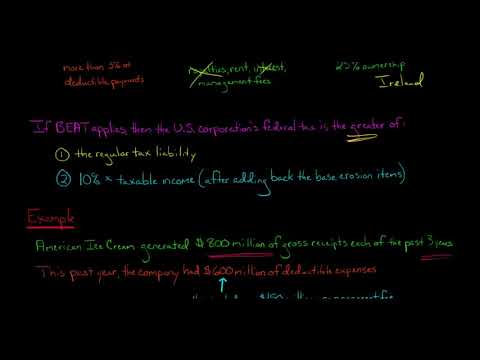
BEAT applies only to applicable taxpayers. In most cases, that means U.S. corporations tested on a controlled-group basis that meet two tests.
First, the group must have average annual gross receipts of at least $500 million over the prior three tax years. Second, its base erosion percentage must be at least 3%, or 2% if any member of the group is a bank or registered securities dealer.
For acquisitions, test the buyer group as it will exist after closing, not the target by itself.
One point is easy to miss: the $500 million threshold is not indexed for inflation. So a group that sits just below the line today can move into scope over a multi-year hold period through ordinary revenue growth alone.
Once a group clears those tests, the focus shifts to the payments that may erode the U.S. tax base.
What counts as a base erosion payment in deal structures
A base erosion payment is generally a deductible amount paid or accrued to a foreign related party. In deal settings, that often includes:
- Intercompany interest
- Royalties
- Management and service fees
- Guarantee fees
- Payments for depreciable or amortizable property
- Certain reinsurance premiums
In acquisition structures, these amounts usually show up through intercompany funding, IP licensing, shared services, and credit support.
Cost of goods sold is generally not a base erosion payment. That’s why manufacturing and distribution structures can look very different from service-heavy models from a BEAT standpoint.
There are a few carveouts that can matter a lot. Certain low-margin services provided at cost under the services cost method can be left out, so it’s worth checking whether shared back-office functions like accounting, HR, or IT fit the rule. Qualified derivative payments that meet specific marking-to-market and ordinary income treatment rules are also excluded, but the requirements are detailed and call for careful documentation.
Those exclusions can change whether BEAT applies at all. If it does apply, the tax result depends on the math.
2026 computation: the 10.5% general rate, the 11.5% rate for certain financial groups, and credit limits
BEAT is computed in four steps. You start with regular taxable income, then add back deductions tied to base erosion payments to get modified taxable income, or MTI. Next, multiply MTI by the applicable rate to calculate tentative BEAT. Then subtract the taxpayer's adjusted regular tax liability - regular tax after allowed credits, with many nonrefundable credits limited for this purpose. If tentative BEAT is higher than that adjusted amount, the difference is the incremental BEAT owed.
| Step | What you do |
|---|---|
| 1. MTI | Regular taxable income plus add-backs for base erosion deductions |
| 2. Tentative BEAT | MTI × 10.5% (general) or MTI × 11.5% (banks/securities dealers) |
| 3. Adjusted regular tax liability | Regular tax after allowed credits, with restrictions |
| 4. Incremental BEAT due | Max(0, tentative BEAT − adjusted regular tax liability) |
For 2026, the permanent rate is 10.5% for general corporations and 11.5% for banks and registered securities dealers. If your model still uses 12.5%, fix it.
That lower permanent rate cuts projected BEAT cash taxes in structures where BEAT applies. In plain English, that can lift after-tax free cash flow and, in some cases, support a higher purchase price. Purchase-price and cash-flow models should reflect that now.
The next issue is how IRS and Treasury guidance handles derivative, securities lending, and filing positions in live deals.
sbb-itb-a3ef7c1
Recent IRS and Treasury guidance that affects live cross-border deals
Qualified derivative payments and securities lending rules
For deal teams, the issue isn't just the rule change. It's the paper trail and reporting burden it creates in treasury-heavy structures.
On December 17, 2025, Treasury and the IRS issued final regulations that clarify how qualified derivative payments (QDPs) tied to securities lending are identified under BEAT. The rules mostly follow the January 2025 proposed regulations, but they tighten a few points that matter for treasury, tax, and legal teams reviewing cross-border structures.
The biggest point: mark-to-market (MTM) gains and losses on the securities leg of intercompany securities lending are excluded from QDP calculations. That can change how treasury teams model netting arrangements. It can also affect whether part of a program ends up being treated as non-QDP for BEAT purposes.
The regulations also say that substitute payments and borrow fees paid to foreign related parties must be specifically identified. If that isn't possible, a prescribed allocation method applies. For targets with centralized treasury or matched-book lending, that can shift the amount treated as a base erosion payment. That's the kind of item diligence teams should trace line by line.
The rules are effective December 17, 2025. Early adoption is allowed for tax years beginning on or after January 10, 2025. QDP reporting starts for payments in tax years beginning on or after January 1, 2027. In practice, post-close BEAT modeling should test both adoption paths.
That technical shift feeds straight into Form 8991 disclosure and diligence support.
Form 8991, IRS practice guidance, and enforcement focus
The IRS updated Form 8991 instructions in December 2025 and put extra weight on detailed Schedule A reporting and clear identification of foreign related-party recipients.
Two areas stand out.
First, related-party service payments. Taxpayers must separately identify amounts paid or accrued to a foreign related party for services and support any exclusion, including the services cost method exception under Reg. § 1.59A-3(b)(3)(i). If a target has been loose here, that can become a problem fast.
Second, intercompany interest deductions. The IRS is checking for consistency between BEAT reporting and the taxpayer's broader transfer pricing and earnings-stripping positions. Put simply, the story told on Form 8991 needs to match the story told everywhere else.
Schedule B, which covers deductions waived to reduce BEAT liability, is also getting attention. The IRS may question whether waiver strategies are backed by documentation and tracked the same way from year to year.
For deal teams, the response is pretty direct: pull the target's historical Form 8991 filings and workpapers during diligence and post-close review, confirm that transfer pricing documentation supports the BEAT positions taken, and run downside cases where key claimed exceptions - QDP exclusions and SCM exceptions - are denied.
| Audit hot spot | What the IRS is checking | Diligence action |
|---|---|---|
| Related-party service payments | Proper application of SCM and other service exclusions | Review Form 8991 Schedule A service line items and supporting transfer pricing |
| Intercompany interest | Consistency with transfer pricing and earnings-stripping positions | Compare BEAT filings to intercompany loan agreements and transfer pricing documentation |
| Deduction waivers (Schedule B) | Whether waivers are tracked and not abusive | Trace waived amounts across prior years in workpapers |
| QDP exclusions | Whether reporting conditions and substantive rules are met | Confirm transaction-level data exists to support QDP claims |
What BEAT means for independent sponsors, searchers, and capital partners
When BEAT becomes a real underwriting issue in lower middle market M&A
For most independent sponsors and searchers buying a standalone U.S. operating company with domestic capital, BEAT usually isn't a live issue.
That changes fast when the buyer is part of a multinational group, a foreign-parented group, or a domestic platform getting close to the line. In lower middle market M&A, three deal profiles tend to trigger BEAT modeling.
- Strategic or platform buyers whose consolidated U.S. gross receipts are at or above $500 million, or are plainly headed there, where even a modest add-on can shift the base erosion percentage
- Groups that already make material interest, royalty, or service fee payments to foreign affiliates, because a new target can add more payments to an existing cross-border setup
- PE-backed add-on platforms where foreign related-party financing or IP licensing already sits at the platform level
Once a deal falls into scope, the next step is simple: figure out which payment streams create the risk.
Common structuring responses and their trade-offs
When BEAT applies, deal teams usually don't try to dodge it altogether. Instead, they adjust cross-border related-party arrangements. The usual moves are pretty familiar: replace foreign related-party debt with U.S. bank debt, move IP ownership onshore, rework management or service fees, and, in narrower cases, waive deductions that would otherwise be allowed in order to bring down the base erosion percentage
The catch is that none of these fixes comes cheap. Lower BEAT exposure often means more pressure somewhere else, such as regular U.S. taxable income, CAMT exposure, or Pillar Two top-up liability. That's why tax advisors usually model several regimes side by side before they suggest any structural change. If you tune BEAT by itself, you can end up making a different part of the tax picture worse.
| Structure / Adjustment | Potential BEAT Effect | Key Non-BEAT Trade-Offs |
|---|---|---|
| Replace foreign related-party debt with U.S. bank debt to reduce interest deductions. | Reduces base erosion interest deductions; lowers BEAT liability | Higher cash interest costs; tighter covenants; may affect CAMT or Pillar Two modeling |
| Move IP onshore to cut royalty deductions. | Eliminates or reduces foreign royalty deductions | Increases U.S. taxable income; may reduce GILTI/FDII benefits; transfer pricing complexity |
| Shift management fees onshore to reduce foreign related-party deductions. | Cuts foreign related-party fee deductions | Higher U.S. taxable income; possible state tax and nexus implications |
| Waive deductions only when the tax trade-off is justified. | Can reduce the base erosion percentage | Directly increases regular U.S. tax |
That puts payment mapping and documentation at the center of diligence.
What sponsors and investors should ask for in diligence
Family offices, co-investors, and lenders working with multinational buyers should treat BEAT diligence like a standard checklist item. Ask for a full map of foreign related-party payments, including interest, royalties, service fees, guarantees, and reinsurance
That map is only the start. Diligence materials should also include threshold testing, both the gross receipts calculation and a base erosion percentage sensitivity analysis, plus the post-close tax assumptions behind the buyer's return model. If the plan is to move the target onto group IP, into a global cash pool, or under shared services, those post-close payment flows need to be modeled in plain terms. That's often where the main BEAT exposure starts
Base Erosion Anti-abuse Tax (BEAT) | U.S. Taxation
Conclusion: A 2026 BEAT checklist for deal teams
BEAT has a pretty tight scope. It applies only when a consolidated group meets both tests: at least $500 million in gross receipts and a base erosion percentage of 3%, or 2% for financial groups. For tax years starting in 2026 and after, use a 10.5% rate, or 11.5% if the group includes a bank or a registered securities dealer.
Recent IRS and Treasury guidance narrowed the rules around QDP, securities lending, and Form 8991 reporting. That mostly matters for groups with treasury centers or intercompany derivatives.
In diligence, BEAT needs to be modeled next to CAMT and other cross-border taxes. The tax that ends up driving cash cost can shift from year to year. Put simply, BEAT should be tested alongside CAMT before signing.
Use this final diligence checklist:
| Checkpoint | What to Confirm |
|---|---|
| Screen scope | Pro forma gross receipts ≥ $500M and base erosion % ≥ 3% (or 2% for financial groups). |
| Use 10.5% / 11.5% | Apply the right rate in ETR and cash-tax models - not 12.5%. |
| Map related-party payments | Identify all payments to foreign related parties that may qualify as base erosion payments. |
| Document QDP positions | Confirm QDP eligibility and Form 8991 reporting readiness for any derivative or securities lending arrangements. |
| Model post-close flows | Test any planned debt pushdown, IP migration, or intercompany financing for BEAT impact. |
| Run CAMT side by side | Identify which regime is the main tax driver in each projected year. |
| Review Form 8991 history | Pull prior filings and any IRS correspondence for existing controversies or adjustments. |
For sponsor-backed platforms, build BEAT into add-on underwriting before the group crosses $500 million. Screen for it early, model it with CAMT, and document foreign-related payment flows before closing.
FAQs
How do I know if my deal is in BEAT scope?
Your deal may fall within BEAT scope if it includes payments from a U.S. corporation to foreign affiliates that may reduce the U.S. tax base.
For 2026, deal teams should model this early, especially in leveraged acquisitions with cross-border financing. That gives you a clearer view of possible exposure and helps shape the deal structure before it gets expensive to change.
Which post-close payments create the most BEAT risk?
In the 2026 BEAT environment, the biggest risk comes from large post-close payments to foreign affiliates in cross-border deals.
The 2025 OBBBA changed QSBS and Section 163(j) interest deduction calculations. But BEAT is still a major issue for deal teams that need to structure these payments and figure out how much risk they bring.
Why model BEAT alongside CAMT?
The sources provided here do not include a 2026 BEAT update or BEAT-specific IRS guidance.
They deal with other tax topics, so they don’t support a summary of 2026 BEAT rule changes or current BEAT market practice for cross-border deals.
The Clearly Acquired materials in this set are also not BEAT-specific.
Related Reading
Find the right lender for your business
Whether it's working capital, an SBA loan, or acquisition financing — we'll match you with the right capital partner.
About the author
Principal & CEO/CIO
Samson Jagoras has 15+ years across finance, real estate, and business acquisitions. He began his career as a Futures & Commodities broker and later served as Chief Strategy Officer of an INC 500 marketing and technology firm, helping scale revenue from $1M to over $100M. Today he buys, builds, and advises a portfolio of companies with a focus on M&A, capital allocation, and operational strategy.