Vertical SaaS Revenue Due Diligence Checklist
Price vertical SaaS on verified, collectible revenue—exclude unverified ARR and tie deal terms to customers, contracts, and collections.
 Samson JagorasPrincipal & CEO/CIOOctober 8, 2026
Get a Quality of Earnings analysis you can trust
Our QofE team validates earnings, normalizes add-backs, and de-risks your deal — flat-fee with fast turnaround.
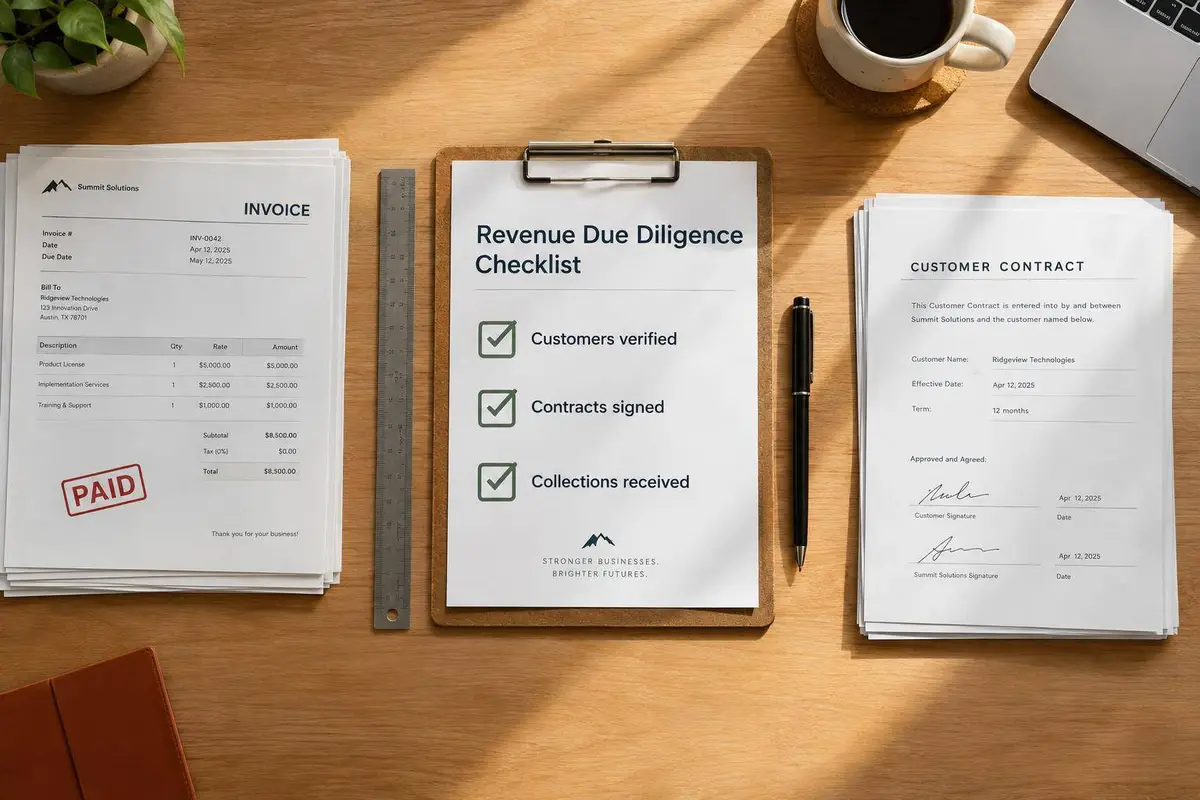
I price a vertical SaaS acquisition on verified revenue and cash flow - not reported ARR. I start with three years of tax returns and accounting records, plus 24 months of bank statements, then match them to customer contracts and billing.
My checklist covers five checks before you commit to a price:
- Revenue quality: Separate subscriptions from services and payments, then verify recurring revenue and margins.
- Retention and pricing: Recalculate churn and expansion, review the top 10 customers, and check whether higher prices turn into collected cash.
- Contracts and collections: Check renewal, termination, and transfer terms, overdue invoices, and prepaid service obligations.
- Deal terms: Account for seller replacement costs and test debt payments if major customers leave. Tie unresolved risks to price or contract protections.
- Post-close tracking: Set a 90-day plan with named owners, then review results monthly using the same revenue definitions.
My rule: If I can’t verify it, I don’t count it in the baseline. That keeps <u>what you pay</u> tied to the revenue you can collect after closing.

Vertical SaaS Revenue Due Diligence: 5 Checks
Demystifying SaaS Revenue: A Hierarchy for Predictability & Valuation | SaaS Metrics School

sbb-itb-a3ef7c1
Verify MRR, ARR, and Revenue Mix
Once you’ve separated revenue sources, check whether the recurring base holds up. It must be contract-backed, collectible, and separate from nonrecurring fees. Assess whether it will survive closing and shifts in customer behavior.
MRR is the monthly recurring base; ARR is annualized MRR. Neither is the same as bookings, revenue, or cash receipts.
Reconcile Customer Billing to Financial Records
Reconcile billed revenue with the general ledger (GL), bank deposits, and deferred revenue. Exclude unresolved amounts from the verified baseline. Explain settlement delays, refunds, prepayments, and missing records. Check that revenue recognition policies don’t treat bookings as earned revenue.
Check MRR Mix and ARR Quality
Break revenue down by customer, product, service line, and geographic region to distinguish recurring revenue from one-time revenue. Review the top 10 customers for concentration risk, and separate contracted renewals from month-to-month accounts.
Measure Service Revenue and Margins
Separate recurring managed services from implementation, training, customization, and project work. Review cost of goods sold (COGS) trends and gross margin stability to check whether delivery or implementation costs are eating into profit.
If the owner still handles delivery, identify the functions the buyer will need to replace after closing. Look for below-market vendor contracts or informal related-party transactions that make margins look stronger than they can remain over time.
Assess Payment Revenue Dependence
Calculate payments’ share of revenue and gross profit separately. Reconcile transaction volume, take rates, settlements, and refunds. Confirm whether payment revenue is reported on a gross or net basis.
Review processor agreements for fees, revenue sharing, and other terms that may not hold up after acquisition. Flag dependence on a single payer, processor, or channel. Stress-test lower volume and lower take rates to see how much gross profit remains.
Use these findings in retention and pricing power testing.
Test Customer Retention and Pricing Power
Start with the verified recurring revenue base. Test whether customers renew, spend more, and accept higher prices - and whether that revenue can support valuation and debt.
Recalculate GRR, NRR, and Logo Retention
Use the same starting customer cohort for every calculation. GRR is starting recurring revenue minus churn and contraction, divided by starting recurring revenue. NRR adds expansion revenue from those same customers. Exclude new customers from both calculations.
Logo retention measures the percentage of starting customers still active at period-end. Calculate subscription retention separately from services and payments so growth in transaction volume doesn't hide subscription churn.
Break down retention by customer and product or service line to see where churn and expansion are concentrated.
Check Churn and Expansion Drivers
Once you've measured retention, check what's driving it. Compare the results with customer satisfaction measures, including Net Promoter Score (NPS) and complaint logs.
Does expansion come from many customers or just a few accounts? Use the top 10 accounts to model how losing any one would affect GRR, NRR, and revenue. With the seller's permission, interview key customers to assess their dependence on the owner and willingness to accept higher prices. Professional consultation services can help facilitate these sensitive customer interviews.
Test Actual Prices and Customer Response
If retention holds, check whether customers actually pay higher prices. Compare contracted, invoiced, and collected prices for each customer. Review up to three years of price history to separate rate increases from changes in usage or customer mix.
Compare retention and lifetime value before and after price increases. This helps show whether customers accepted the increases or quietly left. A higher invoice alone doesn't prove pricing power. If collections worsen, review accounts receivable aging and write-offs.
Track churn and contraction after each increase. Weigh customer interview evidence on pricing tolerance, especially for contract-based accounts. Underwrite further increases only when customer evidence supports them.
Ready to Make Your Next Move?
Whether you're buying, selling, or investing — Clearly Acquired gives you the tools, data, and support to close with confidence.
Review Contracts and Collection Risk
After testing retention and pricing, check whether the revenue is legally enforceable and collectible. Review every material customer account, including the top 10 customers and any concentration account, along with a representative sample of smaller accounts. Gather signed contracts, amendments, side agreements, and informal concessions. Separate committed contracts from at-will accounts, and verify enforceability and assignability. Then test the contract terms and cash collections behind the reported ARR.
Check Renewal, Termination, and Transfer Terms
Confirm that the buyer can take over the revenue stream at closing. Record renewal dates, notice periods, payment terms, minimum commitments, and termination rights. Compare those terms with actual renewals and concessions, and flag arrangements that depend on the founder.
Have counsel review assignment and change-of-control clauses before closing. Identify required customer consents, and confirm whether the software licenses and industry permits needed to run the business can transfer to the buyer. A signed contract doesn’t guarantee assignability.
Review Receivables and Prepaid Commitments
Next, check whether billed revenue turns into cash on time. Review disputes, failed payments, credits, and past write-offs. Trace selected accounts from contract to invoice, bank receipt, and accounting entry. Check subsequent collections to validate overdue balances, and flag informal payment extensions or concessions that aren’t in the contract.
Prepayments leave the buyer with services still to deliver. Quantify the remaining service obligations and refund exposure, and confirm how the purchase agreement treats deferred revenue. Use collections and deferred revenue to determine the actual working-capital need at closing. Identify uncollectible receivables before agreeing on working capital.
Conclusion: Use Revenue Findings to Shape the Deal
Price the deal on normalized revenue, earnings, and downside cash flow - not reported ARR. Use the verified revenue base, customer concentration, and receivables quality to guide your assessment. Include the cost of replacing the seller’s work, and test whether cash flow can cover debt payments if major customers leave.
Document Adjustments and Deal Protections
Turn the verified baseline into price and closing terms. In a findings report, label each item verified, adjusted, or open, then assign an owner, deadline, and valuation impact. Put numbers to each item’s effect on earnings and debt capacity.
Address unresolved material risks through price, indemnity, or reps-and-warranties terms.
Assign Post-Close Tracking and Advisory Support
Use the same revenue definitions in day-one reporting. Set a 90-day action plan with named owners for revenue tracking, collections, and any functions the seller previously handled.
Keep the diligence definitions and source documents used to reconcile reported revenue. These give the team a consistent basis for comparing post-close results against the underwriting.
After the first 90 days, track results monthly.
FAQs
What retention rates should I expect in vertical SaaS?
Aim for 85% to 90% gross retention. Use Net Revenue Retention (NRR) as a proxy for pricing power and how well customers stick around. NRR above the 110% to 120% range is a strong sign of expansion potential.
During due diligence, check auto-renewal and cancellation clauses. Also review the share of revenue from services to make sure it doesn’t hide churn or inflate the valuation.
How much services or payments revenue is too much?
Assess services or payments revenue by separating recurring subscriptions from one-time or contracted services. Review each stream’s share of revenue, payment reliability, chargeback patterns, and gross margin stability.
Cross-check MRR/ARR trends against bank deposits, analytics, and accounting records. Review churn, net revenue retention, customer concentration, and contract terms for renewals, cancellations, and price increases. Gauge pricing power by looking at how customers respond to price changes and expansion.
Which revenue risks should make me walk away?
Before deciding whether to walk away, check revenue quality and whether contracts will hold up over time. Reconcile tax returns, bank deposits, and accounting records. Verify recurring versus one-time revenue and how revenue is recognized. Separate organic MRR/ARR growth from growth driven by acquisitions.
Review churn, NRR, expansion, customer concentration, the share of revenue from services, and payment processor evidence. Check contract terms for renewals, cancellations, and price increases. Include Clearly Acquired’s financial, legal, and operational checklist workstreams, along with its contract review.
Related Reading
De-risk your deal with a Quality of Earnings report
Independent, deal-ready earnings analysis that buyers, sellers, and lenders trust.
About the author
Principal & CEO/CIO
Samson Jagoras has 15+ years across finance, real estate, and business acquisitions. He began his career as a Futures & Commodities broker and later served as Chief Strategy Officer of an INC 500 marketing and technology firm, helping scale revenue from $1M to over $100M. Today he buys, builds, and advises a portfolio of companies with a focus on M&A, capital allocation, and operational strategy.