How to Value Fitness Equipment Marketplaces
A practical guide to valuing fitness equipment marketplaces—covering revenue and EBITDA multiples, GMV, take rate, unit economics, and risk adjustments that move the multiple.
 Samson JagorasPrincipal & CEO/CIOMay 28, 2026

Get matched with the right lender for your business
Compare offers from our vetted network. Pre-qualify in minutes — no impact to your credit.
Valuing a fitness equipment marketplace boils down to understanding its revenue model, operational metrics, and financial health. These platforms connect buyers and sellers of gym gear—new, used, or both—and generate income through transaction fees, listing charges, and recurring services like maintenance plans.
Key factors to consider:
- Revenue Multiples: Typically 0.5x–2.0x for growing marketplaces or up to 4x–8x ARR for recurring revenue models.
- EBITDA Multiples: Mature platforms trade at 2x–5x EBITDA, depending on size, growth, and management independence.
- Core Metrics: Gross Merchandise Value (GMV), take rate, Average Order Value (AOV), and Monthly Active Users (MAUs) are critical.
- Risks and Drivers: Recurring revenue, diversified users, and scalable operations boost value, while owner dependency or revenue decline can lower it.
A balanced approach combining revenue, EBITDA, and comparable transactions ensures a realistic valuation range. Always stress test assumptions and account for risks like customer concentration or declining demand.
Ep40 How to value a gym or fitness franchise business, with Dustin Slypen

Key Data to Collect Before Starting a Valuation
Valuations hinge on accurate data. The quality of your data directly impacts the reliability of any valuation method you use. Without verified numbers, the process can fall apart during due diligence. To avoid this, you need a solid understanding of both the financial and operational aspects of the marketplace before applying any models or multiples.
Core Marketplace Metrics
At the heart of any marketplace valuation are four key metrics: Gross Merchandise Value (GMV), take rate, Average Order Value (AOV), and Monthly Active Users (MAUs).
- GMV: This is the total dollar value of all transactions processed through the platform. It's a high-level indicator of the marketplace's scale.
- Take rate: This is the percentage of each transaction that the platform retains as revenue. For example, if a marketplace processes $10 million in GMV and has a 12% take rate, it earns $1.2 million in revenue. Halve the take rate to 6%, and revenue drops to $600,000—despite the same GMV.
- AOV: This metric reflects the average transaction size. A marketplace selling high-ticket items like commercial treadmills will have very different economics compared to one focused on smaller items like resistance bands.
- MAUs: This measures engagement by tracking the number of unique users active each month. A marketplace with high GMV but declining MAUs may be relying on a shrinking base of repeat users, which raises concerns about long-term viability.
Fitness Equipment-Specific Data
For fitness equipment platforms, additional data is needed to assess the quality and condition of the inventory, as this can significantly influence buyer trust and transaction values.
- Inventory details: For used equipment, collect information on the brand, model, age, and condition. For cardio machines, usage data like mileage or hours is critical. For strength equipment, note weight capacities and structural integrity.
- Appraisals: If the platform's assets include physical inventory or refurbished equipment making up over 30% of its book value, consider a formal appraisal before finalizing the valuation.
- Brand mix: The types of brands listed on the platform also matter. A marketplace featuring commercial-grade brands like Life Fitness or Precor will attract a different buyer demographic—and likely command higher AOVs—compared to one focused on entry-level consumer brands.
Financial Performance Indicators
Once operational metrics and inventory specifics are documented, it's time to dive into financial performance. Three metrics stand out: revenue growth rate, margin profile, and recurring revenue percentage.
- Revenue growth rate: This is a key factor in determining valuation multiples. Sustained growth above 15% annually can increase a valuation multiple by 0.8 to 1.5 turns. On the flip side, declining revenue (down 5% or more) often results in a discount of 1.0 to 1.5 turns.
- Margin profile: Gross and contribution margins provide insight into scalability. For instance, a marketplace with a 60% gross margin is more scalable than one with a 20% gross margin, even if their net profits look similar.
- Recurring revenue: Predictable revenue streams like maintenance contracts, software subscriptions, or equipment management plans can significantly boost valuation. Platforms with 55% or more of their revenue coming from recurring sources can see a multiple increase of 1.0 to 2.0 turns compared to purely transactional models.
To ensure accuracy, collect 24–36 months of financial data and cross-check it against bank deposits. Profit and loss statements alone might not reveal accrual accounting adjustments that can inflate reported earnings.
"Valuation is negotiation dressed up in spreadsheets. The seller wants the highest multiple. You want the lowest price. The 'real' value is whatever you can agree on that makes the deal work for both sides." — Alex Berman, Founder
Assessing Demand, Liquidity, and Unit Economics
Demand and Liquidity Metrics
When evaluating a marketplace, understanding how quickly and efficiently sales occur is crucial. A key measure here is time-to-sale, which tracks how long a listing stays active before it closes. Another important factor is the size and depth of the buyer pool. A larger, more active buyer pool indicates stronger demand. For example, in 2026, the fitness and personal services sector struggled with this, as fewer than 7% of active lower-middle-market buyers showed interest in this space.
Christoph Totter, Managing Partner at CT Acquisitions, highlights the importance of market dynamics:
"The headline is the ceiling for platform-quality businesses. The actual range starts 1-3x lower depending on what buyers find under the hood."
Once demand and liquidity are clear, the next step is to examine customer economics.
How to Evaluate Unit Economics
After assessing how efficiently sales are made, it's time to dive into customer value and cost efficiency. Two essential metrics to focus on are Customer Acquisition Cost (CAC) and Customer Lifetime Value (LTV).
- CAC includes costs like advertising, sales efforts, and referral fees.
- LTV reflects the total revenue a customer generates before they churn.
For subscription-based or recurring-revenue models, a monthly churn rate above 5% can be a red flag. High churn rates mean replacing customers becomes expensive, which can significantly slow growth.
Another factor to consider is operating leverage. Marketplaces with higher gross margins are better positioned to handle growth-related costs. Stronger margins also make acquiring new customers more efficient. Alex Berman explains it well:
"A $1M revenue business with 60% margins is worth more than a $1M revenue business with 20% margins... because the high-margin business has more operational leverage."
Lastly, customer concentration is a potential risk. If a single customer accounts for more than 25% of revenue, it can scare off buyers or lead to valuation discounts. Buyers often apply a discount of 0.5x to 1.0x EBITDA in such cases—or they might walk away from the deal entirely.
Valuation Methods for Fitness Equipment Marketplaces
When it comes to valuing fitness equipment marketplaces, there's no one-size-fits-all formula. The best approach is to combine multiple valuation methods to establish a reasonable range, rather than chasing a single number. This strategy helps create a well-supported valuation that considers varying factors.
Revenue Multiples
Revenue multiples work well for marketplaces that are still in their growth phase or haven't yet turned a profit. For high-growth e-commerce and marketplace businesses in 2026, revenue multiples typically range from 0.5x to 2.0x revenue. If your platform has recurring revenue streams, like subscription-based equipment rentals or memberships, the valuation can climb to 4x–8x ARR, similar to SaaS businesses.
However, revenue multiples don't account for profitability. Two marketplaces with the same revenue but different margins will have very different valuations. A platform with weak margins will be less attractive than one with strong profitability. So, while this method is a great starting point, it shouldn't be your endgame.
Next, let's look at how EBITDA multiples provide deeper insights as platforms mature.
EBITDA Multiples
For more mature marketplaces, EBITDA multiples offer a clearer picture. Once a platform generates $1M or more in EBITDA and has a solid management team, this method becomes the go-to valuation tool. In 2026, EBITDA multiples for the fitness and personal services sector range from 2x to 5x EBITDA. Businesses with EBITDA above $3M often command the higher end of this range—or slightly more—because of competition among private equity buyers.
It's crucial to normalize EBITDA by adding back one-time costs, personal expenses, and above-market owner compensation. Neglecting this step is a common mistake that can undervalue your business. For smaller, owner-operated platforms earning less than $1M, Seller's Discretionary Earnings (SDE) is a better metric. This captures the total financial benefit to the owner, including salary and perks, and typically trades at 2x to 4.5x SDE for smaller deals.
Comparable Transaction Analysis
Comparable transaction analysis is a practical way to ground your valuation in real-world data. To find meaningful comparisons, focus on transactions that:
- Share similar NAICS/SIC codes
- Fall within 50%–150% of your marketplace's revenue or EBITDA
- Closed within the last 24 months
For accurate data, use resources like the SBA FOIA datasets, which provide actual funded transaction prices rather than inflated broker-listed asking prices. Paid tools like DealStats (formerly Pratt's Stats) offer access to over 50,000 private-company transactions, with annual subscriptions costing between $1,000 and $3,000—a worthwhile investment during serious negotiations.
After gathering your comparables, adjust for differences. For example, a marketplace with high customer concentration or heavy owner dependency might see a 0.5x to 1.0x EBITDA discount compared to cleaner deals. On the flip side, a strategic buyer—like a national fitness retailer looking to expand its online presence—might pay 1.5x to 2x more than a financial buyer due to potential synergies.
| Valuation Method | Ideal For | 2026 Typical Range |
|---|---|---|
| Revenue Multiple | Pre-profit or high-growth stage | 0.5x – 2.0x revenue |
| EBITDA Multiple | Established, $1M+ EBITDA, management in place | 2x – 5x EBITDA (fitness sector) |
| SDE Multiple | Owner-operated, sub-$1M earnings | 2x – 4.5x SDE |
| Comparable Transactions | Cross-checking income-based methods | Varies; adjust for size and risk |
Accounting for Risks and Value Drivers
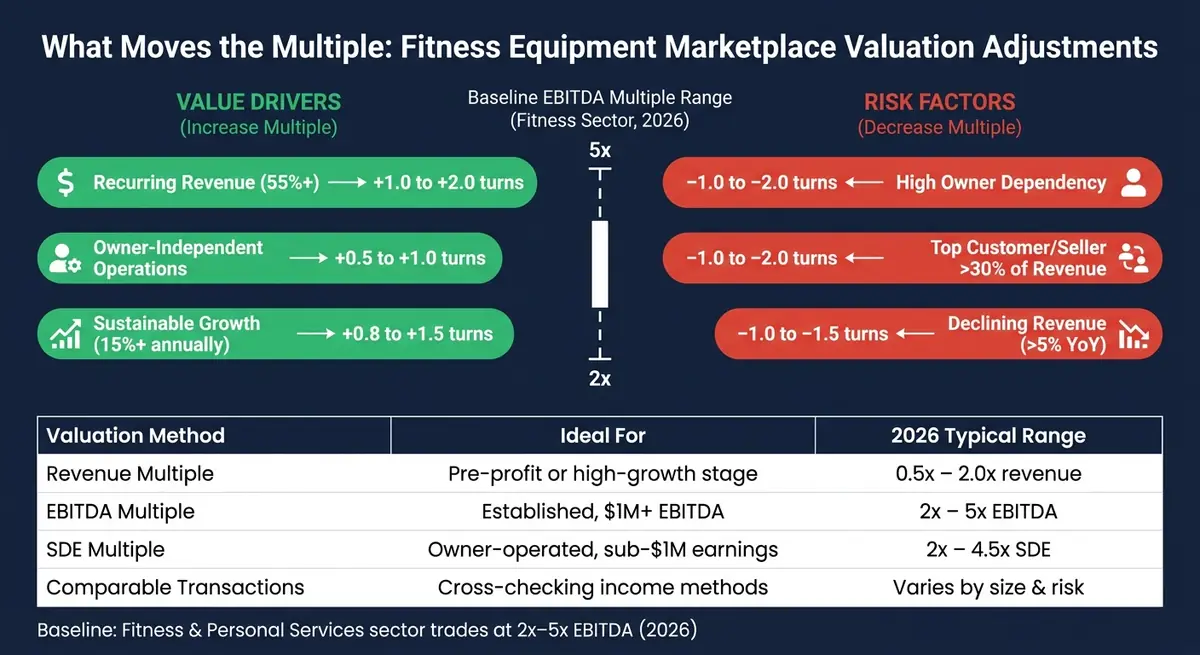
Once you've nailed down the fundamental valuation metrics, the next step is refining the final valuation by accounting for specific risks and value drivers.
After choosing a valuation method, it's essential to tweak the multiple to reflect internal risks and strengths. For instance, in 2026, the fitness and personal services sector typically trades at multiples between 2x and 5x EBITDA.
Risk Factors to Consider
Certain risks in fitness equipment marketplaces—like seller concentration, owner dependency, and weak financial reporting—require careful adjustments to the valuation multiple. Here's how these risks might play out:
- Seller Concentration: If over 20% of revenue comes from a single source, expect a discount of 0.5x to 1.0x EBITDA. If that number climbs above 30%, the discount increases to 1.0x to 2.0x, and it could even jeopardize the deal entirely.
- Owner Dependency: If the business struggles to maintain at least 90% of operations during a 30-day owner absence, a discount is warranted.
"If the business falls apart without the owner, it's worth less. Systems, team, processes that work without you = higher value." — Alex Berman
Revenue Decline: A year-over-year drop in revenue exceeding 5% can cost a business 1.0 to 1.5 turns on its valuation multiple.
Factors That Increase Value
On the flip side, certain factors can boost a business's valuation:
Recurring Revenue: This is a game-changer. Marketplaces with subscription tiers, maintenance contracts, or recurring listing fees can see their multiples jump by 1.0 to 2.0 turns if recurring revenue makes up more than 55% of total revenue.
"Recurring revenue is the single biggest premium driver in LMM services." — Christoph Totter, Managing Partner, CT Acquisitions
- Standardized Equipment Grading: Clear grading criteria for equipment—based on wear, functionality, and history—can reduce operational friction and signal scalability.
- Diversified Seller and Buyer Base: A marketplace with a broad pool of sellers and buyers naturally carries less risk, making it more attractive to investors.
Here's a quick snapshot of how these factors impact valuation multiples:
| Factor | Adjustment to Multiple |
|---|---|
| Recurring revenue (55%+) | +1.0 to +2.0 turns |
| Owner-independent operations | +0.5 to +1.0 turns |
| Sustainable growth (15%+ annually) | +0.8 to +1.5 turns |
| High owner dependency | −1.0 to −2.0 turns |
| Top customer/seller >30% of revenue | −1.0 to −2.0 turns |
| Declining revenue (>5% YoY) | −1.0 to −1.5 turns |
Managing Risks Through Deal Structure
Not all risks can be fully quantified upfront, which is where deal structuring comes into play. Earnouts, for example, often account for 10%–25% of the total price and tie part of the payment to future performance milestones. This approach helps bridge the gap between what a seller believes the business is worth and what a buyer is willing to pay.
Conclusion: Arriving at a Final Valuation
Valuing a business isn't about relying on a single method—it's about combining tools like EBITDA multiples, revenue multiples, comparable transactions, and an asset-based floor to find a realistic range. If your results are all over the place, it's a sign to revisit your assumptions instead of just averaging the numbers.
Once your valuation methods begin to align, consider the size of the marketplace. For fitness equipment marketplaces valued under $10M, multiples-based approaches often work better since projecting future cash flows can be tricky. For deals over $10M, a discounted cash flow (DCF) model is more useful, as it requires clear assumptions about growth and margins. Keep in mind that even small changes—like a 200 basis point (bp) shift in the discount rate—can swing the valuation by 15% to 25%. And don't forget, in a 5- to 7-year model, terminal value frequently makes up 60% to 80% of the total enterprise value.
Before finalizing your valuation, stress test it. Adjust key inputs like revenue growth, EBITDA margins, discount rates, and exit multiples by ±200bp or ±1.0x. This helps you understand the range of possible outcomes and set a firm walk-away price.
"A 'fair price' is whatever survives the buyer's capital structure under realistic downside scenarios, not whatever multiple the broker quoted in the teaser." — Christoph Totter, Managing Partner, CT Acquisitions
Lastly, make sure your transaction comparisons are grounded in real, closed deals—not inflated asking prices. SBA 7(a) FOIA datasets provide insights into what buyers actually paid, whereas asking prices in the lower middle market are often 1.5x to 2x higher than what sellers realistically expect. Using verified transaction data and platforms like Clearly Acquired can help cut through inflated numbers, providing reliable benchmarks for underwriting fitness equipment marketplace deals.
"The discipline of valuation isn't getting to a precise number, it's producing a range you're willing to walk away from." — Christoph Totter, Managing Partner, CT Acquisitions
FAQs
What's a "good" take rate for a fitness equipment marketplace?
When it comes to fitness equipment marketplaces, there's no one-size-fits-all answer to what qualifies as a "good" take rate. It all hinges on factors like your business model, transaction volume, and the value you deliver to your users. Instead of chasing vague industry benchmarks, it's smarter to zero in on your own metrics—think profit margins, customer acquisition costs, and how you stack up against competitors in your niche. Tools like Clearly Acquired's Clara, which leverages AI for financial analysis, can be a game-changer. They help you compare key metrics and uncover ways to boost the overall value of your marketplace.
How do I normalize EBITDA for an owner-run marketplace?
To adjust EBITDA for an owner-run marketplace, focus on aligning reported earnings with what they would look like under professional management. Start by adding back any personal expenses that the owner might have run through the business, as well as any one-time or non-recurring costs. Next, evaluate the owner's salary—if it's significantly above or below what a professional manager would typically earn, adjust it to reflect a fair market rate.
Tools from Clearly Acquired, powered by AI, make this process easier by pinpointing the adjustments needed for accurate normalization.
When should I use a DCF instead of a multiple?
For deals exceeding $10,000,000, a Discounted Cash Flow (DCF) analysis becomes a critical tool. While market multiples offer a quick way to estimate value, DCF digs deeper by evaluating future cash flow projections. It acts as a reality check to ensure valuations align with expected performance.
However, DCF outcomes are highly sensitive to the assumptions made—such as growth rates and discount rates. That's why experienced buyers typically use DCF alongside other methods, such as EBITDA or SDE multiples, comparable transaction analyses, and asset-based valuations, to arrive at a well-rounded and defensible price range. This combination of approaches ensures a more reliable valuation, especially for high-stakes transactions.
Find the right lender for your business
Whether it's working capital, an SBA loan, or acquisition financing — we'll match you with the right capital partner.
About the author
Principal & CEO/CIO
Samson Jagoras has 15+ years across finance, real estate, and business acquisitions. He began his career as a Futures & Commodities broker and later served as Chief Strategy Officer of an INC 500 marketing and technology firm, helping scale revenue from $1M to over $100M. Today he buys, builds, and advises a portfolio of companies with a focus on M&A, capital allocation, and operational strategy.