Survival Periods in Private Acquisitions: Buyer vs. Seller Negotiation Guide
Survival periods set the deadline for post-closing rep & warranty claims. Here's how buyers and sellers should align them with escrow, RWI, and notice rules.
 Samson JagorasPrincipal & CEO/CIOMay 27, 2026

Negotiating Survival Periods in Private Acquisitions
Survival periods in private acquisitions set deadlines for post-closing claims tied to representations and warranties. For buyers, these periods provide a window to address undisclosed issues, while sellers gain clarity on when liabilities end. Here's a quick breakdown:
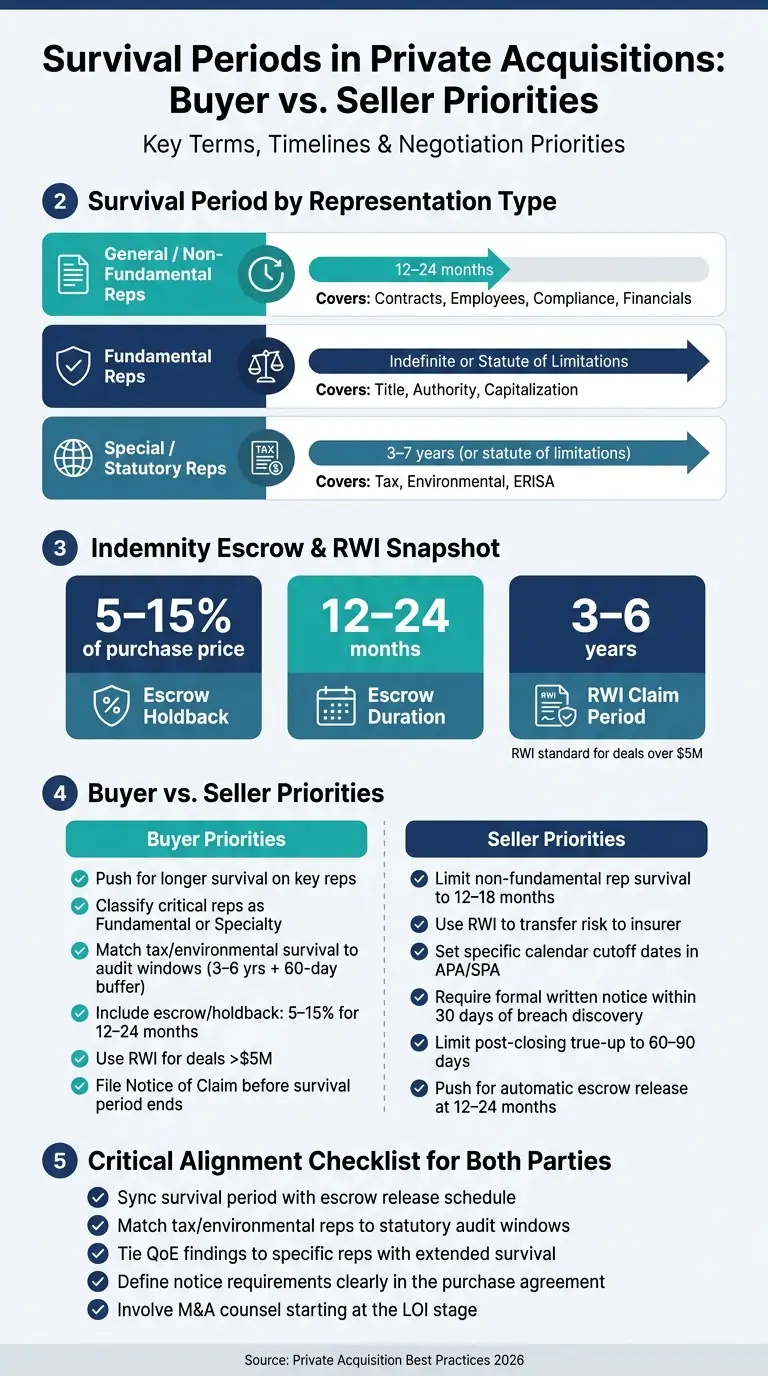
- General Representations: Typically last 12–24 months. Cover contracts, employees, and financials.
- Fundamental Representations: Often indefinite or tied to statutes of limitations. Include ownership, authority, and tax compliance.
- Special Representations: Align with statutory limits (3–7 years), covering taxes and liabilities like contamination.
Key tools include indemnity escrows (5–15% of purchase price held for 12–24 months) and Representation and Warranty Insurance (RWI), which extends claim periods and reduces seller exposure. Aligning survival periods with escrow timelines and ensuring clear notice provisions are essential to avoid disputes. Buyers should negotiate longer survival for critical reps, while sellers should focus on limiting exposure through shorter periods and strict claim requirements.
What Survival Periods Cover
Key Representations and Warranties
When it comes to representations and warranties, they fall into two primary categories: general (non-fundamental) reps and fundamental reps. General reps deal with operational aspects like contract compliance, employee matters, and accurate financial reporting. These typically remain valid for a shorter period after closing. On the other hand, fundamental reps focus on the core elements of the transaction - such as the seller's authority to sell, title to assets or stock, and capitalization. These reps often have much longer survival periods, sometimes even without a set expiration. This distinction highlights why certain areas of risk demand extended coverage.
Areas That Often Carry Extended Coverage
Tax representations are tied to the statute of limitations, which usually lasts three to seven years after closing. This aligns with the IRS's standard audit period of three years, or up to six years in cases of significant underreporting. Similarly, environmental liability issues, like contamination or regulatory violations, may take years to surface. As a result, environmental reps are often assigned longer survival periods. Here's a breakdown of typical survival periods by representation type:
| Representation Category | Typical Survival Period | Key Areas Covered |
|---|---|---|
| General / Non-Fundamental | 12–24 months | Contracts, employees, compliance, financials |
| Fundamental | Extended or indefinite | Title, authority, capitalization |
| Special / Statutory | 3–7 years (or statute of limitations) | Tax, environmental, ERISA |
How Survival Periods Affect Buyers and Sellers
Survival periods play a crucial role in determining post-closing liabilities for both buyers and sellers. For buyers, these periods set a time limit for filing indemnification claims. If the survival window closes, the buyer loses the right to make new claims - even if an issue is discovered later. This is particularly significant in stock purchases, where the buyer inherits the entire legal and financial history of the acquired entity.
For sellers, survival periods provide clarity on when escrow funds are released and when liability for most operational claims ends. A Quality of Earnings (QoE) report can be instrumental here, helping both parties identify potential financial or legal risks early on. This allows for negotiating tailored survival terms rather than defaulting to standard provisions.
"Quality of Earnings reports surface working-capital traps, customer concentration, EBITDA add-back disputes, and legal exposures buyers don't see in audited financials." – CT Strategic Partners
Additionally, Representation and Warranty Insurance (RWI) offers buyers a way to extend claim periods to three to six years while simultaneously reducing the seller's long-term exposure.
How Buyers Can Negotiate Survival Periods
Pushing for Longer Survival on Key Reps
When it comes to negotiating survival periods, buyers have a chance to protect themselves from potential liabilities after the deal closes. A key strategy is to classify certain representations - like ownership, authority, and capitalization - as "Fundamental" or "Specialty" reps. These should not fall under the standard general rep survival period. Fundamental reps should either survive indefinitely or at least align with the full statute of limitations. For tax and environmental reps, aim to match their survival periods with audit windows, which are typically three to six years, plus an additional 60-day buffer for safety.
If the deal is worth $5 million or more, Representation and Warranty Insurance (RWI) can be a game-changer. It allows buyers to secure longer survival periods and higher recovery limits than what sellers usually agree to in traditional indemnity arrangements. However, don't treat RWI as an afterthought - factor it into the deal structure from the beginning. Tailored survival periods, combined with clear notice procedures, create a strong foundation for preserving claims.
Using Notice Provisions to Preserve Claims
A well-defined notice provision is critical for preserving claims. If a formal Notice of Claim is delivered before the survival period ends, the buyer's rights remain intact, even if the exact claim amount is determined later. The purchase agreement should clearly outline what constitutes valid notice - whether it's a formal legal filing or a written notification of a breach. Ambiguous language can lead to disputes, so clarity is key.
Additionally, negotiate a cooperation covenant requiring the seller to provide access to business records after closing. This ensures buyers can identify breaches within the survival period.
"If the seller violates the non-compete or undisclosed liabilities surface, the buyer's remedies depend on what was negotiated into the purchase agreement." – Alex Lubyansky, Esq., Managing Partner, Acquisition Stars
Drafting Clauses That Protect Buyer Interests
Extending survival periods and ensuring timely notice are just part of the equation. Buyers should also focus on drafting strong contractual clauses to further protect their interests. For instance, include an escrow or holdback provision, where 5%–15% of the purchase price is held for 12–24 months. This serves as a financial backstop for indemnification claims. Make sure the escrow release date aligns with the general rep survival period to prevent coverage gaps.
For specific risks flagged during due diligence - like customer concentration or potential tax issues - negotiate specific indemnities outside the standard survival framework. A Quality of Earnings (QoE) report can help identify these risks before finalizing the agreement.
| Clause | Typical 2026 Terms | Buyer Benefit |
|---|---|---|
| Escrow/Holdback | 5–15% of price; 12–24 months | Funds available for indemnification claims |
| Fundamental Rep Survival | Indefinite or statute of limitations | Core ownership protections don't expire |
| Specialty Rep Survival | Statute of limitations + ~60-day buffer | Covers tax and environmental audit windows |
| RWI Coverage | Standard for deals >$5M | Extends recovery limits beyond seller capacity |
Negotiation of Representations and Warranties in the Purchase and Sale Agreement

Ready to Make Your Next Move?
Whether you're buying, selling, or investing — Clearly Acquired gives you the tools, data, and support to close with confidence.
How Sellers Can Negotiate Survival Periods
When it comes to survival periods in purchase agreements, sellers need to actively negotiate terms that limit their exposure after closing. While buyers often aim to extend coverage to protect their interests, sellers should focus on strategies to keep their post-closing liabilities in check.
Limiting Survival for Non-Fundamental Reps
Sellers should make a clear distinction between Fundamental Representations - which typically include title, authority, and tax-related matters - and non-fundamental representations. For the latter, a survival period of 12 to 18 months is common. In deals exceeding $5 million, Representation and Warranty Insurance (RWI) can significantly reduce seller liability by transferring much of the risk to the insurer. This approach mimics a "public company style" structure, where buyers recover losses from the insurer rather than directly from the seller.
"RWI is increasingly standard for $5M+ deals. Skipping RWI shifts diligence risk to the buyer with no insurance backstop." – Business Acquisition Guide 2026
Additionally, a well-prepared data room and a sell-side Quality of Earnings (QoE) report can ease buyer concerns. This preparation can reduce the likelihood of buyers demanding extended survival periods as a hedge against potential risks. By setting clear survival limits, sellers can establish precise cutoff dates for claims.
Setting Clear Cutoff Dates
Ambiguity around expiration dates can leave sellers vulnerable to extended liabilities. To avoid this, the purchase agreement - whether an Asset Purchase Agreement (APA) or Stock Purchase Agreement (SPA) - should include a specific calendar date for the expiration of claims related to non-fundamental representations. Sellers should also negotiate for the indemnity escrow, typically 5%–12% of the purchase price, to be automatically released within 12 to 24 months. This creates a definitive endpoint for general representation claims.
For deals financed through SBA 7(a) loans and other financing options, seller notes often remain on standby for up to 24 months without payments. This structure justifies both shorter survival periods and reduced indemnity caps in such transactions.
Enforcing Strict Notice Requirements
After setting clear cutoff dates, sellers can further protect themselves by establishing and enforcing strict notice requirements for claims. To prevent vague or last-minute allegations, sellers should require buyers to provide formal written notice within 30 days of discovering a breach. This notice should include specific details and supporting evidence regarding the claim. For financial disputes, sellers should aim for a post-closing true-up period limited to 60 to 90 days to finalize working capital adjustments.
Pairing these requirements with a mandatory dispute resolution process - such as accounting arbitration - can help avoid lengthy and costly litigation over unclear claims.
"Undisclosed liabilities, seller non-compete violations, and client contracts that fail to transfer after closing are the most common post-closing issues. Your remedies depend entirely on what was negotiated into the purchase agreement." – Alex Lubyansky, Esq., Managing Partner, Acquisition Stars
How Survival Periods Work with Indemnity Limits
Survival periods operate alongside indemnity mechanisms like caps, baskets, and escrow accounts to establish post-closing protections. Ensuring these elements align is just as important as negotiating the survival period itself.
Aligning Survival Periods with Caps and Baskets
A frequent practice is to synchronize the survival period for general representations with the escrow or holdback release schedule. Escrow accounts typically retain 5% to 15% of the purchase price for 12 to 24 months to cover indemnification claims. However, misalignment between survival periods and escrow release schedules - like an 18-month survival period paired with a 12-month escrow - can result in coverage gaps. For transactions exceeding $5 million, Representation and Warranty Insurance (RWI) often extends coverage beyond the escrow timeframe.
"Escrow: 5–15% held back 12–24 months for indemnification claims." – CT Acquisitions
This highlights the importance of adhering to timely claim notice requirements.
Meeting Deadlines for Claim Notices
Strict adherence to claim notice deadlines is critical. Even if a breach occurs within the survival period, missing the notice deadline can void indemnification rights. Purchase agreements typically mandate that a formal written claim notice be submitted before the survival period ends - not just before initiating litigation. For instance, if a breach is discovered late in the survival period, the window for submitting a notice may be extremely narrow. These notices must outline the breach and estimate damages; failure to provide sufficient detail could invalidate the claim. Buyers should treat the survival period's deadline as non-negotiable and implement internal checkpoints to identify and address potential issues well in advance.
Avoiding Conflicts with Statutory Limitations Periods
Contractual survival periods may impose shorter timelines than those allowed by state statutory limitations. In certain jurisdictions, statutory periods - especially for tax-related or fraud-based claims - cannot be waived by contract and may extend beyond a typical 18-month survival period. To mitigate this risk, survival periods for fundamental representations should be extended to at least match statutory limits. M&A attorneys should carefully review both contractual terms and applicable state laws to prevent gaps or conflicts that could prematurely bar valid claims.
"The purchase agreement must satisfy both state commercial law and SBA SOP requirements... including representations about the seller's compliance with existing contracts and government requirements." – Alex Lubyansky, Esq., Managing Partner, Acquisition Stars
Conclusion and Key Takeaways
Survival periods play a critical role in defining post-closing liabilities by setting deadlines for claims. How these timelines are structured and enforced determines who shoulders the burden of any unexpected issues after the deal closes.
Several key principles apply across deals of all sizes and structures. First, alignment is everything. Survival periods need to match up with escrow release schedules, seller note terms, and financing structures to prevent costly gaps. This is particularly important in smaller deals (under $5 million), where seller financing is common. In these cases, the seller note often acts as a practical tool for addressing post-closing issues if representations turn out to be inaccurate.
"We negotiate an offset right into every seller note: if the seller's representations and warranties prove false, the buyer can offset indemnification claims against remaining seller note payments. Seller note offset provisions serve as an effective escrow mechanism." – Alex Lubyansky, Esq., Managing Partner, Acquisition Stars
Another essential point is that due diligence findings only matter when they are clearly captured in the contract. As discussed earlier, survival periods must align with escrow and financing terms. For example, findings from Quality of Earnings (QoE) reports, customer concentration risks, or one-time revenue items need to be explicitly tied to specific representations and warranties with appropriate survival periods. Without this, they hold little legal significance after the deal closes. On the seller's side, limiting general representations to known and verified facts can help reduce exposure to claims based on vague or overly broad language.
Here's a quick summary of priorities for buyers and sellers:
| Area | Buyer Priority | Seller Priority |
|---|---|---|
| Seller Note | Negotiate offset rights for claims | Understand standby requirements before closing |
| QoE Findings | Link findings to specific reps with extended survival | Use findings to narrow the scope of general reps |
| LOI Stage | Lock in financing contingencies and note terms early | Clarify standby periods to avoid closing-table surprises |
| Escrow Alignment | Match survival period to escrow release schedule | Push for shorter windows on non-fundamental reps |
It's also worth noting the importance of involving specialized M&A counsel early in the process. SBA lenders have their own legal representation, which means their attorneys do not act in the buyer's interest. Relying on lender counsel for post-closing protection can leave buyers unnecessarily exposed. Negotiations around survival periods should begin at the Letter of Intent stage - not at the closing table. These steps emphasize the need to align survival periods with the overall deal structure to ensure strong post-closing safeguards.
FAQs
Which reps should survive the longest in my deal?
In private acquisitions, fundamental representations often have the longest survival periods. These cover crucial aspects like the legal authority to enter the agreement, the valid existence of the business, and the clear title to assets or equity. Because these elements are essential for ensuring the legality of the deal and proper ownership, their survival periods often match the statute of limitations. On the other hand, operational or financial representations typically have shorter survival periods, which are determined by the indemnity terms negotiated in the agreement.
How do survival periods interact with escrow releases?
In private acquisitions, the survival period defines how long a buyer has to make claims for breaches of representations and warranties. These claims allow the buyer to recover funds held in escrow. Generally, 5–15% of the purchase price is placed in escrow for a period of 12–24 months. Once the survival period concludes, any remaining escrow funds are released to the seller - as long as no claims are outstanding or pending during that time.
Does RWI replace the need for long survival periods?
RWI doesn't remove the necessity for extended survival periods. Although it evaluates a business's capacity to handle debt obligations, survival periods are still determined through negotiations. These discussions typically depend on elements such as the deal's structure, how risks are divided, and the unique details of the transaction.
About the author
Principal & CEO/CIO
Samson Jagoras has 15+ years across finance, real estate, and business acquisitions. He began his career as a Futures & Commodities broker and later served as Chief Strategy Officer of an INC 500 marketing and technology firm, helping scale revenue from $1M to over $100M. Today he buys, builds, and advises a portfolio of companies with a focus on M&A, capital allocation, and operational strategy.