State Capital Gains Tax Guide for Sellers
Practical breakdown of how U.S. states tax business sale gains, top high- and no-tax states, and strategies to minimize state-level taxes.
 Samson JagorasPrincipal & CEO/CIOMay 15, 2026
Ultimate Guide to State Capital Gains Tax for Sellers
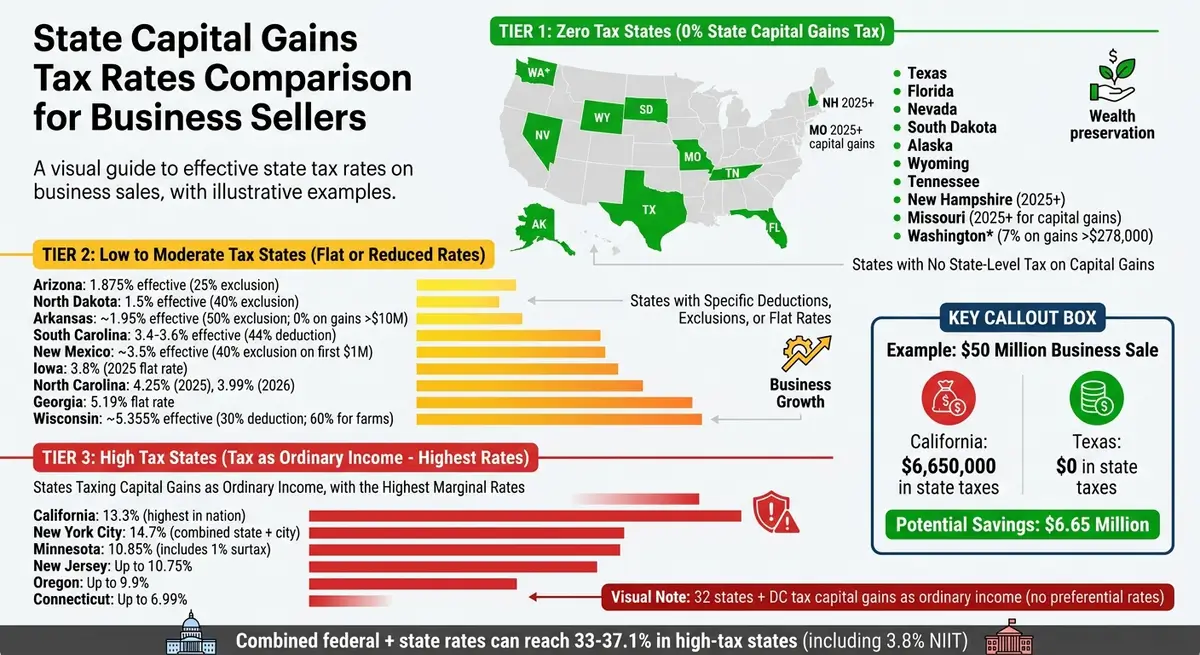
When selling a business, state capital gains taxes can significantly impact your profits — ranging from 0% in states like Texas and Florida to as high as 13.3% in California. Unlike federal capital gains taxes, which offer reduced rates for long-term gains, most states tax capital gains as ordinary income, leading to higher overall tax burdens. For example, selling a $50 million business in California could cost $6.65 million in state taxes, while the same sale in a no-tax state like Texas results in zero state tax liability.
Key Takeaways
- States with no capital gains tax: Texas, Florida, Nevada, and others.
- High-tax states: California (13.3%), New York (up to 14.7% with city taxes), and Minnesota (10.85%).
- Tax-saving strategies: Relocating to no-tax states, using seller financing to defer taxes, and leveraging exemptions like QSBS (Qualified Small Business Stock).
Understanding your state's tax rules and planning ahead — often 6 to 12 months before a sale — can save you millions. Let's break down how state taxes work and strategies for minimizing your tax burden.
State Capital Gains Tax Rates Comparison for Business Sellers 2025–2026
How Capital Gains Tax Works for Business Sellers
When selling a business, the IRS doesn't treat it as one single transaction. Instead, each asset included in the sale is taxed individually, and its classification determines how much you owe in taxes.
Short-Term vs. Long-Term Capital Gains
The length of time you've owned your business plays a big role in how your gains are taxed. Short-term capital gains apply to assets held for one year or less and are taxed at ordinary income rates, which can go as high as 37% at the federal level. On the other hand, long-term capital gains apply to assets held for over a year and are taxed at much lower rates: 0%, 15%, or 20%, depending on your income.
However, while federal tax rates offer lower rates for long-term gains, many states tax capital gains at the same rate as ordinary income. In fact, 32 states and Washington, DC, apply these ordinary income tax rates, which range from 0% to 13.3%.
"Thirty-two states and the District of Columbia overtax capital gains income simply by subjecting capital gains to the same rate schedule that applies to ordinary income." — Katherine Loughead, Director of State Tax Projects, Tax Foundation
Federal Capital Gains Tax Rates for 2026
For the 2026 tax year, federal long-term capital gains tax rates depend on your taxable income and filing status:
| Tax Rate | Single Filers | Married Filing Jointly | Head of Household |
|---|---|---|---|
| 0% | $0 – $49,450 | $0 – $98,900 | $0 – $66,200 |
| 15% | $49,451 – $545,500 | $98,901 – $613,700 | $66,201 – $579,600 |
| 20% | Over $545,500 | Over $613,700 | Over $579,600 |
Additionally, high earners face a 3.8% Net Investment Income Tax (NIIT) if their income exceeds $200,000 (or $250,000 for joint filers). However, active S-corporation owners may qualify for an exemption.
Tax Rates for Specific Business Assets
- Goodwill: Classified as a "Class VII" asset, goodwill is typically taxed at long-term capital gains rates, which are more favorable.
- Inventory and accounts receivable: Taxed at ordinary income rates, not capital gains rates.
- Depreciable equipment: Gains are subject to "depreciation recapture" — the portion tied to prior depreciation is taxed as ordinary income.
- Section 1250 property: For depreciable real estate, unrecaptured gains are taxed at a maximum federal rate of 25%.
- Collectibles and Qualified Small Business Stock (QSBS): Gains are taxed at a maximum rate of 28%.
"Some exceptions exist to the maximum capital gains tax rate of 20%. For instance, gains from the sale of collectibles and the taxable part of gain from the sale of qualified small business stock are taxed at 28%. Plus, gains from the sale of certain real property where prior depreciation was claimed are taxed at 25%." — Kelly Wallace, CPA
When negotiating a business sale, sellers often aim to allocate more of the purchase price to goodwill to take advantage of long-term capital gains rates. Buyers, however, may prefer to allocate more to equipment and real estate to establish a higher depreciation basis for future tax benefits.
How States Tax Capital Gains
Federal capital gains tax rates set the groundwork, but state policies can significantly impact your overall tax liability. While federal rates distinguish between short- and long-term gains, most states treat capital gains as ordinary income. In fact, 32 states and Washington, D.C., apply the same tax rate to capital gains as they do to wages and salaries.
States with No Capital Gains Tax
Eight states avoid taxing capital gains entirely because they don't have a state income tax: Alaska, Florida, Nevada, South Dakota, Tennessee, Texas, Wyoming, and New Hampshire. Notably, New Hampshire repealed its Interest & Dividends Tax effective January 1, 2025.
Missouri takes a different approach. While it taxes regular wages, the state allows a full deduction for individual capital gains starting in 2025, effectively eliminating taxes on such gains from business sales.
Washington stands apart from these states. It doesn't tax wage income but does impose a 7% excise tax on long-term capital gains exceeding $250,000 annually (adjusted for inflation to about $278,000).
"For founders planning business exits in 2025, state capital gains tax policy represents one of the most significant and controllable variables in post-exit wealth preservation." — Peyton Carr, Co-Founder, Keystone Global Partners
States with Flat Capital Gains Tax Rates
Some states simplify tax planning by using flat tax rates that apply to all taxable income, including capital gains. These include Arizona, Colorado, Illinois, Indiana, Kentucky, Michigan, North Carolina, Pennsylvania, and Utah. Arizona's flat rate is 2.5%, but a 25% subtraction for certain assets reduces the effective rate on qualifying long-term gains to about 1.875%. North Dakota's 40% exclusion results in an effective rate of approximately 1.5%.
Some states are transitioning to flat tax systems. Georgia implemented a 5.19% flat rate in 2024, Iowa adopts a 3.8% flat rate in 2025, and North Carolina plans to lower its rate from 4.25% in 2025 to 3.99% by 2026.
States That Tax Capital Gains as Regular Income
The majority of states — 32 plus Washington, D.C. — tax capital gains as ordinary income. California has the highest state capital gains tax rate at 13.3%, which includes a 1% Mental Health Services Tax. In New York City, residents face a combined state and city rate of roughly 14.7%, while Minnesota's top effective rate is 10.85%, including a 1% surtax on investment income over $1 million.
In these high-tax states, the combined federal and state rates on long-term capital gains can reach 33% to 37.1%, factoring in the 3.8% NIIT. A $100,000 capital gain would incur no state tax in Texas but could cost $13,300 in California.
High-tax states like California, New York, and Connecticut closely scrutinize residency claims when taxpayers sell large assets shortly after moving. To establish residency, sellers should provide clear evidence: spending 183+ days in the state, registering to vote, holding a local driver's license, and purchasing a primary residence.
Ready to Make Your Next Move?
Whether you're buying, selling, or investing — Clearly Acquired gives you the tools, data, and support to close with confidence.
Tax Exemptions and Deductions for Business Sellers
When selling a business, state-level tax exemptions and deductions can significantly lighten your tax load.
State Exemptions for Business Sales
- Missouri: Starting in 2025, individuals can deduct 100% of their capital gains.
- Arkansas: 50% exclusion on most long-term gains; fully exempts net gains over $10 million.
- South Carolina: 44% deduction on net long-term gains, resulting in an effective tax rate of ~3.4–3.6%.
- Wisconsin: 30% deduction on most long-term assets; 60% for qualified farm assets.
- Arizona: Excludes 25% of long-term gains for assets bought after Dec 31, 2011 (~1.875% effective rate).
- New Mexico: Starting in 2025, sellers can exclude the greater of $2,500 or 40% of up to $1M in gains from selling in-state businesses.
- Washington: Standard deduction of $278,000 for 2025 before its 7% capital gains tax applies.
The federal Qualified Small Business Stock (QSBS) exclusion under Section 1202 provides substantial tax benefits, but not all states conform. California, Pennsylvania, Alabama, Mississippi, and DC do not. New Jersey will begin conforming starting January 1, 2026. Federally, the QSBS exclusion cap has risen to $15 million for stock issued after July 4, 2025, and now adjusts for inflation.
Home Sale Exclusion for Business Owners
If you operate your business out of your primary residence, you might qualify for the Section 121 home sale exclusion — exclude up to $250,000 (single) or $500,000 (married filing jointly) of gains. The property must have been your primary residence for at least two of the last five years before the sale.
State Deduction Limits and Requirements
| State | Exclusion/Deduction | Effective Rate | Special Requirements |
|---|---|---|---|
| Missouri | 100% deduction (2025+) | 0% | Individual capital gains only |
| Arkansas | 50% exclusion; 100% for gains >$10M | ~1.95% or 0% | Automatic application |
| South Carolina | 44% deduction | ~3.4–3.6% | Net long-term gains |
| Wisconsin | 30% standard; 60% for farms | ~5.355% or lower | Farm asset qualification |
| New Mexico | 40% of first $1M (2025+) | ~3.5% | New Mexico business only |
| Arizona | 25% subtraction | ~1.875% | Assets acquired after 12/31/2011 |
| Washington | $278,000 standard deduction | 7% on gains above | Long-term gains only |
State Tax Rules for Seller Financing
Seller financing allows sellers to defer state tax liability using the installment method under IRC Section 453. This method spreads capital gains over the loan's term, meaning you pay taxes only on the portion received each year.
"Recognizing the entire gain in the year of sale may push the seller into a higher capital gains tax bracket when compared to spreading out the impact to taxable income over several years." — Andrew Murray, CPA
How Installment Sales Affect State Taxes
Most states align with federal rules for installment sales, letting sellers defer capital gains taxes until they receive principal payments. This deferral is particularly helpful in states like Ohio, New York, and California, where capital gains are taxed as ordinary income. However, depreciation recapture is not eligible for deferral and must be taxed in the year of sale. If the installment balance exceeds $5 million, IRC Section 453A imposes interest on the deferred tax liability.
State Taxes on Interest from Seller Notes
While gains can be deferred, interest earned from seller-financed notes is taxed annually as ordinary income. State rates vary widely, from 0% in Texas and Florida to 13.3% in California. In high-tax states, combined federal and state rates on interest can climb to 33%–37%, factoring in the 3.8% NIIT.
California requires withholding 3 1/3% of the down payment and future principal installments, sent to the Franchise Tax Board using Form 593. Sellers can request an alternative withholding calculation based on their expected gain to prevent over-withholding.
Tax Planning Strategies for Seller Financing by State
One potential strategy is geographic arbitrage. By relocating to a zero-tax state like Florida, Texas, or Nevada before receiving installment payments, sellers can avoid paying 5%–13.3% in state taxes on both gains and interest income. Establishing residency at least 6–12 months before the sale is critical to avoid audits from the previous state.
Some sellers use non-grantor trusts located in zero-tax states to hold installment notes, which can potentially shield gains from taxation in their home state. To stay on top of obligations, create an amortization table at the start of the agreement, since interest income must be reported annually and cannot be deferred.
Conclusion
State capital gains tax planning plays a critical role in preserving wealth after a business exit. Since most states tax capital gains as ordinary income, you may not benefit from federal preferential rates of 0%, 15%, or 20%. For founders with venture-backed companies, whether your state aligns with federal QSBS exclusions can mean the difference between keeping or losing millions in otherwise exempt gains.
The secret to maximizing your after-tax proceeds lies in early preparation. Strategies like geographic relocation, trust structuring, or installment sales often require a lead time of 12–36 months. If you're considering a move to a zero-tax state such as Texas, Florida, or Nevada, you'll need to firmly establish residency well before the sale to avoid scrutiny from your previous state.
"For founders planning business exits in 2026, state capital gains tax policy represents one of the most significant and controllable variables in post-exit wealth preservation." — Peyton Carr, Co-Founder, Keystone Global Partners
Platforms like Clearly Acquired offer tools for integrated deal structuring, combining tax planning, buyer screening, and exit readiness. By pairing professional advice with AI-powered valuation and deal management, you can approach your business exit confidently.
FAQs
How do states decide which capital gains are taxable?
Most states treat capital gains as part of taxable income, but the tax rates can differ significantly. Some states apply the same rate as they do for ordinary income, while others set distinct rates or offer exemptions. A handful of states, such as Florida and Texas, don't tax capital gains at all. Typically, these calculations follow federal guidelines, though some states include unique exemptions or deductions in their rules.
What proves I changed residency before selling my business?
To prove a residency change before selling your business, you'll need documentation that shows your new residency status:
- Updated state tax filings reflecting your new state of residence.
- A change of address with the IRS, ensuring your tax records align with your move.
- A new driver's license or state ID issued by your new state.
- Evidence of physical relocation, such as utility bills, lease agreements, or property purchase documents.
Which sale allocations reduce state tax the most?
The primary residence exclusion allows single filers to exclude up to $250,000 and joint filers up to $500,000 from taxable gains on home sales. States like Florida and Texas don't impose state income or capital gains taxes — living in these states can significantly lower your overall state tax liability. Allocating more of the purchase price to goodwill (taxed at long-term capital gains rates) versus inventory or equipment (taxed as ordinary income or subject to depreciation recapture) can also reduce the total tax bill.
About the author
Principal & CEO/CIO
Samson Jagoras has 15+ years across finance, real estate, and business acquisitions. He began his career as a Futures & Commodities broker and later served as Chief Strategy Officer of an INC 500 marketing and technology firm, helping scale revenue from $1M to over $100M. Today he buys, builds, and advises a portfolio of companies with a focus on M&A, capital allocation, and operational strategy.