How SLA Management Impacts Business Valuation
Disciplined SLA tracking and documented delivery affect valuation, multiples, and deal terms during M&A due diligence.
 Samson JagorasPrincipal & CEO/CIOJune 20, 2026

Sell your business for maximum value
Our sell-side advisors package, market, and negotiate your exit to qualified, verified buyers — confidentially.
SLA management can change what a buyer is willing to pay. If service levels are tracked well, contracts match delivery, and ticket data holds up over 12–24 months, a company is easier to trust in diligence. If not, buyers often cut value, push for earnouts, or adjust EBITDA for service fixes.
Here’s the short version:
- Strong SLA results support higher multiples because they point to steadier revenue and lower churn risk.
- Weak SLA controls can pull value down through service credits, ticket backlogs, repeat escalations, and poor records.
- Buyers check raw data, not just dashboards: ticket logs, contracts, billing records, escalations, and CSAT/NPS trends.
- Margin matters as much as revenue. A high-MRR customer can still hurt profit if ticket volume is too high.
In the MSP market, firms with cleaner service delivery and reporting often trade around 4.5x to 8.0x EBITDA, while weaker firms may fall closer to 3x to 5x.
If I were preparing a company for sale, I’d focus on four things first:
- Signed contracts that match actual service terms
- SLA history that is easy to verify
- Low backlog, low reopen rates, and fewer escalations
- Clear workflows that do not depend on one person
A buyer is not just buying revenue. They’re buying the odds that revenue stays in place after closing. That’s why SLA discipline can affect price, deal terms, and buyer confidence at the same time.
How Poor SLA Management Lowers Business Value
Operational failures that surface during diligence
In diligence, buyers want proof that service quality happens the same way every time. They don’t want a business that runs well only because one person knows where all the bodies are buried.
That’s why they dig into service records, ticket volume, resolution times, and escalation patterns. If the data is missing, incomplete, or spread across spreadsheets, it signals extra cleanup work and a higher integration bill after close.
Missed response times, unresolved tickets, and repeat escalations tell a similar story. They suggest the business leans too heavily on the founder or a small group of technical staff. In smaller firms, that kind of knowledge concentration gets flagged as key-person risk, which can push buyers to lower their offer.
Service credits also show up as a quiet problem in the numbers. If SLA breaches happen often enough to trigger credits, gross margins start to slip. Buyers usually don’t see that as a one-off mistake. They see it as a pattern - and patterns like that point to an operating issue that keeps coming back.
Why buyers apply a valuation discount
Poor SLA governance makes buyers less sure about future cash flow. It also tells them they may have to spend time and money fixing the business after close.
A large unresolved-ticket backlog is one of the clearest signs. It can mean the true cost to serve customers is higher than the income statement suggests. So buyers often adjust normalized EBITDA downward to reflect the staffing or process changes they expect to make after closing. Managed service providers with disciplined operations and strong recurring contracts typically sell at 4.5x to 8.0x EBITDA, while those with weak reporting or uneven service delivery often land in the 3x to 5x range.
Inconsistent service delivery creates transfer risk too. That’s the buyer’s concern that performance may slip once ownership changes hands. If workflows live in people’s heads instead of documented systems, there’s no clear reason to believe the business will run the same way after the founder steps back.
That’s why buyers look first at measurable SLA metrics and documented workflows.
SLA Metrics and Practices That Support Higher Valuation
SLA metrics buyers look at during diligence
Buyers don’t want polished dashboard screenshots. They want source data from ticketing systems, PSA exports, and signed contracts.
The main metrics they review are response time, resolution time, first-contact resolution (FCR), escalation rate, ticket reopen rate, and overall SLA compliance rate. Each metric says something different. FCR shows whether your team fixes issues on the first try. Escalation and reopen rates show whether those fixes stick. SLA compliance rate shows whether your team meets the service terms written into customer contracts on a steady basis.
Buyers also look past simple averages and dig into ticket density. That means the number of tickets generated per customer or per seat. A high-MRR account can look good at first glance and still drain margin if it creates too many support tickets. That’s the kind of hidden service load buyers tend to flag when they compare management reports with raw data from CRM, billing, and ticketing systems.
Management practices that produce measurable value
Metrics matter a lot less if the workflow behind them lives in people’s heads.
For metrics to hold up in diligence, the operating system behind them needs to be documented. It starts with clear service definitions. Each contract should state exactly what’s included, the response and resolution standard, and whether the agreement is signed, standardized, and assignable. Loose agreements or mixed contract language can slow diligence and create legal risk after close.
Documented workflow matters just as much. If onboarding steps, escalation paths, and patching protocols sit in a central system instead of one person’s memory, the business can run without the founder stepping into every issue. That makes the company easier to hand off and easier for a buyer to trust.
Regular SLA reviews also help in a very practical way. They can show underpriced accounts, catch compliance drift before it turns into a habit, and connect service delivery to actual margin performance. A business that reviews this stuff on a steady basis looks disciplined, not reactive. And those review records are exactly the kind of evidence buyers test during diligence.
How AI-enabled systems improve visibility and consistency
When ticket counts, billing records, and device counts stop matching, small mistakes can snowball.
AI-enabled monitoring and integrated service-management systems help tighten tracking, reporting, and exception detection by automating ticket tracking, syncing device counts with billing, and flagging exceptions before they turn into bigger issues. The payoff is cleaner records and fewer unpleasant surprises when buyers dig through the data.
Buyers put more weight on AI that’s built into billing, contract, and ticket data than on tools added later without day-to-day visibility. Integrated AI improves reporting accuracy and cuts down on surprises in diligence. That’s what changes the diligence picture.
Get a Quality of Earnings analysis you can trust
Valuation Impact and SLA Risk Review in Due Diligence
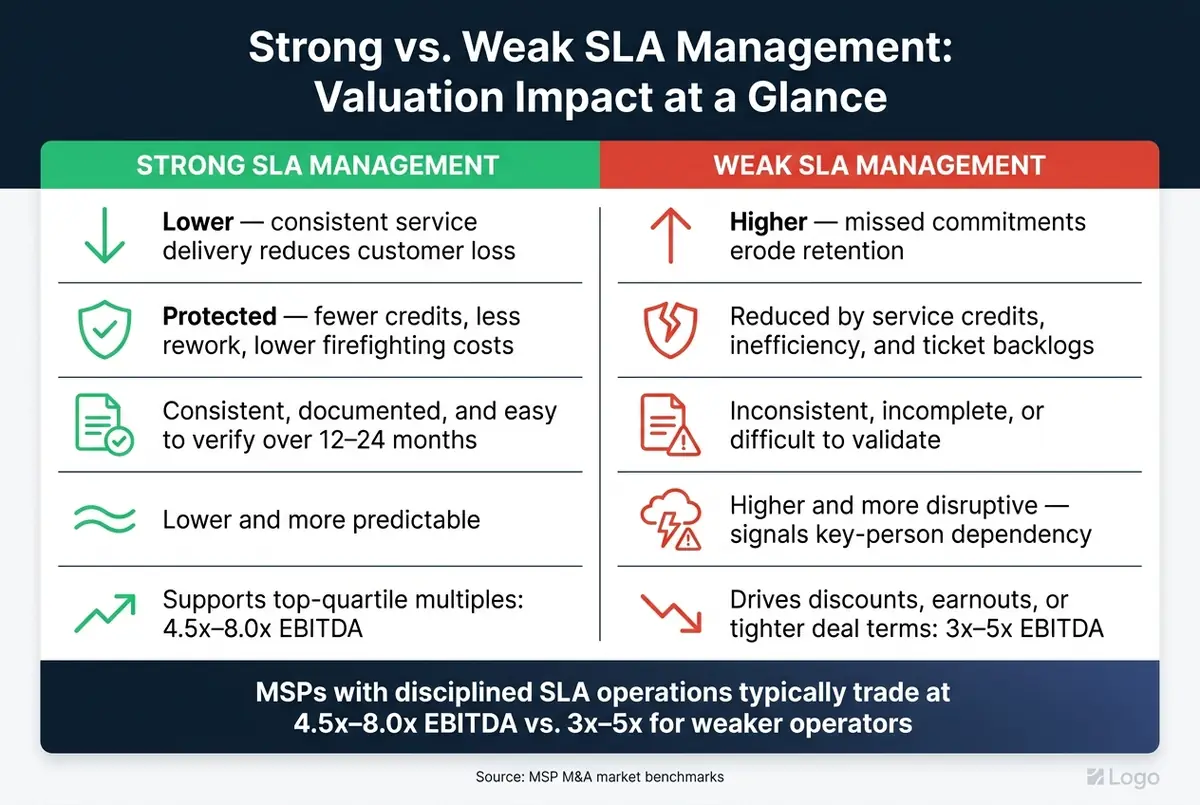
How stronger SLA execution supports higher value
Once a company tracks SLA metrics in a steady way, buyers start turning that data into pricing assumptions. Good SLA execution lowers retention risk, protects margin, and makes future cash flow easier to price.
When SLA compliance stays steady, churn risk tends to fall. Lower churn makes the recurring revenue base more stable, which gives buyers more confidence when they underwrite future cash flows. Strong SLA execution also helps protect margin. Fewer service credits, less rework, and lower escalation volume cut hidden servicing costs. That shows up in cleaner EBITDA and tighter account-level profitability, which buyers look for when they stress-test the numbers.
Consistent SLA data across 12 to 24 months signals repeatable operations instead of ad hoc management. When service delivery ties back to documented, auditable processes instead of personal relationships, buyers gain more confidence that accounts will stay in place after close.
What to review in SLA diligence
Buyers should review signed contracts, escalation logs, service credit records, exception-handling records, and NPS/CSAT trends, along with at least 12 to 24 months of compliance history.
They should also test whether reported performance lines up with contract terms and whether staffing and systems can support those commitments. If contract promises are out ahead of operating capacity, that’s a red flag. It often leads to valuation discounts or tougher deal terms.
Assignability and change-of-control language should get attention early. If customers have exit rights, the revenue base being valued can shrink.
That gap between reported performance and contractual reality is what drives repricing, holdbacks, or earnout pressure.
Strong vs. weak SLA management: a side-by-side comparison
The table below shows how SLA management quality turns into concrete diligence outcomes and valuation effects.
| Factor | Strong SLA Management | Weak SLA Management |
|---|---|---|
| Churn risk | Lower due to consistent service delivery | Higher due to missed commitments and weak retention |
| Margin impact | Better protected through fewer credits and less rework | Reduced by service credits, firefighting, and inefficiency |
| Compliance history | Consistent, documented, and easy to verify | Inconsistent, incomplete, or difficult to validate |
| Escalation frequency | Lower and more predictable | Higher and more disruptive |
| Likely valuation effect | Supports stronger valuation narrative and top-quartile multiples | Can justify discounts, tighter terms, or earnout pressure |
Strong SLA management supports top-quartile multiples. Weak SLA management pushes buyers toward discounts, tighter terms, or earnouts.
These differences are often what separate a clean exit from a discounted one.
Conclusion: SLA Discipline as a Value Driver
SLA management directly affects what a business is worth. When service delivery is steady, documented, and measurable, buyers face less uncertainty, and that tends to support stronger offers. When it’s messy or poorly tracked, that same uncertainty often shows up as a discount. For deal teams, the issue isn’t whether SLAs matter. It’s whether they’re documented well and enforced in day-to-day work.
Strong SLA tracking helps protect revenue, keep high-cost accounts in check, and show that the business runs on systems instead of leaning too much on the owner. That’s the gap that often matters most in a deal.
Key takeaways for buyers, sellers, and investors
What this looks like depends on where you sit in the process.
Sellers should treat SLA documentation as part of exit readiness, not something to clean up at the last minute. Audit contracts 12–24 months before a sale. Make sure they’re signed, assignable, and matched to how service is actually delivered.
Buyers should pressure-test SLA reliability during diligence. Looking at ticketing data, resolution times, and escalation patterns by customer cohort is one of the best ways to check whether recurring revenue is likely to hold up after close.
Investors should view steady SLA performance as evidence that the business can grow without adding headcount at the same rate. Companies with mature SLA systems - integrated PSA/RMM tools, automated reporting, and low ticket density - usually carry a lower support burden and cleaner reporting. That’s why disciplined SLA management can support a higher valuation.
FAQs
How do buyers verify SLA performance?
Buyers verify SLA performance during due diligence by looking for proof that the business runs with discipline and delivers services the way it says it does. A big part of that review comes from reports in PSA and RMM tools, which help them gauge ticketing discipline and day-to-day service consistency.
They also want to see standard documentation, clear operating rhythms, and proof that service delivery lines up with current contract terms. Consistent SLA reporting points to operational maturity and repeatable processes.
Which SLA metrics matter most for valuation?
Buyers look hard at SLA metrics during diligence because those numbers show whether service delivery is steady, repeatable, and built to scale.
The metrics that matter most are:
- ticket density
- response time trends
- resolution time trends
- overall service delivery discipline
Clear SLA reporting tells a simple story: the way you deliver service isn’t improvised. It’s standardized, consistent, and repeatable. That lowers buyer risk and can support higher valuation multiples.
How far in advance should a seller fix SLA issues?
Sellers should deal with SLA issues 12 to 24 months before a sale if they want the best price.
That window gives them time to fix weak spots before due diligence starts and show a steady record of performance. Buyers care more about trends than one-off snapshots. So if your SLA results look strong over time, it can build buyer confidence, support premium pricing, and help you defend your valuation story.
Sell with advisors who maximize your outcome
From valuation and positioning to closing the deal, we run a competitive process to get you the best terms.
About the author
Principal & CEO/CIO
Samson Jagoras has 15+ years across finance, real estate, and business acquisitions. He began his career as a Futures & Commodities broker and later served as Chief Strategy Officer of an INC 500 marketing and technology firm, helping scale revenue from $1M to over $100M. Today he buys, builds, and advises a portfolio of companies with a focus on M&A, capital allocation, and operational strategy.