5 Funding Models for Senior Mobility Partnerships with Healthcare
Five funding models for senior transportation partnerships with healthcare—Medicaid NEMT, Medicare Advantage, value-based care, hospital contracts, and blended grants—with trade-offs and why to avoid >40% payer reliance.
 Samson JagorasPrincipal & CEO/CIOMay 29, 2026

Get matched with the right lender for your business
Compare offers from our vetted network. Pre-qualify in minutes — no impact to your credit.
Transporting seniors to medical appointments is critical, but figuring out how to pay for these services sustainably is a challenge. Here are five funding models that senior mobility providers and healthcare organizations in the U.S. use to address this issue:
- Medicaid Non-Emergency Medical Transportation (NEMT) Contracts: Funded by federal and state Medicaid dollars, these contracts provide predictable revenue but require navigating complex regulations and reimbursement delays.
- Medicare Advantage and Commercial Health Plan Benefits: Private health plans offer flexibility in reimbursement rates, but managing payer diversity and cash flow gaps is essential.
- Value-Based Care and Shared Savings: Revenue is tied to healthcare outcomes, such as reduced hospital readmissions, blending steady base payments with performance-based bonuses.
- Hospital and Health System Direct Contracts: Payments come directly from hospital budgets, offering steady revenue but requiring careful management of contract terms and payer reliance.
- Blended Public Grants, Transit Funds, and Philanthropy: A mix of grants, local funds, and donations provides funding diversity but lacks the predictability of contract-based models.
Key Takeaway: Each model has trade-offs in terms of revenue stability, administrative effort, and growth potential. Diversifying funding sources and avoiding over-reliance on one payer (no more than 40% of revenue) is critical for long-term success.
Quick Comparison
| Model | Revenue Predictability | Administrative Complexity | Scalability | Key Risk |
|---|---|---|---|---|
| Medicaid NEMT Contracts | High | High | Moderate | Reimbursement delays (30–90 days) |
| Medicare Advantage/Health Plan Benefits | High | High | Moderate | Payer concentration risk |
| Value-Based Care/Shared Savings | Moderate | Moderate–High | High | Performance-based revenue |
| Hospital Direct Contracts | Moderate–High | Moderate | Moderate | Single payer reliance |
| Blended Grants/Philanthropy | Low | High | Low–Moderate | Unpredictable funding cycles |
This guide helps you weigh the pros and cons of each funding approach and choose the right fit for your organization's needs.
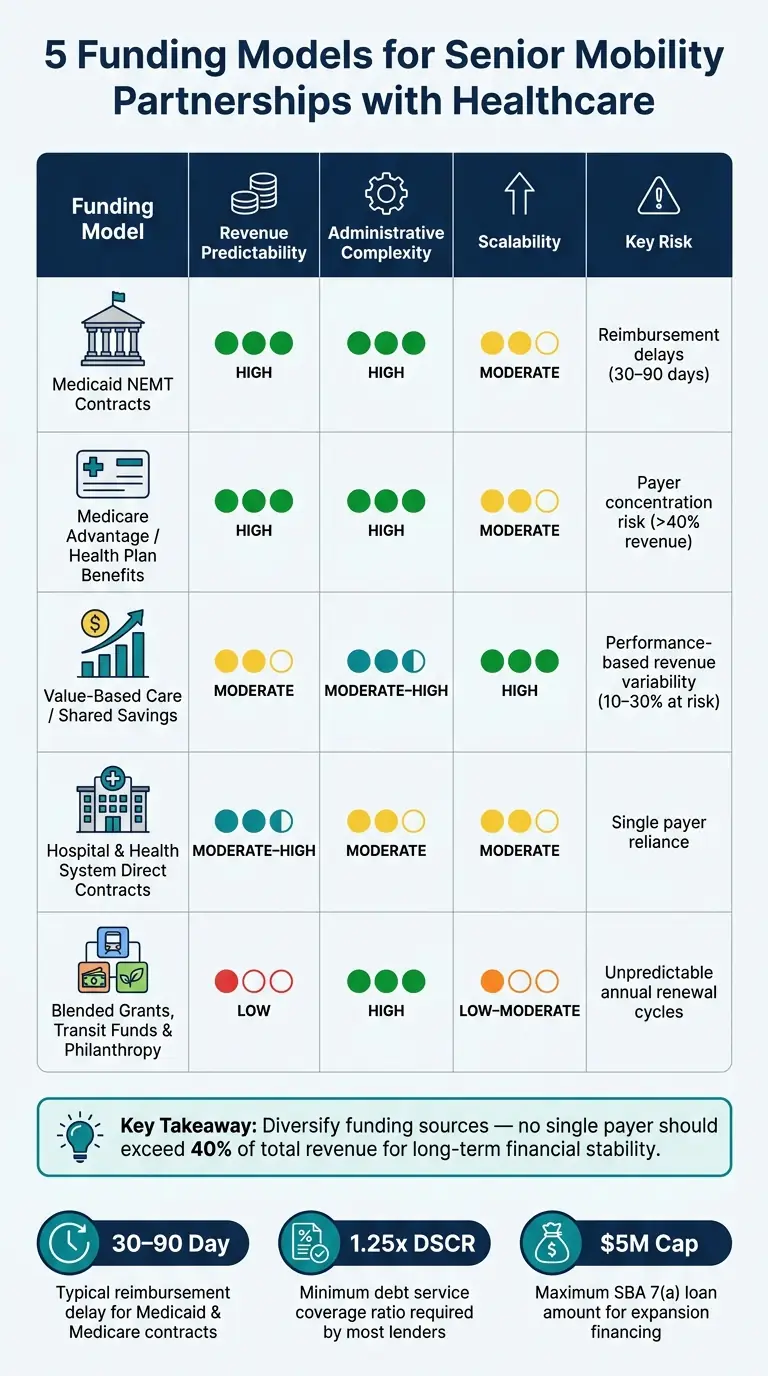
5 Senior Mobility Funding Models: Revenue, Complexity & Scalability Compared
1. Medicaid Non-Emergency Medical Transportation Contracts
Medicaid Non-Emergency Medical Transportation (NEMT) contracts form the backbone of government-supported senior transportation services. States are required to ensure Medicaid beneficiaries have access to non-emergency medical transportation, creating a significant opportunity for mobility providers to secure funding by working directly with state Medicaid agencies or their managed care partners.
Funding Source
Funding comes from a mix of federal and state Medicaid dollars, typically managed through a Managed Care Organization (MCO) or broker. Providers are reimbursed for completed trips, but the payment timeline can range from 30 to 90 days. This delay in reimbursement is a key factor providers must account for when managing their operations.
Revenue Predictability
After securing a contract and operating for at least two years, providers can enjoy a stable and predictable revenue stream. Reimbursement schedules remain consistent, offering a dependable foundation for financial planning. However, an overreliance on one Medicaid contract - especially if it accounts for more than 40% of total revenue - can raise concerns for lenders, as it signals potential risk.
"A practice that's been in operation 24+ months with stable insurance contracts has revenue visibility that most small businesses don't. Underwriters can model the revenue forward with confidence." - ClearValue Lending
Administrative Complexity
Managing Medicaid NEMT contracts involves a fair amount of administrative work. Providers need to handle billing by procedure codes, monitor the aging of insurance receivables, and adhere to both state and federal regulations to avoid disruptions in payment. Significant events, like a Change of Ownership (CHOW), can result in a 30–90 day billing gap while the new agreement is processed. To navigate this, providers often rely on a working capital line of credit tailored to their accounts receivable cycle.
Scalability
While growth is possible within this model, it tends to be slow and requires significant investment. Expanding into new areas often involves re-credentialing, negotiating fresh contracts, and managing additional reimbursement delays. Providers with a diverse payer mix - where no single contract exceeds 20–40% of revenue - are better positioned for smoother scaling and more favorable financing terms. Additionally, maintaining proper licensure and a strong compliance record can serve as soft credit indicators, helping providers secure better loan terms for expansion. This structured and predictable model supports steady growth within the senior mobility sector, though it requires careful planning and financial discipline.
2. Medicare Advantage and Commercial Health Plan Transportation Benefits
Medicare Advantage (MA) plans now allow coverage for non-medical transportation as a supplemental benefit. This change has created a growing opportunity for senior mobility providers. Unlike Medicaid NEMT contracts, which are mandated by the government, these partnerships are driven by private health plans competing to offer better benefits to attract enrollees. This competitive environment can help reduce barriers to care, potentially cutting down on missed appointments and hospital readmissions.
Funding Source
The funding comes directly from private Medicare Advantage plans and commercial health insurers, which contract with transportation providers. Payments are made per completed trip using specific procedure codes, with reimbursement rates negotiated directly in the contract rather than being tied to a government fee schedule. This gives providers more room to negotiate terms, helping establish steady revenue streams and supporting predictable cash flow.
Revenue Predictability
Providers with at least two years of operational history tend to have reliable revenue, which makes it easier for underwriters to model future performance. However, over-reliance on a single payer is a significant risk. If one MA plan accounts for more than 40% of a provider's revenue, lenders often see this as a structural issue. To mitigate this, providers can diversify their contracts across multiple Medicare Advantage and commercial plans, creating a more stable revenue base.
Administrative Complexity
While revenue from these contracts is generally predictable, managing the operational side can be challenging. Reimbursement delays of 30–90 days often strain cash flow, requiring providers to secure working capital lines of credit to bridge the gap. Bank loans typically carry an interest rate of 8–14% APR, while non-bank loans range from 12–22% APR. Additionally, unlike Medicaid's fixed fee schedules, MA and commercial contracts require providers to closely monitor terms, credentialing, and insurance receivables aging. Lenders prioritize these receivables as a key cash-flow indicator over bank deposits.
Scalability
This model is well-suited for growth. Lenders view revenue from these contracts favorably, and providers with a strong compliance record and diversified payer mix can qualify for SBA 7(a) loan terms vs. other financing options. These loans often have interest rates capped at Prime + 2.25–3.0% for amounts over $350,000. Most lenders require a Debt Service Coverage Ratio (DSCR) of 1.25x, which established providers with stable contracts can typically meet. This access to financing provides a significant advantage over relying on public grants or one-off agreements, allowing providers to expand into new markets and increase their capacity effectively.
3. Value-Based Care and Shared Savings Arrangements
This approach involves providers collaborating with Accountable Care Organizations (ACOs) or integrated health systems to generate revenue based on measurable outcomes, such as fewer hospital readmissions.
Funding Source
Revenue in this model comes from the healthcare organization's shared savings pool, which is funded through Medicare or commercial insurance agreements. Unlike fee-for-service income, this revenue stream is tied to insurance reimbursement schedules, making it more predictable. However, a portion of the payout - usually 10–30% - is performance-based. Providers only receive this portion if they meet specific goals, like reducing readmission rates or achieving EBITDA benchmarks.
Revenue Predictability
While base revenue is steady, the performance-based bonus introduces some uncertainty. Providers should plan their finances cautiously, treating the performance-linked portion as a potential bonus rather than guaranteed income. A key risk arises when one payer accounts for more than 40% of total revenue, which lenders often view as a concentration issue. To mitigate this, partnering with multiple ACOs or health systems is an effective strategy.
Unlike Medicaid or Medicare Advantage contracts, value-based care ties part of the revenue directly to patient outcomes. This alignment of incentives sets it apart from fee-for-service models, offering a different pathway for scaling operations.
Administrative Complexity
Shared savings arrangements demand detailed documentation, including procedure-level reporting, payer-mix analyses, and strict compliance oversight. Transitioning to or establishing a Medicare-certified agreement typically takes 90–150 days.
"The right financing structure isn't the cheapest - it's the one that aligns capital cost with target cash-flow predictability and integration timing." - Christoph Totter, CT Acquisitions
Specialized healthcare advisors play a critical role in navigating these complexities. ClearValue Lending emphasizes the importance of working with experts, noting:
"A generalist broker who hasn't funded healthcare deals will leave money and approvals on the table." - ClearValue Lending
This robust documentation process is essential for creating a scalable foundation.
Scalability
Once a Medicare-certified platform is in place, scaling becomes more straightforward through "bolt-on" acquisitions - integrating smaller agencies to avoid the delays of initial certification. Financing options for this growth include SBA 7(a) loans (capped at $5 million) and senior debt priced at SOFR + 450–650 basis points. However, total leverage has tightened to 4–6x EBITDA, a decrease from the 6–7x levels seen in 2021.
4. Hospital and Health System Direct Contracts
Direct contracts with hospitals and health systems represent a model where revenue comes directly from operational budgets, connecting transportation services to patient care outcomes. In this setup, a senior mobility provider works directly with a hospital or health system under a formal agreement. Payments are tied to specific patient care objectives, like minimizing readmissions, improving discharge processes, or ensuring follow-up visits after acute care.
Funding Source
The funding for this model comes straight from the hospital or health system's operating budget, bypassing government programs or insurance intermediaries. This simplifies the funding process but places significant value on the contract itself. As DealFlow OS explains:
"Lenders experienced in healthcare acquisitions understand that Medicare provider agreement continuity - and the associated census and revenue - is the core collateral supporting loan repayment." - DealFlow OS
In this case, the primary assets are intangible - such as contracts, referral networks, and patient census - rather than physical assets like equipment or property. Because of this, lenders assess these deals differently from traditional small business loans. This direct funding approach provides a steady revenue stream, as outlined below.
Revenue Predictability
Direct contracts offer consistent revenue predictability, especially after 24 months or more of stability. Unlike retail sales, reimbursement schedules in this model tend to remain steady, providing a dependable baseline for cash flow projections. However, administrative changes, like contract renegotiations or Medicare CHOW, can lead to temporary billing gaps of 30–90 days. To manage these gaps, budgeting for 2–3 months of working capital upfront is a common practice.
Although the revenue stream is dependable, the administrative demands of this model require careful management.
Administrative Complexity
Operating under direct contracts means meeting strict reporting requirements. Health systems often request detailed production reports broken down by CPT code and payer mix, in addition to accrual-based financial statements and normalized EBITDA reports. Providers must also stay current with credentialing requirements and avoid over-reliance on a single payer for more than 40% of revenue. To navigate cash flow gaps, a line of credit aligned with the accounts receivable cycle is often necessary, with non-bank credit options typically carrying interest rates of 12%–22% APR.
Scalability
Direct contracts offer a stable foundation for growth when paired with strong cash flow and effective management. Financing for expansion or acquisitions under existing contracts is often achieved through SBA 7(a) loans, which have a $5 million cap and terms of up to 10 years. Lenders typically require a minimum 1.25x Debt Service Coverage Ratio (DSCR) to approve loans based on these cash flows. Additionally, leadership stability is a critical factor for lenders, as it is closely tied to repayment risk.
5. Blended Public Grants, Local Transit Funds, and Philanthropy
Blended funding brings together a mix of financial sources, including federal and state grants, local transit authority funds, and charitable contributions. Unlike models with fixed, predictable contracts, this approach requires constant renewal and active management. It's often used by nonprofits and community-based mobility services that either don't qualify for or choose to avoid traditional commercial contracts. While it provides financial diversity, it comes with a trade-off: less predictability compared to contract-based models.
Funding Source
This model relies on a layered funding structure, often referred to as a capital stack, which combines various funding types like senior debt, subordinated debt, mezzanine capital, and equity or philanthropic contributions. Each layer has its own cost, repayment priority, and administrative requirements. Here's how these layers typically break down:
| Funding Layer | Priority Position | Cost Range | Administrative Complexity |
|---|---|---|---|
| Senior Debt (SBA/Bank) | 1st | 8% – 10% | High (government compliance) |
| Subordinated Notes | 2nd | 5% – 8% | Moderate (standby rules) |
| Mezzanine Capital | 3rd | 12% – 20% | High (intercreditor agreements) |
| Equity/Philanthropy | Residual | Highest (dilution risk) | Variable (reporting-heavy) |
SBA 7(a) loans are a common cornerstone in these funding stacks, with rates typically around Prime + 2.25–3.0% (about 9.25–9.75% as of early 2026) and terms extending up to 25 years. In fiscal year 2025, the SBA authorized over $31 billion in 7(a) loans, many of which supported multi-layered funding structures like this.
Revenue Predictability
One of the biggest challenges with blended funding is its lack of revenue predictability. Grants are typically renewed annually or every two years, philanthropic contributions can fluctuate based on donor priorities, and local transit funding depends on municipal budgets. Unlike contract-based systems, such as Medicare Advantage or hospital contracts, where payments are more stable, this model requires constant reapplication and relationship management to maintain funding levels. This makes long-term planning more uncertain and adds operational complexity.
Administrative Complexity
Managing multiple funding sources means dealing with varied timelines and requirements. For instance, private credit can close in as few as 21 days, while SBA-backed loans may take 45 to 90 days from application to funding. Additionally, subordinated funders often require a full standby period of up to 24 months, during which no principal or interest payments are made.
Reporting is another demanding aspect. Funders typically expect detailed production data segmented by provider, procedure code, and payer mix, rather than high-level revenue summaries. Delays in reimbursement are common, which often necessitates a secondary line of credit - usually priced between 8% and 14% for established providers - to maintain cash flow.
Scalability
Scaling under this model is possible but tends to be slower and more uncertain compared to direct contracting or value-based arrangements. Growth relies heavily on renewing grants and sustaining philanthropic contributions, which can be unpredictable. However, providers with a stable track record of at least 24 months can improve their position when seeking expansion capital from lenders or institutional funders. While blended funding offers access to diverse revenue streams, its reliance on fluctuating sources requires careful financial oversight and planning.
Pros and Cons of Each Funding Model
Every funding model has its trade-offs. Choosing the right one depends on factors like your organization's size, risk tolerance, and how much administrative overhead you're prepared to handle.
| Funding Model | Revenue Predictability | Administrative Complexity | Scalability | Regulatory Burden |
|---|---|---|---|---|
| Medicaid NEMT Contracts | High | High (30–90 day billing gaps) | Moderate | High (CMS oversight) |
| Medicare Advantage / Health Plan Benefits | High | High (payer-mix management) | Moderate | High (CHOW process risk) |
| Value-Based Care / Shared Savings | Moderate (performance-dependent) | Moderate–High | High | Moderate |
| Hospital & Health System Direct Contracts | Moderate–High | Moderate | Moderate | Moderate |
| Blended Grants, Transit Funds & Philanthropy | Low (annual renewal cycles) | High (multi-funder reporting) | Low–Moderate | Low–Moderate |
Let's break these down further.
Medicaid NEMT (Non-Emergency Medical Transportation) and Medicare Advantage plans provide high revenue predictability, but they come with substantial challenges. Medicaid, for example, often involves billing gaps of 30–90 days, meaning cash flow can be tight without strong liquidity management. Medicare Advantage plans require navigating payer-mix complexities, and CHOW (Change of Ownership) processes can introduce billing delays.
Value-based care models, on the other hand, tie revenue to performance metrics. While this approach rewards efficiency and outcomes, it introduces variability in revenue. Disputes over metrics - common in earn-out structures (usually 10–30% of deal value) - can complicate financial planning.
Hospital and health system direct contracts strike a middle ground. They are more stable than blended funding models and face fewer federal regulatory hurdles compared to Medicaid or Medicare. However, these contracts carry their own risks, such as over-reliance on a single health system, which could account for 20–40% of revenue.
"Healthcare practices - medical, dental, veterinary, optometry, physical therapy, mental health - get some of the most favorable underwriting treatment available to small businesses in 2026." - ClearValue Lending
Blended funding, which includes grants, transit funds, and philanthropy, offers flexibility but lacks reliability for long-term planning. Fluctuations in grant cycles, donor priorities, or municipal budgets can make it difficult to build a stable financial base.
Understanding these dynamics helps organizations choose funding models that align with their operational needs and strategic goals.
Conclusion
There's no one-size-fits-all funding model for senior mobility providers. The best option depends on factors like your organization's size, cash flow stability, regulatory capabilities, and long-term growth plans.
Each funding model comes with trade-offs. Medicaid NEMT and Medicare Advantage contracts provide steady revenue but require sufficient working capital to bridge 30–90 day reimbursement delays and demand strict compliance. Value-based care arrangements reward efficiency but introduce revenue variability, making disciplined financial planning essential. Hospital direct contracts strike a balance with fewer regulatory hurdles, though relying too heavily on one health system can be risky. Grants and philanthropy, while helpful, work best as supplementary funding rather than a primary source.
Start by evaluating your payer mix. Avoid over-reliance on any single payer - no one source should account for more than 40% of revenue. Diversifying across multiple funding streams strengthens financial stability and makes your organization more appealing to lenders and health system partners.
For those planning growth or acquisitions, your capital structure is just as important as your funding model. Align your financing approach with cash flow predictability and timing needs. As Christoph Totter, Founder of CT Acquisitions, explains:
"The right financing structure isn't the cheapest - it's the one that aligns capital cost with target cash-flow predictability and integration timing."
If you're navigating acquisitions or expanding partnerships, platforms like Clearly Acquired can help craft a balanced capital stack. By combining SBA financing, seller notes, and equity, they can help you close deals while preserving the working capital needed for smooth operations from day one. Use these strategies to diversify funding and build a resilient financial foundation.
FAQs
Which funding model is best for my senior mobility business stage?
For business acquisitions under $5 million, the SBA 7(a) loan is a popular choice. It offers a 10-year term, covers goodwill financing, and requires just a 10% equity injection. If the seller agrees to a note on full standby, the buyer's upfront cash requirement can drop to as low as 5%.
For acquisitions exceeding $5 million or when a quicker closing is needed, conventional financing or a hybrid approach - combining seller financing with private debt - might be more suitable options.
How do providers manage 30–90 day reimbursement delays without cash flow issues?
Providers tackle reimbursement delays of 30 to 90 days by incorporating dedicated working capital reserves into their acquisition funding plans. Flexible financing options, like lines of credit and revenue-based financing, are key to covering liquidity gaps during this period. Clearly Acquired supports operators with specialized debt brokerage services, helping them secure working capital solutions. This ensures businesses remain financially stable through reimbursement cycles while still focusing on growth.
What metrics should we track to succeed in value-based or shared-savings deals?
To thrive in value-based or shared-savings agreements within senior mobility partnerships, it's crucial to keep tabs on performance data. This includes breaking down information by provider, procedure code, and insurance payer to measure efficiency. Equally important is monitoring patient retention indicators, such as recall rates and the number of active patients, to gauge engagement levels. On the financial side, tracking cash flow and debt service coverage ratios is essential to maintain financial health. Clearly Acquired offers tools and advisory services designed to help fine-tune these metrics and improve results.
Find the right lender for your business
Whether it's working capital, an SBA loan, or acquisition financing — we'll match you with the right capital partner.
About the author
Principal & CEO/CIO
Samson Jagoras has 15+ years across finance, real estate, and business acquisitions. He began his career as a Futures & Commodities broker and later served as Chief Strategy Officer of an INC 500 marketing and technology firm, helping scale revenue from $1M to over $100M. Today he buys, builds, and advises a portfolio of companies with a focus on M&A, capital allocation, and operational strategy.