Seller Note Repayment Schedule for Acquisitions
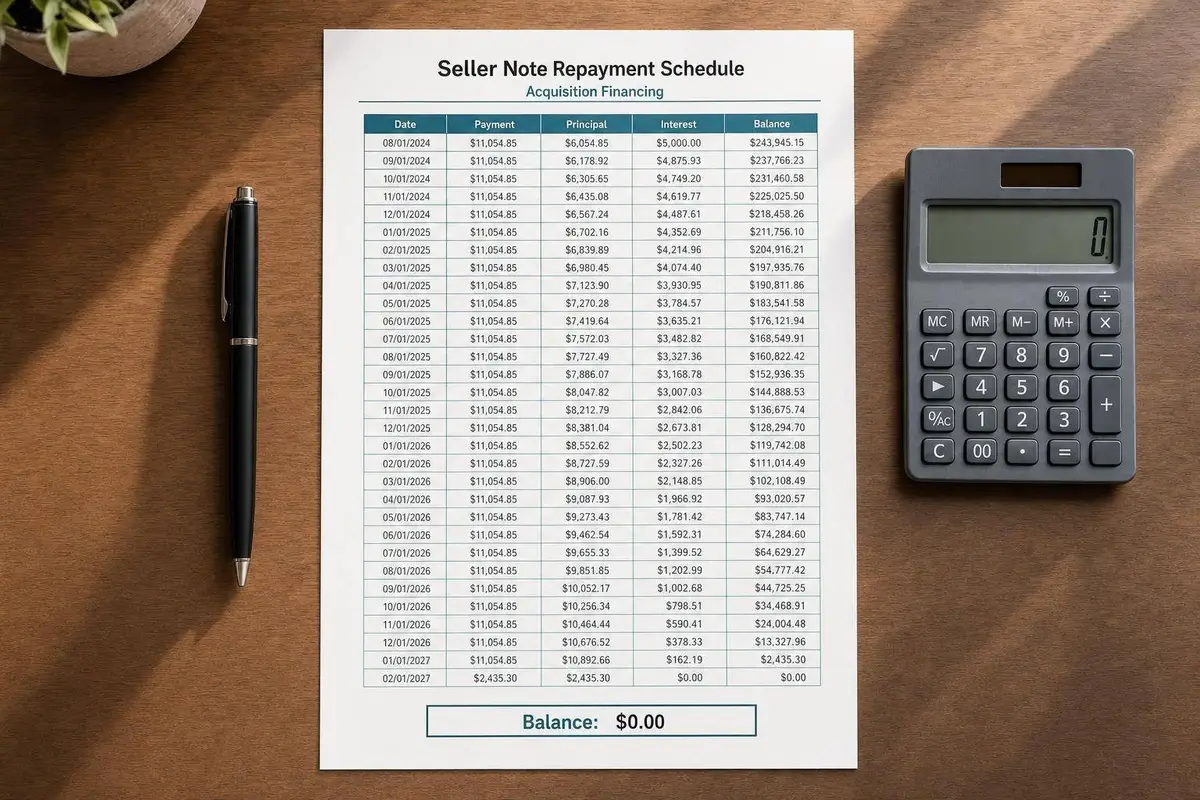
Build a seller note repayment schedule that matches the signed note line-by-line with dates, payments, interest, principal, and a $0.00 final balance.
 Samson JagorasPrincipal & CEO/CIOJuly 16, 2026
Get matched with the right lender for your business
Compare offers from our vetted network. Pre-qualify in minutes — no impact to your credit.
If the repayment schedule does not match the note, closing can get messy. I’d keep it simple: list every payment from the first due date to maturity, show interest, principal, and balance on each line, and make sure the last line ends on the maturity date with $0.00 due.
Here’s the short version:
- I need the schedule to match the signed note line for line
- I should use MM/DD/YYYY dates, such as 07/01/2026
- I should show payment amount, interest, principal, and ending balance
- For a fully amortizing note, the payment stays the same for each month except for the last line if rounding changes it
- For interest-only, standby, balloon, or PIK terms, the balance path changes and the maturity line needs extra care
- The final schedule should be used at closing and later for monthly tracking and seller reporting
A standard monthly note splits each payment into two parts: interest first, principal second. Over time, the interest share usually drops and the principal share usually grows. In many deals, even a 1-cent rounding gap can force a final payment change, so I’d check the last row before the closing set is done.
My takeaway: the schedule is not just a math sheet. It is the payment record everyone follows after closing.
Creating Your First Professional Amortization Schedule (Step-by-Step)

Define the Seller Note Terms Before Building the Schedule
Bad inputs lead to a schedule that doesn’t line up with the closing documents.
Set Principal, Rate, Term, Payment Frequency, and Maturity Date
Start with the core terms: principal, annual interest rate, amortization period, monthly payment frequency, and maturity date.
For balloon notes, keep the amortization period separate from the maturity date. The amortization period controls the regular payment amount. The maturity date is the point when the remaining balance comes due.
That split matters more than it may seem. It shapes how the table is built from the start, so treat it like a hard setup rule, not something to patch in later.
Once those terms are locked in, build the amortization table row by row.
Build the Monthly Amortization Table Step by Step
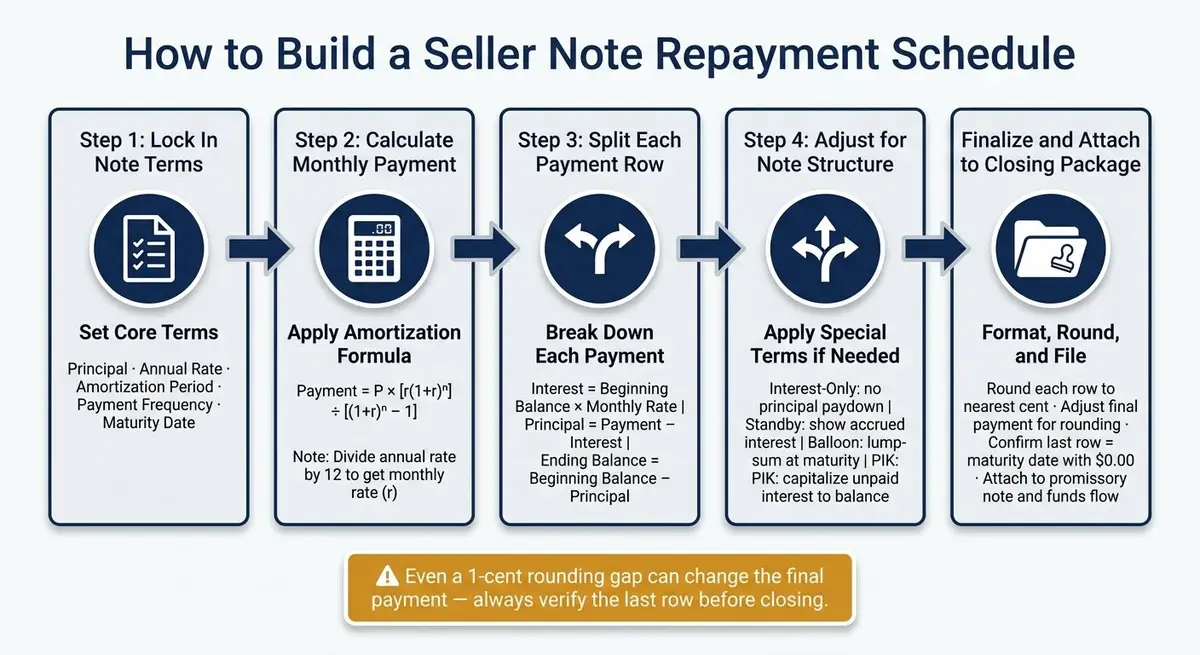
Once the note terms are set, build the schedule one row at a time. Each row starts with the prior row’s ending balance. From there, you calculate the payment, split it into interest and principal, and move to the next period using the new balance.
Calculate the Monthly Payment and First Payment Date
Start by dividing the annual rate by 12 to get the monthly rate. Then count the total number of payment periods and begin the table on the first payment date listed in the note.
For a fully amortizing note, the fixed monthly payment uses the amortizing payment formula:
Payment = P × [r(1+r)ⁿ] ÷ [(1+r)ⁿ − 1]
Here, P is the principal, r is the monthly rate, and n is the total number of payments.
Split Each Payment Between Interest and Principal
Each row follows the same three-part process:
- Interest = Beginning Balance × Monthly Rate
- Principal = Total Payment − Interest
- Ending Balance = Beginning Balance − Principal
Then carry that ending balance into the next row as the new beginning balance.
Format the Schedule for Closing
Keep the same layout for each payment date so the table is easy to read in closing documents. This is the working schedule used in the closing package:
| # | Payment Date | Beginning Balance | Payment | Interest | Principal | Ending Balance |
|---|---|---|---|---|---|---|
| 1 | First payment date | Original principal | Fixed payment | Beginning balance × monthly rate | Payment − interest | Beginning balance − principal |
| 2 | Next payment date | Prior ending balance | Fixed payment | Beginning balance × monthly rate | Payment − interest | Beginning balance − principal |
| … | … | … | … | … | … | … |
Round each row to the nearest cent. Then adjust the final payment for any rounding difference. The last row should match the note’s maturity date and leave a $0.00 balance.
Adjust the Schedule for Common Acquisition Note Structures
When a note doesn’t follow standard monthly amortization, the schedule needs a few changes. The key is simple: make the table reflect when payments happen, whether interest is paid, deferred, or added to the balance, and what’s due at maturity.
Interest-Only and Standby Periods
During an interest-only period, each row should show an interest payment with no principal paydown. That means the ending balance stays flat.
A standby period works differently. No payments are due, so the schedule should make clear whether interest still accrues. If it does, show that accrued interest separately or roll it into the ending balance, based on the note terms.
Different nonstandard terms affect the schedule in different ways.
Balloon Payments and PIK Interest
A balloon note should show the remaining lump-sum payoff at maturity. Most of the schedule may look normal, but the maturity row needs to spell out the final amount due.
For PIK interest, unpaid interest gets added to the balance each period. So instead of staying flat or stepping down, the balance goes up over time as that unpaid interest is capitalized.
Both structures mainly affect the maturity row and the path of the ending balance.
Compare Repayment Structures Before Finalizing Terms
Before locking terms, compare each structure side by side:
- payment timing
- accrued interest
- maturity balance
Then carry those same assumptions into the closing schedule and match the note terms exactly. Use that same setup in the final closing schedule and in post-close tracking.
Use the Schedule in Closing Documents and Post-Close Reporting
Once the schedule is built, add it to the closing set and use it as the post-close control document.
Attach the Schedule to the Promissory Note and Funds Flow
Include the repayment schedule in the closing package with the signed promissory note and funds flow so the payment terms, dates, and maturity all line up. Store one final version in the closing package so everyone is working from the same document. That same version should also move into post-close tracking.
Track the Note After Closing
After closing, keep the schedule in the post-close file as the control document for payment dates, balances, and maturity. Use that same schedule for monthly payment tracking and seller reporting.
Conclusion: Build a Schedule That Matches the Note and the Deal
Match the schedule to the signed note, keep it in the closing package, and use it for post-close payment tracking. Explore more on seller financing and our full library of acquisition financing guides.
FAQs
What if the schedule does not match the signed note?
If the schedule doesn’t match the signed note, the signed note controls. Update the repayment schedule so the payment amounts, the interest and principal breakdown, and the maturity date line up with the executed terms.
Before closing, confirm that both documents match to avoid confusion.
How do I handle a balloon payment at maturity?
At maturity, show the balloon payment as the final lump-sum amount due in the repayment schedule.
Keep it clearly separate from the regular payments, and include the maturity date so it’s easy to see when that last balance must be paid.
Why does the final payment sometimes change by a few cents?
The final payment can be off by a few cents because of rounding in the repayment schedule. Those small gaps can add up over time as each payment is divided between interest and principal.
Because of that, the last payment is often adjusted a bit so the note is paid in full by the maturity date.
Find the right lender for your business
Whether it's working capital, an SBA loan, or acquisition financing — we'll match you with the right capital partner.
About the author
Principal & CEO/CIO
Samson Jagoras has 15+ years across finance, real estate, and business acquisitions. He began his career as a Futures & Commodities broker and later served as Chief Strategy Officer of an INC 500 marketing and technology firm, helping scale revenue from $1M to over $100M. Today he buys, builds, and advises a portfolio of companies with a focus on M&A, capital allocation, and operational strategy.