SBA 7(a) Seller Notes: Standby Rules
When does a seller note count toward SBA 7(a) equity? Full 24-month standby, subordination, and aligned docs decide closing cash needs.
 Samson JagorasPrincipal & CEO/CIOJuly 17, 2026
Get matched with the right lender for your business
Compare offers from our vetted network. Pre-qualify in minutes — no impact to your credit.
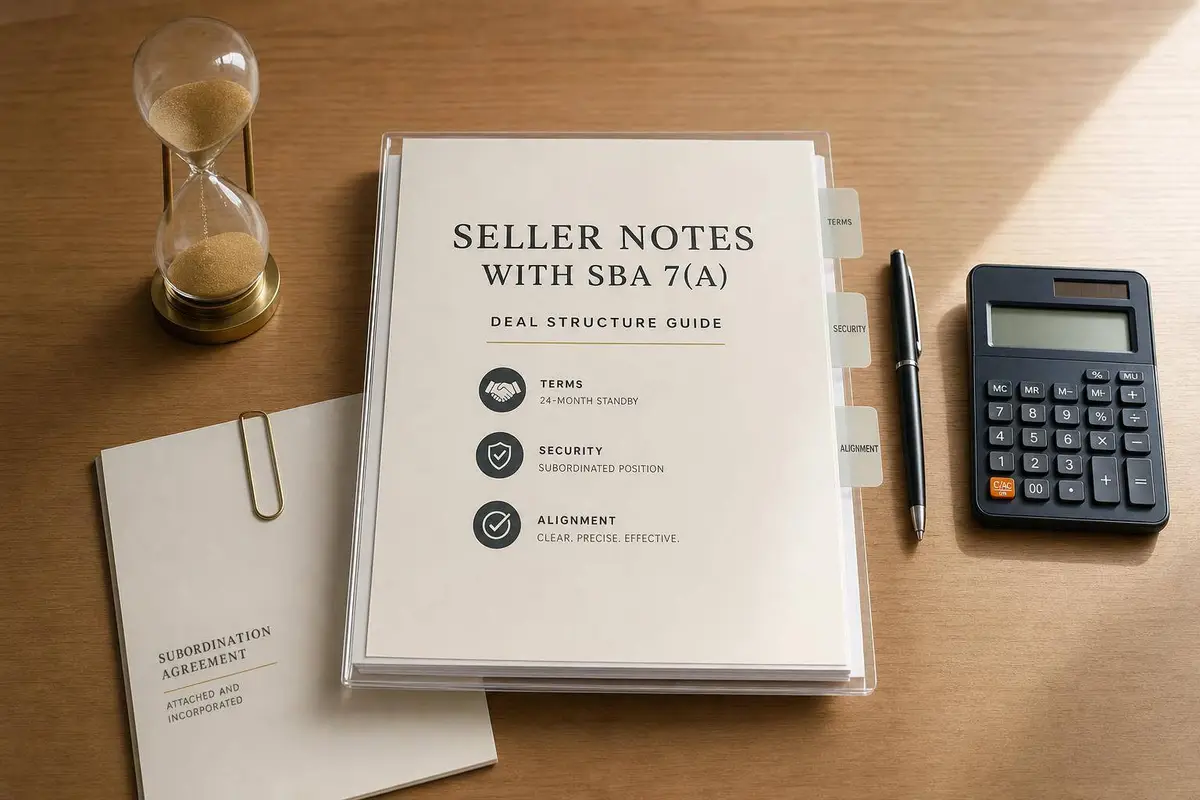
If you want a seller note to help with an SBA 7(a) down payment, it usually must be on full standby for 24 months. That means no principal and no interest payments during that time, and the buyer still needs to put in at least 2.5% of total project cost in cash.
Here’s the short version:
- A seller note is not automatic equity.
- Full standby is what may let the note count for up to 5% of total project cost.
- If the note is not on full standby, the lender will usually treat it as junior debt.
- The lender will also check subordination, lien position, payment timing, and post-close cash flow.
- If the note, standby agreement, and subordination terms do not match, the deal can stall.
In plain terms, I’d look at this article as a guide to one question: Does the seller note lower cash needed at closing, or does it just add another payment later? That answer depends on standby terms, document wording, and whether the business can cover the full debt stack after closing.
| Topic | What matters most |
|---|---|
| Equity injection | Buyer cash of at least 2.5% plus seller note on full standby |
| Seller note credit | Up to 5% of total project cost if lender accepts the setup |
| Standby period | Usually first 24 months |
| During standby | No payments due |
| If standby fails | Note usually treated as subordinated debt, not equity support |
| Lender review | DSCR, lien priority, amortization, repayment start date |
Bottom line: a seller note works best in an SBA 7(a) deal when it is fully subordinated, fully on standby for the required period, and written the same way across every loan document.

SBA 7(a) Seller Note: Full Standby vs. Junior Debt Treatment
Seller Notes with SBA Loans Explained — The 2025 Rules You Can’t Ignore!

SBA Standby Rules and Required Documentation
Standby decides whether a seller note counts toward the equity injection. In plain English: during the standby period, no payments are due. If that standard is met, the note may help satisfy the injection. If not, it usually acts more like junior debt.
When a Seller Note Can Count Toward the Equity Injection
A seller note can count for up to 5% of the total project cost, but there’s a catch: the lender has to accept the standby setup and the subordination terms. For the note to qualify, it must be on full standby for the required period, which is usually the first 24 months of the SBA loan.
That means exactly what it sounds like: no principal and no interest payments during that period. If payments start too early, the note may no longer count toward the equity injection.
Standby Agreements, Subordination, and Note Language
Lenders want the wording to line up across all the documents. If the note says one thing, the standby agreement says another, and the subordination agreement says something else, that can knock out equity credit.
The promissory note, standby agreement, and subordination language need to match on:
- when payments are due
- lien priority
If those documents are loose or inconsistent, the seller note may stop counting toward the equity injection.
These papers also shape how the note is treated in the deal and what it does to cash flow. Once standby and subordination are in place, the next step is to look at how the note changes the equity injection and monthly debt service. You can estimate these costs using an SBA loan qualifications guide.
How Seller Notes Affect Equity Injection and Cash Flow
Once the standby terms are locked in, the next issue is simple: how much cash the buyer needs at closing. Lenders look at seller notes in two ways. They check whether the note can count toward the equity injection, and they look at whether the note adds any repayment pressure after closing.
Cash Equity vs. Full-Standby Seller Note
A seller note counts toward the equity injection only if it is on full standby. If it meets that standard, the buyer can use it to reduce the amount of out-of-pocket cash needed at closing.
That can make a big difference. The clearest upside is keeping more cash on hand for working capital instead of tying it all up in the deal. But there’s a tradeoff to watch: if the seller note includes payments, it still adds to monthly debt service.
When the Note Does Not Qualify for Standby Treatment
If the note does not meet full-standby rules, it cannot count toward the required equity injection. In that case, the lender treats it as junior debt, not equity support.
So what happens? The buyer has to cover that shortfall with other cash. That means less room at closing and less flexibility in how cash gets used.
Key Seller Note Terms Lenders Review
Once standby and equity treatment are set, lenders move to the note’s actual repayment terms. This is where the deal gets more concrete.
They’re checking standby treatment, payment timing, lien position, and post-close cash flow. The interest rate matters, but payment timing and amortization usually matter more. In plain English, lenders want to know:
- Does interest accrue during standby?
- When do principal-and-interest payments start?
- Can the business handle the full debt stack once the note turns on?
Those are the points that often drive approval, pushback, or a rewrite. The lender wants the payment schedule to line up with projected post-close cash flow. That same review also covers who is secured, who is subordinated, and how much payment pressure the seller note adds after closing.
Security, Lien Position, and Transition Support
Lenders verify that the seller note’s lien position matches the subordination agreement and does not conflict with the SBA lender’s first priority. If those pieces don’t line up, the issue tends to surface fast.
A note that starts too high or amortizes too fast can put pressure on DSCR after closing. That’s a big concern because the business still has to operate, cover debt payments, and get through the ownership transition without running short on cash. At the core, lenders are looking at three things: lien position, payment burden, and whether the seller note makes it easier or harder for the buyer to close and run the business.
How Buyers Can Test Terms Before Lender Submission
Stress-test the structure before sending anything to the lender. Make sure the note language, subordination agreement, and repayment schedule all say the same thing. If one document says payments start right away and another says the note is on standby, that mismatch can trigger delays and last-minute deal changes.
Catching those issues early helps avoid a late-stage renegotiation. Once the terms line up, the note can fit into a standard, hybrid, or subordinated structure.
Common SBA 7(a) Deal Structures Using Seller Notes
A seller note can count toward the equity injection only when it’s on full standby. That’s what keeps the deal SBA-compliant and cuts the buyer’s cash need at closing. The setup lenders see most often is the standard standby note.
Standard Standby Structure
The standard standby structure is the baseline lenders run into again and again. It combines buyer cash with a seller note placed on full standby. The result: the buyer brings less cash to closing, while the capital stack still fits SBA 7(a) rules.
Clearly Acquired's financing team provides seller note structuring for SBA deals as part of its acquisition financing brokerage.
That matters for a simple reason. It lowers the upfront equity burden without adding payment pressure right after closing, since the seller note stays on standby during that period.
Conclusion: What Makes a Seller Note SBA-Friendly
A seller note is SBA-friendly when it meets two deal-critical tests.
- It stays on full standby during the required SBA standby period, which is usually the first 24 months.
- It is subordinated to the SBA-guaranteed loan under a signed subordination agreement.
That’s what lenders are looking for when they review a seller note in an SBA 7(a) acquisition.
FAQs
Can interest accrue during standby?
For SBA 7(a) loans, a seller note may help meet part of the equity injection only when the note is on full standby. That means the buyer makes no principal or interest payments during the standby period. Interest may accrue during standby if the note allows it, but the borrower still can’t make payments until the standby period ends.
What happens after the 24-month standby period ends?
After the 24-month standby period ends, the seller note comes off standby, and repayment can start based on the agreed note terms. At that point, lenders may review the payment setup after standby to make sure the business can handle the debt.
How do lenders test whether the business can handle the full debt stack?
Lenders look at one core issue: can the business handle every debt payment in the full deal structure?
That means they review the company’s cash flow, the terms of the seller note, any standby period, and how the equity injection changes the risk level of the deal. They also assess whether the full structure makes sense on paper and can hold up after closing without putting too much strain on the business.
Find the right lender for your business
Whether it's working capital, an SBA loan, or acquisition financing — we'll match you with the right capital partner.
About the author
Principal & CEO/CIO
Samson Jagoras has 15+ years across finance, real estate, and business acquisitions. He began his career as a Futures & Commodities broker and later served as Chief Strategy Officer of an INC 500 marketing and technology firm, helping scale revenue from $1M to over $100M. Today he buys, builds, and advises a portfolio of companies with a focus on M&A, capital allocation, and operational strategy.