SBA 7(a) Independent Business Valuation Requirements
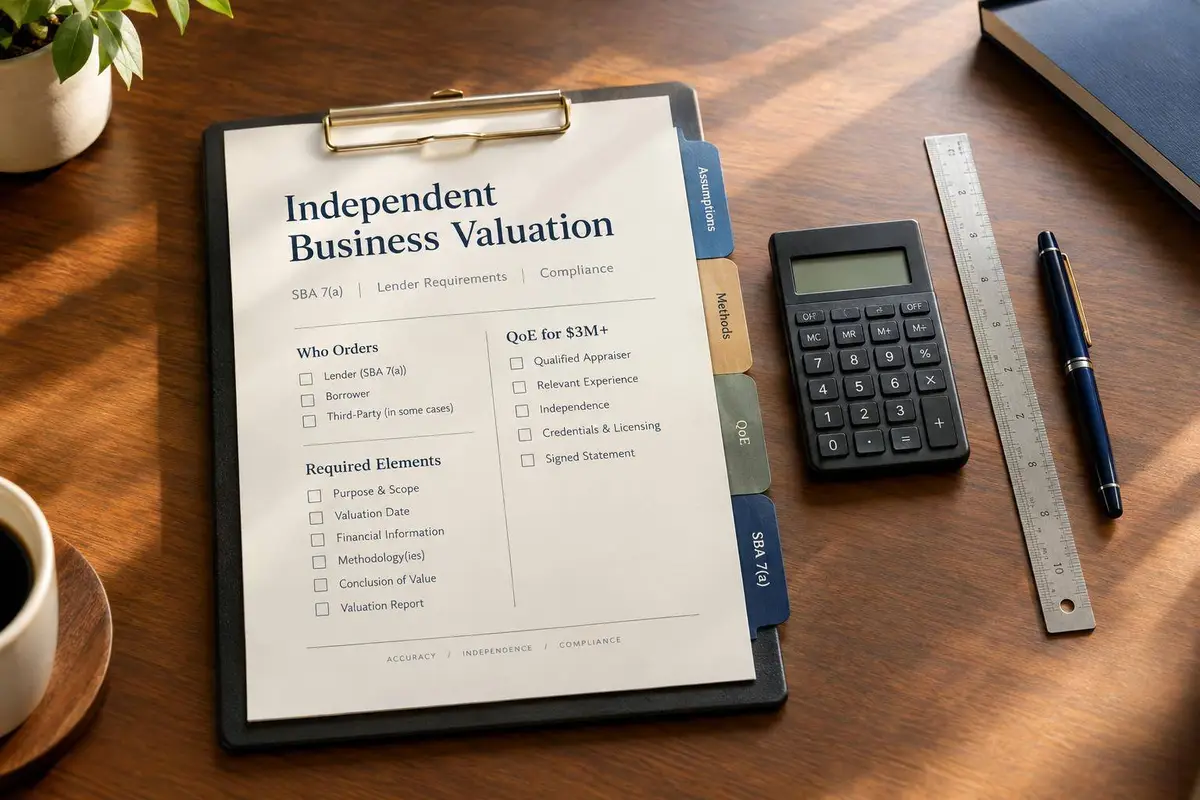
When SBA 7(a) loans need independent valuations, who orders them, required report elements, and QoE rules for $3M+ deals.
 Samson JagorasPrincipal & CEO/CIONovember 21, 2026
Get matched with the right lender for your business
Compare offers from our vetted network. Pre-qualify in minutes — no impact to your credit.
Before you pay for an SBA 7(a) valuation, I recommend getting your lender’s written requirements. Under the guidance described here, a business purchase price above $350,000 generally requires an independent valuation. A close buyer-seller relationship can trigger that requirement at a lower price.
Here’s what I’d confirm first:
- Which rules apply: The governing SBA guidance sets the threshold; your lender may set stricter requirements.
- Who orders the report: The lender must approve the valuation professional, engagement, and scope.
- What the report supports: It must match the deal’s assets, liabilities, and ownership terms. Supporting the price does not establish repayment ability.
- Whether separate earnings diligence applies: Certain acquisitions and expansions priced at $3 million or more also require a lender-ordered quality-of-earnings report.
- What to prepare: Gather financial records, support for add-backs, and deal documents. Resolve report errors or value gaps before closing.
My starting rule: <u>Get lender approval before ordering either report.</u>

SBA 7(a) Valuation: Requirements to Closing
Demystifying Business Valuations for SBA 7a Lenders

sbb-itb-a3ef7c1
Who Orders the Valuation and What It Includes
The lender controls the valuation assignment. It requests the valuation, approves the professional, and sets the scope. The buyer may pay the fee, but the lender remains the intended user.
Before work begins, confirm the fee, when payment is due, and the lender-approved engagement letter. That letter should name the lender as the intended user, state the valuation’s purpose, and define the transaction being analyzed. These details determine whether underwriting will accept the report.
Independent Reports vs. Lender-Performed Valuations
| Valuation type | Who orders and prepares it | Permitted use | Lender approval |
|---|---|---|---|
| Lender-ordered independent report | The lender hires an independent, qualified valuation professional | Acquisition underwriting when an independent valuation is required | The lender must approve the professional and scope before engagement |
| Lender-performed valuation | The lender assigns qualified internal personnel, when permitted | Internal underwriting for transactions eligible for lender-performed valuation | Must meet SBA conditions and the lender’s procedures |
| Buyer- or seller-commissioned report | The buyer or seller hires the professional | Background information, negotiation, or preliminary planning | Not automatically acceptable as the SBA report; the lender must check engagement, independence, scope, and credential requirements |
An existing report may not work if it names the wrong client, uses the wrong valuation date or purpose, or relies on transaction assumptions that don’t match the deal. The lender may require a new engagement or an update that meets its requirements.
The lender must also check the professional’s qualifications and independence.
Who Can Prepare an Independent Valuation
Recognized credentials include ASA, CBA, ABV, CVA, and BCA. Credentials alone aren’t enough: the lender must also confirm valuation experience, industry familiarity, independence, and approval.
Have the lender verify credential status, conflicts, and compensation terms. The credit file should document the professional’s qualifications and the lender’s acceptance.
Report Scope and Contents
The report must match the deal structure, including the assets, liabilities, and ownership interest being transferred. An asset purchase identifies the transferred assets and assumed liabilities. A stock purchase addresses the ownership interest and underlying obligations.
Account for equipment, inventory, working capital, and goodwill. Identify real estate separately and handle it under the applicable appraisal requirements so it isn’t counted twice.
| Check | Report element | SBA requirement versus lender-requested detail |
|---|---|---|
| ☐ | Value conclusion | State the value conclusion. |
| ☐ | Valuation date and intended use | State the effective date and the lender’s financing purpose. Confirm timing and update requirements with the lender; don’t assume a standard expiration period. |
| ☐ | Methods and assumptions | Explain the approaches considered, methods selected, and material assumptions. |
| ☐ | Professional’s qualifications | Show credentials, industry and transaction experience, and valuation work. |
| ☐ | Signature and certifications | Include the analyst’s signature, independence disclosures, and any certifications required by professional standards and the lender. |
| ☐ | Sale inclusions and assumed liabilities | Identify included and excluded assets and assumed debt so the conclusion matches the purchase agreement. |
| ☐ | Value allocations | Provide allocations only when required by the governing guidance or lender. |
When a report misses these requirements, underwriting usually calls for corrections, updates, or a new engagement. Scope errors and independence issues affect underwriting - not just the paperwork.
How Valuation Results Affect Loan Approval
Once the valuation arrives, the lender checks whether it supports the purchase price and whether the business can repay the loan.
Valuation supports the price; underwriting tests repayment. The lender compares the valuation with the purchase agreement and sources-and-uses statement. That review includes buyer equity, seller financing, assumed debt, and separately appraised real estate. Seller financing forms part of the funding mix, and its payment or standby terms can affect approval. The lender must confirm that the funds used to buy the business do not exceed the supported value.
The lender also checks the valuation’s earnings assumptions against tax returns, financial statements, documented add-backs, and post-close projections. Cash flow the business can maintain - not seller claims - must cover debt service and working capital. Other credit factors also affect the decision.
Addressing Valuation Gaps and Report Problems
A pricing problem and a report problem need different fixes. Missing information may call for a corrected report. A value shortfall may require new deal terms. Adding buyer equity or seller financing does not automatically make a higher purchase price acceptable.
| Finding | Possible lender response | What must be resolved |
|---|---|---|
| Value supports the contract price | Continue underwriting | Repayment capacity and other approval requirements |
| Value falls below the price | Seek a price reduction, more buyer equity, or an SBA-compliant restructure | Value and repayment tests |
| Scope omits assumed debt or other transaction components | Require a corrected report or addendum | Alignment with the purchase agreement |
| Add-backs or projections lack support | Request records and revised analysis | Support for earnings the business can maintain |
| Valuation professional does not meet SBA or lender standards | Order a replacement report | Qualifications and independence |
The lender’s response depends on applicable SBA guidance and lender policy. If the purchase agreement changes after the valuation, the lender should revisit the analysis before closing. Changes to the price, assets, seller debt, assumed liabilities, or real estate can all trigger that review.
If earnings support is also in doubt, the lender may require a separate quality-of-earnings report.
When a Separate Quality-of-Earnings Report Is Required
Under current guidance, a lender-ordered quality-of-earnings report is required for an Initial Acquisition or Business Expansion with a business purchase price of $3 million or more. The calculation is made before buyer equity and seller financing and generally excludes owner-occupied real estate.
The requirement depends on the transaction category, not SBA loan size alone. Buyers and sellers should confirm the rule and the lender’s requirements before ordering a report. It must be commissioned by and prepared for the lender. A buyer- or seller-ordered report may not satisfy the requirement without lender reliance procedures.
| Issue | Business valuation | Quality-of-earnings report |
|---|---|---|
| Purpose | Supports the business or transaction value | Tests earnings accuracy and sustainability |
| Preparer qualifications | Qualified valuation professional meeting applicable SBA and lender standards | Accounting or financial-diligence professional acceptable to the lender; confirm any required credentials |
| Independence | Must meet applicable independence requirements | Must be prepared for the lender under applicable SBA guidance and lender standards |
| Timing | Completed when needed for the lender’s approval and closing process | Required early enough for findings to affect cash-flow underwriting |
| Scope | Value conclusion and supporting analysis | Revenue quality, add-backs, working capital, customer concentration, and related diligence |
| Underwriting use | Supports the value being financed | Informs repayment analysis; does not replace valuation or the lender’s credit decision |
Buyer and Seller Preparation Checklist
Once you know which SBA report applies, use this checklist to avoid paying for diligence that doesn’t match the lender’s required scope.
Confirm Requirements Before Ordering Reports
Get written lender instructions when you sign the LOI. Confirm how the purchase price is calculated, whether owner-occupied real estate is excluded, whether the lender will use an internal or independent valuation, and whether a separate QoE report is required. Disclose buyer-seller relationships early, and clarify which requirements come from the SBA versus lender policy.
Get the lender’s written approval of the valuation professional, intended user, scope, valuation date, due date, and report format. Also confirm who orders and pays for the report, the fees, and any update requirements. Do not order before lender approval. Costs and turnaround times vary.
Gather Financial and Deal Documents
Create a shared document index that assigns each item an owner, deadline, and status: received, incomplete, mismatched, or pending. These records help the lender check the valuation, review support for add-backs, and verify the final sources-and-uses schedule.
Common requests include:
- Deal terms: LOI or purchase agreement, seller-note terms, leases, and material contracts.
- Financial records: Tax returns, historical and year-to-date financials, general ledger and trial balance, bank statements, A/R and A/P aging, and debt schedule.
- Valuation support: Inventory and equipment lists, payroll records, customer and supplier concentration, and material licensing, litigation, or regulatory matters.
Sellers should reconcile financial records and document every add-back. Buyers, sponsors, and equity partners should track financing and ownership documents separately. Confirm the checklist with the lender.
Before final approval, compare the completed report against the purchase-price allocation and sources-and-uses schedule. Check inventory, working capital, assumed debt, seller financing, and real estate.
Send the lender and valuation professional one consolidated discrepancy list. Preserve the original report and track revisions. Flag changes to the agreement or financial results, and ask whether the report needs an update. Keep both parties aligned on deal changes before closing.
How Clearly Acquired Helps With Diligence
Clearly Acquired helps organize deal records, screen financials, and flag missing support. It does not replace a lender-accepted independent valuation or a lender-required QoE.
Conclusion: Verify Requirements Before Ordering Reports
Order the report only after the lender confirms the governing SOP and written underwriting conditions. Older guidance used a different threshold, but current deals must follow the governing SOP and the lender’s written rules. An independent valuation is required when the governing threshold is exceeded. Related-party deals may require one regardless of the amount.
SBA rules set the floor, not the ceiling. Lenders can require an outside valuation below the threshold. They may also request additional earnings analysis if the deal is complex or the records are weak.
Before ordering, confirm the applicable SBA guidance, the valuation path, and the lender’s written underwriting conditions. Disclose any buyer-seller relationship early.
Clearly Acquired can organize diligence and flag valuation or QoE issues. The final requirement still depends on the applicable SBA guidance and the lender’s written policy.
FAQs
How do I confirm which SBA valuation rules apply?
For SBA 7(a) acquisition loans, confirm requirements with your SBA-approved lender. Your lender applies SBA guidance, orders reports, and tells you which documents you need. Its requirements may be stricter than SBA’s baseline.
Ask whether you need a tangible asset/FF&E appraisal or a business valuation to support the purchase price and repayment ability. Clearly Acquired can help organize appraisal inputs and prepare lender-ready documentation.
Can I reuse my valuation if I switch lenders?
Check with your new lender before assuming you can reuse your valuation. The SBA sets overall guidelines, but each lender handles underwriting and may set its own requirements, such as stricter thresholds or specific appraisal standards.
Lenders order valuation reports, so confirm the required scope with your new lender before commissioning any additional appraisals.
Can I challenge a valuation below my purchase price?
If a valuation comes in below your purchase price, ask your lender to confirm the required valuation methods and appraiser standards in writing. Lenders order independent valuations to support purchase prices and manage risk.
SBA rules set the baseline, but lenders may have stricter internal standards. Confirm your lender’s requirements before ordering reports.
Related Reading
Find the right lender for your business
Whether it's working capital, an SBA loan, or acquisition financing — we'll match you with the right capital partner.
About the author
Principal & CEO/CIO
Samson Jagoras has 15+ years across finance, real estate, and business acquisitions. He began his career as a Futures & Commodities broker and later served as Chief Strategy Officer of an INC 500 marketing and technology firm, helping scale revenue from $1M to over $100M. Today he buys, builds, and advises a portfolio of companies with a focus on M&A, capital allocation, and operational strategy.