Reducing CAC: Strategies for Acquired Companies
Recalculate CAC after acquisition, cut inefficient spend, fix funnel leaks, and boost retention to lower long-term acquisition costs.
 Samson JagorasPrincipal & CEO/CIOJune 4, 2026

Get matched with the right lender for your business
Compare offers from our vetted network. Pre-qualify in minutes — no impact to your credit.
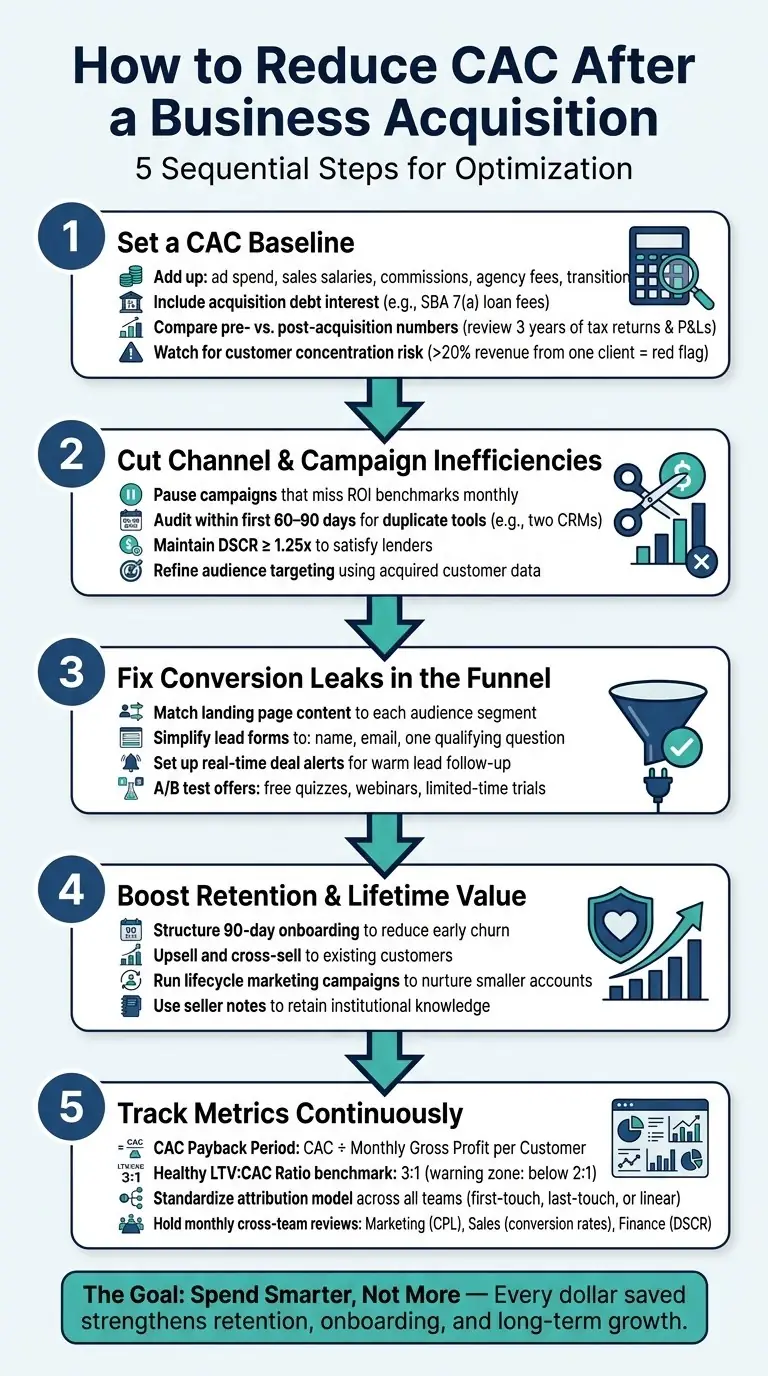
Lowering Customer Acquisition Cost (CAC) after acquiring a business is crucial for maintaining profitability and ensuring growth. Acquisitions often bring outdated marketing strategies, hidden costs, and operational challenges that can drive up CAC. Here's how to tackle it:
- Set a CAC Baseline: Recalculate CAC from scratch, including ad spend, sales salaries, transition costs, and acquisition debt interest. Compare pre- and post-acquisition numbers to uncover inefficiencies.
- Cut Inefficiencies: Audit and eliminate underperforming campaigns, redundant tools, and poorly targeted ads. Refocus on high-performing channels.
- Fix Conversion Leaks: Optimize landing pages, simplify lead forms, and streamline sales handoffs to improve conversion rates without increasing spend.
- Boost Retention: Strengthen onboarding, focus on upselling, and run lifecycle campaigns to retain customers and increase lifetime value.
- Track Metrics Continuously: Monitor CAC payback periods and LTV:CAC ratios. Use consistent attribution models and cross-team reviews to spot and fix inefficiencies.
The goal is to spend smarter, not more. By addressing inefficiencies, improving conversions, and focusing on retention, you can keep CAC under control and set your business up for steady, long-term growth.
How To Reduce Customer Acquisition Cost (CAC) From Your Marketing

Setting a CAC Baseline After an Acquisition
The first step after an acquisition is to establish an accurate baseline for your Customer Acquisition Cost (CAC). The previous owner's records may not fully reflect the actual costs, so it's essential to build your calculations from the ground up. This baseline provides a clear foundation for analyzing expenses in detail.
What to Include in Your CAC Calculation
To calculate CAC, add up all costs directly tied to acquiring customers. This includes ad spend, sales salaries, commissions, agency fees, and any transition-related expenses like integration consulting or 90-day onboarding support. If you financed the acquisition, such as through an SBA 7(a) loan, don't forget to account for interest and fees tied to that debt, as they increase your overall cost base.
It's also wise to include a working capital reserve. This cushion can prevent you from making rushed - and often expensive - marketing decisions.
| Cost Category | What to Include |
|---|---|
| Direct Sales & Marketing | Ad spend, sales salaries, commissions, agency fees |
| Transition Costs | Integration consulting, 90-day onboarding support |
| Financial Overhead | Acquisition debt interest, SBA fees |
| Operational Adjustments | Adjusted owner compensation, working capital |
| Risk Factors | Customer concentration, key employee retention agreements |
Comparing Pre- and Post-Acquisition CAC Numbers
After building your baseline, compare it to historical financial data. Review three years of tax returns, profit and loss (P&L) statements, and current financials to identify a pre-acquisition benchmark. Then, compare those figures to your actual spending during the first 45 to 75 days after closing.
This analysis often uncovers unexpected findings. For example, a marketing channel that seemed cost-effective under the previous owner might have relied on a personal relationship that no longer exists. Or, you might find that what was categorized as "marketing spend" included personal expenses unrelated to the business. Revisiting the original acquisition plan and any deal-stage marketing and sales projections can help you verify whether the channels are performing as expected.
Why an Accurate Baseline Matters
Having a precise baseline is critical. It helps you identify wasted spending and sets a measurable benchmark for future improvements. Without it, any changes to your strategy are essentially guesswork.
"Many first-time buyers focus entirely on the purchase price and forget they need 2–3 months of operating working capital on day one." - CapFront
One specific risk to monitor is customer concentration. If a single client accounts for over 20% of your revenue, losing that customer could force you to replace a significant portion of your income - at potentially high costs. Recognizing this risk early allows you to develop a plan to mitigate it before it becomes a problem. By starting with a clear baseline, you'll be better positioned to refine your marketing channels and improve conversion rates down the line.
Cleaning Up Channels and Campaigns
Once you've established your CAC baseline, it's time to fine-tune your marketing efforts by cutting out inefficiencies. Acquired businesses often come with unnecessary expenses - like paid campaigns that stopped delivering results, redundant tools, or poorly configured audience targeting.
Pausing Campaigns That Are Not Delivering
Stop pouring money into campaigns that don't perform. To keep your CAC in check, implement a monthly review process and evaluate each active channel against a clear ROI benchmark. If a campaign doesn't meet its payback window, it's time to hit pause.
This isn't just about improving marketing efficiency. Lenders closely monitor your Debt Service Coverage Ratio (DSCR), which measures whether your cash flow can cover debt payments. Most lenders expect a DSCR of at least 1.25x. By cutting underperforming campaigns, you can boost your DSCR, maintain lender confidence, and free up funds for more effective initiatives.
From here, focus on eliminating duplicate expenses and refining your audience targeting to further reduce costs.
Cutting Duplicate Spend and Fixing Audience Targeting
Acquisitions often come with overlapping tools and systems. For example, you might inherit two CRMs, multiple outreach platforms, or ad campaigns targeting the same audience across different channels. Conduct a thorough audit within the first 60–90 days to identify and eliminate these redundancies.
At the same time, revisit your audience targeting. Wasted impressions or poorly defined segments can drain your budget. Use the acquired business's customer data to understand who's converting and why. Build segments based on these insights to ensure your campaigns are reaching the right people. Leveraging AI tools can speed up this process by identifying patterns in customer behavior that might otherwise take weeks to uncover.
Getting More Out of Paid Media and Partner Channels
Improving CAC for paid media isn't about spending more - it's about spending smarter. Shift your budget to channels with a lower cost-per-conversion and higher-quality customers. In paid search, this might involve refining keyword match types and eliminating broad-match terms that attract clicks but not conversions. For paid social, consider narrowing your lookalike audiences or refreshing ad creatives that have grown stale.
The same principles apply to partner channels. Focus your resources on partnerships that consistently deliver qualified leads, and let inactive ones go dormant. A smaller, well-maintained network of partners often outperforms a larger, unmanaged one - and it's far more cost-effective to sustain.
Improving Conversion Rates Across the Funnel
Cutting wasteful spending can only take you so far. If your funnel has leaks - where prospects drop off before converting - you're still overpaying to acquire each customer. The solution isn't necessarily a bigger budget; it's about addressing the weak spots. Start by refining your landing pages and lead forms to ensure you're capturing every qualified lead.
Fixing Landing Pages and Lead Forms
One of the biggest reasons for poor conversion rates is the disconnect between your ad promises and the content on your landing page. When prospects land on a generic or irrelevant page, they're likely to bounce. Make sure the content on your landing pages aligns perfectly with the specific audience segment you're targeting. For example, if you're running campaigns tailored to different buyer profiles, create separate landing pages for each group. Speak directly to their needs and expectations.
Simplify your lead forms to include only the essentials - name, email, and one qualifying question. This reduces friction and makes it easier for prospects to complete the form. If verifying lead quality is critical for your business, consider integrating tools like Plaid. These third-party authentication tools validate user profiles in real time, giving you reliable data without putting extra work on the prospect. Less effort for them, better insights for you - it's a win-win.
Tightening Sales Handoffs and Recovering Lost Leads
Once your landing pages are optimized to capture quality leads, the next step is ensuring those leads transition smoothly to your sales team. Leads that go unaddressed waste marketing dollars, which is a common issue in many businesses - especially those where the previous owner managed sales directly.
"One team, one platform, zero handoffs." - Clearly Acquired
The key here is to close the gap between marketing and sales. When both teams operate on the same system, leads won't get buried in email threads or forgotten in spreadsheets. Implement real-time deal alerts - automated notifications triggered when a prospect meets specific criteria - to ensure your sales team reaches out while the lead is still warm. Timing is critical; the longer the delay between a prospect's initial action and your follow-up, the lower your chances of converting them.
For businesses that have recently been acquired, the first 90 days post-acquisition are especially risky for lead leakage. If the previous owner was the main point of contact for customers, structuring the deal with a seller note can help. This gives the seller a financial incentive to stay involved, introduce key contacts, and support a smooth handoff to your sales team.
Testing Offers to Increase Conversions
Once your funnel is running efficiently, it's time to refine your offers to boost conversion rates further. Small tweaks to what you're asking prospects to commit to can lead to noticeable improvements - without increasing your ad spend.
Start with low-friction entry offers: tools like free prequalification quizzes, short webinars, or limited-time trials. These options remove the pressure of a big commitment and make it easier for prospects to take the first step. From there, experiment with variations - different headlines, calls to action, or incentive structures. Use A/B testing to determine what resonates most with your audience. Test one variable at a time to ensure your results are statistically reliable, and watch as small adjustments lead to meaningful improvements in conversion rates.
Using Retention to Reduce Pressure on CAC
Lowering customer acquisition costs (CAC) isn't just about optimizing your sales funnel. Strong retention strategies can make a big difference, too. When your current customers stick around and spend more, you don't have to constantly chase new leads to hit your growth goals.
Strengthening Onboarding and Customer Success
The first 90 days after acquiring a business are critical. During this period, customers often feel uncertain, increasing the risk of them jumping ship. A structured onboarding and integration program can help smooth this transition. Focus on operational handoffs and introductions to key accounts to minimize early churn.
This is where customer success becomes a priority from day one. Seller notes can also be an asset here. When sellers retain a financial stake in the business, they're often motivated to help your team build relationships with key accounts and share valuable institutional knowledge.
"Our support doesn't end at closing. We provide transition planning, operational onboarding, and 90-day integration support to ensure a smooth handoff." - Clearly Acquired
Growing Revenue Through Upselling and Cross-Selling
Retaining customers is just the beginning - getting them to spend more over time is equally important. Increasing customer lifetime value is a cost-efficient way to lessen your dependence on acquiring new customers. Since existing customers don't add incremental retention costs, every extra dollar they spend improves your overall profitability.
For acquired businesses, upselling and cross-selling opportunities often surface in the first year post-acquisition. For instance, Kerianne Los, Principal COO of Pursuit Training & Performance, used expansion financing to buy new equipment and grow her facility. This strategy allowed her to boost revenue from her existing customer base rather than relying solely on attracting new clients.
Here's a quick look at financing products that can support cross-selling as your business grows:
| Financing Product | Typical Use Case | Key Benefit |
|---|---|---|
| Lines of Credit | Managing daily cash flow | Encourages recurring usage and builds client loyalty |
| Equipment Loans | Financing new or used machinery | Offers up to 100% financing, preserving client cash |
| Bridge Loans | Addressing short-term gaps | Provides quick funding for urgent needs |
| Recapitalization | Refinancing existing debt | Improves cash flow and strengthens client ties |
| SBA 7(a) | Supporting primary acquisitions | Creates a long-term financing relationship |
Running Lifecycle Marketing Campaigns
Once you've worked on expanding revenue, keeping customers engaged is essential. Lifecycle marketing campaigns help you stay connected with your audience without constantly pushing new offers. The idea is to remain relevant throughout their journey, so your business is the first they think of when they need something.
One important risk to watch is customer concentration. If a single customer accounts for more than 20% of your revenue, it can create structural issues and scare off lenders. Lifecycle campaigns that nurture smaller accounts and encourage repeat purchases can help balance your revenue streams. Additionally, tracking metrics like your Debt Service Coverage Ratio (DSCR) - lenders prefer at least 1.25x coverage - can help you gauge whether your retention efforts are translating into the steady cash flow needed for long-term growth.
Tracking CAC and Keeping It Under Control Long-Term
Even with strong retention strategies and optimized funnels, the benefits can fade without consistent tracking. Keeping your Customer Acquisition Cost (CAC) in check over the long haul requires monitoring essential metrics and instilling habits that catch inefficiencies before they quietly drain your budget. This continuous oversight ensures that early wins evolve into lasting efficiency.
CAC Payback Period and LTV:CAC Ratio Explained
The CAC payback period measures how long it takes to recoup the money spent acquiring a customer. For instance, if your CAC is $1,200 and the monthly gross profit per customer is $400, the payback period is three months. A shorter payback period means less cash is tied up in growth efforts, allowing for quicker reinvestment.
The LTV:CAC ratio compares the lifetime value (LTV) of a customer to the cost of acquiring them. A 3:1 ratio is often seen as a healthy benchmark - $3 in lifetime value for every $1 spent on acquisition. On the other hand, a ratio below 2:1 could indicate that acquisition costs are eating into profitability.
Using both metrics together provides a clearer picture of channel performance. For example, a paid search campaign might deliver a strong 5:1 LTV:CAC ratio, while a trade show might only hit 1.5:1. In this case, it might make sense to reallocate resources from the less effective channel to the stronger one.
Building Reliable Attribution
Accurate attribution is key to understanding which channels deliver results. However, tracking can get messy - especially after acquisitions, when ad accounts, UTM parameters, and tracking setups may differ. The solution lies in consistency. Standardize lead tagging across all channels, integrate your CRM with marketing platforms, and agree on a single attribution model across teams. Whether you use first-touch, last-touch, or linear attribution, sticking to one model ensures clarity.
Monthly performance reviews are vital for spotting trends that one-off audits might miss. Regular reporting allows you to connect spend to outcomes more effectively, helping you refine your approach over time.
Setting Up a Cross-Team Review Process
CAC can quietly creep up if inefficiencies go unnoticed. A poorly performing campaign might run for weeks before anyone flags it, and by the time finance reviews the numbers, a significant chunk of the budget could already be wasted. To prevent this, establish a regular review process involving marketing, sales, and finance.
- Marketing should track cost-per-lead by channel.
- Sales should report conversion rates and average deal size.
- Finance should monitor CAC alongside metrics like lifetime value and cash flow (e.g., DSCR).
When everyone works from the same data and definitions, inefficiencies can be spotted and corrected faster. These reviews, paired with earlier channel and funnel adjustments, ensure that decisions are consistently data-driven.
"We are built AI-first... This means faster diligence, better pattern recognition across deals, and an operating model that scales without proportionally scaling headcount." - Clearly Acquired
Centralizing your data is essential to making these reviews productive. If teams rely on separate data sources, meetings can devolve into reconciling numbers instead of making decisions. A shared dashboard, buyer tools, or data room - where all teams can access the same figures - turns these reviews into actionable discussions.
Conclusion: Keeping CAC Low While Continuing to Grow
Lowering CAC after an acquisition isn't something you tackle once and forget - it's an ongoing effort. The key lies in using a solid baseline, cutting unnecessary expenses, refining your funnel, focusing on retention, and ensuring cross-team collaboration. When these elements come together, reducing CAC becomes a natural outcome, not a constant uphill battle. These efforts don't just lower costs - they set the stage for steady, long-term growth.
The goal isn't just to spend less - it's to spend smarter. Every dollar you save can go toward enhancing your offer, improving onboarding, or strengthening retention efforts to increase customer lifetime value.
The first 90 days of a post-acquisition workflow are critical. Operational instability during this period can lead to ballooning marketing and sales expenses. A stable start can help you avoid reactive and costly decisions.
To help navigate this challenging phase, Clearly Acquired provides tools and support tailored for operators. Their AI-powered platform offers real-time financial insights, risk evaluations, access to over 500 lenders, and dedicated advisory services to guide you through the post-acquisition period.
"I worked with Clearly Acquired on a recent acquisition, and from the first interaction, it went smoothly and exceeded my expectations... I'm not sure the deal would have gotten done if it wasn't for their help." - Aaron Lae, Owner-Operator
The companies that excel at managing CAC after an acquisition aren't necessarily the ones with the deepest pockets. Instead, they're the ones with clear, actionable data, disciplined workflows, and the right infrastructure to make informed decisions. By following these strategies, acquired businesses can successfully lower CAC while continuing to grow.
FAQs
What's the fastest way to calculate true CAC after an acquisition?
To get an accurate picture of your true customer acquisition cost (CAC) after acquisition, AI-driven financial tools are your best bet. Solutions like Clearly Acquired simplify the process by automating tasks like cleaning historical data, isolating marketing expenses, and analyzing customer growth metrics. This not only removes the hassle of manual work but also delivers precise insights, empowering you to fine-tune your growth strategies with ease and confidence.
Which post-acquisition costs should be included in CAC (debt, transition, overhead)?
Customer Acquisition Cost (CAC) focuses solely on the direct expenses tied to bringing in new customers - think sales and marketing efforts. Costs like debt, transition expenses, and overhead fall under operational or capital expenditures instead. Adding these to CAC would distort efficiency metrics since they reflect the broader costs of running the business rather than the specific expense of acquiring customers.
Should I cut ad spend or focus on improving conversion and retention first?
Pouring money into ads without fixing underlying issues is like trying to fill a bucket full of holes - it's wasteful and costly. When your funnel isn't working efficiently, scaling up ad spend only increases customer acquisition costs without delivering lasting value.
To avoid this, prioritize refining your systems and customer journeys. Make sure the traffic you're already bringing in translates into meaningful, long-term revenue. Strengthen your retention strategies and ensure your unit economics are solid. Once these foundations are in place, you can confidently ramp up your marketing efforts, creating growth that's not just scalable but also profitable and sustainable.
Find the right lender for your business
Whether it's working capital, an SBA loan, or acquisition financing — we'll match you with the right capital partner.
About the author
Principal & CEO/CIO
Samson Jagoras has 15+ years across finance, real estate, and business acquisitions. He began his career as a Futures & Commodities broker and later served as Chief Strategy Officer of an INC 500 marketing and technology firm, helping scale revenue from $1M to over $100M. Today he buys, builds, and advises a portfolio of companies with a focus on M&A, capital allocation, and operational strategy.