Pool & Spa Compliance in M&A Diligence
How licensing, certifications, permits, and records affect pool & spa deals — fixes, holdbacks, price cuts, and closing conditions.
 Samson JagorasPrincipal & CEO/CIOJuly 21, 2026
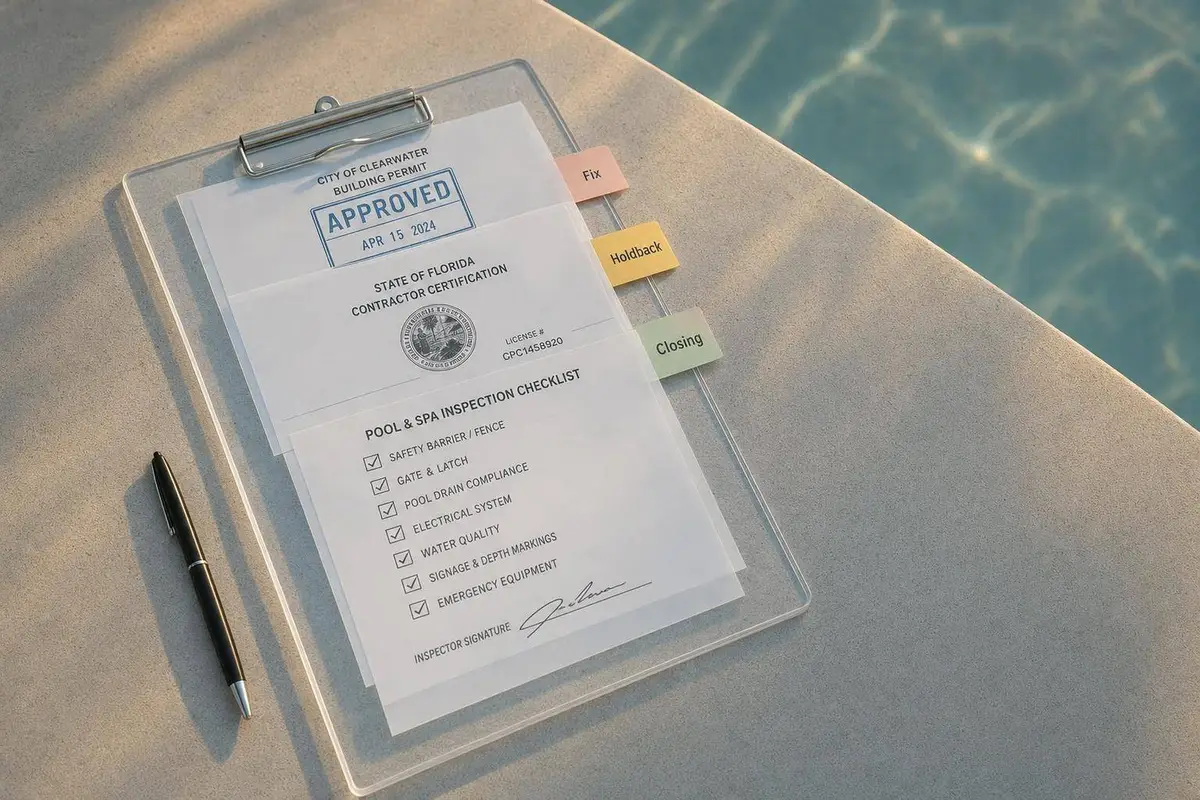
If a pool or spa company sold work it was not licensed or certified to do, part of that revenue may not count in the deal.
When I look at this type of diligence, I boil it down to a short list:
- License problems: missing, expired, or wrong license for the work sold
- Certification gaps: staff credentials, including CPO issues
- Permit and safety file gaps: missing records, open items, or poor documentation
- Deal impact: lower value, delayed funding, holdbacks, scope cuts, or indemnities
- Fix path: cure before close, prove it in writing, or shift the risk into the purchase terms
In plain terms, buyers want a clean match between services sold, licenses held, and records on file. If that match breaks, they often discount the affected revenue, change closing terms, or leave a service line out of the deal. In many lower middle-market deals, even a small non-compliant revenue slice — say 5% to 15% of sales tied to the wrong scope — can change pricing and lender comfort.
A few points stand out fast:
- Work outside licensed scope can lead to a price cut
- Expired certifications can become a closing condition
- Permit or record gaps often lead to an escrow holdback
- Open enforcement matters may stop funding until they are cleared or dismissed
If I had to sum up the whole article in one line, it would be this: fix legal-to-operate issues before closing, and price or isolate everything else.
Commercial Pool Service: Difficulty with the County Health Department

Common Compliance Problems Buyers Find in Pool and Spa Diligence
Buyers usually start with a simple check: does each service on the books line up with a valid contractor license and the right technician credentials? If the answer is no, part of that revenue may be non-compliant.
License and Certification Mismatches
A common problem is that contractor licenses are missing, expired, or don''t match the work the company actually performs. The same issue shows up with technician credentials. For example, a business may lack Certified Pool Operator (CPO) certification, or its staff credentials may not fit the company''s current mix of services.
That can point to a bigger problem: the business may have billed for work it was not allowed to perform.
Buyers also look closely at safety and chemical-handling gaps, which often lead to the next set of issues.
How Each Compliance Finding Affects Underwriting and Closing

In pool and spa deals, unresolved licensing, certification, permit, and recordkeeping issues can hit price, financing, and closing conditions. What starts as a compliance question quickly becomes an underwriting issue, and then shows up in the final deal terms.
Revenue Quality and Scope-of-Work Risk
The main issue is simple: does the revenue being valued line up with the business the buyer will actually own?
If earnings rely on work done outside licensed scope, or by technicians without the right credentials, buyers don''t just shrug and move on. They may adjust the financial model, narrow the scope of the deal, or ask for a price cut.
Licensing, Insurance, and Enforcement Exposure
Open licensing and certification issues also create doubt about whether the business can operate on day one. Buyers usually want those items fixed before funding. If not, they tend to push that risk into the deal through pricing or closing terms.
In practice, the effect usually lands in three areas: underwriting, operations, and closing.
| Compliance Gap | Underwriting Impact | Operational Risk |
|---|---|---|
| Open licensing item | May require additional diligence or a model adjustment | Could disrupt post-close operations |
| Missing certification | Related revenue may be discounted or excluded from the model | Corrective action may be needed |
| Permit gap | Deal terms may need to change | Could delay closing |
| Incomplete permit or compliance records | Harder to verify the business case | More items must be cleared before funding |
These findings often lead straight to seller cures, holdbacks, or price changes.
Ready to Make Your Next Move?
Whether you're buying, selling, or investing — Clearly Acquired gives you the tools, data, and support to close with confidence.
How Buyers Resolve Pool and Spa Compliance Problems Before Closing
Once diligence turns up a compliance issue, buyers usually do one of two things: fix it before closing or deal with it in the purchase terms.
Seller Cures and License Updates
Some problems need to be fixed before funding. That''s especially true for anything tied to the company''s license, certifications, or core operating permits.
Common pre-close fixes include:
- Renewing licenses
- Replacing expired certifications
- Correcting permit records with the issuing agency
Ask for written proof that the issue is fixed before funding. A promised fix is still just a promise. It is not a closed item.
If the seller can''t show proof before closing, the buyer should move that risk into the deal terms.
Revised Scope, Holdbacks, and Price Adjustments
The most useful tools here are a narrower scope, escrow holdbacks, and price cuts. If the issue touches only one service line, buyers can leave that part out of the deal until it has the right license. That trims the risk without blowing up the transaction.
When the issue is clear and the cost can be measured, an escrow holdback is often the cleanest path. Part of the purchase price stays in escrow and gets released only after the seller proves the issue has been fixed. A purchase price reduction makes more sense when the cleanup cost is known at the start. Buyers can also add targeted indemnities to the purchase agreement so they have cover if a problem shows up after closing.
| Compliance Finding | Preferred Resolution | Timing |
|---|---|---|
| License mismatch | Seller cure before close | Verify before funding |
| Expired certification | Seller renewal and documentation | Verify before funding |
| Permit/recordkeeping gap | Escrow holdback or price reduction | Negotiate in purchase agreement |
| Scope issue tied to unauthorized work | Revised scope or exclusion | Set during diligence |
| Health or safety documentation gap | Seller cure or targeted indemnity | Resolve or cover contractually |
| Known enforcement exposure | Targeted indemnity | Written into purchase agreement |
Using Diligence Systems to Track Open Items
Once the remedy is picked, the next job is simple: track every open item all the way to funding.
Use a business acquisition checklist or diligence tracker to log findings, proof of cure, and open deadlines. When a seller fixes a licensing item, log that update and tie it back to the original issue. That makes it much easier to see what is still open and what is cleared for closing.
Closing Conditions and Final Deal Terms
Once the diligence findings are confirmed, the last step is simple in theory and tricky in practice: decide which issues stop funding and which ones get folded into the purchase agreement.
Every open compliance item in the diligence tracker goes into one of two buckets:
- A closing condition that must be cleared before funding
- A deal term that accounts for the risk still left in the transaction
What Must Be Resolved Before Funding
Some problems can''t just be pushed into the contract. If an issue would stop the business from operating legally on day one, it has to be fixed before funding.
Buyers usually treat these as closing conditions:
- Licensing gaps must be cured before funding. The buyer needs written proof of a valid, current contractor license — not a pending application.
- Expired certifications must be renewed and documented. The seller supplies the updated credential, and the buyer checks it against the original finding in the diligence tracker.
- Core operating permits must be confirmed active. Any permit tied to the business''s main service scope needs to be in good standing at closing.
- Open enforcement actions must be resolved or formally dismissed. If an enforcement matter is still open, it blocks closing until the seller provides written proof that it has been resolved.
What Can Be Handled Through Deal Structure
Known issues that aren''t critical can move into escrow, price, or indemnity. The right tool depends on one thing: can the cost be measured at signing?
- Escrow holdback — Part of the purchase price stays in escrow and is released only after the seller shows the issue has been closed. This works when the fix is still pending but the cost is already known.
- Purchase price reduction — Used when the cleanup cost or revenue impact is known at signing and can be taken straight off the purchase price.
- Targeted indemnity — Added to the purchase agreement to protect the buyer if a specific compliance issue shows up after close. This fits enforcement exposure or recordkeeping gaps that can''t be fully checked before funding.
- Scope exclusion — Scope issues call for a revised purchase definition. If a service line was performed outside licensed authority, that line stays out of the deal until the proper license is in place.
The final purchase agreement should line up with the risk tied to the unresolved items.
FAQs
How much can non-compliant revenue affect deal value?
Non-compliant revenue can reduce deal value. The size of the impact depends on how much revenue is tied to the issue and whether the parties fix it before closing.
That fix can happen in a few ways:
- holdbacks
- seller remediation
- license updates
- a revised scope of the deal
- purchase price changes
So this isn''t just a legal or licensing problem. It can hit valuation directly if part of the revenue base isn''t compliant at signing or can''t be supported after close.
Which compliance issues must be fixed before closing?
Issues that usually need to be fixed before closing are the ones that could stop the business from operating legally or being transferred to the buyer. That often includes licensing gaps, permit problems, or cases where the business being sold doesn''t line up with the licenses or approvals already in place.
Buyers usually deal with these issues through seller fixes before closing, holdbacks, license updates, changes to the deal scope, or price adjustments.
When should buyers use holdbacks instead of price cuts?
Buyers often use holdbacks when a compliance issue can likely be fixed after closing. In that case, they set aside part of the purchase price and release it once the issue is resolved.
A price cut usually makes more sense when the problem won''t go away, lowers the business''s value, or probably can''t be fixed before or after closing.
About the author
Principal & CEO/CIO
Samson Jagoras has 15+ years across finance, real estate, and business acquisitions. He began his career as a Futures & Commodities broker and later served as Chief Strategy Officer of an INC 500 marketing and technology firm, helping scale revenue from $1M to over $100M. Today he buys, builds, and advises a portfolio of companies with a focus on M&A, capital allocation, and operational strategy.