How Net Profit Margin Impacts Business Valuation
Net profit margin is a critical factor in determining how much your business is worth. Strong margins drive higher valuation multiples, better financing options, and increased buyer interest.
 Samson JagorasPrincipal & CEO/CIOMay 28, 2026

Sell your business for maximum value
Our sell-side advisors package, market, and negotiate your exit to qualified, verified buyers — confidentially.
Net profit margin is a critical factor in determining how much your business is worth. It shows how efficiently your business turns revenue into profit and directly influences valuation multiples, financing options, and buyer interest. Here's what you need to know:
- Higher Margins = Higher Valuation: Businesses with strong margins often fetch 9–11x EBITDA, while lower-margin businesses might see only 3.5x.
- Normalized Earnings Matter: Adjusting for owner-specific or one-time expenses (like personal car payments) gives buyers a clearer picture of true profitability.
- Industry Benchmarks: Different sectors have varying margin expectations, which influence valuation ranges (e.g., SaaS businesses command higher multiples than restaurants).
- Margins Affect Financing: Thin margins can make it hard to secure SBA loans or other financing, potentially derailing deals.
- Common Issues: Overpaying for personal expenses, underpricing, and poor cost management often reduce margins and valuation.
Improving margins before selling—through better pricing, reducing unnecessary expenses, and diversifying revenue streams—can significantly boost your business's value. Tools like quality of earnings (QofE) reports and financial normalization are key steps to prepare for a successful sale.
6 Things to Consider Net Margin Valuation

Net Profit Margin in a Valuation Context
What Is Net Profit Margin?
Net profit margin is determined by dividing net income by total revenue. Unlike gross or operating margins, which exclude certain categories of expenses, net profit margin reflects all costs, offering a complete picture of how much of each dollar earned is retained by the business. This makes it an essential metric for understanding normalized earnings during valuations.
However, in the context of valuations, raw net profit often doesn't provide the full picture. Buyers and lenders tend to focus on normalized earnings figures, such as Seller's Discretionary Earnings (SDE) or EBITDA, depending on the business size. For smaller, owner-operated businesses (typically under $1M–$2M in revenue), SDE is used. This metric adjusts net profit by adding back the owner's total compensation. For larger businesses with established management teams, EBITDA is the standard. It's calculated as net income plus interest, taxes, depreciation, and amortization, but it excludes the owner's salary since a replacement manager would likely need to be hired.
Why Normalized Net Profit Matters in SMB Valuations
Small business owners often charge personal expenses to their business, such as family car payments, health insurance, or one-time legal fees. While these reduce the reported profit, they don't represent the actual earnings a new owner could expect. Normalization removes these non-business-related expenses to reveal the true, ongoing cash flow a buyer is acquiring.
This process is typically formalized in a Sell-Side Quality of Earnings (QofE) report, which documents all legitimate add-backs. This ensures buyers and lenders can trust the financials. As M&A attorney Alex Lubyansky explains:
"A Quality of Earnings report is the professional standard for verifying normalized earnings before closing. Add-backs that are not substantiated are the most common source of post-LOI price disputes."
Unverified add-backs can derail deals. For example, if a QofE report flags $100,000 in unsupported add-backs on a deal with a 3x multiple, the purchase price could shift by $300,000. That's a significant difference for both buyer and seller.
Understanding the normalization process is also key when comparing your margins to industry standards.
Industry Benchmarks and Typical Net Profit Margin Ranges
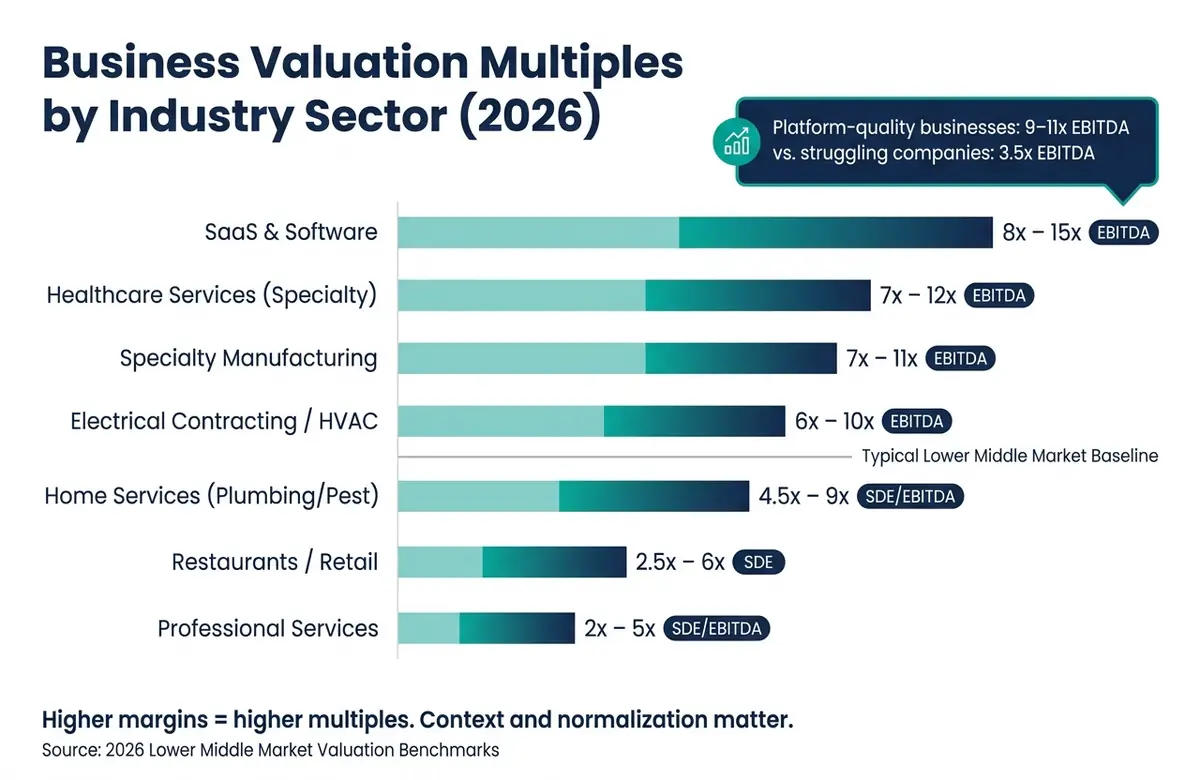
How your margins compare to industry peers plays a major role in how buyers and lenders evaluate your business. For instance, a 15% net margin might be outstanding in the restaurant industry but average in SaaS. Context matters. The valuation multiples projected for 2026 by sector highlight these differences:
| Industry Sector | Primary Metric | 2026 Multiple Range |
|---|---|---|
| SaaS & Software | EBITDA | 8x – 15x |
| Healthcare Services (Specialty) | EBITDA | 7x – 12x |
| Specialty Manufacturing | EBITDA | 7x – 11x |
| Electrical Contracting / HVAC | EBITDA | 6x – 10x |
| Home Services (Plumbing/Pest) | SDE / EBITDA | 4.5x – 9x |
| Professional Services | SDE / EBITDA | 2x – 5x |
| Restaurants / Retail | SDE | 2.5x – 6x |
Sectors with higher margins, like SaaS, attract premium multiples because they benefit from operational leverage, allowing them to grow without a proportional rise in costs. On the other hand, lower-margin businesses, such as restaurants, come with more inherent risk, which reduces what buyers are willing to pay. Understanding where your margins stand in relation to your industry is the first step in determining your valuation potential.
How Net Profit Margin Affects Business Valuation
How Margins Influence Valuation Multiples
Net profit margin plays a key role in shaping how buyers determine valuation multiples. Businesses with higher margins signal better cost management, lower risk, and greater growth potential without a proportional rise in expenses. These qualities often lead buyers to pay a premium.
For example, in 2026, lower middle market businesses typically see valuation multiples ranging from 3.5x EBITDA for smaller or struggling companies to 9–11x EBITDA for "platform-quality" businesses. These top-tier companies boast strong margins, recurring revenue, and solid management teams. That difference of 1–2x EBITDA can mean hundreds of thousands—or even millions—of dollars in additional sale value.
Christoph Totter, Managing Partner at CT Acquisitions, highlights a common error sellers make:
"The single biggest valuation mistake we see in 2026: owners reading the headline industry multiple, multiplying by EBITDA, and assuming that's their number. The headline is the ceiling for platform-quality businesses."
How Margins Affect Financing and Deal Structure
Margins don't just impact valuation—they also influence financing options. Lenders, especially SBA and conventional ones, use the Debt Service Coverage Ratio (DSCR) to assess whether a business generates enough cash flow to cover loan payments post-sale. Thin margins can lead to deals failing underwriting entirely, regardless of the asking price.
Alex Lubyansky, Esq., an M&A Attorney, puts it bluntly:
"SBA lenders require that the business generate sufficient cash flow to service the acquisition debt. A purchase price that exceeds supportable cash flow will not underwrite."
When margins are weak, buyers often seek alternative deal structures like earnouts—where part of the sale price depends on future performance—or seller financing, where the seller finances 10%–30% of the purchase price. These arrangements shift financial risk back to the seller and typically result in a lower effective sale price. On the other hand, businesses with strong margins are more likely to secure straightforward financing with fewer contingencies, making the process smoother for both parties.
How Buyers Evaluate Margin When Assessing a Deal
Margins also serve as a key indicator of operational stability, which buyers carefully evaluate. Stable, high margins suggest pricing power, efficient cost control, and reliable cash flow—qualities that make the transition after acquisition far less risky. Conversely, unstable or declining margins can raise concerns about customer concentration, competitive pressures, or inefficiencies.
A major red flag for buyers is owner dependency. If a business's profitability depends heavily on the owner's personal relationships or unique skills, buyers often discount the valuation multiple by 1.0 to 2.0 turns to account for the risk of declining profitability post-sale. Sellers can protect their valuation by addressing this dependency before going to market.
Another concern tied to margins is customer concentration. When a single customer accounts for more than 20% of revenue, buyers often apply a 0.5x–1x EBITDA discount, as this concentration makes future cash flows less predictable and more vulnerable. Buyers aren't just purchasing the margins a business has today—they're investing in the confidence that those margins will remain stable in the future.
Common Net Profit Margin Problems That Reduce Valuation
Beyond affecting financing and valuation multiples, specific operational issues can chip away at net profit margins, ultimately lowering your business's worth. Spotting and addressing these problems is key to boosting your company's attractiveness and final valuation.
Excessive Operating Expenses
High operating expenses can drag down the sale price of a business, often in ways that aren't immediately obvious. For instance:
- Overpaying family members for minimal work
- Running personal expenses, like auto or travel, through the business
- Maintaining an owner's compensation well above the cost of a replacement manager
These practices shrink margins and invite scrutiny during due diligence. Buyers and lenders carefully examine such expenses, and if adjustments appear sloppy or poorly documented, it undermines confidence in the financials. Slow monthly closes or reliance on compiled-only statements during due diligence can shave 0.5x–1x EBITDA off the valuation. For a business generating $500,000 in EBITDA, that could mean losing up to $500,000 in sale value.
Weak Pricing Strategies
Underpricing is a hidden profit drain that often surfaces when a business is prepared for sale. Many owners stick to outdated pricing structures that no longer align with market rates. Buyers don't view these contracts as reliable revenue streams but as below-market commitments that are tough to renegotiate after acquisition.
Sales compensation plans can worsen the situation. For example, paying sales reps 100% upfront commissions without clawbacks encourages them to close deals at heavily discounted rates. This approach results in a customer base filled with low-margin accounts that carry high churn risks. To buyers, thin margins signal weak pricing power, which directly impacts valuation multiples.
Pricing issues aside, poor cost management can further erode profitability.
Poor Cost Management
Ineffective cost management, like inventory missteps and deferred maintenance, creates unexpected liabilities that buyers factor into their offers. For instance, delaying equipment or facility repairs might look like a smart cost-saving move on paper. However, buyers see deferred maintenance as a looming expense, not a one-time issue.
Similarly, overpriced related-party arrangements distort the true cost structure. Examples include paying above-market rent to a connected real estate entity or relying on supplier relationships based on personal ties rather than competitive pricing. When a Quality of Earnings report uncovers $100,000 in unsupported add-backs on a deal priced at a 3x multiple, the purchase price could drop by $300,000—or worse, trigger a complete re-trade.
These aren't hypothetical risks—they're predictable outcomes of avoidable cost management problems. Addressing them before going to market can help preserve value and avoid unpleasant surprises.
Get a Quality of Earnings analysis you can trust
How to Improve Net Profit Margin Before Selling
Improving your net profit margin is key to increasing the value of your business before selling. Buyers and lenders want to see a business with strong, sustainable margins, and addressing any issues well in advance—ideally 12–24 months before the sale—can demonstrate consistent improvement instead of a last-minute boost. Focusing on areas like normalizing financials, adjusting pricing, and cutting unnecessary costs can help strengthen margins and maximize valuation.
Normalize Your Financial Statements
Normalizing your financials means adjusting them to show the true earning potential of your business. This involves removing expenses that a new owner wouldn't inherit, along with one-time costs that won't recur. Examples of legitimate add-backs include:
- Owner compensation above market rates
- Personal expenses, such as auto or travel costs
- Health insurance
- Non-recurring professional fees
To avoid disputes during the sale process, document these adjustments thoroughly with evidence like receipts, invoices, or payroll records. Unsubstantiated add-backs are a common cause of price renegotiations after a letter of intent (LOI) is signed, which can lower the final sale price or lead to re-trades.
Consider completing a sell-side Quality of Earnings (QofE) report about six months before listing your business. This report can elevate your business valuation, potentially adding 1x to 2x to the EBITDA multiple. Additionally, switching from cash-based to accrual-based accounting and tightening your monthly financial close to within 10 days can signal financial discipline to potential buyers.
Improve Pricing and Product Mix
Once your financials are in order, focus on refining your revenue strategy. Underpricing can hurt margins, but the solution isn't always a blanket price increase. Instead, identify low-margin products or services and either adjust their pricing or phase them out in favor of higher-margin offerings.
Recurring revenue is another area to prioritize. Businesses with over 50% recurring revenue often achieve 1.5x to 2x higher multiples compared to those with only 10% recurring revenue. Converting one-time customers into service agreements or retainer contracts—such as three-year agreements—can stabilize cash flow and make your business more attractive to buyers. Additionally, if any single customer accounts for more than 20% of your revenue, it could trigger a 0.5x to 1x EBITDA discount. Diversifying your customer base is just as important as optimizing pricing.
Reduce Unnecessary Operating Expenses
Cutting costs doesn't mean making drastic cuts like reducing staff or deferring maintenance—both of which can raise red flags for buyers. Instead, focus on eliminating waste that doesn't contribute to performance but does impact your margins. For example, review related-party arrangements, such as:
- Above-market rent
- Overpriced supplier contracts
- Inflated compensation
Hiring a fractional CFO 12–24 months before selling can also be a game-changer. They can upgrade your financial reporting and spot inefficiencies that may not be obvious to someone deeply involved in daily operations. By presenting clean, well-documented financials, you'll increase the likelihood of closing faster, achieving higher multiples, and avoiding re-trades during the diligence process.
How Clearly Acquired Helps Owners Improve Margins and Valuation

Clearly Acquired provides tools and advisory services designed to help business owners not only identify issues but also take actionable steps to boost margins and overall business valuation. Success in this area requires more than just spotting problems—it demands accurate data, benchmarking against industry standards, and flawless execution of a sale. Clearly Acquired focuses on supporting Main Street and lower-middle-market businesses in achieving these goals.
AI-Powered Financial Analysis and Benchmarking
At the heart of Clearly Acquired's offering is Clara, an AI-driven business analyst. Clara combines valuation insights, industry benchmarks, and performance coaching to evaluate businesses across 8 key pillars—including Finance, Operations, Growth, and Exit Readiness. The result? A health score out of 1,000 that provides a clear, data-backed snapshot of your business margins and identifies areas needing improvement.
"Clara analyzes your financials, benchmarks your performance, and shows you exactly where and how to improve your business value." — Clearly Acquired
Clara makes it easy to sync data directly from QuickBooks Online or upload financial statements manually. Once the data is in, the platform compares your metrics to industry standards and creates valuation scenarios. These scenarios demonstrate how implementing specific recommendations can directly impact your business's value.
Sell-Side Advisory Services
Once your financials are optimized, Clearly Acquired's sell-side advisory team steps in to prepare your business for sale. Their approach includes financial normalization, crafting a compelling buyer narrative, and designing a tailored go-to-market strategy. For businesses with an enterprise value under $1.5M, the brokerage model operates on a success-fee basis, meaning there are no upfront costs.
For larger transactions, the team offers a Sell-Side Quality of Earnings (QofE) report. This report ensures that any financial improvements are well-documented, reducing the likelihood of price renegotiations after signing a Letter of Intent (LOI). Andrew Meredith, owner of Mountain West Disposal, shared his experience working with Clearly Acquired, noting how closely the advisors partnered with him to align his company's growth with market value and ensure a smooth sale.
Additionally, the platform's distribution engine creates over 30,000,000 qualified buyer impressions annually, connecting sellers with a verified network of buyers and capital partners.
Deal Management and Financing Support
Even with strong margins, a deal can fall apart without proper execution. Clearly Acquired addresses this by streamlining due diligence and financing. They pre-screen buyers for identity, liquidity, and acquisition experience before sharing financial details. This rigorous vetting process ensures that those looking to buy a business are serious and qualified. Moreover, they connect buyers with a network of over 100 active capital partners, including SBA-preferred lenders, banks, and private debt providers. This approach ensures deals close within 60 to 120 days—considerably faster than the typical 9–12 month broker timeline.
"Our network of banks, SBA-preferred lenders, trusts, and private debt partners ensures every deal has the financial backing to close."
Conclusion: Improving Margins to Maximize Business Value
Net profit margin plays a crucial role in determining business value. Strong margins reflect operational efficiency, attract serious buyers, and lead to higher valuation multiples. On the flip side, weak margins can invite greater scrutiny, lead to valuation discounts, and create challenges in securing financing.
Focusing solely on headline multiples without tackling margin issues can significantly impact the final sale price—often reducing it by 1–3x EBITDA. These valuation gaps are almost always linked to margin-related problems that could have been resolved earlier.
The solution is straightforward: refine your financials, reduce unnecessary expenses, increase recurring revenue streams, and spread out customer reliance. For instance, moving from a lower-tier to a mid-tier performance level can add $2M–$4M in value for a business with $2M in EBITDA. These steps not only simplify the sale process but also help secure the best possible business value.
Not sure where your margins stand? Use Clearly Acquired's Clara platform to get clear benchmarks and actionable insights for boosting your business value. Remember, the businesses that achieve the best exits aren't always the biggest or fastest-growing—they're the ones with solid financials, dependable margins, and a compelling story that buyers can believe in.
FAQs
What margin changes actually increase my valuation multiple?
Improving your net profit margin is a great way to increase your business's valuation. However, if you want to boost your multiple, you need to focus on reducing perceived risks. Buyers tend to prioritize businesses with recurring revenue, as it offers predictability. A strong management team is also critical—it minimizes reliance on the owner and ensures smooth operations. Additionally, having a diversified customer base is key to avoiding concentration risk.
Maintaining a steady growth trajectory can further enhance your appeal to potential buyers. Tools from Clearly Acquired leverage AI to help you benchmark these factors and pinpoint the most effective strategies for increasing your valuation.
How do I prove add-backs and normalized earnings to buyers?
To substantiate add-backs and normalized earnings, you need to provide clear and detailed documentation for every adjustment. Buyers and lenders will scrutinize this information during due diligence, and poorly documented add-backs can lead to disputes—or even derail a deal.
It's crucial to maintain thorough records for the following:
- One-time or non-recurring expenses: These are costs that won't impact the business moving forward.
- Personal expenses run through the business: Clearly separate these from operational expenses.
- Owner compensation and benefits: Essential for Seller's Discretionary Earnings (SDE) calculations.
Tools like Clearly Acquired's AI can help organize and validate these records, ensuring they're ready for professional review.
How strong do margins need to be for SBA loan approval?
SBA lenders don't mandate a particular profit margin percentage. Instead, they focus on whether the business produces sufficient cash flow to handle key financial obligations like acquisition debt, working capital needs, capital expenditures, and management compensation. Approval hinges on the business's ability to maintain steady earnings, whether the purchase price aligns with those earnings, and the lender's evaluation of repayment capability and the overall structure of the transaction.
Sell with advisors who maximize your outcome
From valuation and positioning to closing the deal, we run a competitive process to get you the best terms.
About the author
Principal & CEO/CIO
Samson Jagoras has 15+ years across finance, real estate, and business acquisitions. He began his career as a Futures & Commodities broker and later served as Chief Strategy Officer of an INC 500 marketing and technology firm, helping scale revenue from $1M to over $100M. Today he buys, builds, and advises a portfolio of companies with a focus on M&A, capital allocation, and operational strategy.