How to Assess Market Entry Barriers in SMB Acquisitions
Assess regulatory, financial, and operational barriers in SMB deals; score cost, time, and risk to guide due diligence and deal structure.
 Samson JagorasPrincipal & CEO/CIOJune 5, 2026

Get matched with the right lender for your business
Compare offers from our vetted network. Pre-qualify in minutes — no impact to your credit.
Buying a small-to-medium business (SMB) is about more than just profits — it's about understanding the obstacles that protect or hinder its market position. Market entry barriers can either safeguard your investment or create risks that lead to failure.
Here's how you can evaluate these barriers to make informed decisions:
- Market entry barriers include licensing, customer relationships, technical expertise, or capital requirements.
- Key risks to watch for: owner dependency, customer concentration (one client = 20%+ revenue), and regulatory hurdles.
- Underserved markets often offer opportunities with less competition but require careful due diligence.
- Barrier categories: Regulatory (e.g., licensing), Financial (e.g., funding requirements), and Operational (e.g., key personnel reliance).
- Scoring barriers: Rate each barrier by severity, cost to resolve, and time needed to address. Utilizing specialized buyer tools can help streamline this evaluation process.
Understanding these barriers helps you avoid costly mistakes, structure better deals, and turn challenges into advantages post-acquisition. Let's break it down step by step.
Step 1: Define the Market and Acquisition Context
Start by clearly defining your target market and acquisition rationale. This eliminates guesswork when analyzing potential barriers.
Identify the Target Market
The most promising small-to-medium business (SMB) acquisition targets often operate in less obvious industries — think B2B services, niche distribution, specialty manufacturing, or home services. These types of businesses typically offer recurring revenue, a loyal customer base, and attract less competition from institutional buyers.
When narrowing down your target market, focus on three key factors: geography, customer segment, and service or product line. For instance, a business catering to a specific regional industrial sector is easier to assess and defend compared to one competing in a sprawling, fragmented national market.
Watch out for two major red flags that can signal a weak market: high owner dependency and customer concentration. If one client generates more than 20% of the company's revenue, consider it a warning. If that figure exceeds 40%, it's often a deal-breaker.
"Knowing how to evaluate a deal is only useful if you know which deals to look at in the first place." — Ilia Lotov, Founder, Kaizen X Capital
Once you've outlined the market boundaries, fine-tune your approach with a precise acquisition thesis.
Outline the Acquisition Thesis
After defining your target market, create an acquisition thesis to sharpen your focus. This thesis should specify the industry, target size, geographic scope, and owner situation. It not only helps filter potential opportunities but also highlights which barriers to entry deserve closer examination. For funded searches, target businesses typically fall in the $1M–$5M+ EBITDA range, while self-funded SBA deals often aim smaller. Understanding how to use SBA 7(a) loans for business purchases is essential for these smaller acquisitions. Look for owner situations like retiring founders without a succession plan.
The type of acquisition you pursue also dictates which barriers matter most. If it's a first-time acquisition, prioritize businesses with straightforward operations that don't require specialized expertise. For a roll-up or bolt-on strategy, pay close attention to whether potential targets fall under the same NAICS code. This is crucial because SBA 7(a) loan terms vs. other financing options are important to understand, as these loans are capped at $5 million per industry code. Combining acquisitions within the same code could limit your borrowing capacity across the portfolio.
In May 2026, Ilia Lotov of Kaizen X Capital raised over $500,000 from 14 investors to search for U.S.-based B2B services businesses with EBITDA exceeding $2 million. His thesis deliberately excluded businesses reliant on a single customer or the founder's personal relationships. This approach minimized transition risks and safeguarded post-acquisition cash flow. That level of detail transforms a thesis from a vague idea into a practical, actionable plan.
"The hardest part is not finding a target. It is turning down one that almost fits." — Ilia Lotov, Founder, Kaizen X Capital
A well-defined thesis also lays the groundwork for barrier analysis. Once you've identified your target market and deal type, you can distinguish between barriers that genuinely protect the business and those that merely create unnecessary friction.
Step 2: Categorize and Analyze Market Entry Barriers
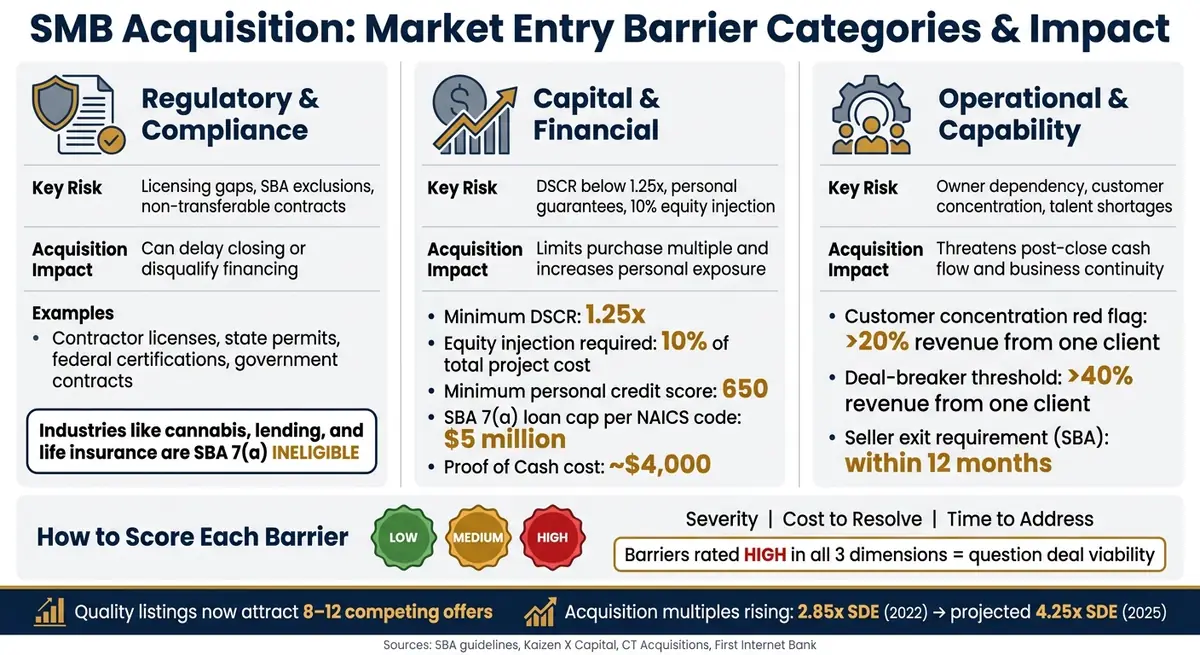
With your acquisition thesis in place, the next move is to break down and analyze the obstacles that could hinder a successful market entry. Organizing these barriers into three main categories helps simplify the process and lays the groundwork for assessing risks and refining your due diligence.
Regulatory and Compliance Barriers
This category often presents hurdles like licensing and contract transferability. For instance, lacking the necessary industry license — whether it's a contractor's license, state permit, or federal certification — can lead to lenders declining to finance the deal altogether. Similarly, contract transferability is crucial. In areas like government contracting or niche trades, contracts and licenses might not be transferable in an asset purchase. In such cases, a stock purchase might be the only way to keep the business running post-acquisition.
If SBA financing is part of your plan, additional challenges may arise. Certain industries, such as cannabis, lending, or life insurance, are entirely excluded from SBA 7(a) eligibility. If your target business falls into one of these excluded categories, you'll need to line up alternative financing from the start. This can significantly alter the deal's financial structure. On the flip side, these regulatory complexities can deter other buyers, creating opportunities for those who are well-prepared to navigate them.
Capital and Financial Barriers
Next, evaluate the financial requirements tied to the deal. These barriers go beyond just the purchase price. For example, SBA deals require a 10% equity injection of the total project cost. This can often be structured as 5% cash and 5% seller note held on standby for two years, which reduces the immediate cash needed.
Lenders also have strict financial benchmarks. A debt service coverage ratio (DSCR) of at least 1.25x, based on historical tax returns, is typically required. Additionally, personal credit scores need to be above 650, and personal guarantees often put primary assets at risk if business collateral falls short.
"Capital stack design is the most under-engineered piece of small-business acquisitions. Buyers spend months negotiating multiple and structure on the deal side, then casually accept whatever the SBA bank approves on the financing side." — Christoph Totter, Managing Partner, CT Acquisitions
Operational and Capability Barriers
Operational challenges are often underestimated during due diligence. One major risk is owner dependency. If the seller is the business's primary relationship builder, salesperson, or technical expert, their departure could destabilize operations. SBA rules also mandate that sellers exit within 12 months unless they retain rollover equity.
Customer concentration is another red flag. SBA lenders typically prefer that no single customer accounts for more than 20% of total revenue. Exceeding this threshold complicates financing and raises concerns about long-term cash flow stability. Additionally, finding and retaining skilled employees is one of the biggest operational risks in small businesses today. If the business relies on specialized labor that is hard to find locally — especially in underserved areas — this challenge must be carefully weighed when structuring the deal.
| Barrier Category | Key Risk | Acquisition Impact |
|---|---|---|
| Regulatory | Licensing gaps, SBA exclusions, non-transferable contracts | Can delay closing or disqualify financing |
| Financial | DSCR below 1.25x, personal guarantees, 10% equity injection | Limits purchase multiple and increases personal exposure |
| Operational | Owner dependency, customer concentration, talent shortages | Threatens post-close cash flow and business continuity |
Breaking down these barriers and understanding their potential impact is a critical step in fine-tuning your due diligence and shaping the terms of your acquisition deal.
Step 3: Measure Barrier Impact and Assess Feasibility
After identifying and categorizing barriers in Step 2, the next step is to quantify them in terms of cost, time, and risk. This is where many buyers falter — they recognize barriers but fail to translate them into concrete numbers. Without this, deciding whether a deal is worth pursuing becomes almost impossible.
Score Barriers for Decision-Making
Start by rating each barrier based on its severity, cost to resolve, and time required for resolution using a simple scale: low, medium, or high. For example, a barrier that takes 30 days and costs $2,000 to address is vastly different from one requiring 18 months of federal approval. Treating both as equal skews your understanding of the risks involved.
Once you've rated the barriers, stack-rank them. Barriers that score high in all three dimensions should prompt a serious discussion about whether the deal is even viable. Medium-rated barriers can often become points of negotiation, while low-rated ones are usually manageable after the deal closes.
Assess Financial Implications
Every barrier carries a financial cost, and turning qualitative concerns into specific dollar amounts is critical. For instance, if the business needs a $200,000 equipment upgrade to meet industry standards, this directly impacts your Normalized Free Cash Flow (NFCF) and, as a result, your Debt Service Coverage Ratio (DSCR).
"EBITDA is NOT true cash flow. And relying on it without understanding its limitations can lead to costly mistakes." — Matt DePaola, Fundamental Investing Institute
NFCF is a better metric than EBITDA for analyzing barriers because it considers the actual capital expenditures (CapEx) required to maintain or expand into a market. EBITDA, on the other hand, only reflects operating profit on paper. If the costs of addressing a barrier push your DSCR below lender thresholds, the deal's financial foundation collapses — no matter how attractive the valuation multiple may seem.
To avoid surprises, allocate around $4,000 for a Proof of Cash as soon as you sign the Letter of Intent. This quick financial check can help uncover potential red flags before you dive into full due diligence.
With these financial impacts quantified, you can now evaluate whether the costs also provide strategic advantages.
Weigh Feasibility Against Defensibility
After understanding the financial implications, the next question is whether these barriers create a strategic moat or simply add unnecessary complexity. Some barriers protect your profitability once you're in the market. The key question to ask is: does this barrier provide a competitive edge, or is it just a burden?
For example, a complex licensing process that took the current owner years to navigate can act as a competitive advantage after the acquisition. Similarly, high capital requirements that deter less-funded competitors might justify a higher purchase price — especially if the business generates contractually recurring revenue or has strong net-revenue retention. On the flip side, barriers that strain your DSCR without offering any strategic benefits are pure risk.
One clear indicator that a barrier is defensible rather than disqualifying is the presence of middle management capable of running operations independently. Additionally, a diversified revenue base that can weather the transition period strengthens the case. When these conditions are met, even high-barrier markets can become attractive opportunities.
Step 4: Apply Barrier Insights to Deal Strategy
Now that you've assessed barriers and evaluated their financial impact, it's time to weave these insights into your deal strategy. The goal is to turn your analysis into actionable steps during due diligence, deal structuring, and post-close planning.
Run Barrier-Specific Due Diligence
Generic due diligence checklists often overlook critical details tied to specific barriers. Instead, create a targeted workplan that addresses the challenges you've identified. For instance, in industries requiring licenses — like HVAC, electrical contracting, or pest control — ensure all permits and credentials are up-to-date, transferable, and tied to the business itself rather than the owner. If a license is personally held by the seller, it could signal a major hurdle during the transition.
Customer concentration is another area that requires detailed scrutiny. If a few clients contribute a significant portion of revenue, consider speaking directly with these customers. This can help you determine whether their loyalty stems from the product or service itself, or from a personal connection with the founder.
When underwriting deals, rely on tax returns rather than just the Confidential Information Memorandum. Heather Endresen, Owner of Viso Business Capital, emphasizes:
"The most important risk metric in most deals is not DSCR. It's working capital."
Additionally, conduct a Proof of Cash early in the post-LOI phase to verify financial details and uncover any revenue inconsistencies.
Adjust Deal Terms to Reflect Barrier Risk
The barrier scoring from Step 2 should directly influence your deal structure. For example, if the seller holds a critical license that you can't immediately replicate, consider securing at least 1% rollover equity. This keeps the seller involved beyond the standard 12-month period, giving you time to obtain the necessary credentials.
In cases where customer concentration poses a risk, structure an earnout tied to customer retention. This ensures the seller remains motivated to help maintain key relationships during the transition.
On the financing side, work with lenders to negotiate terms that account for barrier risks. For example, arrange a seller note that stays on full standby for 24 months. Jared Johnson of First Internet Bank explains:
"With us, if the seller note is on standby for two years, we don't include it in debt service coverage. That's a huge difference from some lenders that still include it."
This strategy can help you meet lender requirements while managing the financial impact of unresolved barriers. Once you've tailored the deal terms, focus on turning these challenges into strategic advantages after the acquisition.
Use Barriers to Your Advantage Post-Acquisition
Barriers don't have to remain obstacles — they can become strategic assets. After addressing them in due diligence and structuring the deal to account for risks, aim to leverage these barriers to strengthen your competitive position. For example, institutionalize compliance processes to turn regulatory or operational complexities into assets. Similarly, work on systematically transferring key relationships from the seller to your team to ensure continuity.
Implement a structured 100-day plan that prioritizes quick wins, thorough financial reporting, and team evaluations. This will help stabilize the business and set the stage for growth. Preserving working capital during this transition isn't just about having a safety net — it's essential for enabling operational improvements that competitors might struggle to implement.
Conclusion: Making Confident Market Entry Decisions
Evaluating market entry barriers is an ongoing process woven into every stage of acquiring an SMB. From identifying your target market, assessing competitors, and evaluating barriers to scoring their impact, testing your financial resilience, and integrating these insights into due diligence and deal structuring, each step builds on the last. The ultimate aim? Understand exactly what you're stepping into before committing your capital. These steps lay the groundwork for focused due diligence and thoughtful deal structuring.
As highlighted earlier, normalized free cash flow and working capital metrics play a key role in validating your financial stress tests. Working capital, in particular, stands out as a crucial risk indicator. This metric, combined with your barrier scoring and feasibility evaluations from earlier steps, should guide your final decision to move forward — or not.
The market is growing more competitive, with quality listings now drawing 8–12 offers and median acquisition multiples projected to rise from 2.85x SDE in 2022 to 4.25x SDE by 2025. In such a climate, a disciplined approach to barrier analysis isn't just wise — it gives you an edge.
Technology can make this process far more efficient. Platforms like Clearly Acquired are designed to support structured acquisition strategies. With AI-driven tools such as Clara AI, buyers can automate financial screenings, assess risks, and model valuations — slashing due diligence timelines while identifying potential issues that manual methods might overlook. Additional features like access to over 500 lenders, secure data rooms, and comprehensive M&A advisory services make the process less daunting. Advisory services start at just $49/month.
What may initially seem like obstacles often turn out to be the very factors that make a business worth owning. The most successful buyers don't just overcome these barriers — they leverage them to negotiate smarter deals, structure effectively, and operate with confidence.
FAQs
How do I tell if a barrier is a moat or just a headache?
A moat represents a long-term competitive edge that keeps a business ahead, such as recurring revenue streams or high switching costs that discourage customers from leaving. On the other hand, a headache refers to a short-term problem — like messy bookkeeping or chaotic operations — that can be resolved with improved management practices.
When evaluating a business, ask yourself: Is the business heavily dependent on the founder, or can it run smoothly on its own? Also, consider whether the issue at hand is a fixable obstacle or a sign of a strong, defensible advantage that sets the business apart.
How can I quickly quantify barriers in dollars and DSCR impact?
To assess market entry barriers and their effect on the Debt Service Coverage Ratio (DSCR), it's essential to normalize the target's free cash flow. This involves adjusting for factors like owner compensation, one-time expenses, and anticipated changes after acquisition. Typically, lenders look for a DSCR in the range of 1.25x to 1.30x.
The AI-powered platform from Clearly Acquired simplifies this process by automating financial analysis. It can uncover hidden risks and help you model the dollar-based impacts on your financing needs with greater precision.
When should I structure the deal differently because of licenses or contracts?
When licenses or contracts are essential to a business's operations or revenue stability, it's smart to rethink the deal structure. If these assets rely heavily on the founder's personal connections or might face disruption during a transition, it could affect the business's ability to secure financing. To safeguard cash flow and keep the business stable and attractive to lenders after the sale, consider modifying the capital stack or deal terms to address these potential risks.
Find the right lender for your business
Whether it's working capital, an SBA loan, or acquisition financing — we'll match you with the right capital partner.
About the author
Principal & CEO/CIO
Samson Jagoras has 15+ years across finance, real estate, and business acquisitions. He began his career as a Futures & Commodities broker and later served as Chief Strategy Officer of an INC 500 marketing and technology firm, helping scale revenue from $1M to over $100M. Today he buys, builds, and advises a portfolio of companies with a focus on M&A, capital allocation, and operational strategy.