Capital Gains Tax Rules for Installment Sales
Spread capital gains with seller-financed installment sales—rules on GPR, depreciation recapture, AFR, NIIT, and annual Form 6252 reporting.
 Samson JagorasPrincipal & CEO/CIOJune 11, 2026

Get matched with the right lender for your business
Compare offers from our vetted network. Pre-qualify in minutes — no impact to your credit.
When you sell a business or major asset and receive payments over time instead of upfront, the IRS allows you to use the installment method to spread out your tax liability. This approach can help you manage your tax brackets and avoid higher rates, but it comes with specific rules and exceptions.
Key Takeaways
- Installment Sales: Payments received in future years are taxed proportionally, including capital gains, interest income, and a tax-free return of your basis.
- Depreciation Recapture: Must be paid in the sale year and is taxed as ordinary income.
- Gross Profit Ratio (GPR): Determines the taxable portion of each payment. Formula: GPR = Gross Profit ÷ Contract Price.
- Interest Income: Taxed at ordinary income rates, and the note must meet the IRS’s minimum interest rate (AFR).
- Deferred Tax Risks: If combined installment obligations exceed $5M, additional interest charges may apply under Section 453A.
Benefits:
- Taxes are spread across years, potentially keeping you in lower brackets.
- Helps avoid the 20% long-term capital gains rate and the 3.8% Net Investment Income Tax (NIIT) for high earners.
Challenges:
- Depreciation recapture is taxed upfront.
- Complex reporting (e.g., Form 6252 annually).
- Early payoffs or defaults can accelerate taxable gains.
By understanding these rules, structuring payments wisely, and consulting a tax professional, you can reduce your overall tax liability and manage cash flow effectively.
How Capital Gains Are Calculated in Installment Sales
Calculating Total Gain, Selling Price, and Contract Price
When selling an asset, the selling price is the total amount agreed upon, while the contract price is the selling price minus any qualifying debt the buyer assumes. To determine your adjusted tax basis, start with the original cost of the asset, add any improvements, and subtract depreciation. From the selling price, subtract your adjusted basis, selling expenses (like legal fees or advisory commissions), and any depreciation recapture to calculate your gross profit - essentially, your total realized gain.
If the buyer assumes debt that exceeds your adjusted basis, the excess is taxed in the year of sale. This can result in a gross profit ratio of 100%, making all future principal payments fully taxable. These figures are crucial for managing tax obligations over the life of a seller-financed transaction.
“The IRS pretends installment sales are simple. They’re not. Get the depreciation recapture wrong and the ‘deferred tax’ you thought you were getting becomes a $200K surprise bill in April.” - Christoph Totter, Managing Partner, CT Acquisitions
These calculations directly impact the taxable portion of each installment payment you receive.
Gross Profit Percentage and How Gains Are Taxed Each Year
The Gross Profit Ratio (GPR) is key to determining the taxable portion of each installment payment. It’s calculated as:
GPR = Gross Profit ÷ Contract Price
Here’s an example of a business sale:
| Item | Value |
|---|---|
| Selling Price | $5,000,000 |
| Adjusted Basis | $1,000,000 |
| Selling Expenses | $200,000 |
| Depreciation Recapture (Section 1245) | $500,000 |
| Gross Profit | $3,300,000 |
| Contract Price | $5,000,000 |
| Gross Profit Ratio (GPR) | 66% |
This means that for every $1.00 of principal received, $0.66 is taxable gain, while $0.34 is a tax-free return of basis.
Each installment payment includes three components: interest income (taxed as ordinary income), return of basis (tax-free), and capital gain (taxed at long-term rates, which could reach 20% federally in 2026, plus a potential 3.8% Net Investment Income Tax). It’s important to note that Section 1245 depreciation recapture cannot be deferred and must be paid upfront. Be sure your down payment covers this immediate tax liability.
Additionally, if your total outstanding installment obligations exceed $5,000,000 at year-end and the sale price is over $150,000, the IRS imposes an extra interest charge on deferred tax liability under Section 453A.
Interest Income and the Adequate Stated Interest Requirement
Once you’ve calculated the taxable portions of principal payments, it’s essential to address how interest income is treated. The IRS requires seller-financed notes to include a minimum interest rate, called the Applicable Federal Rate (AFR). This rate is published monthly and varies based on the note’s term: short-term (up to 3 years), mid-term (3–9 years), or long-term (over 9 years). The lowest AFR during the three-month period before the sale closing applies.
If the stated interest rate on your note is lower than the AFR, the IRS enforces imputed interest rules under IRC §1274 or §483. This reclassifies part of your principal payments as interest income, which is taxed at ordinary income rates (up to 40.8%, including the NIIT) instead of capital gains rates. This adjustment also reduces your contract price and increases your GPR, making a larger share of future principal payments taxable.
For seller-financed sales of $7,296,700 or less (adjusted for inflation in 2026), the AFR is capped at 9% compounded semiannually. For land sales between related parties, the cap is 6%. Setting your note’s interest rate at or above the applicable AFR helps avoid these complications.
| Component | Tax Form | Federal Tax Rate (Max) |
|---|---|---|
| Interest Income | Schedule B | 40.8% (incl. NIIT) |
| Capital Gain | Form 6252 → Schedule D | 23.8% (incl. NIIT) |
| Return of Basis | Form 6252 | 0% (Tax-free) |
These calculations lay the groundwork for strategic tax planning in seller-financed transactions, especially over multiple years.
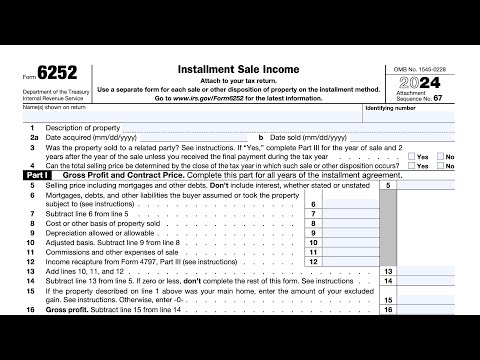
IRS Form 6252 walkthrough (Installment Sale Income)
Special Tax Rules That Apply to Business Installment Sales
Understanding these tax rules is key to structuring seller financing in a way that minimizes tax burdens. While the installment method allows for deferring taxes, there are specific rules that can limit or alter how this deferral works in practice.
Depreciation Recapture and Ordinary Income Tax
One important limitation is that depreciation recapture cannot be deferred. Unlike capital gains, any depreciation recapture must be reported as ordinary income in the year of sale, no matter how much cash is received.
For Section 1245 property (such as equipment, vehicles, machinery, and furniture), the rules are particularly strict. The full recapture amount is taxed immediately at ordinary income rates (up to 37%). Only the remaining gain, after accounting for recapture, qualifies for installment deferral.
Here’s an example: In May 2026, Alex sold a manufacturing business for $2,000,000 with a basis of $800,000. Of the $1,200,000 gain, $350,000 was Section 1245 recapture tied to machinery. Even though Alex received a $500,000 down payment, the entire $350,000 had to be reported as ordinary income on Form 4797. The remaining $850,000 of gain was eligible for installment deferral, based on a 42.5% gross profit ratio.
For Section 1250 property (like commercial real estate), the rules are more favorable. Recaptured depreciation is taxed at a maximum rate of 25% and is recognized proportionally with each installment payment. This makes real estate a better fit for installment sales from a cash flow perspective.
If depreciation recapture applies, it’s smart to structure your down payment to cover the immediate tax liability. Otherwise, you might owe more in taxes than the cash you receive at closing.
These nuances highlight how depreciation rules can create very different tax outcomes for asset sales compared to equity sales.
Asset Sales vs. Equity Sales: Tax Differences
The way a business sale is structured - whether as an asset sale or an equity sale - has a major impact on how much of the gain qualifies for installment deferral.
In an asset sale, different types of assets are taxed differently. For instance:
- Equipment and personal property trigger Section 1245 recapture immediately.
- Goodwill and customer lists generate capital gains, which can be deferred.
- Inventory is taxed as ordinary income in the year of sale.
This mixed treatment means that part of the gain is recognized upfront, regardless of the payment schedule. The allocation of the purchase price across asset categories is documented on Form 8594, which both the buyer and seller must file consistently.
On the other hand, an equity sale (selling stock in a C-corp or S-corp) is simpler for the seller. The entire gain is treated as long-term capital gain, making it fully eligible for installment deferral. Plus, there’s no depreciation recapture at the entity level.
| Feature | Asset Sale | Equity (Stock) Sale |
|---|---|---|
| Gain Recognition | Mixed: part immediate, part deferred | Fully deferrable |
| Depreciation Recapture | Fully recognized in Year 1 (ordinary income) | Often not applicable to seller |
| Tax Rates | Ordinary rates up to 37% + capital gains | Primarily long-term capital gains rates |
| Reporting Complexity | Higher (requires Forms 8594 and 6252) | Lower (usually only Form 6252) |
| Buyer Benefit | Stepped-up basis for depreciation | No step-up; assumes liabilities |
Negotiations often involve price adjustments to account for these tax differences, making the sale structure a critical decision in managing taxes over the life of an installment deal.
High-income sellers also need to consider additional taxes, such as the Net Investment Income Tax.
Net Investment Income Tax on Installment Sale Gains
For high-income sellers, the 3.8% Net Investment Income Tax (NIIT) may apply to the taxable portion of each installment payment, including both capital gains and interest income. This surtax kicks in when your modified adjusted gross income (MAGI) exceeds $200,000 for single filers or $250,000 for married couples filing jointly.
The NIIT is applied annually as income is recognized, not on the total gain at the time of sale. By spreading payments over multiple years, you might be able to keep your MAGI below the threshold in some years and avoid the surtax.
“Spreading the gain keeps each year’s MAGI below the NIIT threshold, avoiding 3.8 percent on the gain.” - Munib Ur Rehman, Author
It’s worth noting that NIIT thresholds are not adjusted for inflation, so more people may become subject to this tax over time. If your income is near these limits, modeling your annual installment income before finalizing the terms can help you reduce your overall tax liability over the course of the deal.
Reporting and Managing Installment Sales Over Time
Managing installment sales—a key part of acquisition financing strategies—involves not just calculating gains but also understanding how to report them and navigate the rules over the life of the sale.
When the Installment Method Is Required and When to Opt Out
By default, the installment method applies to most sales unless they involve losses, dealer dispositions, or publicly traded securities.
If you prefer not to use this method, you can opt out by reporting the entire gain upfront. To do this, include the full gain on Form 8949, Form 4797, or both, when filing your return for the sale year. Importantly, you should not file Form 6252. Keep in mind that once you opt out, the decision is permanent.
Opting out can be beneficial in certain scenarios. For example, if you have significant capital loss carryforwards, these can offset the gain in the first year. Similarly, if you anticipate higher tax rates in the future, reporting the gain immediately can secure the current lower rates. On the other hand, using the installment method can help limit your annual income, potentially keeping it within the 15% long-term capital gains bracket. In 2026, this bracket applies to taxable incomes up to $545,500 for single filers and $613,700 for married couples filing jointly.
However, state-specific rules can complicate things. For example, California requires full gain recognition in the sale year, regardless of federal elections. Always double-check your state’s rules before assuming federal deferral applies.
Once you’ve decided on the method - or whether to opt out - accurate annual reporting becomes key.
Annual Tax Reporting for Installment Sales
Accurate yearly reporting is essential to manage deferred taxes and ensure compliance with installment sale rules. Each year you receive payments, you must file Form 6252 (Installment Sale Income). This form calculates the taxable portion of each payment based on the gross profit ratio determined at the time of sale. The taxable gain is then reported on either Schedule D for capital gains or Form 4797 for business property sales, depending on the nature of the asset.
Here’s a quick breakdown of the forms involved:
| Form/Schedule | Purpose in Installment Sales |
|---|---|
| Form 6252 | Calculates annual taxable gain from installment payments |
| Schedule D | Reports capital gains from installment payments |
| Form 4797 | Reports gains from business property, including recapture amounts |
| Form 8594 | Documents asset allocation in business asset sales (filed at closing) |
| Form 1040, Schedule B | Reports interest income from the installment note |
Form 6252 must be filed every year until the installment note is fully paid, even if you only receive interest that year. Interest income is reported separately on Schedule B and taxed as ordinary income. For larger sales - those exceeding $150,000 with obligations over $5,000,000 - an additional 8% interest charge under Section 453A applies to the deferred tax liability starting in 2026.
Early Payoffs, Defaults, and Note Modifications
Changes in how payments are received can significantly impact the recognition of deferred gains. If the buyer pays off the note early, the remaining gain must be recognized immediately, using the original gross profit ratio. If the buyer defaults, gain recognition stops. For real property repossessions, IRC §1038 limits recognized gain to the cash received minus any gains already reported. Importantly, changes to the note’s terms don’t affect the original gross profit ratio.
Understanding these nuances is critical to managing installment sales effectively and avoiding surprises.
Tax Planning for Multi-Year Seller Notes
A carefully designed seller note can determine when and how much of your gain is taxed each year, making it an essential tool for managing tax liabilities.
Using Gain Deferral to Avoid Tax Bracket Spikes
Installment sales let you spread out the recognition of your gain, taxing it only as principal payments are received. For example, a $2 million gain is taxed incrementally rather than in a single year.
In 2026, the 20% long-term capital gains tax rate applies to income above $545,500 for single filers and $613,700 for joint filers. By structuring payments over five to seven years, many sellers can keep their annual recognized gain within the 15% tax bracket, which can result in substantial savings on a large transaction. Additionally, deferring gains can help some sellers avoid the 3.8% Net Investment Income Tax (NIIT).
However, keep an eye on the total balance of your installment notes. If the combined outstanding balances exceed $5 million at year-end, Internal Revenue Code (IRC) §453A imposes an annual interest charge on your deferred tax liability. Monitoring this aggregate balance across all deals is crucial to avoid unexpected costs.
Now, let’s explore how specific terms of the seller note can impact your taxable income.
How Note Terms Affect Taxable Income
The terms of your seller note - such as interest rate, amortization schedule, and balloon payments - play a significant role in shaping your taxable income.
- Interest Rate: A higher interest rate increases your ordinary income each year since interest is taxed at regular income rates, not capital gains rates.
- Amortization Schedule: A longer schedule limits annual gain recognition by reducing the size of principal payments. However, this also increases your exposure to the risk of buyer default over an extended period.
- Balloon Payments: These can trigger a large taxable gain in a single year, potentially pushing you into the 20% capital gains bracket or exposing you to the NIIT.
One key rule to remember: never use your installment note as collateral for another loan. Under IRC §453A(d), the IRS treats the loan proceeds as a “deemed payment” on the note, which forces immediate recognition of the deferred gain - even if you haven’t received any actual payments.
“The IRS pretends installment sales are simple. They’re not. Get the depreciation recapture wrong and the ‘deferred tax’ you thought you were getting becomes a $200K surprise bill in April.” - Christoph Totter, Managing Partner, CT Acquisitions
How Installment Sales Work with Earnouts and SBA Deals
- Earnouts: These create challenges for installment sales because the final sale price isn’t fixed upfront. Instead, contingent payments like earnouts fall under Treasury Regulation §15A.453-1(c), which uses special rules to determine how much of each payment is taxable. Depending on whether the earnout has a defined maximum price and payment period, you may recover more of your basis earlier in the payment stream, delaying significant gain recognition.
- SBA Financing: Deals involving SBA 7(a) loans often require the seller note to be on full standby - meaning no principal or interest payments - for the first 24 months. While this delays your gain recognition and tax liability, it also defers your cash flow. If you’re counting on installment payments for living expenses or reinvestment, this delay can be a major limitation, so carefully model this scenario before closing.
For sellers navigating these complexities, platforms like Clearly Acquired can help you model the entire capital stack. This includes factoring in seller note terms, SBA financing vs. other options, and earnout provisions, ensuring you understand the tax and cash flow implications before signing. Accurate modeling is essential for managing multi-year seller notes effectively.
Key Takeaways for Business Sellers
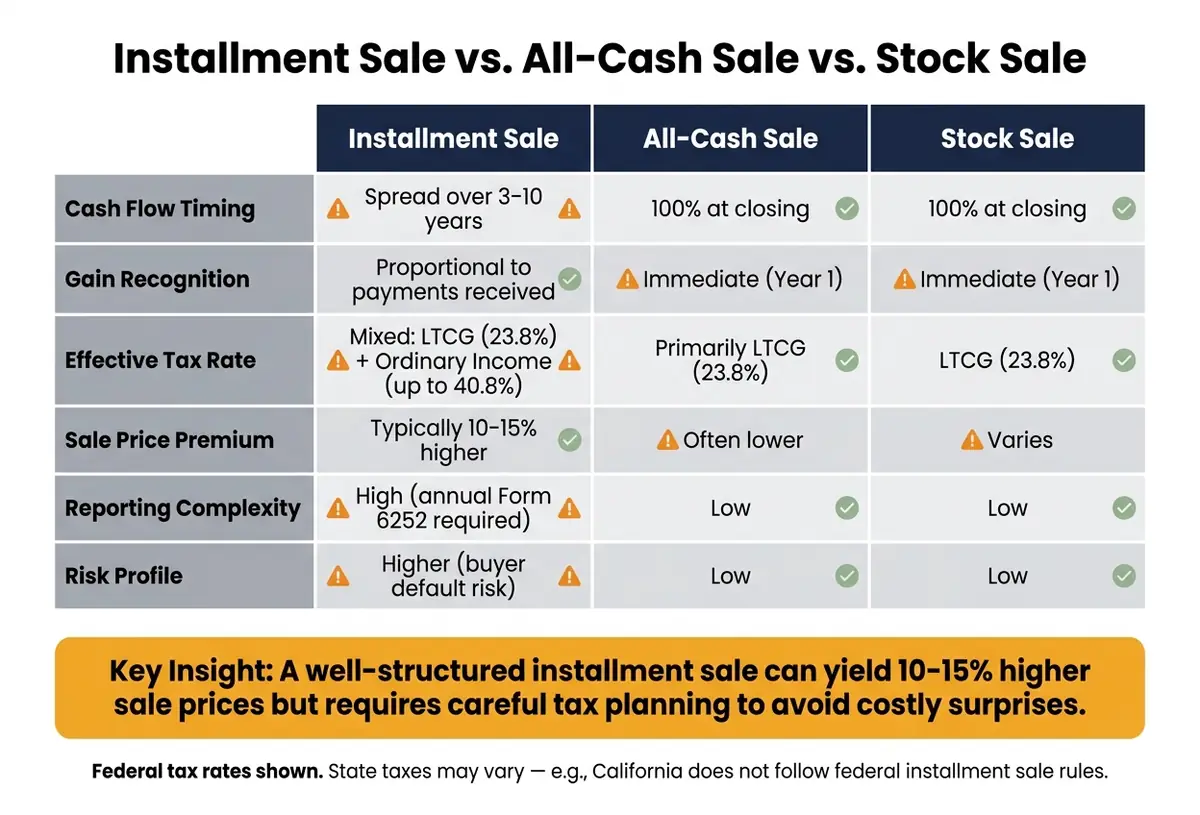
Installment Sale vs. All-Cash Sale: Tax Comparison Guide
When selling a business, understanding the tax implications can make a big difference in what you ultimately take home. Here’s a breakdown of the main points on deferred taxation, immediate liabilities, and timing strategies.
Installment sales provide a tax advantage by spreading out your tax payments over time. Instead of paying taxes on your entire gain in the year of the sale, you pay proportionally as you receive the principal payments. For instance, if you have a $2 million gain, installment payments might keep you in the 15% long-term capital gains (LTCG) bracket, potentially avoiding the higher 20% rate and the 3.8% Net Investment Income Tax (NIIT).
However, not all amounts can be deferred. Section 1245 depreciation recapture is an exception - it’s taxed as ordinary income in the year of the sale. To account for this, ensure your down payment is large enough to cover the immediate tax owed.
Several rules can also shape your overall tax strategy. For example, setting your note’s interest rate at or above the Applicable Federal Rate (AFR) ensures that part of your gain isn’t reclassified as ordinary income. Additionally, keeping total outstanding installment obligations under $5 million at year-end helps you avoid the Section 453A annual interest charge on deferred tax liabilities.
Here’s a quick comparison of installment sales versus all-cash sales:
| Feature | Installment Sale | All-Cash Sale |
|---|---|---|
| Gain Recognition | Proportional to payments received | 100% in the year of sale |
| Tax Rate | Possible 15% LTCG + 0% NIIT | Likely 20% LTCG + 3.8% NIIT |
| Depreciation Recapture | Fully taxed in Year 1 | Fully taxed in Year 1 |
| Complexity | High (requires annual Form 6252) | Low |
| Risk | Buyer default/credit risk | Low (cash in hand) |
Lastly, timing your preparations is crucial. Consult with a CPA or tax attorney 12 to 24 months before you plan to sell, not after signing a Letter of Intent (LOI). Decisions about asset allocation and state residency can have a big impact, but many options disappear once the deal is finalized. Running detailed models to compare the after-tax outcomes of an installment sale versus an all-cash deal before signing the LOI is one of the smartest steps you can take.
FAQs
When does an installment sale not qualify for tax deferral?
An installment sale cannot defer taxes in the following situations:
- If the sale results in a loss, the entire loss must be reported in the year of the sale.
- Transactions involving inventory, dealer dispositions, or property held specifically for sale to customers are not eligible.
- Stock or securities traded on established markets do not qualify.
Depreciation recapture under IRC Section 1245 must be fully recognized in the year of the sale, even if other gains are deferred.
How do I calculate the taxable gain in each installment payment?
To figure out the taxable gain, start by calculating your Gross Profit Ratio (GPR). This is done by dividing your total gross profit by the contract price. Gross profit is determined by subtracting your adjusted basis, selling expenses, and any depreciation recapture (which is fully recognized in the year of sale) from the selling price. Once you have the GPR, multiply it by the principal portion of each payment to determine the taxable gain. Keep in mind, any interest you receive is taxed separately as ordinary income.
What events can trigger immediate tax on the remaining deferred gain?
Several situations can lead to the immediate recognition of deferred gains under the installment method:
- Depreciation recapture under Section 1245 is fully taxable in the year the sale occurs.
- Using the installment note as loan collateral is considered a constructive payment, which triggers the gain.
- When property is sold to a related party, and that party sells it within two years, the deferred gain becomes taxable right away.
Find the right lender for your business
Whether it's working capital, an SBA loan, or acquisition financing — we'll match you with the right capital partner.
About the author
Principal & CEO/CIO
Samson Jagoras has 15+ years across finance, real estate, and business acquisitions. He began his career as a Futures & Commodities broker and later served as Chief Strategy Officer of an INC 500 marketing and technology firm, helping scale revenue from $1M to over $100M. Today he buys, builds, and advises a portfolio of companies with a focus on M&A, capital allocation, and operational strategy.