Form 6252: Reporting Installment Sale Income
Clear, practical guide to Form 6252: when to file, splitting principal vs interest, depreciation recapture, related-party rules, and annual reporting.
 Samson JagorasPrincipal & CEO/CIOJune 23, 2026
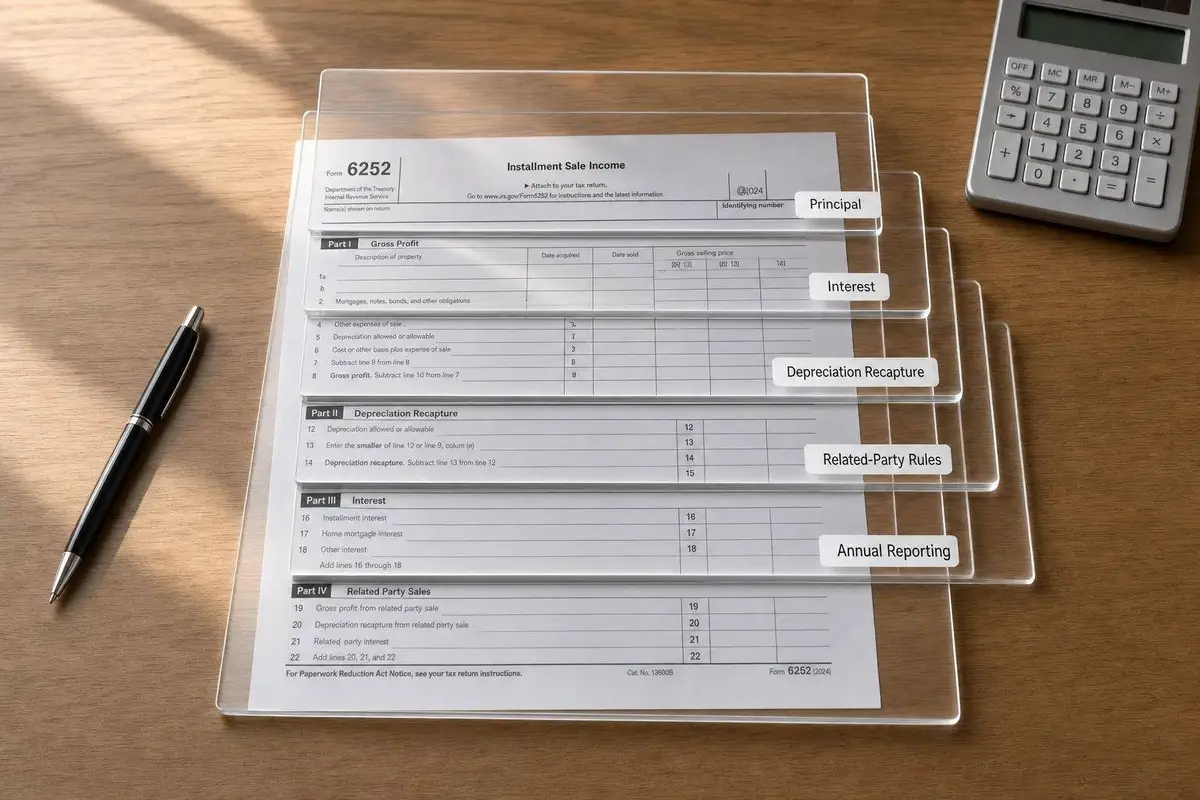
Sell a business or property and let the buyer pay you over time, and you don’t report the whole gain in year one. Instead, you report gain as you collect — and the form that makes that work is IRS Form 6252, Installment Sale Income. For seller-financed deals, it can spread tax over several years, smooth cash flow, and sometimes lower the overall rate.
If I had to sum up this guide in one line, it would be this: figure your gross profit percentage once, apply it to the principal you collect each year, keep interest off the form, and watch out for depreciation recapture and related-party rules. Get those four things right and Form 6252 is straightforward.
Here’s what this article covers:
- When you must (and can’t) use Form 6252 — the installment method basics
- Gross profit percentage — the one calculation that drives every year
- Principal vs. interest — what goes on Form 6252 and what goes on Schedule B
- Depreciation recapture — why some gain is taxed up front in year one
- Related-party rules — the traps under Section 453 that can accelerate gain
- Annual reporting — filing every year until the note is paid off
- SMB deal context — how this plays out in real seller-financed acquisitions
A few points matter most right away:
- Depreciation recapture is taxed in full in the year of sale — it can’t be spread out
- Interest is never reported on Form 6252; it always goes on Schedule B
- You file Form 6252 every year you receive a payment, even if that year’s payment is $0 in a standby period
- Sale prices above $150,000 may trigger a Section 453A interest charge on deferred tax
- Selling to a related party can collapse the deferral if they resell within two years
What Form 6252 Is and When You File It
Form 6252 reports income from an installment sale — a sale of property where you receive at least one payment after the tax year of the sale. The installment method lets you recognize gain proportionally as you collect the sale price, rather than all at once. That is the default treatment for most eligible sales, so if you do nothing, the installment method usually applies.
You generally file Form 6252 when all of these are true:
- You sold property at a gain.
- You will receive at least one payment in a tax year after the year of sale.
- You are not electing out of the installment method.
Some sales don’t qualify. The installment method cannot be used for sales of inventory, sales of stock or securities traded on an established market, or sales that result in a loss. Dealer dispositions are also generally excluded. When the method doesn’t apply, the gain is reported in full in the year of sale on Schedule D or Form 4797 instead.
IRS Form 6252 walkthrough (Installment Sale Income)

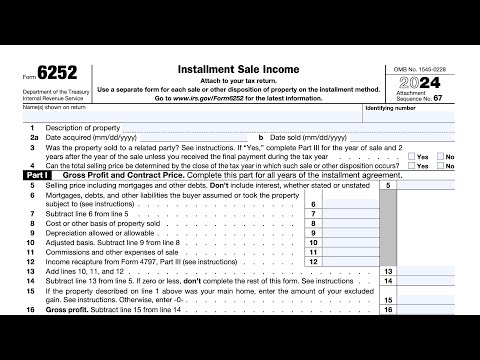
The form itself is short, but the order of operations matters. Part I establishes the gross profit and the contract price for the year of sale. Part II calculates the installment sale income to report for the current year. Part III applies only when you sold to a related party. Walking through it once with real numbers — as in the video above — makes the mechanics click.
The One Calculation That Matters: Gross Profit Percentage
Everything on Form 6252 flows from a single ratio: the gross profit percentage. You calculate it once, in the year of sale, and apply it to the principal you collect every year afterward.
The building blocks are:
- Selling price — the total you’ll receive, including the note, cash, and any liabilities the buyer assumes.
- Adjusted basis — your cost in the property, plus selling expenses, plus any depreciation recapture income.
- Gross profit — selling price minus adjusted basis (and selling expenses).
- Contract price — generally the selling price reduced by certain assumed liabilities.
The formula is:
Gross profit percentage = Gross profit ÷ Contract price
Each year, multiply that percentage by the principal payments you received to get the gain to report. A quick example: you sell for $1,000,000 with a $400,000 basis (no recapture). Gross profit is $600,000 and the contract price is $1,000,000, so the gross profit percentage is 60%. If you collect $200,000 of principal this year, you report $120,000 of installment sale income (60% × $200,000). The remaining $80,000 of principal is a tax-free return of your basis.
| Term | What it means | In the example |
|---|---|---|
| Selling price | Total consideration received | $1,000,000 |
| Adjusted basis | Cost + selling expenses + recapture | $400,000 |
| Gross profit | Selling price − adjusted basis | $600,000 |
| Contract price | Selling price less qualifying assumed debt | $1,000,000 |
| Gross profit % | Gross profit ÷ contract price | 60% |
| Gain on $200k principal | Gross profit % × principal collected | $120,000 |
Splitting Principal vs. Interest
This is where filers slip up most often. A buyer’s payment is almost always part principal and part interest, and the two are taxed in completely different places.
- Principal — the part that pays down the sale price. Only principal flows through the gross profit percentage on Form 6252.
- Interest — the cost of financing. Interest is ordinary income and is reported on Schedule B, never on Form 6252.
If the note doesn’t charge adequate interest, the IRS can impute it under the imputed-interest and original-issue-discount rules, recharacterizing part of your “principal” as interest. That generally hurts the seller, because interest is taxed at ordinary rates and doesn’t benefit from any capital-gain treatment. Setting a market interest rate in the note up front avoids the surprise.
Depreciation Recapture: Taxed Up Front
Here is the rule that catches business sellers off guard: depreciation recapture cannot be spread over the installment period. Any ordinary-income recapture under Sections 1245 or 1250 is reported in full in the year of sale, even if you collect little or no cash that year.
Mechanically, the recapture amount is treated as gain in the year of sale and is also added to your basis for purposes of the installment calculation. That increases your adjusted basis, lowers your gross profit percentage, and means only the gain above recapture gets the installment deferral. The practical takeaway: if you’ve taken heavy depreciation on equipment or real property, expect a taxable hit in year one regardless of your payment schedule — and plan cash to cover it.
Ready to Make Your Next Move?
Whether you're buying, selling, or investing — Clearly Acquired gives you the tools, data, and support to close with confidence.
Related-Party Rules Under Section 453
Selling on installments to a related party — a spouse, child, controlled entity, or similar — comes with anti-abuse rules designed to stop families from deferring tax indefinitely. Part III of Form 6252 exists for exactly this situation.
The core trap: if a related buyer resells the property within two years of your sale, the second sale can accelerate your remaining deferred gain, treating those proceeds as if you received them. There are also special rules for installment sales of depreciable property to a controlled entity, which can deny installment treatment altogether. Sales of more than 50% controlled entities generally don’t qualify for installment treatment under IRC §453(g).
None of this means related-party installment sales are off-limits — they just need careful structuring and documentation, ideally with tax counsel involved before signing.
Annual Reporting Until the Note Is Paid
Form 6252 isn’t a one-and-done filing. You attach it to your return for the year of sale and for every later year in which you receive a payment on the note. In the year of sale you complete Parts I and II; in later years you typically complete Part II only, applying the same gross profit percentage to that year’s principal.
A few ongoing details to track:
- Keep filing even during standby or interest-only periods — report $0 of principal if that’s what you collected, but keep the schedule alive.
- For sales over $150,000, a Section 453A interest charge may apply on the deferred tax once your outstanding installment obligations exceed $5,000,000 at year-end.
- If the buyer defaults and you repossess, there are separate rules for calculating gain or loss on the repossession.
- Keep meticulous records of basis, gross profit percentage, and principal collected each year — you’ll need them until the note is retired.
Electing Out: When Full Gain Recognition Makes Sense
The installment method is the default, but you can elect out and report the entire gain in the year of sale. You might do that if you have offsetting losses or expiring carryovers to absorb the gain, if you expect tax rates to rise, or if you simply want to avoid years of extra filings. The election is generally made by the due date (including extensions) of the return for the year of sale, and it’s difficult to revoke — so model it carefully first.
| Factor | Installment Sale (Form 6252) | Full Gain Recognition (Electing Out) |
|---|---|---|
| Cash flow impact | Taxes paid as cash is received — preserves liquidity | Large tax bill in year 1 — may exceed cash received at close |
| Tax liability timing | Spread over the life of the note (often 3–10 years) | 100% recognized in the year of sale |
| Reporting complexity | High — annual Form 6252 + recordkeeping | Low — one-time reporting on Schedule D / Form 4797 |
| Risk | Buyer default risk; tax rates may rise in future | No future tax risk; simplifies all future filings |
| Key note | File Form 6252 every year, even during standby periods with $0 received | Simpler but can create immediate liquidity pressure |
Applying Form 6252 to Seller-Financed SMB Deals

Seller financing is common in small and mid-market business sales, and Form 6252 is how the seller’s tax follows the money. A typical structure: the buyer puts down cash at close and signs a promissory note for the balance, paying principal and interest over three to seven years. The seller reports gain on the principal as it’s collected, books interest on Schedule B, and recognizes any depreciation recapture up front.
What this means in practice for a deal:
- Allocation matters. The purchase price allocation across assets (equipment, goodwill, real estate) drives how much gain is recapture vs. capital gain — negotiate it deliberately.
- Down payment sizing. A large down payment can create a year-one tax bill that exceeds the cash collected once recapture is layered in.
- Interest rate. Set a market rate so the IRS doesn’t impute interest and recharacterize principal.
- Threshold awareness. Above $150,000, keep the Section 453A interest charge on your radar; interest always lands on Schedule B, never Form 6252.
For buyers and sellers structuring seller-financed acquisitions, getting the tax treatment modeled before the LOI stage avoids unpleasant surprises at filing time. Clearly Acquired helps source, structure, underwrite, and finance these deals — including the seller-note mechanics that flow onto Form 6252.
Conclusion
Form 6252 turns a multi-year payout into a manageable, year-by-year tax story. Calculate the gross profit percentage once, apply it only to principal, keep interest on Schedule B, recognize depreciation recapture in year one, and mind the related-party and Section 453A rules. Do that, and the installment method does exactly what it’s designed to do: align your tax with your cash.
If you’re weighing seller financing on a purchase or sale, run the numbers both ways — installment vs. electing out — before you sign. Clearly Acquired can help you structure, finance, and close the deal with the tax treatment built in from the start.
FAQs
Do I file Form 6252 every year?
Yes. You file it for the year of sale and for every later year in which you receive a payment on the installment note. Even in a standby or interest-only year where you collect no principal, keep the schedule alive — you report it until the note is fully paid.
Where does the interest portion of a payment go?
Interest never goes on Form 6252. It’s ordinary income reported on Schedule B. Only the principal portion of each payment flows through the gross profit percentage on Form 6252.
Can depreciation recapture be spread over the installment period?
No. Section 1245 and 1250 depreciation recapture is taxed in full in the year of sale, regardless of how little cash you collect that year. It also increases your basis for the installment calculation, which lowers your gross profit percentage on the remaining gain.
What happens if I sell to a related party?
Special rules in Part III apply. If the related buyer resells the property within two years, your remaining deferred gain can be accelerated. Sales of depreciable property to a more-than-50% controlled entity generally don’t qualify for installment treatment at all. Structure these carefully with tax counsel.
About the author
Principal & CEO/CIO
Samson Jagoras has 15+ years across finance, real estate, and business acquisitions. He began his career as a Futures & Commodities broker and later served as Chief Strategy Officer of an INC 500 marketing and technology firm, helping scale revenue from $1M to over $100M. Today he buys, builds, and advises a portfolio of companies with a focus on M&A, capital allocation, and operational strategy.