Escrow Dispute Resolution: Key Contract Clauses
Well-drafted escrow clauses prevent costly post-close disputes. Learn objective release triggers, notice and cure timelines, deadlock handling, and resolution methods.
 Samson JagorasPrincipal & CEO/CIOMay 29, 2026

Escrow disputes often arise from unclear terms or unmet conditions, making well-drafted agreements essential. Whether you're buying or selling a business, the right clauses can prevent costly delays and disagreements. Here's what you need to know:
- What is an Escrow Agreement? A neutral third party holds funds or assets until both parties fulfill their obligations.
- Why Disputes Happen: Common triggers include price reductions during due diligence, unclear release terms, and unmet conditions.
Key Clauses to Include:
- Clear Release Conditions: Use measurable milestones, not vague terms like "satisfactory."
- Notice and Cure Periods: Define timelines for raising and resolving objections.
- Deadlock Handling: Provide instructions for unresolved disputes, such as holding funds until arbitration or expert review.
- Resolution Methods: Options include expert determination (fastest), arbitration, or litigation (slowest and costliest).
- Cost Considerations: Agreements should address who pays fees, how interest is allocated, and protections for escrow agents.
Disputes are expensive, but clear, precise clauses can save time, money, and headaches. Nail down the details upfront to protect your deal.
Key Contract Clauses for Escrow Dispute Resolution
When disputes arise in escrow agreements, having the right contract clauses in place can make all the difference. These clauses outline clear procedures for resolving conflicts and ensure that both parties are protected. Below are the key terms that play a critical role in dispute resolution.
Release Conditions and Objective Triggers
One of the biggest sources of escrow disputes is vague release language. Terms like "satisfactory" are open to interpretation and often lead to disagreements. Instead, it's better to use measurable, objective criteria.
For example, link disbursement to specific milestones, such as completing a training period, obtaining lien releases, securing formal SBA loan authorization, or getting an independent appraisal for transactions exceeding $250,000.
In SBA-financed acquisitions, release conditions should align with the lender's closing checklist. As Alex Lubyansky, Esq., Managing Partner of Acquisition Stars, explains:
"The purchase agreement must satisfy both state commercial law and SBA SOP requirements."
In practice, this means escrow release triggers in SBA deals often include completing a full-standby agreement and meeting all SBA compliance conditions before any funds are released. Once these triggers are clearly defined, structured notice and cure periods can help address disputes that may arise.
Notice, Objection, and Cure Periods
Even with well-defined release conditions, disputes can still occur. This is where notice, objection, and cure period clauses come into play. These clauses establish a formal process for resolving disagreements before they escalate.
For instance, if a buyer believes the seller hasn't fulfilled an agreed-upon condition - such as completing a transition period - they must raise their concerns in writing within a specified timeframe. This written objection then triggers a response period, giving the other party a chance to address or resolve the issue. During this time, funds remain in escrow until the matter is resolved, either through mutual agreement or legal action. To avoid confusion, it's crucial to document all contingency deadlines and understand the SBA loan process in the purchase agreement, making timelines clear and disputes easier to manage.
When disputes reach a standstill, deadlock handling clauses are essential.
Deadlock Handling and Hold Instructions
In cases where disputes cannot be resolved through standard procedures, hold instructions offer a safeguard. Without clear instructions, the escrow agent may be left in a difficult position. These instructions direct the agent to keep the disputed funds in a neutral account until the issue is resolved, whether through negotiation, arbitration, or court judgment.
A common example is indemnity escrows, which typically hold 5% to 12% of the purchase price for 12 to 24 months after closing. If a claim notice is filed during this period, the escrow agent retains the disputed amount until the matter is resolved. This structure protects buyers from surprises like undisclosed liabilities or non-compete violations while giving sellers a timeline for when they can expect the remaining funds.
"If the seller violates the non-compete or undisclosed liabilities surface, the buyer's remedies depend on what was negotiated into the purchase agreement." - Alex Lubyansky, Esq., Managing Partner, Acquisition Stars
For hold instructions to work effectively, the purchase agreement must outline specific remedies. The escrow agent is then bound to follow only the instructions detailed in the agreement, ensuring a clear and neutral process for both parties.
How Escrow Disputes Get Resolved
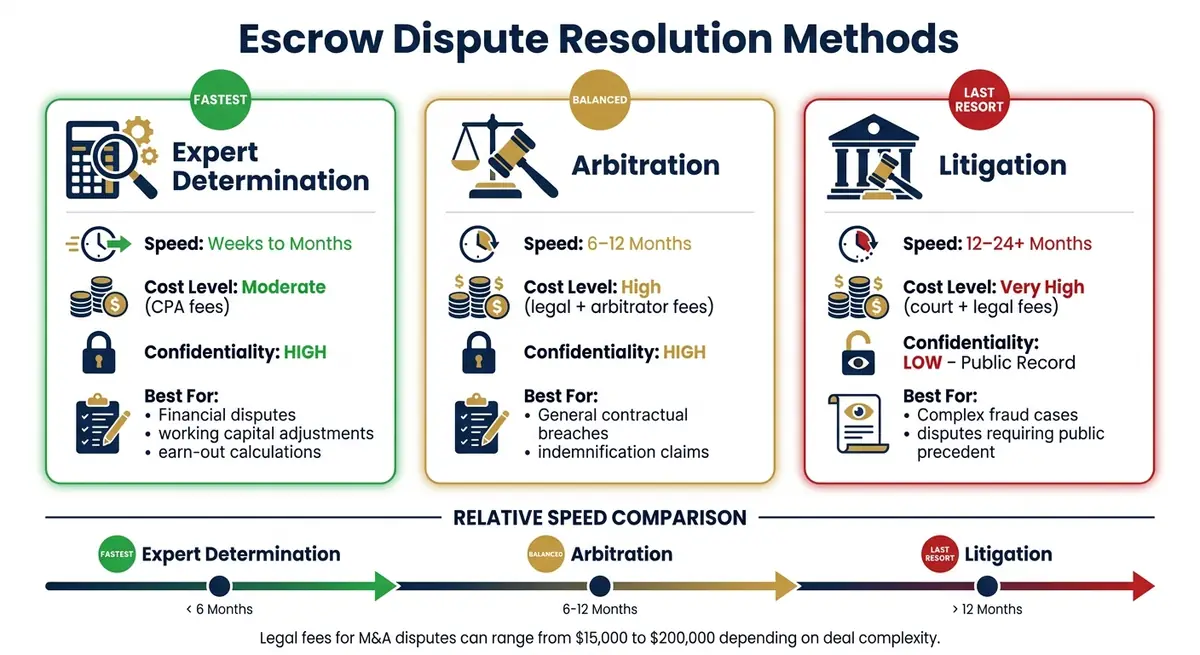
Escrow Dispute Resolution Methods: Speed, Cost & Confidentiality Compared
When standard hold instructions and objection periods fail to resolve a dispute, the purchase agreement often outlines specific steps for escalation. These predefined procedures help ensure disputes are resolved in a timely and consistent manner.
Arbitration, Litigation, and Expert Determination
Escrow disputes are typically resolved through three main approaches. Expert determination is the quickest and most efficient option for financial disagreements, such as working capital adjustments or earn-out calculations. In this process, a CPA or independent financial expert reviews the data and delivers a binding decision, usually within a few weeks or months. Arbitration, on the other hand, is better suited for broader issues like contractual breaches or indemnification claims. This process involves a private judge and generally takes 6 to 12 months. Finally, litigation is the slowest and most costly route, often stretching over 12 to 24 months or longer. Additionally, litigation makes all details public, which can pose challenges when sensitive business information is involved.
| Method | Speed | Cost | Confidentiality | Best Used For |
|---|---|---|---|---|
| Expert Determination | Weeks to months | Moderate (CPA fees) | High | Financial disputes, working capital adjustments, earn-out calculations |
| Arbitration | 6–12 months | High (legal + arbitrator fees) | High | General contractual breaches, indemnification claims |
| Litigation | 12–24+ months | Very high (court + legal fees) | Low (public record) | Complex fraud cases or disputes requiring public precedent |
These resolution methods complement earlier objection and cure periods, creating a structured framework to address conflicts.
Earn-outs are one of the most common sources of disputes. These typically account for 10% to 30% of the deal value, and disagreements often arise from what CT Acquisitions describes as post-close operational manipulations - situations where the buyer's decisions after the deal closes impact the seller's ability to meet their earn-out targets.
"Earn-out pitfalls [include] operational misalignment, post-close disputes, [and] measurement gaming." - CT Acquisitions
The Escrow Agent's Role During a Dispute
Once a dispute arises, the escrow agent's role becomes pivotal. They transition from a passive administrator to a strictly neutral custodian, adhering to the hold instructions until the issue is resolved. The agent does not take sides, make decisions, or release funds based on requests from one party alone.
For post-close adjustments like working capital true-ups, both parties must agree on the final numbers, or an expert must issue a determination before any funds are released. In cases involving SBA-financed deals, the process is even more complex. The escrow agent must ensure that any disbursements comply with SBA Standard Operating Procedure (SOP) requirements before releasing funds. This is why involving lender counsel early in the process can help avoid complications later.
Ready to Make Your Next Move?
Whether you're buying, selling, or investing — Clearly Acquired gives you the tools, data, and support to close with confidence.
Cost Considerations and Added Protections
When discussing dispute resolution in escrow agreements, it's equally important to consider the financial aspects and safeguards in place. These financial terms directly affect the bottom line for all involved parties. Two key areas stand out: how the escrow agent's liability is handled if things go wrong, and who ultimately shoulders the costs of resolving disputes.
Escrow Agent Liability Limits and Indemnification
Escrow agents typically limit their liability to instances of gross negligence or willful misconduct. In simpler terms, as long as the agent follows the written instructions in good faith, they are usually protected from financial repercussions - even if a dispute arises.
Indemnification clauses are another layer of protection for escrow agents. These clauses require both the buyer and seller to shield the agent from any losses, legal fees, or liabilities that result from conflicting instructions. For example, if a dispute forces the agent to hire legal counsel to navigate competing claims, the parties involved are responsible for covering those costs.
Fees, Interest, and Cost Allocation
The way costs are distributed plays a significant role in how disputes are resolved. Typically, fees associated with dispute-related escrow services are split equally between the parties. Interest earned on escrow funds may be allocated to the eventual recipient, divided between both parties, or used to offset fees. These details, while seemingly minor, can have a notable impact on the overall cost of a dispute.
Another critical aspect is the inclusion of attorneys' fees clauses. Many agreements feature a prevailing party provision, which requires the losing party to cover the legal expenses of the winning side. As Promise Legal explains:
"The guarantee itself is SBA Form 148... includes a federal-law choice-of-law clause that governs when SBA is the holder of the note, a sweeping waiver of defenses, and an attorneys'-fees-and-costs provision that obligates the guarantor to reimburse every dollar the lender spends enforcing the instrument."
Considering that legal fees for mergers and acquisitions can range from $15,000 to $200,000, depending on the complexity of the deal, a prevailing party clause can significantly influence the financial dynamics of a dispute. In some cases, it may even discourage frivolous objections from being raised in the first place.
Conclusion: Writing Clear Dispute Resolution Clauses
Escrow disputes don't just happen out of thin air. They almost always stem from unclear language, undefined terms, or decisions pushed off to "the definitive agreement." As CT Acquisitions aptly states:
"We'll work that out in the definitive agreement" is the most expensive sentence in M&A.
Ambiguity comes with a steep price tag. For instance, working capital disputes are the top cause of post-close litigation, while earn-outs - often accounting for 10%–30% of the purchase price - frequently rank as the next biggest source of conflict. When the terms governing these elements are left vague, both parties can find themselves locked in costly and time-consuming disputes over issues they thought were resolved.
To avoid these pitfalls, the key is in the drafting. As highlighted earlier, objective terms and defined triggers are essential. For example:
- Clearly define your working capital peg in the LOI.
- Use specific triggers for earn-out releases.
- Lock in details like escrow size, indemnification caps, and standby requirements.
Sellers who approach negotiations with detailed and well-drafted documentation often secure 15%–30% more in net proceeds compared to those who don't. It's not just about maximizing valuation - it's about ensuring the agreed-upon price remains intact from the LOI to closing. Ambiguity opens the door to disputes, and disputes can erode the value of the deal.
As Alex Lubyansky, Esq., Managing Partner at Acquisition Stars, puts it:
"Counsel post-closing without a well-drafted purchase agreement is damage control with limited tools."
The takeaway? Nail down the language before signing. Clear, precise clauses are your best defense against post-close disputes and a surefire way to protect your interests.
FAQs
What should I use as objective escrow release triggers?
To minimize disputes, escrow release triggers should be tied to clear, measurable milestones. Examples include the end of survival periods for indemnification claims, the completion of a post-closing transition, or the settlement of pre-closing liabilities. For working capital adjustments, it's important to use well-defined accounting formulas to reduce potential conflicts. These specific and verifiable events create clarity and help both sides avoid disagreements over payouts.
How long should notice and cure periods be?
Notice and cure periods usually range from 60 to 180 days. These timeframes, along with contractual lockouts, are put in place to safeguard the seller during exclusivity periods. They ensure both parties have enough time to resolve any potential issues.
When should I choose expert determination vs arbitration?
The decision to use expert determination or arbitration hinges on several factors, including the type of dispute, the complexity of the contract, and the level of speed or formality you're looking for. It's always wise to seek advice from legal counsel to identify the most suitable approach for your specific case. Clearly Acquired provides integrated advisory and deal management services, helping entrepreneurs design acquisition agreements that minimize post-closing disputes and streamline resolution processes.
About the author
Principal & CEO/CIO
Samson Jagoras has 15+ years across finance, real estate, and business acquisitions. He began his career as a Futures & Commodities broker and later served as Chief Strategy Officer of an INC 500 marketing and technology firm, helping scale revenue from $1M to over $100M. Today he buys, builds, and advises a portfolio of companies with a focus on M&A, capital allocation, and operational strategy.