How Buyers Verify Revenue with Bank Deposits
Bank deposits must back reported revenue—use 24–36 months of statements, strip non-sales, and flag recurring gaps over ~5%.
 Samson JagorasPrincipal & CEO/CIOSeptember 17, 2026
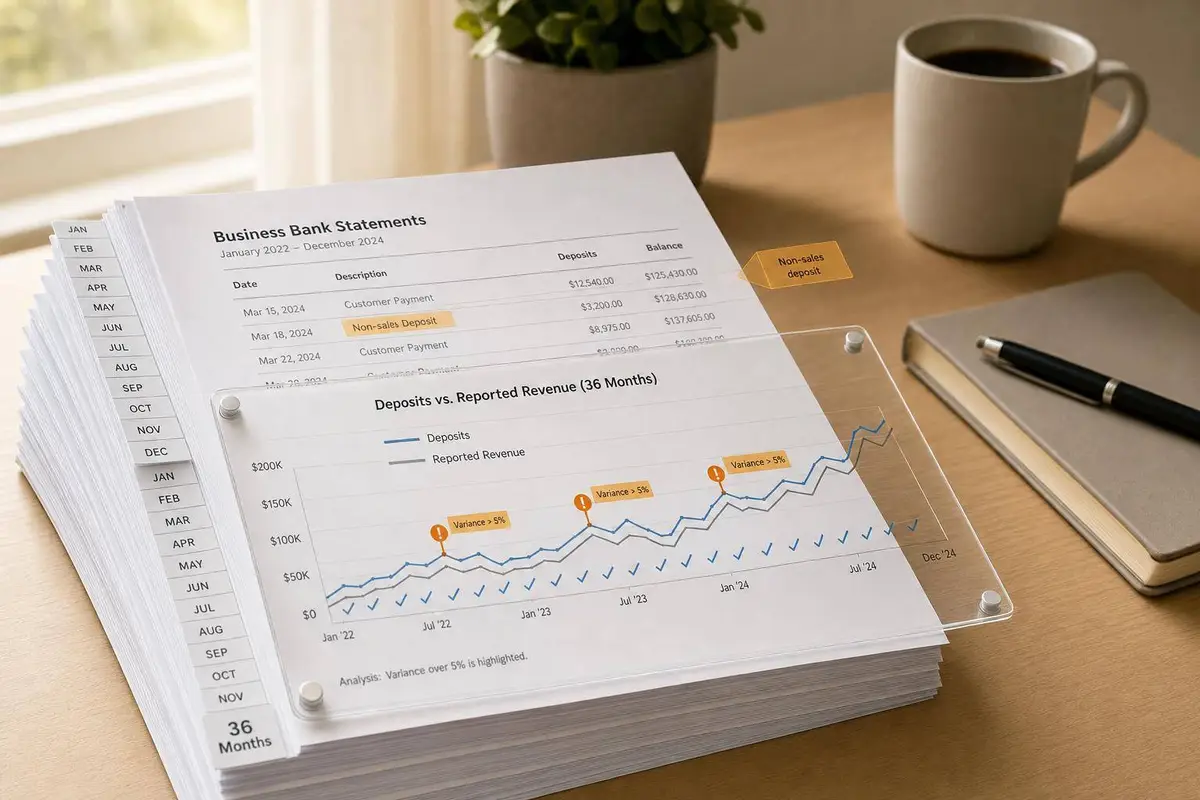
If bank deposits do not support reported revenue, buyers often cut the revenue number, lower the price, or change deal terms. I’d treat deposit testing as a fast first check: pull 24–36 months of bank statements, remove non-sales deposits, match cash and card receipts by month, and flag gaps above about 5%.
Here’s the short version:
- I compare reported revenue to bank deposits month by month
- I remove items that are not sales, like loan draws, owner deposits, and account transfers
- I adjust for timing, since card payouts and checks often land 1–7 days later
- I test cash sales and card sales on separate tracks
- I cross-check deposits with P&Ls, tax returns, processor statements, POS reports, and 1099-Ks
- I treat repeat gaps with no paper trail as a deal issue
A clean match does not prove everything. But it does show whether the cash coming into the business lines up with the seller’s top-line story. If it doesn’t, that can affect financing, underwriting, and what a buyer is willing to pay.
Below, I break down the process into a simple workflow you can use in diligence without getting lost in accounting detail.

How to Verify Business Revenue with Bank Deposits: A Step-by-Step Buyer's Guide
Understanding Proof of Cash #financialreport #business #acquisitions #entrepreneur

sbb-itb-a3ef7c1
Step 1: Gather the Records Needed for a Revenue-to-Deposit Reconciliation
Before you test a single number, follow a business acquisition checklist to get the paperwork together first. Then turn it into a month-by-month reconciliation.
Pull full statements for every business account, including operating, payroll, and merchant accounts, for at least 24 months. If the business has seasonality - like HVAC, landscaping, or retail - 36 months is even better. Match those records with monthly P&Ls, 3 years of federal and state tax returns, merchant processor statements, Form 1099-Ks, and POS reports for any business with heavy cash or card volume.
Each record tells you something a little different:
- P&Ls show reported sales
- Tax returns show filed receipts
- Processor statements show card activity and payouts
- Bank statements show what actually hit the account
A 12-month view can hide seasonality or one-off jumps. A 24- to 36-month window gives you the full pattern.
Build a Month-by-Month Source File
Once you have the documents, build a simple spreadsheet with one row for each month.
Track these columns:
- Reported revenue from the P&L
- Gross bank deposits
- Non-revenue deposits removed like transfers, loan proceeds, and owner contributions
- Timing adjustments
- Verified operating deposits
- The final dollar and percentage gap
That last figure matters most. It shows the variance after you strip out non-operating deposits.
This worksheet becomes the main working file for the full deposit review. Flag any month where the variance is more than about 5%. Add a notes column too, so you can log the reason for each gap as you go. If a month has a big variance and no clear reason, move it to the top of the review list. Once this file is set up, the monthly gaps get a lot easier to explain - or challenge.
Use Cross-Checks Beyond the Bank Account
Don’t rely on the bank account alone. Put bank statements next to the P&L, tax filings, and processor or POS data. The strongest reconciliations use at least three separate sources. When those records sit side by side, it gets much harder for one number to prop up an inflated revenue story.
| Document | What It Shows | Cross-Check Purpose |
|---|---|---|
| Bank statements (24–36 months) | Actual cash inflows by account | Anchor for all deposit comparisons |
| Federal & state tax returns (3 years) | Filed gross receipts | External anchor for comparison |
| Merchant processor statements | Gross card sales, fees, net payouts | Reconcile card revenue to bank deposits |
| Form 1099-K | Annual gross card/digital payment volume | Verify processor data against P&L card revenue |
| POS reports | Daily/monthly register totals, cash vs. card split | Match physical sales activity to deposits |
| Sales tax filings | Taxable sales volume by period | Independent check on reported revenue for retail/hospitality |
For a restaurant or retail business, POS daily summaries should line up with the mix of cash deposits and card processor payouts. For an ecommerce brand using Shopify or Stripe, gateway statements and 1099-Ks should tie back to both the P&L and the operating account. If they don’t, treat that mismatch as a diligence issue.
With the source file in place, the next move is the monthly deposit match and the work of explaining each variance.
Step 2: Match Reported Sales to Deposits and Explain the Gaps
With your source file ready, the next step is the side-by-side check.
Compare Monthly Revenue to Total Deposits First
Start with the basics: place each month's reported revenue from the P&L next to that same month's total bank deposits. The dollar gap and percentage gap are your first clues.
Small month-to-month variances often come from timing or posting issues. But if the same kind of gap keeps showing up, that's where you need to dig in.
Look at the pattern, not just one month. A single rough month can be noise. Repeated shortfalls usually point to a recurring revenue gap. On the other hand, months where deposits are materially higher than reported revenue often trace back to loan proceeds, owner contributions, or inter-account transfers, not customer sales.
Adjust for Timing Gaps Between Sales and Cash Receipt
Now separate timing issues from actual revenue issues. A lot of mismatches come down to timing.
Card processor settlements often hit the bank 1–3 days after the sale. Checks written near month-end may not clear until the first week of the next month. ACH payments from B2B customers can also lag by several business days.
A simple fix is to roll 3–7 days before and after each month-end when matching deposits to sales. Here's a common example:
If a processor batch of $20,000 in card sales closes on June 29 and deposits $19,600 on July 1 after $400 in fees, that July deposit belongs to June revenue - not July.
That kind of detail matters. If you don't map processor batch dates to bank deposit dates, normal settlement timing can create fake mismatches. For accrual-basis businesses, trace when invoices were paid, not when they were booked.
Separate Operating Deposits from Transfers and Financing Proceeds
Once you've dealt with timing, the next job is classification. Not every dollar that lands in the bank is customer revenue. Mix financing inflows with operating receipts, and the business can look stronger than it is.
Give each deposit one of these five labels in your reconciliation file:
| Deposit Type | Examples | Include in Revenue Test? |
|---|---|---|
| Operating revenue | Card settlements, customer ACH, cash deposits, checks from AR | Yes |
| Inter-account transfer | Funds moved between company accounts or merchant settlement accounts | No |
| Owner / related-party funds | Capital contributions, personal deposits labeled "owner" | No |
| Loan / financing proceeds | SBA draws, line-of-credit advances, equipment loans | No |
| Chargebacks, customer refunds, vendor credits | Chargebacks, returned payments, vendor credits | No |
After that cleanup, split cash sales from card sales and review deposit trends. The goal is simple: check whether the remaining receipts line up with the stated sales mix.
Step 3: Handle Cash Sales, Card Sales, and Deposit Trends Correctly
Once you've stripped out transfers, owner funds, and financing proceeds, the next check is simple: do operating deposits line up with how the business makes sales? That means looking at cash and card sales on separate tracks, then checking whether deposit patterns support the seller's revenue story.
Reconcile Cash Sales and Card Sales Separately
Cash-heavy and card-heavy businesses usually break in different places. So don't lump them together.
For cash-heavy businesses like restaurants, convenience stores, salons, and auto shops, ask for POS summaries, cash-count logs, deposit slips, manual cash logs, and monthly cash-versus-non-cash revenue reports. Then build a daily or weekly schedule that compares POS cash sales with the cash that should have been deposited after paid-outs and retained float. From there, match that expected amount to the cash deposit that hit the bank.
If reported cash sales keep running higher than actual deposits over several weeks, that's a warning sign. It can point to under-depositing, skimming, or off-books expense payments. In cash-heavy U.S. businesses, deposits should usually follow the operating rhythm. Restaurants, convenience stores, and salons often deposit daily or several times per week. So if you see long gaps with no cash deposits, that's worth a hard look.
For card-heavy businesses, the cleanest way to check things is to build a three-part bridge:
- POS gross sales
- Processor net payout
- Bank deposit
Start by pulling gross card sales by tender type from the POS. That means Visa, Mastercard, debit, Amex, and any other card category the system tracks. Then get merchant processor statements from each provider. Those statements should show gross sales, refunds, chargebacks, fees, and net payouts.
Next, match each processor payout to a bank deposit using the funded date, amount, and reference ID. This part matters because processors deposit net proceeds, not gross sales. So before comparing anything to the bank statement, account for fees, refunds, chargebacks, reserves, and manual adjustments. Also, match by batch or settlement period, not by day. Daily matching sounds neat, but it often falls apart once processor timing gets involved.
| Card Reconciliation Step | What to Do |
|---|---|
| Start with POS gross card sales | Pull by tender type (Visa, Mastercard, debit, Amex) |
| Reconcile to processor statement | Confirm gross volume; subtract refunds and chargebacks |
| Subtract fees and adjustments | Arrive at expected net payout |
| Match net payout to bank deposit | Use the funded date, amount, and reference ID |
| Flag material gaps | Investigate missing processor accounts or owner diversion |
Material gaps here shouldn't be brushed off. They may point to missing processor accounts or owner diversion.
Use Deposit Trends to Test the Seller's Revenue Claim
After you've matched individual deposits, zoom out. The bigger test is whether the full deposit trend backs up the seller's revenue claim.
Chart 24–36 months of monthly cash and card deposits next to reported revenue. A steady business should show steady deposits. A seasonal business should show repeatable peaks and troughs. And if the seller is pitching growth, you want to see a sustained upward trend, not a sudden jump right before the sale.
Those pre-sale spikes can look great on the surface. But if they don't have invoice support or processor records behind them, they're a red flag and need to be checked.
Tender mix also tells a story. In U.S. consumer businesses, it's normal to see cash deposits drift down over time while card deposits climb as tap-to-pay and mobile wallets become more common. But a sharp, unexplained shift in the cash-to-card mix is different. That may reflect changes in recording, not customer behavior, and it can affect underwriting.
Common Problems Buyers Find During Deposit Testing
After the basic cleanup, four issues usually stick around. Once you strip out transfers and financing items, these are the main reasons the numbers still don’t match.
Unbanked Cash and Inconsistent Cash Deposit Habits
Cash-heavy businesses often keep part of their sales out of the bank or deposit cash on an uneven schedule. That makes the math messy fast. Buyers should compare POS Z-reports with cash deposits month by month and check whether the ratio stays fairly steady.
That pattern matters a lot. When cash support is weak, it often shows up as a lower verified revenue base.
Net Processor Deposits That Hide Gross Sales Detail
Card processors send net deposits, not gross sales. Those payouts come after fees, refunds, chargebacks, and reserves are taken out. So if you only look at what hit the bank, the sales picture can look smaller than it was.
Buyers should line up processor statements with bank deposits before calling the gap a revenue problem. The shortfall should not be treated as missing revenue until gross card sales are reconciled.
Transfers, Owner Funds, and Loan Proceeds Mixed with Customer Receipts
When one account mixes customer payments with transfers, owner money, and loan proceeds, total deposits stop being a clean signal. At that point, each line needs to be sorted before the deposit test means much.
A simple tagging system helps:
- Operating receipts
- Transfers
- Financing inflows
- Non-operating items
Only operating receipts belong in the revenue test. Until that sorting is done, the deposit test reflects balance-sheet activity as much as customer demand.
Month-End Cutoff Problems and Bookkeeping Errors
Timing mistakes are common. Settlements, deposits, or bookkeeping entries can land in the wrong month, and that can create a gap that looks worse than it is.
Here’s the basic read:
- A gap that reverses the next month is usually a timing issue.
- A gap that keeps growing, or doesn’t tie to tax returns, points to revenue risk.
When cutoff errors keep showing up, the issue is no longer just cleanup. It becomes part of deal-risk analysis.
Ready to Make Your Next Move?
Whether you're buying, selling, or investing — Clearly Acquired gives you the tools, data, and support to close with confidence.
When Mismatches Should Change Price, Terms, or Diligence Scope
Once you strip out transfers, fees, and timing issues, the next step is simple: decide whether the gap changes the deal.
Small Explainable Variances Versus Recurring Unexplained Gaps
Set a materiality threshold based on deal size before diligence starts. That gives everyone a clear line in the sand.
Small variances are usually fine when they can be traced to timing, fees, or documented cash procedures. The bigger problem is a shortfall that shows up again and again without a clear reason. That’s the kind of pattern that can shift price, terms, or how far you need to dig.
How Lenders and Investors View Weak Revenue Support
Lenders want the financial statements, tax returns, and bank deposits to line up. When they don’t, lenders tend to underwrite more cautiously. That can mean less leverage, more equity from the buyer, and tighter deal terms.
Unsupported revenue often gets left out of cash flow. And when deposits don’t back up EBITDA, sponsors often push for extra protection, like earnouts, seller notes, or escrow.
Practical Responses When Deposit Support Is Weak
If the gap is material but the business still looks worth pursuing, expand diligence step by step.
Start by extending the bank-statement review period to see whether the issue is recent or baked into the business. After that, pull processor reports, POS exports, invoices, cash logs, and tax tie-outs. The goal is to rebuild revenue by payment type and match it against deposits. If the gap still won’t close, a third-party quality of earnings (QoE) review or forensic bookkeeping analysis may be the next move.
If the numbers still don’t reconcile, the deal structure should reflect that risk. Common moves include lowering the purchase price so it rests on verified deposits instead of claimed revenue, requiring a seller note tied to post-close cash flow, adding an earnout that pays only if bank-verified deposits hit agreed targets, or using an escrow holdback of 10% to 15% of the purchase price for 60 to 180 days. The response should fit both the size of the gap and the strength of the seller’s explanation.
Use the gap type to guide the response:
| Gap Type | Likely Cause | Buyer Response |
|---|---|---|
| Small, one-time, fully explained | Timing, processor fees, cutoff | Document and proceed |
| Recurring, explainable pattern | Seasonal lag, consistent cash handling | Note in diligence memo, monitor |
| Recurring, unexplained, above threshold | Unbanked cash, inflated revenue | Lower price, add earnout or holdback |
| Large gap, no documentation | Possible misrepresentation | Expand diligence or walk away |
Once the gap is classified, record it in the monthly reconciliation file and compare it across the full review period.
A Simple Reconciliation Framework Buyers Can Reuse
Turn the reconciliation into a monthly template you can use again and again across deals.
Monthly Revenue-to-Deposit Checklist
Use the same setup each month so the review is easy to compare.
- Pull bank statements for all operating and concentration accounts, then export monthly deposit totals into a spreadsheet.
- Tag each deposit as either an operating receipt or a non-operating item, such as owner transfers, loan draws, tax refunds, and intercompany transfers.
- Remove non-operating items to get the verified operating deposit total for each month.
- Reconcile card settlements by matching processor net payouts to bank deposits, adjusted for fees, chargebacks, and refunds.
- Reconcile cash deposits by comparing register summaries to actual deposit slips, adjusted for cash paid out and any cash over/short outside the set tolerance.
- Adjust for cutoff timing, especially sales recorded in the last few days of the month that deposit in the next month.
- Log every residual variance that still remains after adjustments.
What a Good Reconciliation File Should Show
The file matters just as much as the math.
The summary tab should show, by month, reported revenue, total bank deposits, adjustments for non-operating items, timing differences, and the resulting variance. Then the supporting tabs should hold the detail: one for bank detail, one for card reconciliation, one for cash reconciliation, and a variance log.
That variance log should list each open item, its amount, direction, and status. If something is still unresolved, the file should show the date, dollar amount, and whether the gap is only a timing issue or a possible revenue problem. Annual variance totals should also be summarized against reported revenue, so an outside reviewer can trace a single month from top-line revenue down to verified operating deposits without needing the buyer team to walk through the file all over again.
Conclusion: What a Clean Bank Deposit Match Means for the Deal
A clean deposit match shows that reported revenue is backed by actual cash coming into the business. After the reconciliation work, the core issue is pretty simple: does the revenue story hold up? If the answer is yes, buyers start from firmer ground.
That said, a clean match doesn't prove everything. It won't tell you whether customers will stick around, whether revenue is too tied to a small group of accounts, or whether EBITDA add-backs make sense. But it does give buyers a solid base to price the deal and line up financing. In Main Street and lower middle-market transactions, financial reporting is often thin. That's why deposit testing is one of the most reliable first-pass checks buyers can use.
For lenders, a clean reconciliation helps support underwriting. Unexplained gaps tend to slow financing down or knock it off track.
Key Takeaways for Buyers, Sponsors, and Investors
Use bank deposits as the starting point, and ask for a clear explanation for any revenue that doesn't reconcile. If the deposits don't support the revenue, the valuation doesn't either.
Also pair deposit data with processor statements and tax returns to check gross sales, fees, refunds, and chargebacks. When deposits, processor records, and tax filings line up, buyers have a defensible revenue base for pricing and financing.
FAQs
What counts as a non-sales deposit?
A non-sales deposit is money that lands in the business bank account but does not come from customer sales.
When buyers review a business during diligence, they separate these deposits from revenue. Why? Because they’re comparing reported sales to bank deposits, and not every deposit is a sale.
Common examples include:
- Transfers between accounts
- Loan proceeds
- Owner contributions
- Other non-operating deposits
This step helps explain timing gaps and keeps non-sales cash from making revenue look higher than it is.
How do buyers handle month-end timing differences?
Buyers reconcile reported revenue to bank deposits and source documents during diligence. They line up tax returns, accounting records, and bank statements to find timing gaps between recorded sales and when customer money actually hit the account.
They also test cash vs. card sales and remove transfers from the review. By matching merchant-processor statements, sales-tax returns, and deposit history, they can check that deposits tie back to legitimate transactions and that revenue isn’t overstated.
What should I do if deposits do not match revenue?
Perform a multi-year reconciliation using 24 to 36 months of bank statements obtained directly from the bank. Compare monthly revenue shown on tax returns and in accounting records against actual deposits.
Trace large invoices to specific deposits. Reconcile merchant processor records and sales tax records when they apply. Review timing gaps between recorded revenue and cash receipts.
If a match is missing or inconsistent, treat it as unverified and dig into it further.
Related Reading
About the author
Principal & CEO/CIO
Samson Jagoras has 15+ years across finance, real estate, and business acquisitions. He began his career as a Futures & Commodities broker and later served as Chief Strategy Officer of an INC 500 marketing and technology firm, helping scale revenue from $1M to over $100M. Today he buys, builds, and advises a portfolio of companies with a focus on M&A, capital allocation, and operational strategy.